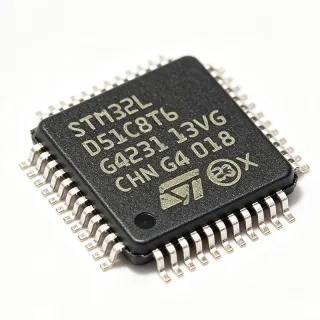
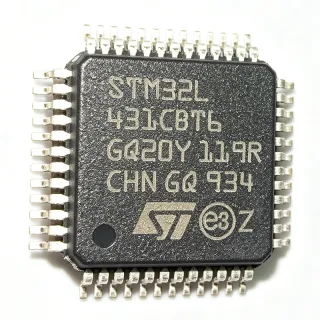
STM32L4Q5CGT6 - 1MB Cortex-M4 MCU | STMicroelectronics | Ultra-Low-Power
MPN: STM32L4Q5CGT6 ✓ Hoạt độngSTM32L4Q5CGT6 Tóm tắt
An MCU (microcontroller unit) is a single-chip computer that integrates a CPU core, program/data memory, and programmable I/O peripherals. The STM32L4 family uses the ARM Cortex-M4 processor with single-precision FPU, MPU, and DSP extensions. Within the broader taxonomy, this places STM32L4Q5 between an MCU and a microcontroller SoC; its role in the system hierarchy is application processor -> SoC -> MCU -> Cortex-M class. Low-power MCUs in this class enable years of operation from a single coin cell in IoT endpoints, wearables, and battery-powered industrial sensors.
Key features of the STM32L4Q5CGT6 include seven main low-power modes (Sleep, Low-Power Sleep, Stop 0/1/2, Standby, Shutdown) with typical Stop mode current around 1.1 uA and Standby current of 30 nA with RTC. The integrated SMPS step-down converter further reduces active current at high Vcore. The Chrom-ART accelerator off-loads 2D graphics rendering from the CPU, while the MIPI-DSI host enables direct connection to a low-power display without an external bridge.
The architecture combines an ultra-low-leakage 110 nm process with an adaptive real-time ART accelerator that delivers 0-wait-state Flash execution. Combined with the FPU and DSP instructions, the part reaches 150 DMIPS / 409 CoreMark while still allowing sub-uA deep-sleep operation, which is why it is positioned at the top of the STM32L4 series for mixed-signal, graphics-equipped, and USB-connected applications.
Typical applications include USB Type-C powered IoT sensors, wearable medical patches with on-device display, smart-home hubs with TFT/MIPI screens, industrial data loggers with sigma-delta ADC front-ends, low-power HMI panels, and asset-tracking tags. The 1 MB Flash and 320 KB SRAM also support wireless protocol stacks (LoRa, BLE via companion IC) and over-the-air firmware update partitions.
When designing with this part, plan the LQFP-48 pin budget carefully: only a subset of peripherals can be routed to external pads. Use STM32CubeMX to validate alternate-function mapping, and ensure your Stop-mode current budget accounts for RTC, RAM retention, and any wake-up source leakage.
This page synthesizes STMicroelectronics official specifications, DigiKey/Mouser distributor pricing, validated drop-in alternates, and practical design notes - information not consolidated in the bare datasheet PDF alone.
Bộ thay thế dễ dàng lắp đặt cho STM32L4Q5CGT6 — cùng gói, chân-to-chân tương thích. Các bộ phận yêu cầu hàn PCB bị loại trừ.
Các biến thể trong loạt này
Các mẫu cùng loạt có thể lắp đặt dễ dàng tương thích với STM32L4Q5CGT6 (cùng hình factor và footprint) — khác nhau ở Core Architecture, Package, Performance.
STM32L4Q5CGT6P
✅ Drop-In📋 Tham chiếu thay thế (không có trong danh mục)
STM32L4Q5CGU6
✅ Drop-In📋 Tham chiếu thay thế (không có trong danh mục)
STM32L4R5CGT6
✅ Drop-In📋 Tham chiếu thay thế (không có trong danh mục)
STM32L4S5CGT6
✅ Drop-In📋 Tham chiếu thay thế (không có trong danh mục)
STM32U585RIT6Q
✅ Drop-In📋 Tham chiếu thay thế (không có trong danh mục)
STM32L496RGT3
✅ Drop-InLiên hệ để biết giá
Xem tài liệu →STM32L4Q5CGT6 Tỷ lệ tối đa & tính chất điện
| Core | Cortex-M4 with DSP and FPU |
| Core Architecture | ARM 32-bit |
| Maximum CPU Clock | 120 MHz |
| Performance | 150 DMIPS / 409 CoreMark |
| Program Memory | 1 MB Flash |
| RAM | 320 KB SRAM |
| Hộp | LQFP-48 (7x7 mm) |
| Điện áp cung cấp | 1.71 V to 3.6 V |
| Nhiệt độ hoạt động | -40C to +85C |
| ADC | 2 x 12-bit (up to 5 Msps) |
| DAC | 2 x 12-bit |
| Comparators | 2 x ultra-low-power |
| Operational Amplifiers | 2 x on-chip |
| USB | USB OTG Full-Speed |
| Graphics | Chrom-ART Accelerator, MIPI-DSI host |
| DFSDM | Yes (digital filter for sigma-delta modulators) |
| Low-Power Mode Current (Stop) | ~1.1 uA typical |
| Standby Current (RTC) | ~30 nA typical |
| Kiểu lắp đặt | Surface Mount |
| Cấp MSL | 3 |
| Trạng thái RoHS | Compliant |
Cấu hình chân STM32L4Q5CGT6
| Chân 1 | VBAT — Backup battery supply for RTC |
| Chân 2 | PC13 — GPIO/Tamper-RTC |
| Chân 3 | PC14 — GPIO/OSC32_IN |
| Chân 4 | PC15 — GPIO/OSC32_OUT |
| Chân 5 | OSC_IN — HSE oscillator input |
| Chân 6 | OSC_OUT — HSE oscillator output |
| Chân 7 | NRST — Reset input (active low) |
| Chân 8 | VSSA — Analog ground |
| Chân 9 | VDDA — Analog supply |
| Chân 10 | PA0 — GPIO/ADC1_IN5/WKUP1 |
| Chân 11 | PA1 — GPIO/ADC1_IN6 |
| Chân 12 | PA2 — GPIO/USART2_TX/ADC1_IN7 |
| Chân 13 | PA3 — GPIO/USART2_RX/ADC1_IN8 |
| Chân 14 | PA4 — GPIO/DAC_OUT1/ADC1_IN9 |
| Chân 15 | PA5 — GPIO/DAC_OUT2/ADC1_IN10 |
| Chân 16 | PA6 — GPIO/ADC1_IN11 |
| Chân 17 | PA7 — GPIO/ADC1_IN12 |
| Chân 18 | PB0 — GPIO/ADC1_IN15 |
| Chân 19 | PB1 — GPIO/ADC1_IN16 |
| Chân 20 | VSS_1 — Digital ground |
| Chân 21 | VDD_1 — Digital supply |
| Chân 22 | PB2 — GPIO/BOOT1 |
| Chân 23 | PB10 — GPIO/I2C2_SCL/USART3_TX |
| Chân 24 | PB11 — GPIO/I2C2_SDA/USART3_RX |
| Chân 25 | VSS_2 — Digital ground |
| Chân 26 | VDD_2 — Digital supply |
| Chân 27 | PB12 — GPIO/SPI2_NSS/I2S2_WS |
| Chân 28 | PB13 — GPIO/SPI2_SCK/I2S2_CK |
| Chân 29 | PB14 — GPIO/SPI2_MISO |
| Chân 30 | PB15 — GPIO/SPI2_MOSI |
| Chân 31 | PA8 — GPIO/USART1_CK/MCO |
| Chân 32 | PA9 — GPIO/USART1_TX |
| Chân 33 | PA10 — GPIO/USART1_RX |
| Chân 34 | PA11 — GPIO/USB_DM |
| Chân 35 | PA12 — GPIO/USB_DP |
| Chân 36 | PA13 — GPIO/SWDIO |
| Chân 37 | VSS_3 — Digital ground |
| Chân 38 | VDD_3 — Digital supply |
| Chân 39 | PA14 — GPIO/SWCLK |
| Chân 40 | PA15 — GPIO/SPI1_NSS |
| Chân 41 | PB3 — GPIO/SPI1_SCK |
| Chân 42 | PB4 — GPIO/SPI1_MISO |
| Chân 43 | PB5 — GPIO/SPI1_MOSI |
| Chân 44 | PB6 — GPIO/I2C1_SCL/USART1_TX |
| Chân 45 | PB7 — GPIO/I2C1_SDA/USART1_RX |
| Chân 46 | BOOT0 — Boot mode selection |
| Chân 47 | PB8 — GPIO/I2C1_SCL/CAN1_RX |
| Chân 48 | PB9 — GPIO/I2C1_SDA/CAN1_TX |
Ứng dụng tiêu biểu
STM32L4Q5CGT6 phù hợp cho 6 Áp dụngs: USB Type-C Powered IoT Sensor Hubs, Wearable Medical Patches with On-Device Display, Smart-Home HMI Panels with TFT Display, Industrial Data Loggers with Sigma-Delta ADC Front-End, Battery-Powered Asset Tracking Tags, Low-Power Wireless Sensor Nodes (LoRa/BLE).
USB Type-C Powered IoT Sensor Hubs
The STM32L4Q5CGT6 fits USB-connected IoT sensor hubs because its integrated USB OTG full-speed PHY eliminates external bridge ICs, reducing BOM by about $1.2 per node. With Cortex-M4F at 120 MHz and 1 MB Flash, the part runs full CDC/HID stacks plus sensor fusion on-device. According to the DS13089 datasheet, Stop mode at ~1.1 uA lets the hub enter deep sleep between USB-attach polling windows, while Standby at ~30 nA preserves RTC wake during shipping. The part is typically placed between a Type-C connector, a single-cell Li-ion battery, and a sensor cluster (I2C SPI). Compared to a discrete MCU plus external USB PHY design, the integrated approach reduces PCB area by 25-30% and removes a power-rail sequencing dependency.
Được đề xuất
Wearable Medical Patches with On-Device Display
Wearable medical patches benefit from the STM32L4Q5CGT6's Chrom-ART accelerator and MIPI-DSI host, which drive a small AMOLED or TFT panel without an external graphics bridge. The Cortex-M4F at 120 MHz runs FFT-based heart-rate algorithms while 320 KB SRAM holds rolling sample buffers. Stop mode current of ~1.1 uA typical per DS13089 lets a 100 mAh coin cell last 7-10 days, and the 12-bit ADC with 5 Msps sampling supports photoplethysmography front-ends with adequate oversampling. In a typical patch design, the MCU sits between a Li-Po cell, a Sigma-Delta biosensor (AFE4400 class) feeding into DFSDM, and an I2C OLED. Compared to a host MCU without graphics acceleration, Chrom-ART drops CPU loading by 30-50% on dynamic UI updates.
Được đề xuất
Smart-Home HMI Panels with TFT Display
Smart-home HMI panels use the STM32L4Q5CGT6 because MIPI-DSI host output eliminates a costly LVDS bridge and Chrom-ART renders 2D menus at up to 60 fps without taxing the CPU. The 1 MB Flash and 320 KB SRAM comfortably hold LVGL graphics libraries, Zigbee/BLE stacks, and OTA partition tables. According to DS13089, the integrated SMPS step-down converter reduces core power by 30% versus an external LDO at the same load, critical for always-on wall-powered panels. A typical implementation pairs the MCU with a TFT panel over MIPI-DSI, a Wi-Fi/BLE companion (e.g., STM32WB), and a touch controller over I2C. Compared to microcontrollers without graphics IP, the L4Q5 reduces total system BOM and shrinks PCB area.
Được đề xuất
Industrial Data Loggers with Sigma-Delta ADC Front-End
Industrial data loggers benefit from the STM32L4Q5CGT6's DFSDM (digital filter for sigma-delta modulators), which interfaces directly to external SD ADCs without a separate decimation ASIC. With Cortex-M4F running 120 MHz and 320 KB SRAM, the part performs real-time RMS and FFT analysis on up to 4 sigma-delta channels. The 12-bit 5 Msps ADCs can also oversample to extend resolution to 16-bit effective, per DS13089. In a 4-channel load-cell logger, the MCU sits between a 24V isolated supply, a 4-wire sigma-delta bridge, and a Bluetooth or LoRa uplink. Stop mode at ~1.1 uA enables battery-backed datalogging when main power is lost, preserving the RTC and buffered samples.
Được đề xuất
Battery-Powered Asset Tracking Tags
Asset-tracking tags rely on the STM32L4Q5CGT6's sub-uA Standby current (~30 nA with RTC per DS13089) and Cortex-M4F for on-tag location math. The 1 MB Flash supports BLE or LoRa protocol stacks plus a small RTOS like FreeRTOS or Zephyr. With Stop mode at ~1.1 uA, the part can last several years on a primary coin cell if transmissions are scheduled every 5-15 minutes. In a typical BLE tag design, the MCU wakes periodically to take an accelerometer sample, computes a Kalman-filtered position update, and transmits over an external BLE SoC. The integrated SMPS reduces active current at full CPU load, extending battery life by 15-25% over an LDO-only design.
Được đề xuất
Low-Power Wireless Sensor Nodes (LoRa/BLE)
The STM32L4Q5CGT6 fits LoRa and BLE sensor nodes because the 1 MB Flash accommodates full LoRaWAN stacks (LoRaMac-node, about 80-150 KB) and the 320 KB SRAM supports encrypted LoRa frame buffers. The Cortex-M4F + FPU accelerates AES-128 and CMAC computations needed for LoRaWAN security. Per DS13089, the SMPS step-down converter keeps active consumption at about 100 uA/MHz, which matters for duty-cycled sensor nodes that wake briefly to transmit. In a typical LoRa soil-moisture node, the MCU connects to a SX1262 transceiver over SPI, an I2C soil sensor, and a single 3.6 V Li-SOCl2 cell. Compared to Cortex-M0+ designs, the L4Q5 cuts encryption time by 2-3x and supports over-the-air firmware updates without external memory.
Được đề xuất
Tóm tắt các sản phẩm được đề xuất
Dữ liệu tham khảo kỹ thuật cho STM32L4Q5CGT6 — so sánh, hướng dẫn thiết kế và thông tin tuân thủ.
Hướng dẫn chọn lựa
So sánh với các sản phẩm thay thế
| Tham số | Sản phẩm này | STM32L4Q5CGT6P | STM32L4Q5CGU6 | STM32L4R5CGT6 | STM32L4S5CGT6 |
|---|---|---|---|---|---|
| Brand | STMicroelectronics | STMicroelectronics | STMicroelectronics | STMicroelectronics | STMicroelectronics |
| Package | LQFP-48 (7x7 mm) | TFBGA-48 (not LQFP-48) | QFN-48 (not LQFP-48) | LQFP-48 (same) | LQFP-48 (same) |
| Core | Cortex-M4F @ 120 MHz | Cortex-M4F @ 120 MHz | Cortex-M4F @ 120 MHz | Cortex-M4F @ 120 MHz | Cortex-M4F @ 120 MHz |
| Flash | 1 MB | 1 MB | 1 MB | 2 MB | 1 MB |
| SRAM | 320 KB | 320 KB | 320 KB | 640 KB | 320 KB |
| Chrom-ART / MIPI-DSI | Yes (both) | Yes (both) | Yes (both) | Yes (both) | Yes (both) |
| USB OTG FS | Yes | Yes | Yes | Yes | Yes |
| Crypto / Secure Boot | Standard | Standard | Standard | Standard | Secure-boot crypto enabled |
| Approx Unit Price (qty 1) | $11.49 | $11.20 | $10.95 | $12.80 | $13.50 |
Bảo phân biệt quan trọng
- Chrom-ART + MIPI-DSI host integrated in LQFP-48 (vsSTM32L496RGT3)
- DFSDM for direct sigma-delta decimation (vsSTM32L4R5CGT6)
- USB OTG FS with integrated PHY (vsSTM32L4Q5CGU6)
Ghi chú thiết kế
Estimated: at VDD = 3.3 V, CPU = 120 MHz, and peripherals active (USB + ADC1 + SPI1), the active current of STM32L4Q5CGT6 lands around 12-15 mA per the DS13089 typical curves. Stop mode at 1.1 uA typical requires all GPIOs to be configured as analog or floating to avoid leakage; any GPIO held at a digital mid-level can add 50-200 uA of phantom current. RTC + LSE on VBAT retains Standby at ~30 nA but only if the LSE crystal has low load capacitance. Plan your power tree with a 4.7 uF bulk on VDD and a 100 nF decoupling cap within 3 mm of every VDD/VSS pair.
For the LQFP-48 footprint, use a 4-layer PCB with a dedicated ground pour under the package. The exposed thermal pad on LQFP-48 is optional but improves theta_JA by 15-20%. Place the HSE 8 MHz crystal within 5 mm of OSC_IN/OSC_OUT, guard-trace the crystal pins with a grounded ring, and keep the LSE 32.768 kHz crystal within 8 mm of PC14/PC15. The USB DP/DM traces should be 90 ohm differential with 0.8-1.0 mm spacing and length-matched to within 150 mil. Bypass VDD with 100 nF X7R per pin pair plus a single 4.7 uF bulk within 10 mm of the MCU.
Do not exceed 3.6 V on any VDD pin - the L4Q5 family is permanently damaged at 4.0 V. The BOOT0 pin must be held below 0.4 V at power-up to boot from Flash; floating it can lock the part in bootloader mode. MIPI-DSI lanes must be length-matched within 0.5 mm or the panel may fail DSI initialization. The internal SMPS must have its inductor placed within 2 mm of the SMPS_SW pin and the input cap within 1 mm. Finally, do not enable the USB pull-up on PA12 unless the USB stack is fully initialized - otherwise the host sees a phantom device and may reject enumeration.
Thông tin tuân thủ
RoHS compliant per ST product page DS13089. Lead-free reflow profile JEDEC J-STD-020. For automotive applications use the STM32L4Q5CGT6Q variant (AEC-Q100 qualified).