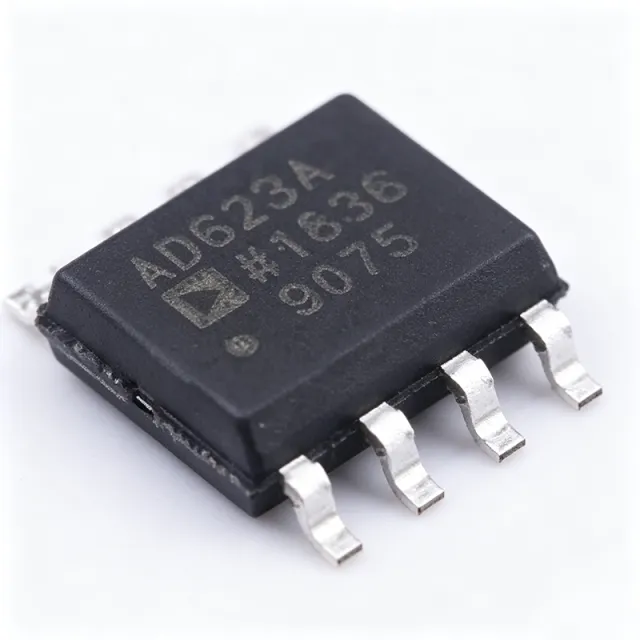
AD623ARZ-R7 - Rail-to-Rail In-Amp, 3-12V | Analog Devices
MPN: AD623ARZ-R7 ✓ 啟用中AD623ARZ-R7 概覽
An instrumentation amplifier (in-amp) is a type of differential amplifier that amplifies the difference between two input signals while rejecting common-mode voltages. Characterized by high input impedance, high common-mode rejection ratio (CMRR), and low offset voltage, in-amps form a specialized subclass within the operational amplifier family and are essential building blocks in analog signal conditioning chains for precision sensing.
Key features of the AD623ARZ-R7 include gain programming with a single external resistor via the formula G = 1 + 100 kOhm/RG (unity gain with no external resistor), rail-to-rail output swing, and input common-mode range extending 150 mV below ground on a single supply. It operates from single supplies of 3 V to 12 V or dual supplies of +/-2.5 V to +/-6 V, suiting both portable and industrial systems.
Technically, the AD623 uses a classic three-op-amp topology with a laser-trimmed internal precision resistor network. The input stage provides high impedance and excellent CMRR, while the output stage delivers rail-to-rail swing. The REF terminal allows low-impedance level shifting of the output, critical for centering signals in single-supply data acquisition systems. A and B grades differ in offset voltage and drift specifications.
Typical applications include load cell and pressure sensor signal conditioning, medical ECG front ends, thermocouple amplification, and industrial process control, where the high CMRR rejects common-mode noise in electrically noisy environments.
When designing, place the gain resistor close to the device, bypass each supply pin with 0.1 uF, and drive the REF pin from a low-impedance source to preserve CMRR.
This page synthesizes distributor pricing, drop-in alternatives, and practical design notes not found in the manufacturer datasheet.
直接替換替代品,適用於 AD623ARZ-R7 — 相同封裝,腳位對腳位相容。需重新設計 PCB 的不同封裝零件不列入。
此系列的變體
與下列產品可直接替換的同系列型號: AD623ARZ-R7 (相同外形與佔位) — 差異在於 Package, Gain Range, CMRR, Quiescent Current, Number of Circuits.
AD623ARZ
✅ 直接替換📋 參考替代品(不在目錄中)
AD623BRZ-R7
✅ 直接替換📋 參考替代品(不在目錄中)
AD8226BRZ
✅ 直接替換聯絡詢價
查看資料表 →AD8221ARZ
✅ 直接替換聯絡詢價
查看資料表 →AD620ARZ
✅ 直接替換聯絡詢價
查看資料表 →INA128PA
✅ 直接替換聯絡詢價
查看資料表 →INA122PA
✅ 直接替換📋 參考替代品(不在目錄中)
AD623ARZ-R7 最大額定值與電氣特性
| Amplifier Type | Instrumentation Amplifier |
| Number of Circuits | 1 |
| Supply Voltage Range (Single) | 2.7 V to 12 V |
| Supply Voltage Range (Dual) | +/-2.5 V to +/-6 V |
| 輸出類型 | Rail-to-Rail |
| 3 dB Bandwidth | 800 kHz |
| Slew Rate | 0.3 V/us |
| CMRR | 90 dB (min) at G = 1 |
| Gain Setting | Single external resistor, G = 1 + 100 kOhm/RG |
| Gain Range | 1 to 1000+ |
| Input Common-Mode Range | Extends 150 mV below ground (single supply) |
| 工作溫度 | -40C to +85C |
| 封裝 | 8-SOIC (0.154 in, 3.90 mm width) |
| 安裝類型 | Surface Mount |
| Packaging | Tape & Reel (R7) |
| RoHS 狀態 | Compliant |
| Grade | A grade (B grade offers lower offset/drift) |
AD623ARZ-R7 腳位配置
| 腳位 1 | RG- — Gain resistor terminal (connect RG between pins 1 and 8) |
| 腳位 2 | -IN — Inverting input |
| 腳位 3 | +IN — Non-inverting input |
| 腳位 4 | -VS — Negative supply / ground (single supply) |
| 腳位 5 | REF — Reference terminal - drive from low impedance to level-shift output |
| 腳位 6 | OUTPUT — Rail-to-rail amplifier output |
| 腳位 7 | +VS — Positive supply (2.7 V to 12 V single) |
| 腳位 8 | RG+ — Gain resistor terminal (connect RG between pins 1 and 8) |
典型應用
AD623ARZ-R7 適用於 6 應用s: Load Cell and Bridge Sensor Conditioning, ECG and Medical Instrumentation Front End, Thermocouple Amplifiers, Industrial Process Control (4-20 mA Loops), Portable and Battery-Powered Data Acquisition, Pressure and Strain Gauge Sensor Interfaces.
Load Cell and Bridge Sensor Conditioning
The AD623ARZ-R7 fits load cell signal conditioning because its single-resistor gain equation (G = 1 + 100 kOhm/RG) directly scales millivolt-level bridge outputs, and its 90 dB minimum CMRR at G = 1 rejects common-mode noise picked up on long cable runs. In a typical circuit, the bridge differential output drives pins 2 and 3, gain is set to 100 or more with RG near 1 kOhm, and REF is tied to a buffered mid-supply or ground reference. The rail-to-rail output maximizes ADC dynamic range on a 5 V single supply, while the 150 mV below-ground input range tolerates bridge offset. Estimated bandwidth at G = 100 is about 8-10 kHz, ample for static weighing.
推薦
ECG and Medical Instrumentation Front End
For battery-powered ECG front ends, the AD623ARZ-R7 combines single-supply operation (2.7 V minimum), high input impedance, and strong common-mode rejection - exactly the profile needed to extract weak electrode signals from mains interference. Per the ADI datasheet typical application, the electrodes drive the differential inputs through protection resistors, the gain resistor sets G around 10-100, and the REF pin is driven by a right-leg-drive or mid-supply buffer to keep the output centered. The input common-mode range extending 150 mV below ground accommodates electrode offset on a single 3 V cell. B grade parts (AD623BRZ-R7) with 0.3 uV/C drift improve DC stability for diagnostic-grade designs.
推薦
Thermocouple Amplifiers
The AD623ARZ-R7 amplifies microvolt-per-degree thermocouple signals with the DC precision this task demands: low offset, low offset drift, and high CMRR against ground noise. The thermocouple is applied differentially with a bias network referencing inputs within the common-mode range (which extends 150 mV below ground on single supply), gain is set to several hundred via RG, and cold-junction compensation is performed with an RTD or sensor at the connector. The rail-to-rail output lets the signal occupy the full span into a 3.3 V or 5 V ADC. With bandwidth in the low kHz range at high gain, the AD623 is well matched to slow thermal processes.
推薦
Industrial Process Control (4-20 mA Loops)
In industrial process control, the AD623ARZ-R7 acts as the precision front end for pressure, flow, and level transmitters, where sensors sit far from the ADC and ground potential differences inject large common-mode voltages. Its 90 dB minimum CMRR (improving at higher gain) and high input impedance preserve signal integrity across these grounds. The REF pin allows direct level shifting of the output to match controller input ranges, and the 12 V maximum single supply tolerates harsh industrial rails. Rail-to-rail output swing ensures the full measured range maps onto the ADC span even at low supply. Gain is reprogrammed with one resistor, simplifying product variants.
推薦
Portable and Battery-Powered Data Acquisition
Battery-powered data loggers benefit from the AD623ARZ-R7's 2.7 V minimum supply and rail-to-rail output, which keep full signal swing as the battery discharges from fresh (3.3-4.2 V) toward cutoff. Single-supply operation eliminates a negative rail, reducing cost, size, and quiescent drain versus dual-supply in-amp designs. The input range extending 150 mV below ground simplifies single-supply sensor biasing. Bandwidth of 800 kHz at low gain covers vibration and acoustic channels, while the SOIC-8 footprint suits compact boards. For sub-mA budget analysis, verify total consumption including the gain network current, which flows through RG and scales with gain.
推薦
Pressure and Strain Gauge Sensor Interfaces
Piezoresistive pressure sensors and strain gauges produce small differential outputs superimposed on a large common-mode voltage; the AD623ARZ-R7's high CMRR (90 dB minimum at G = 1, typically much higher at gain) rejects this common-mode component while amplifying the differential signal. Because the gain equation needs only one external resistor, one PCB supports multiple pressure ranges by changing RG - valuable across product families. The REF pin ties to a buffered offset so zero-pressure output sits at the desired ADC code. Estimated gain of 50-200 with RG from roughly 500 ohms to 2 kOhm suits typical 10-100 mV full-scale sensors on a 5 V supply.
推薦
推薦產品摘要
工程參考資料,適用於 AD623ARZ-R7 — 比較、設計指引及合規資訊。
選型指南
與替代品比較
| 參數 | 本產品 | AD623ARZ | AD623BRZ-R7 | AD8226BRZ | INA128PA |
|---|---|---|---|---|---|
| Package | 8-SOIC (3.90 mm) | 8-SOIC - same | 8-SOIC - same | 8-SOIC - same | 8-SOIC - same |
| Brand | Analog Devices | Analog Devices | Analog Devices | Texas Instruments | |
| Operating Temperature | -40C to +85C | -40C to +85C | -40C to +125C | -40C to +125C | -40C to +85C |
主要差異化特點
- Single-resistor gain programming with unity gain default (對比INA128PA)
- Lowest-cost precision tier within ADI in-amp family (對比AD8221ARZ)
- Wide low-voltage single-supply range with input below ground (對比AD620ARZ)
設計說明
Place the gain resistor RG as close as possible to pins 1 and 8 to minimize parasitic series resistance and capacitance, which otherwise degrade gain accuracy and stability at high gains. Use 1% or better, low-TC resistors. Bypass both supply pins with 0.1 uF ceramic capacitors placed within a few millimeters, plus a bulk 10 uF capacitor nearby. Keep the high-impedance input traces short and guarded from switching nodes to preserve CMRR in noisy industrial environments.
Never drive the REF pin (pin 5) from a resistor divider. Any series impedance in REF adds directly to the internal gain-setting network, causing gain error and CMRR degradation. Always buffer REF with a low-output-impedance op amp or tie it directly to ground/a precision reference. Also remember that closed-loop bandwidth scales inversely with gain: at G = 100 the -3 dB point is roughly 8-10 kHz (estimated from the 800 kHz gain-bandwidth behavior), so do not expect 800 kHz at high gain.
The AD623ARZ-R7 accepts single supplies from 2.7 V to 12 V or dual supplies of +/-2.5 V to +/-6 V. On single supply, keep input common-mode within the datasheet range (extending 150 mV below ground but limited near the top rail); verify that the input CMVR versus output swing plot in the ADI datasheet matches your gain and reference configuration. Note the current flowing through RG adds to supply consumption at high gain - size your power budget accordingly in battery designs.
合規資訊
RoHS compliant and lead-free per the Z-suffix designation in ADI product data; REACH and halogen-free declarations should be verified against current Analog Devices compliance documentation.