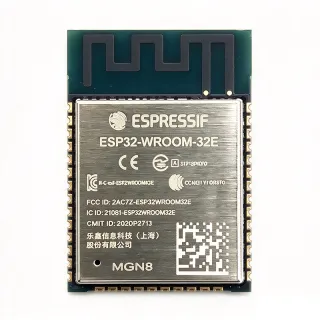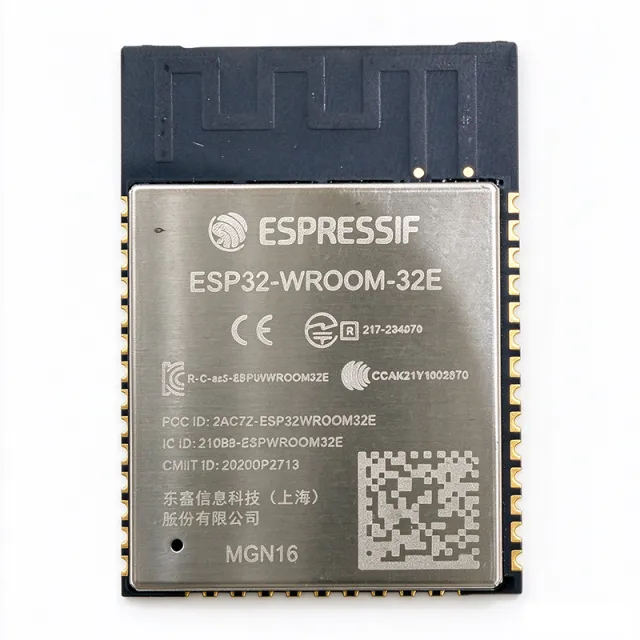
ESP32-WROOM-32E - WiFi + BT 4.2 MCU Module | Espressif
MPN: ESP32-WROOM-32E ✓ 啟用中ESP32-WROOM-32E 概覽
A Wi-Fi + Bluetooth MCU module is a surface-mount system-in-package that combines a microcontroller, radio transceiver, RF matching network, flash memory, crystal, and antenna onto a single certified PCB assembly. Such modules sit at the top of the embedded hierarchy: semiconductor -> wireless SoC -> RF-certified module -> end IoT device, letting engineers add wireless connectivity without RF design expertise or regulatory re-certification of the radio section.
Key differentiating features include dual-core processing that separates Wi-Fi protocol stacks from user applications, 802.11 b/g/n with a data rate up to 150 Mbps, Bluetooth v4.2 BR/EDR and BLE Class 1/2/3 operation, and 38 castellated edge pads that allow both hand soldering and automated assembly. The castellated half-hole pads also enable mounting the module as a sub-PCB on a carrier board.
Technically, the ESP32-D0WD-V3 silicon inside is the bug-fixed revision 3 die, improving RF transmit spectrum cleanliness and resolving the well-known strapping-pin flash-voltage issue found in older revision 1 silicon used in the original ESP32-WROOM-32. The module integrates a 40 MHz crystal, flash memory, and a PCB inverted-F antenna tuned during production.
Typical applications include low-power sensor networks, voice encoding and MP3 streaming devices, smart-home nodes, and industrial IoT gateways, where integrated dual-radio connectivity and sufficient compute headroom are required in one certified package.
For design, respect the strapping pins (GPIO0, GPIO2, GPIO12, GPIO15) at boot and keep the antenna area of the host PCB free of copper and components for best RF performance.
This page synthesizes datasheet specifications, drop-in replacement options, and practical design notes not found on standard distributor listings.
直接替換替代品,適用於 ESP32-WROOM-32E — 相同封裝,腳位對腳位相容。需重新設計 PCB 的不同封裝零件不列入。
此系列的變體
與下列產品可直接替換的同系列型號: ESP32-WROOM-32E (相同外形與佔位) — 差異在於 RoHS Status, Supply Voltage.
ESP32-WROOM-32E-N8
聯絡詢價
查看資料表 →ESP32-WROOM-32E-N4
📋 參考替代品(不在目錄中)
ESP32-WROOM-32E-N16
📋 參考替代品(不在目錄中)
ESP32-WROOM-32UE
📋 參考替代品(不在目錄中)
ESP32-WROOM-32D
📋 參考替代品(不在目錄中)
ESP32-WROOM-32E 規格(製造商公布)
| Core SoC | ESP32-D0WD-V3 |
| CPU | Dual-core Xtensa LX6, up to 240 MHz |
| SRAM | 520 KB |
| ROM | 448 KB |
| Wi-Fi Standard | 802.11 b/g/n, 2.4 GHz to 2.5 GHz |
| Bluetooth | v4.2 BR/EDR + BLE, Class 1, 2 and 3 |
| 供應電壓 | 3.0 V to 3.6 V (typical 3.3 V) |
| 工作溫度 | -40C to +85C |
| Antenna Type | Integrated PCB antenna |
| Package Dimensions | 18 x 25.5 x 3.1 mm |
| 腳位數 | 38 castellated pads |
| 安裝類型 | Surface Mount |
| Peripherals | SPI, I2C, I2S, UART, CAN, PWM, ADC, DAC, touch sensor |
| RoHS 狀態 | Compliant |
ESP32-WROOM-32E 腳位配置
| 腳位 1 | GND — Ground |
| 腳位 2 | 3V3 — Power supply, 3.0 V to 3.6 V |
| 腳位 3 | EN — Chip enable, active high (pull-up recommended) |
| 腳位 4 | SENSOR_VP (GPIO36) — ADC1 CH0 / sensor input |
| 腳位 5 | SENSOR_VN (GPIO39) — ADC1 CH3 / sensor input |
| 腳位 6 | IO34 — GPIO34, input only, ADC1 CH6 |
| 腳位 7 | IO35 — GPIO35, input only, ADC1 CH7 |
| 腳位 8 | IO32 — GPIO32, ADC1 CH4, XTAL_32K_P option |
| 腳位 9 | IO33 — GPIO33, ADC1 CH5, XTAL_32K_N option |
| 腳位 10 | IO25 — GPIO25, DAC1 / ADC2 CH8 |
| 腳位 11 | IO26 — GPIO26, DAC2 / ADC2 CH9 |
| 腳位 12 | IO27 — GPIO27, ADC2 CH7, touch7 |
| 腳位 13 | IO14 — GPIO14, ADC2 CH6, touch6, HSPI CLK |
| 腳位 14 | IO12 — GPIO12 (MTDI), strapping pin - flash voltage select |
| 腳位 15 | GND — Ground |
| 腳位 16 | IO13 — GPIO13, ADC2 CH4, touch4, HSPI MOSI |
| 腳位 17 | NC — Not connected (per datasheet) |
| 腳位 18 | NC — Not connected (per datasheet) |
| 腳位 19 | NC — Not connected (per datasheet) |
| 腳位 20 | NC — Not connected (per datasheet) |
| 腳位 21 | NC — Not connected (per datasheet) |
| 腳位 22 | NC — Not connected (per datasheet) |
| 腳位 23 | IO15 — GPIO15 (MTDO), strapping pin, ADC2 CH3, touch3 |
| 腳位 24 | IO2 — GPIO2, strapping pin, must be low/floating for download boot |
| 腳位 25 | IO0 — GPIO0, strapping pin - low at reset enters download mode |
| 腳位 26 | IO4 — GPIO4, ADC2 CH0, touch0, SD data |
| 腳位 27 | IO16 — GPIO16, HSPI-ready/UART2 RX option |
| 腳位 28 | IO17 — GPIO17, UART2 TX option |
| 腳位 29 | IO5 — GPIO5, strapping-timing pin, VSPI CS0 |
| 腳位 30 | IO18 — GPIO18, VSPI CLK |
| 腳位 31 | IO19 — GPIO19, VSPI MISO |
| 腳位 32 | NC — Not connected (per datasheet) |
| 腳位 33 | IO21 — GPIO21, I2C SDA default |
| 腳位 34 | RXD0 (IO3) — UART0 RX / GPIO3 |
| 腳位 35 | TXD0 (IO1) — UART0 TX / GPIO1 |
| 腳位 36 | IO22 — GPIO22, I2C SCL default |
| 腳位 37 | IO23 — GPIO23, VSPI MOSI |
| 腳位 38 | GND — Ground |
功率與熱特性
| 功率輸入 | 3.0 V to 3.6 V (typical 3.3 V) |
| 操作溫度 | -40C to +85C |
ESP32-WROOM-32E 由製造商公布的功率輸入與熱參數。
典型應用
ESP32-WROOM-32E 適用於 6 應用s: Smart Home and IoT Sensor Nodes, Voice Encoding and Audio Streaming Devices, Industrial IoT Gateways, Wearable and Portable Connected Devices, Security and Camera-Adjacent IoT Devices, Prototyping and STEM Education.
Smart Home and IoT Sensor Nodes
The ESP32-WROOM-32E fits smart-home sensor and actuator nodes because it integrates Wi-Fi 802.11 b/g/n and Bluetooth v4.2 + BLE in one certified module, removing the need for a separate radio BOM line. Its ESP32-D0WD-V3 dual-core LX6 CPU at up to 240 MHz handles TLS, MQTT, and local control loops concurrently on separate cores, while 520 KB SRAM buffers sensor data. In typical use, the module runs ESP-IDF or Arduino firmware, samples I2C sensors, and reports over Wi-Fi with BLE used for provisioning. Deep-sleep modes reduce current to microamps between wake cycles, and the 3.0-3.6 V input range pairs directly with a single Li-ion cell through a 3.3 V LDO, making multi-year deployments practical.
推薦
Voice Encoding and Audio Streaming Devices
Espressif explicitly targets voice encoding, music streaming, and MP3 decoding with this module family. The dual-core architecture dedicates one LX6 core at 240 MHz to audio codecs while the other manages Wi-Fi streaming, and the 520 KB SRAM plus external SPI flash store codec firmware and buffers. The I2S peripheral connects directly to audio ADC/DAC or codec chips such as the ES8388, and the N8/N16 flash variants accommodate large firmware and asset images for OTA updates. Because the Wi-Fi radio achieves up to 150 Mbps PHY rate, sustained MP3 or AAC streaming with modest headroom is achievable, though designers should validate throughput under concurrent BLE activity.
推薦
Industrial IoT Gateways
In industrial settings, the ESP32-WROOM-32E serves as a low-cost protocol gateway bridging Modbus, CAN, or RS-485 field devices to cloud services. The module's CAN controller, multiple UARTs, SPI, and I2C interfaces connect to transceiver PHYs, while the -40C to +85C operating range covers control-cabinet temperatures. The Wi-Fi 802.11 b/g/n radio with 150 Mbps PHY rate uploads aggregated telemetry, and BLE enables local commissioning from mobile tools. Designers should protect the module's GPIO from industrial transients with TVS diodes and isolation, and use the castellated pads for solderable, vibration-tolerant attachment on carrier PCBs within DIN-rail enclosures.
推薦
Wearable and Portable Connected Devices
For portable and wearable connected products, the 18 x 25.5 x 3.1 mm footprint and 3.0-3.6 V supply allow direct operation from a single-cell Li-ion battery via a compact LDO. The BLE radio supports smartphone pairing for configuration and data sync, while Wi-Fi handles bulk uploads when in range. Light-sleep and deep-sleep modes cut average current dramatically, extending battery life between charges, and the 520 KB SRAM supports on-device signal processing such as motion classification. The integrated PCB antenna of the 32E avoids external-antenna BOM cost, though plastic enclosures and antenna keep-out zones on the host PCB are required for optimal RF performance.
推薦
Security and Camera-Adjacent IoT Devices
The ESP32-WROOM-32E supports door/window sensors, PIR-based alarms, and low-frame-rate camera accessories via its SPI camera interface compatibility within the ESP32 family. Dual radios enable a Wi-Fi alarm path plus BLE proximity keyfob detection, and the 240 MHz dual-core CPU performs local decision logic and encrypted transport (TLS) without a host MCU. AES, SHA, and RSA hardware accelerators in the ESP32-D0WD-V3 secure cloud communication and secure-boot chains. Designers should note that GPIO count and SRAM limit full video streaming; for high-resolution camera streams, the ESP32-S3 or ESP32-CAM-class solutions are the recommended upgrade, while the 32E excels at sensor-heavy security endpoints.
推薦
Prototyping and STEM Education
The ESP32-WROOM-32E is the module at the heart of popular dev boards such as the ESP32-DEVKITC-32E, making it a default choice for prototyping and education. Castellated pads support both hand soldering and pogo-pin fixtures, the Arduino IDE, MicroPython, and ESP-IDF toolchains are fully supported, and an enormous community library ecosystem shortens time-to-first-demo. Because the module is the same certified part used in production hardware, prototypes port directly to manufacturing without re-certification of the radio section. Students and engineers can move from breadboard experiments with the dev board to a custom carrier PCB carrying the module with identical firmware behavior.
推薦
推薦產品摘要
工程參考資料,適用於 ESP32-WROOM-32E — 比較、設計指引及合規資訊。
選型指南
與替代品比較
| 參數 | 本產品 | ESP32-WROOM-32E-N4 | ESP32-WROOM-32E-N16 | ESP32-WROOM-32UE | ESP32-WROOM-32D |
|---|---|---|---|---|---|
| Package | 38-pad castellated module, 18 x 25.5 x 3.1 mm, PCB antenna | 38-pad castellated module - same footprint | 38-pad castellated module - same footprint | 38-pad castellated module - same footprint | 38-pad castellated module - same footprint |
| Brand | Espressif Systems | Espressif Systems | Espressif Systems | Espressif Systems | Espressif Systems |
| SoC / Silicon Revision | ESP32-D0WD-V3 (rev 3) | ESP32-D0WD-V3 (rev 3) | ESP32-D0WD-V3 (rev 3) | ESP32-D0WD-V3 (rev 3) | ESP32-D0WD (earlier revision) |
| Antenna | Integrated PCB antenna | Integrated PCB antenna | Integrated PCB antenna | IPEX connector for external antenna | Integrated PCB antenna |
| Radio | Wi-Fi 802.11 b/g/n + BT v4.2 BR/EDR + BLE | Wi-Fi 802.11 b/g/n + BT v4.2 BR/EDR + BLE | Wi-Fi 802.11 b/g/n + BT v4.2 BR/EDR + BLE | Wi-Fi 802.11 b/g/n + BT v4.2 BR/EDR + BLE | Wi-Fi 802.11 b/g/n + BT v4.2 BR/EDR + BLE |
| Pins 17-22 | NC (not connected) | NC (not connected) | NC (not connected) | NC (not connected) | Partially usable - migration caution |
| Lifecycle Status | Active | Active | Active | Active | Legacy - 32E recommended |
主要差異化特點
- Bug-fixed rev 3 silicon (ESP32-D0WD-V3) (對比ESP32-WROOM-32D)
- Integrated PCB antenna at no extra BOM cost (對比ESP32-WROOM-32UE)
- Active lifecycle with flash-size scalability (對比ESP32-WROOM-32D)
設計說明
Keep a complete antenna keep-out zone on the host PCB: no copper, traces, or components under or beside the module's PCB antenna section (roughly the top 8-10 mm of the module). Route no signals on layers beneath the antenna area; a solid GND plane should stop before the antenna region. Espressif's hardware design guidelines specify module placement at the board edge with the antenna extending beyond or over free space for best radiation efficiency.
Provide a 3.3 V supply with at least 500 mA headroom. Wi-Fi transmit bursts draw high peak current, so place a 10 uF bulk capacitor plus a 100 nF ceramic decoupling capacitor close to the 3V3 and GND pads. Avoid long thin power traces; use a power plane or at least wide (>=0.5 mm) traces. An LDO chosen only for average current will cause brownout resets during TX bursts - verify supply droop under radio stress during validation.
Respect the strapping pins: GPIO0 (download mode), GPIO2, GPIO12/MTDI (flash voltage), and GPIO15/MTDO are sampled at reset. Never let external circuitry pull GPIO12 high at boot, since it selects a 1.8 V flash voltage and prevents startup on 3.3 V flash modules. Add appropriate pull-ups (EN, IO0 via boot switch) and pull-downs per Espressif hardware guidelines, and leave pads 17-22 unconnected since they are NC on the 32E.
Use castellated pads for both reflow and hand-solder attachment; add a periphery landing pattern with slightly elongated pads for inspection. ESP32 module modules are Moisture-Sensitive Devices - follow the MSL rating on the packing label and bake if the floor-life is exceeded before reflow.
合規資訊
RoHS compliant per Espressif product documentation. Module carries regional radio certifications (FCC/CE and others) per Espressif certification documentation; specific cert IDs were not present in provided data.