The Samsung K4RAH086VE-BCWM is a 16Gb DDR5 SDRAM chip organized as 2G x 8, operating at a 5600 Mbps data rate from a 1.1V VDD supply in an 82-ball FBGA surface-mount package, rated for 0C to +85C and currently in mass production. As of 2026-09-23, XAIPART lists tier pricing from $9.80 at qty 1 down to $7.60 at qty 1000, with 99,999 units in stock and MOQ 1, so buyers can source immediately without RFQ lead-time risk. The 5600 Mbps speed bin supports DDR5-5600 modules (PC5-44800 class), and the 1.1V supply is the JEDEC DDR5 standard voltage that cuts dynamic power versus the 1.2V of DDR4. This guide covers verified specifications, design-in guidance for 5600 Mbps operation, drop-in alternatives within the K4RAH086 family, application scenarios from UDIMMs to RDIMMs, and sourcing strategy on XAIPART.
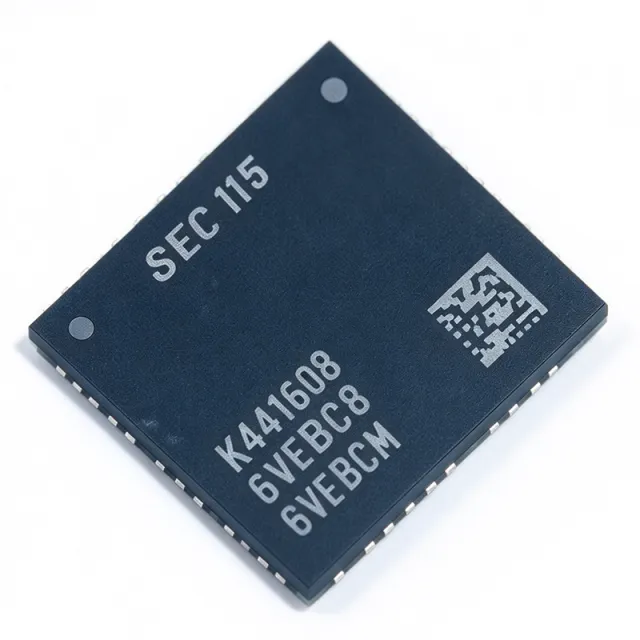
Quick Answers: What Is the Samsung K4RAH086VE-BCWM?
The K4RAH086VE-BCWM is Samsung Electronics' 16Gb DDR5 SDRAM component in a x8 organization (2G x 8). It is the fifth-generation double-data-rate DRAM family, succeeding DDR4 as the main memory standard for PCs, servers, and gaming platforms. DDR5 doubles bank groups and prefetch (16n versus 8n), integrates an on-die power management IC, and delivers higher bandwidth at lower per-bit power than DDR4.
Here are the verified specifications you need at a glance:
| Parameter | Value |
|---|---|
| Manufacturer | Samsung Electronics |
| Memory Type | DDR5 SDRAM |
| Density | 16 Gb |
| Organization | 2G x 8 |
| Data Rate | 5600 Mbps |
| Supply Voltage (VDD) | 1.1 V |
| Package | 82-ball FBGA |
| Mounting Type | Surface Mount |
| Operating Temperature | 0C to +85C |
| Lifecycle Status | Mass Production |
Availability: The part is in mass production and XAIPART holds 99,999 units as of 2026-09-23. Pricing starts at $9.80 for qty 1, $9.20 at qty 10, $8.60 at qty 100, $8.10 at qty 500, and $7.60 at qty 1000, a 22% discount at the 1k break. MOQ is 1, so engineering samples and volume production runs both clear through the same channel.
Takeaway: If your platform requires DDR5-5600 x8 components at commercial temperature, this MPN is available now from the XAIPART product page with published tier pricing.
Technical Guide: How Do You Design In the K4RAH086VE-BCWM?
Module configuration math
The 2G x 8 organization directly determines module capacity. Eight x8 chips populate a 16GB single-rank UDIMM; sixteen chips create a 32GB dual-rank configuration. For soldered-down client boards, four chips provide 8GB and eight chips provide 16GB per platform. For workstation RDIMMs, sixteen x8 chips build a dual-rank 32GB module.
Bandwidth scales from the verified 5600 Mbps pin speed: a 64-bit DDR5 module at 5600 Mbps delivers roughly 44.8 GB/s peak bandwidth (PC5-44800 class), matching current mainstream desktop platform memory specifications.
Power architecture
The chip operates from a 1.1V VDD supply. DDR5 moves power management onto the module via a PMIC converting 5V to 1.1V, which is one of the reasons DDR5 achieves lower per-bit power than the 1.2V DDR4 generation. In RDIMM designs, the module PMIC also manages the 1.8V VPP rail. Decouple both rails with dense low-ESL ceramic capacitance placed close to the FBGA balls.
Signal integrity at 5600 Mbps
At 5600 Mbps, DDR5 signal integrity is demanding. Follow these verified design practices from Samsung datasheet guidance:
- Use fly-by command/address routing with tight length matching.
- Apply JEDEC DDR5 on-die termination and DFE training settings during memory training.
- Perform per-byte DQ length matching to the FBGA balls on module layouts.
- On RDIMMs, route the DRAM through the registering clock driver (RCD) and implement module-level PMIC and clocking per the Samsung datasheet design guide.
DDR5 integrates an on-die ECC feature that improves data reliability, complementing side-band CRC and RCD parity on registered designs.
Thermal and temperature qualification
The BC suffix in the ordering code denotes the 0C to +85C commercial operating range. This covers typical desktop, notebook, and client computing ambients. Do not deploy this exact suffix in extended-temperature industrial or automotive environments; specify the industrial-temperature BI variant instead (see the alternatives section).
Soldering and assembly
The 82-ball FBGA reflows onto standard OSP-finish PCB pads in conventional SMT reflow profiles. The package suits the low-profile component height limits of SODIMM assembly and dense ball-out routing on four-layer consumer module PCBs, where short trace lengths support 5600 Mbps signal integrity.
Controller validation
Before committing a production build, verify the exact die revision and speed bin against the CPU memory controller's qualified vendor list (QVL). DDR5 training firmware compatibility on memory-down designs must also be confirmed with your chipset's DDR5-5600 support matrix. Always check the official Samsung K4RAH0x6 family datasheet PDF for AC timing parameters during final sign-off.
Takeaway: Budget one training/validation cycle per platform: fly-by routing, on-die termination settings, and QVL verification of the VE die revision are the three items that most often delay DDR5-5600 designs.
Alternatives & Comparison: Which Parts Are Drop-In Replacements?
The closest drop-in replacement is the Samsung K4RAH086VB-BCWM, which shares the same 16Gb DDR5 x8 organization, 5600 Mbps speed grade, 1.1V supply, and 82-ball FBGA footprint; the VE versus VB letters denote die revision. Other pin-compatible family members include K4RAH086VP-BCWM (VPP termination variant) and K4RAH086VB-BIWM (industrial temperature).
Note that the alternatives table below compares family members qualitatively based on verified family data; full per-MPN specification tables are available on their respective product pages:
| Parameter | K4RAH086VE-BCWM | K4RAH086VB-BCWM | K4RAH086VP-BCWM | K4RAH086VB-BIWM |
|---|---|---|---|---|
| Density | 16 Gb | 16 Gb | 16 Gb | 16 Gb |
| Organization | 2G x 8 | 2G x 8 | 2G x 8 | 2G x 8 |
| Data Rate | 5600 Mbps | 5600 Mbps | 5600 Mbps | 5600 Mbps |
| VDD | 1.1 V | 1.1 V | 1.1 V | 1.1 V |
| Package | 82-ball FBGA | 82-ball FBGA | 82-ball FBGA | 82-ball FBGA |
| Die Revision | VE | VB | VP (VPP termination variant) | VB |
| Temperature Grade | 0C to +85C (BC) | 0C to +85C (BC) | 0C to +85C (BC) | Industrial (BI) |
Three substitution warnings from verified distributor data:
- K4RHE086VB-BCWM is not a drop-in. Both are Samsung 16Gb DDR5 x8 parts, but K4RAH086VE-BCWM belongs to the K4RAH (B-die) generation while K4RHE086VB-BCWM is a K4RHE-series part. Die revision, binning, and supply status differ, so substitution requires validation.
- K4RAH165VB-BCWM is not directly interchangeable. It is a 4G x 4 (x4 organization) 16Gb DDR5 component. The DQ ball assignment and bus width differ, so it works only in module designs supporting the alternate organization. For x8 designs, stay within the K4RAH086 family.
- No verified cross-brand equivalent exists. Micron and SK Hynix make 16Gb DDR5-5600 x8 FBGA components, but no verified pin-compatible cross-reference for K4RAH086VE-BCWM was found in current data, and DDR5 ball maps can differ subtly between vendors. Validate against both vendors' datasheets and the memory controller compatibility list before PCB use.
Takeaway: For second sourcing, qualify K4RAH086VB-BCWM first (identical footprint, speed, and voltage; only die revision differs), and keep substitution decisions inside the K4RAH086 family unless you can fund a full cross-brand validation.
Industry Insight: What Is the Market and Supply Position of This DDR5 Component?
The K4RAH086VE-BCWM is in mass production with an active lifecycle status, so it is not a last-time-buy or end-of-life risk. Samsung positions the K4RAH086 family specifically for PC and gaming applications, which places this component at the center of the highest-volume DDR5 segment.
Supply indicators are healthy. Family member K4RAH086VB-BCWM showed about 27,700 pieces in distributor stock as of August 31, 2026 per icDirectory, indicating healthy supply in the K4RAH086 family. On XAIPART specifically, 99,999 units of the VE suffix are on hand as of 2026-09-23 with MOQ 1, which means the usual DDR5 RFQ friction is removed for this MPN.
DDR5 DRAM pricing varies with quantity, date code, and market conditions, and many RFQ-based distributors (Win Source, Ampheo, DRex Electronics, AIChipLink, Zeano Electronics) quote this MPN rather than publishing fixed prices. XAIPART publishes transparent tier pricing as of 2026-09-23: $9.80 at qty 1, $9.20 at qty 10, $8.60 at qty 100, $8.10 at qty 500, and $7.60 at qty 1000. Plan module production orders around the 500 and 1000-piece breaks, where unit cost drops 17% to 22% versus single-piece pricing.
Takeaway: Mass production status plus six-figure stock means you can lock the VE die revision for your QVL today; re-confirm stock before large builds because DDR5 supply rotates between production lots and distributor channels.
Trends & Outlook: What Should Buyers Watch for DDR5 Sourcing?
Three trends anchored to this component's verified specs should shape your 2026 sourcing plan.
1. The 5600 Mbps bin is the mainstream desktop standard. The PC5-44800 class (44.8 GB/s per 64-bit module) matches current mainstream platform memory specifications. As platform memory controllers standardize on DDR5-5600, demand for this exact speed grade will track desktop and notebook refresh cycles. Buyers supporting gaming and enthusiast segments should also note the family's position for overclocking-oriented module designs, which keeps the 2G x 8 organization in high demand beyond pure OEM volume.
2. Density drives module roadmaps. Sixteen 16Gb x8 chips build a 32GB dual-rank module; 64GB configurations require 32Gb die or higher chip counts. As platforms move default capacity upward, expect sourcing pressure to shift toward higher-density die, making 16Gb parts like this one the cost floor for 16GB and 32GB modules.
3. Temperature suffix matters more as DDR5 moves into industrial and edge systems. The commercial BC grade (0C to +85C) covers client and desktop ambients, but industrial PCs, edge servers, and networking appliances operating from -40C require the BI suffix (K4RAH086VB-BIWM). DDR5's on-die ECC supports long-life unattended deployments, so edge platforms are adopting DDR5-5600 bandwidth to serve multi-core industrial processors and edge AI inference accelerators that saturate DDR4 bandwidth. Segment your BOM by temperature grade now to avoid a mid-production substitution.
For deeper context on the prior memory generation and how DDR4 parts are being displaced, see the Samsung 4Gb DDR4-3200 complete guide and the K4A4G165WF-BCRC DDR4-2400 buyer guide on the XAIPART blog, or browse the full component catalog.
Takeaway: Watch three things quarterly: stock depth of the VE die revision, tier-pricing movement at the 500/1000-piece breaks, and platform QVL updates that could favor the VB or BI variants.
评论
成为第一个评论的人。
🔐 请 登录 即可发表评论。
还没有账户? 注册