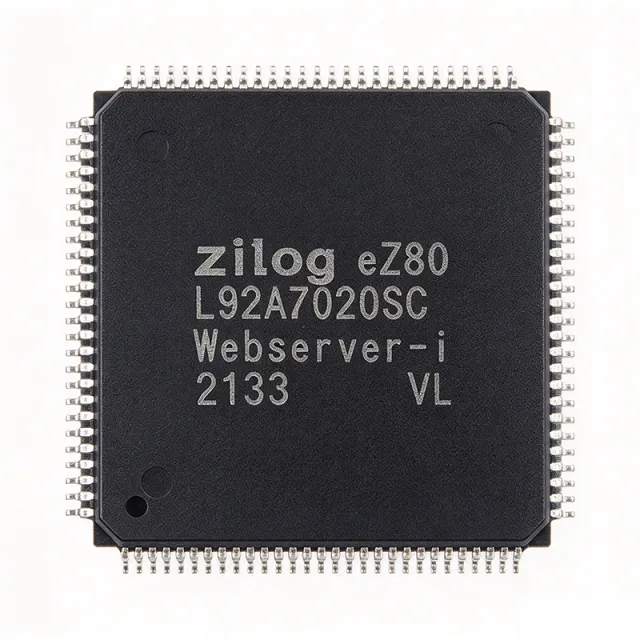
EPM9560RI304-20C
EPM9560RI304-20C - 560-Macrocell MAX 9000 CPLD, 5V, 304-Pin RQFP | Altera
The Altera EPM9560RI304-20C is a high-density CMOS EEPROM-based Complex Programmable Logic Device (CPLD) from the MAX 9000 family, featuring 560 macrocells, 212 user I/O pins, and a 100 MHz maximum internal clock frequency in a 304-pin RQFP (Plastic Quad Flat Pack) surface-mount package. It provides 12,000 usable gates with 23.6 ns pin-to-pin propagation delay, operates from a single 5.0 V supply, and supports in-system programmability via the built-in IEEE Std. 1149.1 JTAG interface.
A CPLD (Complex Programmable Logic Device) is a non-volatile programmable logic IC that combines multiple PAL/GAL-style macrocell arrays on a single die, connected by a programmable interconnect matrix (the Multiple Array MatriX, or MAX, architecture used here). Unlike FPGAs, which use RAM-based lookup tables and require external boot memory, CPLDs retain their configuration in on-chip EEPROM and provide deterministic, glitch-free propagation delays. MAX 9000 sits in Altera's taxonomy as a high-density 5V legacy CPLD, between MAX 7000 (mid-density 5V) and FLEX 10K (early SRAM-based FPGA).
Key features include third-generation MAX architecture for predictable timing, 5.0 V in-system programmability through JTAG (IEEE 1149.1), 16 logic array blocks, 36 macrocells per LAB, fast parallel expansion across multiple devices, and pin-compatible speed grades (-20, -15, -10) within the EPM9560 family. The 304-pin RQFP provides the maximum I/O count (212) for the EPM9560 die, allowing it to replace multiple discrete logic ICs in glue-logic, bus-interface, and state-machine roles.
The EPM9560RI304-20C uses CMOS EEPROM process technology with a multi-array matrix interconnect that distributes signals across 16 LABs in a predictable, deterministic-timing fabric. Designers can synthesize state machines, decoders, and bus interfaces using Altera/Intel Quartus II (legacy MAX+PLUS II) software, then program the device in-system through the JTAG pins without removing it from the board. This makes it well-suited for long-life industrial equipment where field upgrades are rare but reliability is critical.
Typical applications include industrial control glue logic, telecommunications bus interfaces, ASIC prototyping, peripheral controllers, and legacy 5V system designs. It is also used as a bus arbiter or address decoder where deterministic 23.6 ns propagation delay and 5V tolerance are required.
When designing with the EPM9560RI304-20C, ensure the JTAG chain (TCK, TMS, TDI, TDO) is properly terminated and that unused I/O pins are left floating or grounded per the MAX 9000 datasheet to minimize inrush during ISP. Note that newer 3.3V-only designs should migrate to MAX II or MAX V families instead.
This page synthesizes distributor pricing, in-package same-family drop-in alternatives, and practical JTAG/5V design notes that are not assembled in any single manufacturer or distributor page.
询价
联系我们