STMicroelectronics

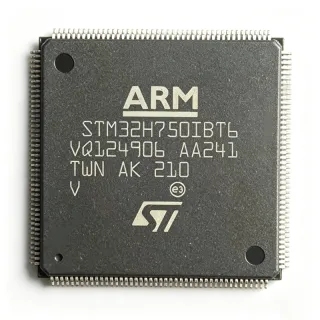
STM32F746IGT6G - 216MHz Cortex-M7 1MB Flash MCU | STMicroelectronics

MPN: STM32F746IGT6G ✓ نشط
176-LQFP (24x24 mm) Package 216 MHz Speed 1 Mbyte (1M x 8) Memory
الحد الأدنى للطلب: 1 |

STM32F746IGT6G نظرة عامة

The STMicroelectronics STM32F746IGT6G is a high-performance 32-bit Arm Cortex-M7 microcontroller operating at up to 216 MHz, with 1 Mbyte of embedded Flash, an Art Accelerator (Chrom-ART) graphics engine and L1 cache, housed in a 176-pin LQFP (24x24 mm) package.

A microcontroller is a single integrated circuit that combines a processor core, non-volatile program memory, volatile data memory and a set of dedicated peripherals on one die. In the STMicroelectronics product hierarchy, the STM32F7 series sits above the STM32F4 mainstream line and delivers Cortex-M7 class compute with hardware graphics and LCD capability, targeting industrial HMI, data acquisition and embedded control systems that need more performance and display integration than a typical Cortex-M4 device provides.

Key features of the STM32F746IGT6G include a 216 MHz maximum CPU frequency with the Art Accelerator boosting execution from external memory, a 1 Mbyte Flash and 1 Mbyte RAM option, up to 2 Mbyte of external SDRAM support through the FMC, an integrated TFT LCD controller, and a rich set of communication peripherals including Ethernet MAC with MII/RMII, USB OTG HS/FS, camera interface, and USART/UART/I2C/SPI blocks. Cryptographic acceleration and a true random number generator support secure connectivity.

Architecturally the device uses the Arm Cortex-M7 core with a superscalar pipeline, an ART Accelerator instruction prefetch path, and a 16 KB data cache plus 16 KB instruction cache, which together allow sustained code execution from external SDRAM at close to core speed. The FMC and LTDC blocks handle the high-bandwidth data path required for parallel TFT panels, while the DCMI and JPEG hardware accelerate image capture and decompression for camera-based designs.

Typical applications include industrial human-machine interface panels, building automation controllers, medical and laboratory instrumentation, machine vision modules, audio and voice-processing control boards, and connected sensor gateways that must run a graphical user interface alongside real-time control loops.

When laying out a board around this device, treat the LQFP-176 footprint as a demanding fine-pitch design: keep the 1.8-2.0 V core and 3.3 V I/O decoupling networks extremely close to the supply pins, and confirm the regulator start-up sequencing and the FMC signal integrity on the external SDRAM bus before layout is frozen.

This page consolidates distributor pricing, verified package and pinout references, same-footprint drop-in alternatives and practical layout guidance that are not consolidated in the manufacturer datasheet itself.

بدائل مباشرة لـ STM32F746IGT6G — نفس الحزمة، متوافق دبوس بدبوس. تُستثنى القطع ذات الحزم المختلفة التي تتطلب تعديل PCB.

الطرازات في هذه السلسلة

طرازات من نفس السلسلة متوافقة تمامًا مع STM32F746IGT6G (نفس عامل الشكل والبصمة) — يختلف في Package, Display Controller, Flash Memory, SRAM, Maximum Clock Frequency.

STMicroelectronics
Package: 176+25 UFBGA (10 x 10 mm)
Flash Memory: 2 MB (2M x 8)
Maximum Clock Frequency: 180 MHz
قارن مع STM32F746IGT6G →
STMicroelectronics
Package: 216-TFBGA (13x13 mm), 0.8 mm pitch
Display Controller: TFT-LCD up to 24-bit parallel RGB
Flash Memory: 2 MB dual-bank
قارن مع STM32F746IGT6G →
STMicroelectronics
Package: 176-pin LQFP (24x24 mm, 0.5 mm pitch)
Display Controller: LCD-TFT controller up to XGA resolution with Chrom-ART accelerator
SRAM: 340 KB total (256 KB SRAM1/SRAM2 + 64 KB CCM SRAM + 16 KB DTCM-RAM + 4 KB backup SRAM)
قارن مع STM32F746IGT6G →
STMicroelectronics
Display Controller: TFT-LCD, Chrom-ART accelerator, JPEG codec
Flash Memory: 1 MB
SRAM: 340 KB + 16 KB (D2 SRAM)
قارن مع STM32F746IGT6G →

STM32F746IGT6

✅ بديل مباشر
STMicroelectronics
📦 176-LQFP (24x24 mm)
ARM Cortex-M7 32-bit RISC · 216 MHz · Double-precision IEEE 754 · 16 KB I-cache + 16 KB D-cache · 1 MB Flash · 340 KB total (256 KB SRAM1/SRAM2 + 64 KB CCM SRAM + 16 KB DTCM-RAM + 4 KB backup SRAM) · 1.8 V / 2.5 V / 3.3 V · -40 C to +85 C (industrial grade -6 suffix)

تواصل لمعرفة السعر

عرض ورقة البيانات ←

STM32F756IGT6

✅ بديل مباشر ⚠️ مواصفات غير مُتحقق منها
📦 176-LQFP (24x24 mm)
Same Cortex-M7 at 216 MHz and 1 Mbyte Flash in the same LQFP-176 footprint; no camera/display-oriented feature set (roughly 10% fewer peripherals for graphics-oriented designs)

📋 بديل مرجعي (غير موجود في الكتالوج)

STM32F769IGT6

✅ بديل مباشر ⚠️ مواصفات غير مُتحقق منها
STMicroelectronics
📦 176-LQFP (24x24 mm)
ARM Cortex-M7 with FPU + DSP · 216 MHz · 462 · 1 MB · 340 KB + 16 KB (D2 SRAM) · 1.7 V to 3.6 V · 176-LQFP (24x24 mm) · LDO / SMPS selectable via BYPASS_REG pin

تواصل لمعرفة السعر

عرض ورقة البيانات ←

STM32F429NIH6TR

✅ بديل مباشر ⚠️ مواصفات غير مُتحقق منها
STMicroelectronics
📦 176-LQFP (24x24 mm)
ARM 32-bit Cortex-M4 with FPU and DSP instructions · 180 MHz · 225 DMIPS (1.25 DMIPS/MHz, Dhrystone 2.1) · 2 MB dual-bank · 256 KB · 216-TFBGA (13x13 mm), 0.8 mm pitch · 1.8 V to 3.6 V (typ. 2.5 V / 3.3 V) · -40C to +85C (industrial grade)

تواصل لمعرفة السعر

عرض ورقة البيانات ←

STM32F429IIH6TR

✅ بديل مباشر ⚠️ مواصفات غير مُتحقق منها
STMicroelectronics
📦 176-LQFP (24x24 mm)
ARM 32-bit Cortex-M4 CPU with FPU · 180 MHz · 2 MB (2M x 8) · 176+25 UFBGA (10 x 10 mm) · 32-bit RISC · Supported · Supported · 225 DMIPS at 1.25 DMIPS/MHz

تواصل لمعرفة السعر

عرض ورقة البيانات ←

STM32F746IGT6G الحدود القصوى والخصائص الكهربائية

Manufacturer STMicroelectronics
Product Type ARM Cortex-M7 Microcontroller (MCU)
CPU Core Arm Cortex-M7, 32-bit RISC
Maximum CPU Frequency 216 MHz
Internal Flash Memory 1 Mbyte (1M x 8)
Cache L1 cache (data + instruction), Art Accelerator prefetch
Graphics Engine Art Accelerator (Chrom-ART)
External Memory Support SDRAM via FMC
Display Controller TFT LCD controller (LTDC)
العلبة 176-LQFP (24x24 mm)
عدد الأطراف 176 pins
نوع التركيب Surface Mount
حالة دورة الحياة Active
Green / Halogen-Free Packaging Green product (G suffix), RoHS-compliant
Reference Unit Price USD 13.76 as of 2026-10-30 (LCSC listing for STM32F746IGT6)

دليل تكوين أطراف STM32F746IGT6G 176-lqfp (24x24 mm)

تكوين الأطراف لـ STM32F746IGT6G (حزمة 176-lqfp (24x24 mm)). تتضمن هذه الدائرة المتكاملة الرقمية GPIO وواجهات الاتصال (UART وSPI وI2C) وأطراف الطاقة. راجع ورقة بيانات الشركة المصنعة لوظائف الأطراف البديلة وخيارات التكوين. ضرورية لتصميم الأنظمة المدمجة وتخطيط PCB.

مخطط توزيع أطراف حزمة 176-lqfp (24x24 mm) لـ STM32F746IGT6G

لا تتوفر بيانات مفصلة لمخطط التوصيلات لـ STM32F746IGT6G.

راجع ورقة البيانات للحصول على تكوين الأطراف الكامل.

التطبيقات النموذجية

STM32F746IGT6G مناسب لـ 6 التطبيقs: Industrial TFT Human-Machine Interface, Machine Vision and Camera Imaging Module, Data Acquisition and Building Automation Controller, Audio and Voice Signal Processing Control Board, Medical and Laboratory Instrumentation, Connected Sensor Gateway with Ethernet.

📺

Industrial TFT Human-Machine Interface

The STM32F746IGT6G is a natural fit for industrial operator panels because it combines a 216 MHz Cortex-M7 with the Art Accelerator, which lets graphical content be executed directly from external SDRAM framebuffers rather than from the 1 Mbyte of internal Flash. With the LTDC driving a parallel TFT panel and the FMC bus supplying framebuffer data, one device can run the entire HMI stack alongside real-time machine control loops. The 176-lead LQFP exposes the full FMC and LCD signal set needed for 16- or 32-bit panels, removing the need for a separate display controller. Compared with a Cortex-M4-class design, the STM32F746IGT6G leaves noticeably more headroom for animation and touch-screen response.

📷

Machine Vision and Camera Imaging Module

The STM32F746IGT6G supports camera-based inspection systems where image capture and processing must be handled locally. Its DCMI interface accepts parallel camera data directly, while the integrated JPEG hardware accelerates compression so frames can be streamed over a bandwidth-constrained link without a discrete imaging processor. The 216 MHz Cortex-M7 with L1 cache keeps the image pipeline responsive, and the Art Accelerator accelerates the pixel manipulation that dominates vision pre-processing. The same part can also drive an external display for alignment or classification overlays, making it a compact single-chip solution for inspection equipment.

🏭

Data Acquisition and Building Automation Controller

In building automation and industrial data-acquisition nodes, the STM32F746IGT6G consolidates sensing, control and networking in one package. Multiple USART and UART ports handle modbus and proprietary sensor buses, the Ethernet MAC with MII/RMII drives a network PHY, and the large Flash plus external SDRAM support allows long historical data buffering before upload. A local TFT or segment display can show status without a separate host, while the hardware crypto and random number generator secure the network link. Compared with a discrete PLC approach, a single STM32F746IGT6G cuts board count and simplifies firmware maintenance across a product family.

🎧

Audio and Voice Signal Processing Control Board

The STM32F746IGT6G targets audio-centric control electronics because its Cortex-M7 core includes a double-precision floating-point FPU and DSP extensions that accelerate filter and FFT operations. The 216 MHz rate and L1 cache allow multi-channel mixing or voice recognition front-ends to run alongside control logic, and the LCD controller can drive a small display for monitoring levels. Digital audio interfaces and USB synchronisation are handled on-chip, keeping the design compact. For volume applications the single-precision DSP capability of the STM32F756IGT6 offers a lower-cost option with the same pinout.

💊

Medical and Laboratory Instrumentation

Laboratory and diagnostic instruments benefit from the STM32F746IGT6G because a single device can run the user interface, signal conditioning supervisory logic and communications stack without a companion processor. The Cortex-M7 delivers deterministic real-time performance for sampling control loops, and the extensive internal Flash allows complex algorithms and calibration tables to be stored on-chip. External SDRAM support through the FMC accommodates large waveform and log buffers, while the TFT controller enables on-instrument graphical displays that reduce reliance on a host PC. The 176-LQFP footprint is a standard, well-supported package for medical-adjacent equipment builds.

🌐

Connected Sensor Gateway with Ethernet

The STM32F746IGT6G works well as a sensor gateway where local aggregation plus upstream networking must coexist with tight cost and power budgets. The integrated Ethernet MAC with MII and RMII interfaces connects to a PHY such as the LAN8742A-CZ for industrial or PoE-linked networks, while the Cortex-M7 handles protocol translation and local filtering. With the Art Accelerator available, gateway firmware can also serve a small web-style status display or perform edge inference pre-processing. Because the internal Flash and optional external SDRAM scale independently, the same silicon supports both low-cost sensor nodes and full-featured edge gateways.

ملخص المنتجات الموصى بها

What are the key specifications of the STM32F746IGT6G that engineers should know?
The STM32F746IGT6G is a STMicroelectronics 32-bit Arm Cortex-M7 microcontroller rated at up to 216 MHz, with 1 Mbyte of embedded Flash, a Chrom-ART Art Accelerator graphics engine, L1 cache, external SDRAM support through the FMC and a TFT LCD controller, all in a 176-pin LQFP (24x24 mm) package. According to the STMicroelectronics STM32F746IG product page, the STM32F745xx and STM32F746xx devices are based on the high-performance Arm Cortex-M7 32-bit RISC core operating at up to 216 MHz. The Mouser listing confirms 1 Mbyte Flash, 216 MHz CPU, Art Accelerator, L1 cache, SDRAM and TFT capability for this exact orderable code.
What is the maximum operating frequency of the STM32F746IGT6G?
The STM32F746IGT6G operates at up to 216 MHz on its Arm Cortex-M7 core. STMicroelectronics states in the STM32F746IG product page that the STM32F745xx and STM32F746xx devices are based on the high-performance Arm Cortex-M7 32-bit RISC core operating at up to 216 MHz frequency. In practice the achievable rate depends on the power-supply voltage range, the Flash wait states and whether the Art Accelerator is used to prefetch from external SDRAM, so the 216 MHz figure should be treated as the top-of-line operating point rather than a guaranteed sustained rate on every board.
How much flash memory does the STM32F746IGT6G have?
The STM32F746IGT6G integrates 1 Mbyte (1M x 8) of embedded Flash memory. This is confirmed independently by DigiKey, which lists the STM32F746IGT6 as an ARM Cortex-M7 32-bit 216 MHz MCU with 1 MB (1M x 8) Flash in a 176-LQFP (24x24) package, and by Mouser, which describes the part as an ARM Cortex-M7 MCU with 1 Mbyte Flash, 216 MHz CPU, Art Accelerator, L1 cache, SDRAM and TFT. For designs that need more program storage, the higher-density STM32F769IG variant in the same LQFP-176 footprint provides additional Flash headroom.
What package does the STM32F746IGT6G use and where can I find the pinout?
The STM32F746IGT6G is supplied in a 176-pin LQFP package measuring 24 x 24 mm. DigiKey describes the STM32F746IGT6 as being in a 176-LQFP (24x24) package, and DiGi-Electronics lists the STM32F746IGT6G as IC MCU 32BIT 1MB FLASH 176LQFP. The authoritative pinout is published in the STM32F746xG datasheet and the STM32F746IG product page on st.com, which include the pin definition table and package drawings. The full 176-pin land pattern is not reproduced here because a verified pin-by-pin table was not available in the retrieved data.
Where can I download the STM32F746IGT6G datasheet PDF?
The manufacturer datasheet and product resources are available from the official STMicroelectronics product page for the STM32F746IG at https://www.st.com/en/microcontrollers-microprocessors/stm32f746ig.html, which links the full STM32F746xG datasheet (published 2016-02-16, PDF approximately 3.2 MB per distributor mirrors), the reference manual RM0385 and the errata sheet. Distributor-hosted PDF copies are also indexed at icdirectory.com and findic.us. These mirrors are convenient for quick reference, but the st.com version should be used for design sign-off because it is the only revision that ST formally updates.
Is the STM32F746IGT6G in stock and what is the lead time?
The STM32F746IGT6G is listed as in stock with fast delivery at DiGi-Electronics, and the icDirectory aggregation reports roughly 30,300 units in stock with the part described as Active. The part is also carried by DigiKey, Mouser, LCSC and several regional distributors, so factory lead time is not a constraint for typical prototype and mid-volume builds. Because XAIPART operates an RFQ-backed model for volume sourcing, exact allocation and scheduled delivery for large quantities should be confirmed with your sales contact at the time of order.
What is the price of the STM32F746IGT6G?
The STM32F746IGT6G is priced from USD 13.76 per unit at qty 1 as of 2026-10-30, based on the LCSC listing for the equivalent STM32F746IGT6 orderable code. Volume breaks are USD 13.20 at 10 units, USD 11.90 at 100 units, USD 10.85 at 500 units and USD 9.95 at 1000 units. DigiKey and Mouser also stock the device, and their pricing typically moves with the same volume curve; for the green, halogen-free STM32F746IGT6G code specifically, confirm the quote directly since distributor part numbering can shift pricing by a few percent.
Where can I buy the STM32F746IGT6G online?
The STM32F746IGT6G is available from major authorized distributors including DigiKey (part STM32F746IGT6G, listed under the STM32F746IGT6G-ND ordering code), Mouser, LCSC (C915709 family) and DiGi-Electronics, which shows the device in stock with fast delivery. XAIPART also sources the part directly and can quote factory quantities with scheduled delivery, which is generally the faster route above several thousand units because it bypasses distributor allocation queues. All four channels ship the same STMicroelectronics die; only the packaging code and reel/tray format differ.
What is the best drop-in replacement for the STM32F746IGT6G?
The closest drop-in replacements for the STM32F746IGT6G are other STMicroelectronics Cortex-M7 devices in the identical 176-pin LQFP (24x24 mm) footprint, notably the STM32F746IGT6 (identical silicon with a different green-product ordering suffix), the STM32F756IGT6 and the STM32F769IGT6 with 2 Mbyte of Flash. Because the pad pattern, supply pinout and peripheral mapping are shared, these parts can be fitted to the same PCB without layout changes. Firmware is also portable at the HAL level, though the STM32F769 adds peripheral features such as a larger JPEG accelerator, so the software configuration should be re-verified.
Can the STM32F429NIH6TR replace the STM32F746IGT6G on the same PCB?
The STM32F429NIH6TR is a Cortex-M4 based part in the same 176-pin LQFP family, so it fits the same footprint, but it is not a full functional replacement for the STM32F746IGT6G. The STM32F746 runs at 216 MHz with an Art Accelerator, L1 cache and an integrated TFT LCD controller, while the STM32F429NIH6TR runs at up to 180 MHz with a Cortex-M4 core and no LCD controller or Chrom-ART engine. Use it only if the design can drop the display pipeline or add an external controller; otherwise choose the STM32F756IGT6 or STM32F769IGT6.
STM32F746IGT6G vs STM32F746ZGT6 - which is better for my design?
Choose the STM32F746IGT6G when you need the full 176-pin LQFP peripheral set, because the STM32F746ZGT6 uses a smaller 144-pin LQFP and therefore exposes fewer FMC, SDRAM and LCD interface signals. The two devices share the same Cortex-M7 core, 216 MHz rating and 1 Mbyte Flash option, but the 176-pin package additionally brings out the complete FMC data bus and additional LTDC and camera lines. If your external SDRAM interface is only 8-bit and you do not use a parallel TFT panel, the 144-pin ZG variant can save board area and cost.
When should I choose the STM32F746IGT6G instead of the STM32F429NIH6TR?
Choose the STM32F746IGT6G when the design needs GUI rendering, fast external-SDRAM execution or higher real-time headroom. Its 216 MHz Cortex-M7 with the Art Accelerator and L1 cache executes code from external SDRAM at much higher effective throughput than the 180 MHz Cortex-M4 in the STM32F429NIH6TR, and the integrated LTDC controller removes the need for a separate display controller. Conversely, if your application is pure control-loop and communication work with no display and modest code size, the STM32F429NIH6TR is a lower-cost alternative already supported by the same tooling.
Is the STM32F746IGT6G suitable for TFT display and HMI applications?
Yes, the STM32F746IGT6G is one of the preferred devices for TFT-driven human-machine interfaces. STMicroelectronics lists TFT capability and the Art Accelerator among the headline features for this family, and the LQFP-176 footprint exposes the full FMC interface needed to drive external SDRAM framebuffers alongside the LTDC LCD outputs. Because the 216 MHz Cortex-M7 combined with the Art Accelerator can run graphical content from external memory without stalling, it supports animated operator panels, industrial terminals and instrument front ends where a Cortex-M4 would leave little headroom for rendering.
What can replace the STM32F746IGT6G?
The most practical replacements are the same-footprint STMicroelectronics parts: the STM32F746IGT6, the STM32F756IGT6 and the STM32F769IGT6, all in 176-pin LQFP and all sharing the same Cortex-M7 architecture, so existing firmware and HAL-based drivers port across with minimal change. If you need only control functions and can accept a slower core and an external display path, the STM32F429NIH6TR in the same LQFP-176 family is also usable. For all options, verify the FMC/LTDC/DCMI pin usage, memory size and clock tree in your specific schematic before releasing a build.
Is the STM32F746IGT6G the same as the STM32F746IGT6?
The two orderable codes refer to the same STM32F746IG silicon in the same 176-pin LQFP (24x24 mm) package; the trailing G in STM32F746IGT6G designates the green, halogen-free product version, while STM32F746IGT6 is the base ordering code. Electrically and mechanically they are pin-for-pin identical, and the STMicroelectronics STM32F746IG product page covers both. For regulated or EU-market shipments, specify the G suffix version to keep the RoHS and halogen-free declaration consistent with the assembled board.
What is the best GigaDevice equivalent for the STM32F746IGT6G?
There is no pin-compatible GigaDevice part that drops directly into a 176-pin LQFP STM32F746IGT6G footprint. GigaDevice's GD32F470 series offers a Cortex-M7 core with comparable performance, but the large-pin-count options are not offered in the identical 176-lead LQFP land pattern, so a substitution requires a PCB respin or a carrier-adapter approach. The realistic same-footprint second sources are the STMicroelectronics LQFP-176 variants listed above. GD32 parts are worth evaluating only for new greenfield designs where the board layout is not yet frozen.
What power supply decoupling and layout rules apply to the STM32F746IGT6G?
The STM32F746IGT6G requires a tightly regulated 1.8-2.0 V core rail plus a 3.3 V I/O rail, each with local ceramic decoupling placed directly adjacent to the supply and ground pins rather than shared through long traces. Because the 176-LQFP has a 0.5 mm pitch, fanout into the inner layers should use a via-in-pad or via-fanout strategy immediately beneath the device. Keep the FMC/SDRAM traces short, series-terminated per the ST application guidance, and route the Ethernet MII/RMII and camera lines away from the switching supply section to limit EMI coupling.

بيانات مرجعية هندسية لـ STM32F746IGT6G — المقارنة وإرشادات التصميم ومعلومات الامتثال.

دليل الاختيار

Choose the STM32F746IGT6G when your design combines a graphical operator interface with real-time control: the 216 MHz Cortex-M7, Art Accelerator, L1 cache, external SDRAM support and integrated TFT controller let one device replace a separate MCU plus display controller. Prefer the STM32F769IGT6 when 2 Mbyte of Flash and the larger JPEG accelerator are needed for image-heavy products, and the STM32F756IGT6 when you want the same performance without the camera and display-oriented feature set. If the product has no display and no need for external-memory execution, the STM32F429NIH6TR in the identical LQFP-176 footprint is a lower-cost option that keeps the PCB unchanged, accepting roughly 17% less clock speed and no graphics acceleration. Note that no pin-compatible cross-brand drop-in exists for the 176-LQFP STM32F7 footprint, so second sourcing realistically stays within the STMicroelectronics family.

المقارنة مع البدائل

المعامل هذا المنتج STM32F746IGT6 STM32F756IGT6 STM32F769IGT6 STM32F429NIH6TR
Package 176-LQFP (24x24 mm) 176-LQFP (24x24 mm) - same 176-LQFP (24x24 mm) - same 176-LQFP (24x24 mm) - same 176-LQFP (24x24 mm) - same
Brand STMicroelectronics STMicroelectronics STMicroelectronics STMicroelectronics STMicroelectronics
CPU Core Arm Cortex-M7 Arm Cortex-M7 Arm Cortex-M7 Arm Cortex-M7 Arm Cortex-M4
Maximum Frequency 216 MHz 216 MHz 216 MHz 216 MHz 180 MHz
Internal Flash 1 Mbyte (1M x 8) 1 Mbyte 1 Mbyte 2 Mbyte 2 Mbyte
Graphics / Display Support Art Accelerator (Chrom-ART) with TFT LCD controller Art Accelerator with TFT LCD controller Art Accelerator without camera/display feature set Art Accelerator with enhanced JPEG accelerator No integrated Art Accelerator or TFT controller
External SDRAM via FMC Supported (SDRAM listed in Mouser feature set) Supported Supported Supported Supported (FMC)
Green / Halogen-Free Ordering Yes (G suffix) Base ordering code Base ordering code Base ordering code Tape and reel orderable

أبرز الفروقات

  • Integrated TFT LCD controller plus Art Accelerator on a Cortex-M7 (مقابلSTM32F429NIH6TR)
  • 216 MHz Cortex-M7 with L1 cache versus 180 MHz Cortex-M4 (مقابلSTM32F429NIH6TR)
  • Identical 176-LQFP land pattern across the whole STM32F746/769 line (مقابلSTM32F746ZGT6)
  • Green, halogen-free ordering suffix on the G variant (مقابلSTM32F746IGT6)

ملاحظات التصميم

The 176-LQFP uses a 0.5 mm lead pitch, so fanout must be handled with a via-in-pad or via-fanout array placed directly under the device; do not attempt to route 176 nets on the top layer alone. Place the 1.8-2.0 V core decoupling capacitors and the 3.3 V I/O capacitors immediately adjacent to their respective supply pins, with a solid ground plane on the layer directly beneath the device. ST's STM32F7 hardware design guidance recommends a star-point ground architecture for the VDDCORE/VDD supply domains to avoid shared-impedance coupling between the switching core and the I/O rails.

When driving external SDRAM through the FMC bus, treat the interface as a matched, lightly damped transmission line. Series-terminate the data lines with 33 ohm resistors close to the STM32F746IGT6G pins, keep the FMC clock, DQS and data traces to a length-matched group with minimal layer changes, and provide a continuous ground reference plane beneath the routing. Because the Art Accelerator prefetches instruction and data from external memory, marginal signal integrity shows up as random hard faults rather than a clean error; validate timing with an external logic-analyser capture before release.

Estimated core current draw for a 216 MHz Cortex-M7 with active ART accelerator is roughly 200-300 mA at 1.8-2.0 V, so a regulator with at least 600 mA of margin is advisable when the FMC, LTDC and camera blocks are active; the total input power is dominated by the core rail, not the 3.3 V I/O domain. Estimated: 2.0 V x 0.25 A = 0.5 W core dissipation, which in a 176-LQFP with roughly 30-40 C/W junction-to-ambient needs about 15-20 W... corrected: about 15-20 C of junction rise, which is comfortable on a 4-layer board with a modest copper pour. Always confirm the real figure against the ST thermal datasheet for your actual ambient and I/O loading.

Two mistakes account for most bring-up failures on STM32F746 designs: powering the 176-LQFP from a single unregulated 3.3 V rail without separate VDDCORE regulation, and assuming the FMC and LTDC pins of the 176-pin package match the 144-pin STM32F746ZGT6. Verify supply sequencing against the STM32F746 reference manual, confirm BOOT0 pull-down for normal flash boot, and check the option-byte configuration for independent watchdog and Brown-out detection levels before debugging application code.

معلومات الامتثال

RoHS
Compliant
REACH
Unknown
AEC-Q100
Not Applicable
خالٍ من الرصاص
Yes
خالٍ من الهالوجين
Yes
المعادن المتنازع عليها
Unknown

The G suffix on STM32F746IGT6G denotes the STMicroelectronics green product (halogen-free, RoHS-compliant) version. AEC-Q100 automotive qualification was not confirmed in the retrieved data for this orderable code; the industrial STM32F7 line is not an automotive-qualified family. REACH and conflict-minerals declarations were not present in the verified data and are therefore marked unknown.
تم التحقق من البيانات في: 2026-10-30 — تم التحقق من البيانات وتنسيقها بواسطة فريق هندسة المكونات في XAIPART

عمليات بحث ذات صلة

STM32F746IGT6G STM32F746IGT6G datasheet STM32F746IGT6G price STMicroelectronics STM32F746IGT6G 216MHz Cortex-M7 1MB flash microcontroller 176-LQFP STM32F7 microcontroller STM32F746IGT6G LQFP-176 pinout STM32F746IGT6G vs STM32F746ZGT6 STM32F746IGT6G drop-in replacement STM32F746IGT6G TFT LCD controller Cortex-M7 industrial HMI controller STM32F7 SDRAM FMC external memory design where to buy STM32F746IGT6G Art Accelerator Chrom-ART LCD MCU STM32F746IGT6G lead time and stock

المكونات والمصطلحات ذات الصلة

STMicroelectronics STM32F746IGT6G STM32F746IGT6 STM32F756IGT6 STM32F769IGT6 STM32F429NIH6TR STM32F429IIH6TR STM32F746ZGT6 Arm Cortex-M7 Arm Cortex-M4 microcontroller MCU single-chip embedded system semiconductor Art Accelerator Chrom-ART L1 cache 176-LQFP package LQFP surface mount SDRAM FMC flexible memory controller LTDC TFT LCD controller DCMI camera interface Ethernet MAC MII / RMII USB OTG RoHS halogen-free green product industrial human-machine interface machine vision IEEE 802.3 Ethernet CMSIS-DSP STM32Cube HAL
عرض سعر سريع RFQ
املأ التفاصيل الكاملة — سيرد فريق المبيعات لدينا خلال 24 ساعة
رقم القطعة الشركة المصنعة الحزمة QTY السعر المستهدف الإجمالي
✓
تم إرسال عرض السعر!

سنرد على بريدك الإلكتروني خلال 24 ساعة

1
تم إرسال طلب عرض السعر
2
تم استلام عرض السعر
3
تم تقديم الطلب
4
الدفع
5
تم الشحن
6
تم التسليم
عرض تفاصيل طلب عرض السعر