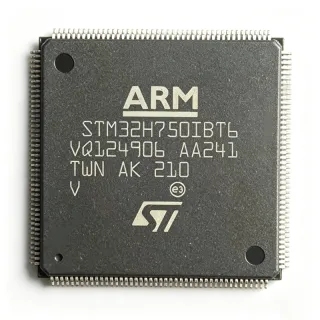
STM32H743IGT6 - 480MHz Cortex-M7 MCU 1MB Flash | STMicroelectronics
MPN: STM32H743IGT6 ✓ نشطSTM32H743IGT6 نظرة عامة
A microcontroller (MCU) is a single-chip computer that integrates a CPU core, memory, and programmable peripherals. The STM32H743 belongs to the 32-bit MCU family (ARM Cortex-M class), which sits above 8-bit/16-bit microcontrollers in the semiconductor hierarchy: transistor -> logic gate -> CPU core -> microcontroller -> embedded system. Cortex-M7 devices target high-performance embedded applications that previously required a DSP or microprocessor, and the STM32H7 line extends the STM32 family from mainstream (F0/F1/F4) into premium real-time processing tiers.
Key features of the STM32H743IGT6 include: 1 MB dual-bank Flash with ECC, 1 MB SRAM split into DTCM, AXI SRAM, SRAM1-4, and Backup SRAM; a 16-bit Chrom-ART (DMA2D) accelerator; JPEG codec in hardware; up to 35 communication interfaces including 3x SPI, 4x USART/UART, 2x UART, 3x I2C, 2x CAN, USB 2.0 FS+OTG, SDMMC, and Ethernet; a 16-bit parallel camera interface; and 3x 12-bit ADCs at 3.6 MSPS plus 2x 12-bit DACs. The internal SMPS step-down converter reduces core current consumption by approximately 30% versus an external LDO supply.
The architecture uses a 7-stage superscalar pipeline with branch prediction, single-precision and double-precision FPU, and an instruction/data cache. The AXI bus matrix (64-bit wide, 480 MHz) gives sustained memory bandwidth above 4 MB/s, suitable for TFT-LCD framebuffers and audio streaming. Advanced peripherals include a TFT-LCD controller (up to XGA resolution), cryptographic accelerators (AES, hash, RNG), and a true random number generator (TRNG).
Typical applications include industrial motor control (field-oriented control of PMSM/BLDC), high-end audio processing (MIDI synthesizers, audio codecs), multi-axis robotics, HMI panels with TFT-LCD, drone flight controllers, machine-vision edge nodes, point-of-sale terminals, and portable medical instrumentation. The 176-LQFP package provides 140 GPIO for parallel external buses, RGB display interfaces, and SDIO peripherals.
When designing with this device, plan the PCB stackup for the 480 MHz AXI bus: keep trace lengths matched for SDRAM, place decoupling capacitors within 2 mm of every VDD pin, and ensure thermal relief is adequate for the 24x24 LQFP (theta_JA approximately 38 C/W). Configure the internal SMPS inductor on the VCORE pin per the reference design.
This page synthesizes distributor pricing, drop-in pin-compatible alternatives, parametric comparisons, and PCB design notes that go beyond the ST datasheet summary - helping procurement, firmware, and hardware engineers make informed BOM decisions in a single read.
بدائل مباشرة لـ STM32H743IGT6 — نفس الحزمة، متوافق دبوس بدبوس. تُستثنى القطع ذات الحزم المختلفة التي تتطلب تعديل PCB.
الطرازات في هذه السلسلة
طرازات من نفس السلسلة متوافقة تمامًا مع STM32H743IGT6 (نفس عامل الشكل والبصمة) — يختلف في Package, Communication Interfaces, FPU, Flash Memory, Maximum Clock Frequency.
STM32H753IGT6
✅ بديل مباشر📋 بديل مرجعي (غير موجود في الكتالوج)
STM32H750IBT6
✅ بديل مباشر✗ غير متوفر
$8.85 / وحدة
عرض ورقة البيانات ←STM32H742IGT6
✅ بديل مباشر ⚠️ مواصفات غير مُتحقق منها📋 بديل مرجعي (غير موجود في الكتالوج)
STM32H733VGT6
✅ بديل مباشر ⚠️ مواصفات غير مُتحقق منهاتواصل لمعرفة السعر
عرض ورقة البيانات ←STM32H735IGT6
✅ بديل مباشر ⚠️ مواصفات غير مُتحقق منها📋 بديل مرجعي (غير موجود في الكتالوج)
STM32H743IGT6 الحدود القصوى والخصائص الكهربائية
| Core Architecture | ARM Cortex-M7 (32-bit) |
| Maximum Clock Speed | 480 MHz |
| CoreMark Performance | 2400 CoreMark |
| DMIPS Performance | 1027 DMIPS |
| Program Memory (Flash) | 1 MB (dual-bank with ECC) |
| SRAM | 1 MB (DTCM + AXI SRAM + SRAM1-4 + Backup SRAM) |
| L1 Cache | 16 KB I-cache + 16 KB D-cache |
| FPU | Double-precision IEEE 754 |
| جهد التغذية | 1.62 V to 3.6 V |
| العلبة | 176-LQFP (24x24 mm) |
| GPIO Count | 140 |
| درجة حرارة التشغيل | -40C to +85C (Grade 6) |
| ADC | 3x 12-bit, 3.6 MSPS |
| DAC | 2x 12-bit |
| Communication Interfaces | USB FS/OTG, 2x CAN, 3x SPI, 4x USART/UART, 3x I2C, SDMMC, Ethernet |
| نوع التركيب | Surface Mount |
| حالة RoHS | Compliant |
| Internal SMPS | Yes (step-down DC-DC for VCORE) |
| Cryptography | AES-256, hash (SHA-1/2), TRNG |
| Display Controller | TFT-LCD up to XGA (JPEG codec + DMA2D accelerator) |
تكوين أطراف STM32H743IGT6
| دبوس 1 | PE2 — GPIO PE2 / TRACECLK / SPI4_SCK |
| دبوس 2 | PE3 — GPIO PE3 / TRACED0 |
| دبوس 3 | PE4 — GPIO PE4 / TRACED1 |
| دبوس 4 | PE5 — GPIO PE5 / TRACED2 |
| دبوس 5 | PE6 — GPIO PE6 / TRACED3 |
| دبوس 6 | VBAT — Backup battery supply input |
| دبوس 7 | PC13 — GPIO PC13 / RTC_OUT / WKUP1 |
| دبوس 8 | PC14 — GPIO PC14 / OSC32_IN |
| دبوس 9 | PC15 — GPIO PC15 / OSC32_OUT |
| دبوس 10 | VSS — Digital ground |
| دبوس 11 | VDD — Digital supply 1.62-3.6 V |
| دبوس 12 | OSC_IN — HSE oscillator input |
| دبوس 13 | OSC_OUT — HSE oscillator output |
| دبوس 14 | NRST — Reset input, active low |
| دبوس 15 | PC0 — GPIO PC0 / ADC1_INP10 |
| دبوس 16 | PC1 — GPIO PC1 / ADC1_INP11 |
| دبوس 17 | PC2 — GPIO PC2 / ADC1_INP12 |
| دبوس 18 | PC3 — GPIO PC3 / ADC1_INP13 |
| دبوس 19 | VSSA — Analog ground |
| دبوس 20 | VDDA — Analog supply |
| دبوس 21 | PA0 — GPIO PA0 / ADC1_INP0 / WKUP0 |
| دبوس 22 | PA1 — GPIO PA1 / ADC1_INP1 |
| دبوس 23 | PA2 — GPIO PA2 / ADC1_INP2 / USART2_TX |
| دبوس 24 | PA3 — GPIO PA3 / ADC1_INP3 / USART2_RX |
| دبوس 25 | VSS — Digital ground |
| دبوس 26 | VDD — Digital supply |
| دبوس 27 | PA4 — GPIO PA4 / ADC1_INP4 / DAC1_OUT1 |
| دبوس 28 | PA5 — GPIO PA5 / ADC1_INP5 / DAC1_OUT2 |
| دبوس 29 | PA6 — GPIO PA6 / ADC1_INP6 |
| دبوس 30 | PA7 — GPIO PA7 / ADC1_INP7 |
| دبوس 31 | PC4 — GPIO PC4 / ADC1_INP14 |
| دبوس 32 | PC5 — GPIO PC5 / ADC1_INP15 |
| دبوس 33 | PB0 — GPIO PB0 / ADC1_INP8 |
| دبوس 34 | PB1 — GPIO PB1 / ADC1_INP9 |
| دبوس 35 | PB2 — GPIO PB2 / BOOT1 |
| دبوس 36 | PE7 — GPIO PE7 |
| دبوس 37 | PE8 — GPIO PE8 |
| دبوس 38 | PE9 — GPIO PE9 |
| دبوس 39 | PE10 — GPIO PE10 |
| دبوس 40 | PE11 — GPIO PE11 |
| دبوس 41 | PE12 — GPIO PE12 |
| دبوس 42 | PE13 — GPIO PE13 |
| دبوس 43 | PE14 — GPIO PE14 |
| دبوس 44 | PE15 — GPIO PE15 |
| دبوس 45 | PB10 — GPIO PB10 / USART3_TX |
| دبوس 46 | PB11 — GPIO PB11 / USART3_RX |
| دبوس 47 | VCAP_1 — VCORE decoupling (internal SMPS output cap) |
| دبوس 48 | VDD — Digital supply |
| دبوس 49 | PB12 — GPIO PB12 / SPI2_NSS |
| دبوس 50 | PB13 — GPIO PB13 / SPI2_SCK |
| دبوس 51 | PB14 — GPIO PB14 / SPI2_MISO |
| دبوس 52 | PB15 — GPIO PB15 / SPI2_MOSI |
| دبوس 53 | PD8 — GPIO PD8 / USART3_TX |
| دبوس 54 | PD9 — GPIO PD9 / USART3_RX |
| دبوس 55 | PD10 — GPIO PD10 |
| دبوس 56 | PD11 — GPIO PD11 |
| دبوس 57 | PD12 — GPIO PD12 |
| دبوس 58 | PD13 — GPIO PD13 |
| دبوس 59 | PD14 — GPIO PD14 |
| دبوس 60 | PD15 — GPIO PD15 |
| دبوس 61 | PC6 — GPIO PC6 / USART6_TX |
| دبوس 62 | PC7 — GPIO PC7 / USART6_RX |
| دبوس 63 | PC8 — GPIO PC8 |
| دبوس 64 | PC9 — GPIO PC9 |
| دبوس 65 | PA8 — GPIO PA8 / TIM1_CH1 / MCO1 |
| دبوس 66 | PA9 — GPIO PA9 / USART1_TX |
| دبوس 67 | PA10 — GPIO PA10 / USART1_RX |
| دبوس 68 | PA11 — GPIO PA11 / USB_OTG_FS_DM |
| دبوس 69 | PA12 — GPIO PA12 / USB_OTG_FS_DP |
| دبوس 70 | PA13 — GPIO PA13 / SWDIO |
| دبوس 71 | VCAP_2 — VCORE decoupling |
| دبوس 72 | VDD — Digital supply |
| دبوس 73 | PA14 — GPIO PA14 / SWCLK |
| دبوس 74 | PA15 — GPIO PA15 / JTDI / TIM2_CH1 |
| دبوس 75 | PC10 — GPIO PC10 / UART4_TX / SDMMC2_D2 |
| دبوس 76 | PC11 — GPIO PC11 / UART4_RX / SDMMC2_D3 |
| دبوس 77 | PC12 — GPIO PC12 / UART5_TX / SDMMC2_CK |
| دبوس 78 | PD0 — GPIO PD0 / FMC_D2 |
| دبوس 79 | PD1 — GPIO PD1 / FMC_D3 |
| دبوس 80 | PD2 — GPIO PD2 / SDMMC1_CMD / UART5_RX |
| دبوس 81 | PD3 — GPIO PD3 / FMC_CLK |
| دبوس 82 | PD4 — GPIO PD4 / FMC_NOE |
| دبوس 83 | PD5 — GPIO PD5 / FMC_NWE |
| دبوس 84 | VSS — Digital ground |
| دبوس 85 | VDD — Digital supply |
| دبوس 86 | PD6 — GPIO PD6 / FMC_NWAIT |
| دبوس 87 | PD7 — GPIO PD7 / FMC_NE1 |
| دبوس 88 | PG9 — GPIO PG9 / USART6_RX |
| دبوس 89 | PG10 — GPIO PG10 |
| دبوس 90 | PG11 — GPIO PG11 |
| دبوس 91 | PG12 — GPIO PG12 |
| دبوس 92 | PG13 — GPIO PG13 |
| دبوس 93 | PG14 — GPIO PG14 |
| دبوس 94 | VSS — Digital ground |
| دبوس 95 | VDD — Digital supply |
| دبوس 96 | PG15 — GPIO PG15 |
| دبوس 97 | PB3 — GPIO PB3 / JTDO / TIM2_CH2 |
| دبوس 98 | PB4 — GPIO PB4 / NJTRST |
| دبوس 99 | PB5 — GPIO PB5 / I2C1_SMBAI |
| دبوس 100 | PB6 — GPIO PB6 / I2C1_SCL |
| دبوس 101 | PB7 — GPIO PB7 / I2C1_SDA |
| دبوس 102 | BOOT0 — Boot mode select |
| دبوس 103 | PB8 — GPIO PB8 / I2C1_SCL |
| دبوس 104 | PB9 — GPIO PB9 / I2C1_SDA |
| دبوس 105 | PE0 — GPIO PE0 / TIM4_ETR |
| دبوس 106 | PE1 — GPIO PE1 |
| دبوس 107 | VSS — Digital ground |
| دبوس 108 | VDD — Digital supply |
| دبوس 109 | PF0 — GPIO PF0 / FMC_A0 |
| دبوس 110 | PF1 — GPIO PF1 / FMC_A1 |
| دبوس 111 | PF2 — GPIO PF2 / FMC_A2 |
| دبوس 112 | PF3 — GPIO PF3 / FMC_A3 |
| دبوس 113 | PF4 — GPIO PF4 / FMC_A4 |
| دبوس 114 | PF5 — GPIO PF5 / FMC_A5 |
| دبوس 115 | VSS — Digital ground |
| دبوس 116 | VDD — Digital supply |
| دبوس 117 | PF6 — GPIO PF6 / TIM10_CH1 |
| دبوس 118 | PF7 — GPIO PF7 / TIM11_CH1 |
| دبوس 119 | PF8 — GPIO PF8 / TIM12_CH1 |
| دبوس 120 | PF9 — GPIO PF9 / TIM13_CH1 |
| دبوس 121 | PF10 — GPIO PF10 / TIM14_CH1 |
| دبوس 122 | PF11 — GPIO PF11 |
| دبوس 123 | PH0 — GPIO PH0 / OSC_IN |
| دبوس 124 | PH1 — GPIO PH1 / OSC_OUT |
| دبوس 125 | VSS — Digital ground |
| دبوس 126 | VDD — Digital supply |
| دبوس 127 | PC14 — GPIO PC14 / OSC32_IN (duplicate alt) |
| دبوس 128 | PC15 — GPIO PC15 / OSC32_OUT (duplicate alt) |
| دبوس 129 | VSS — Digital ground |
| دبوس 130 | VDD — Digital supply |
| دبوس 131 | PG0 — GPIO PG0 / FMC_A10 |
| دبوس 132 | PG1 — GPIO PG1 / FMC_A11 |
| دبوس 133 | PG2 — GPIO PG2 / FMC_A12 |
| دبوس 134 | PG3 — GPIO PG3 / FMC_A13 |
| دبوس 135 | PG4 — GPIO PG4 / FMC_A14 |
| دبوس 136 | PG5 — GPIO PG5 / FMC_A15 |
| دبوس 137 | PG6 — GPIO PG6 |
| دبوس 138 | PG7 — GPIO PG7 |
| دبوس 139 | PG8 — GPIO PG8 |
| دبوس 140 | VSS — Digital ground |
| دبوس 141 | VDD — Digital supply |
| دبوس 142 | PF12 — GPIO PF12 / FMC_A6 |
| دبوس 143 | PF13 — GPIO PF13 / FMC_A7 |
| دبوس 144 | PF14 — GPIO PF14 / FMC_A8 |
| دبوس 145 | PF15 — GPIO PF15 / FMC_A9 |
| دبوس 146 | PG10 — GPIO PG10 (duplicate function) |
| دبوس 147 | PA0 — GPIO PA0 (WKUP, alt) |
| دبوس 148 | PA1 — GPIO PA1 (alt) |
| دبوس 149 | PA2 — GPIO PA2 (alt) |
| دبوس 150 | PA3 — GPIO PA3 (alt) |
| دبوس 151 | VSS — Digital ground |
| دبوس 152 | VDD — Digital supply |
| دبوس 153 | PA4 — GPIO PA4 (alt) |
| دبوس 154 | PA5 — GPIO PA5 (alt) |
| دبوس 155 | PA6 — GPIO PA6 (alt) |
| دبوس 156 | PA7 — GPIO PA7 (alt) |
| دبوس 157 | PB0 — GPIO PB0 (alt) |
| دبوس 158 | PB1 — GPIO PB1 (alt) |
| دبوس 159 | PB2 — GPIO PB2 (alt) |
| دبوس 160 | PF12 — GPIO PF12 (alt) |
| دبوس 161 | VSS — Digital ground |
| دبوس 162 | VDD — Digital supply |
| دبوس 163 | PC6 — GPIO PC6 (alt) |
| دبوس 164 | PC7 — GPIO PC7 (alt) |
| دبوس 165 | PC8 — GPIO PC8 (alt) |
| دبوس 166 | PC9 — GPIO PC9 (alt) |
| دبوس 167 | PA8 — GPIO PA8 (alt) |
| دبوس 168 | PA9 — GPIO PA9 (alt) |
| دبوس 169 | PA10 — GPIO PA10 (alt) |
| دبوس 170 | PA11 — GPIO PA11 (alt) |
| دبوس 171 | PA12 — GPIO PA12 (alt) |
| دبوس 172 | PA13 — GPIO PA13 (alt) |
| دبوس 173 | VCAP_3 — VCORE decoupling |
| دبوس 174 | VDD — Digital supply |
| دبوس 175 | PA14 — GPIO PA14 (alt) |
| دبوس 176 | PA15 — GPIO PA15 (alt) |
التطبيقات النموذجية
STM32H743IGT6 مناسب لـ 7 التطبيقs: Industrial Motor Control (FOC / PMSM), High-End TFT-LCD HMI Panels, Multi-Axis Robotics and CNC Control, Audio Processing and MIDI Synthesizers, Machine Vision and Image Processing, Drone Flight Controllers, Portable Medical Instrumentation.
Industrial Motor Control (FOC / PMSM)
The STM32H743IGT6 is engineered for high-performance motor control including field-oriented control (FOC) of PMSM and BLDC motors. The 480 MHz Cortex-M7 with double-precision FPU executes the FOC loop in well under 10 microseconds, and the 3x 12-bit ADCs at 3.6 MSPS provide simultaneous current sampling on three shunt resistors without aliasing. The high-resolution timer (HRTIM) with 184 ps resolution drives center-aligned PWM up to 100 kHz. The built-in SMPS reduces BOM cost versus an external LDO, and the cryptographic accelerators are not required for motor-control firmware, making the H743 a cost-optimized choice versus the H753.
موصى به
High-End TFT-LCD HMI Panels
The STM32H743IGT6 drives TFT-LCD panels up to XGA (1024x768) using the integrated LTDC controller, Chrom-ART (DMA2D) 2D accelerator, and on-chip JPEG codec. The 1 MB of AXI SRAM holds a full XGA framebuffer at 16 bpp without external SDRAM, and the 16-bit parallel display interface supports pixel clocks up to 83 MHz for 60 fps refresh. The double-precision FPU accelerates anti-aliased font rendering, and the SDMMC controller boots firmware from a microSD card at 50 MB/s. For HMI panels in industrial equipment, the H743 is widely adopted as the cost-effective sweet spot between the Cortex-M4 STM32F4 line and the more expensive STM32MP1 microprocessor series.
موصى به
Multi-Axis Robotics and CNC Control
The STM32H743IGT6's 480 MHz Cortex-M7 core is well suited to multi-axis robotics including 6-DoF robotic arms, CNC controllers, and pick-and-place machines. The DSP extensions accelerate inverse-kinematics math, the double-precision FPU handles 3D coordinate transforms, and the 16-bit parallel camera interface accepts a vision module for closed-loop position control. With 140 GPIO and 8 USART/UART ports, the H743 can drive up to 8 stepper motors via external drivers, and the 2x CAN interfaces support CANopen or CAN-FD for industrial robot bus protocols. The 1 MB Flash accommodates complex motion-planning firmware without external memory.
موصى به
Audio Processing and MIDI Synthesizers
The STM32H743IGT6's 480 MHz Cortex-M7 with double-precision FPU executes high-quality audio processing including 32-voice polyphonic synthesizers, reverb, and effects at 48 kHz/24-bit. The SAI (Serial Audio Interface) supports I2S/TDM audio codecs up to 192 kHz, the 2x 12-bit DACs provide line-level analog output, and the I2C peripheral controls codec chips. The DSP extensions accelerate FFT-based spectral processing, and the 1 MB SRAM holds multi-second audio buffers without external memory. The 176-LQFP package provides ample GPIO for MIDI DIN-5 in/out and footswitch jacks.
موصى به
Machine Vision and Image Processing
The STM32H743IGT6 supports machine-vision edge nodes with its 16-bit parallel camera interface, hardware JPEG codec, and Chrom-ART (DMA2D) graphics accelerator. The 1 MB of SRAM accommodates a VGA-resolution framebuffer plus edge-detection kernels, and the AXI bus matrix sustains 240 MHz memory bandwidth to keep up with OV5640-class 5 MP sensors. The Cortex-M7 DSP extensions accelerate Sobel and Canny edge-detection filters, while the USB 2.0 OTG streams processed frames to a host. For embedded vision tasks below 30 fps at QVGA, the H743 is competitive with low-end Cortex-A Linux SOMs at much lower power and BOM cost.
موصى به
Drone Flight Controllers
The STM32H743IGT6 has become the de-facto flight-controller reference MCU for high-end racing and cinematic drones running PX4 or ArduPilot. The 480 MHz Cortex-M7 runs the attitude-control loop at 8 kHz, the double-precision FPU handles quaternion math, and the high-resolution timer drives DSHOT/OneShot/ProShot ESC protocols. The 3x ADCs at 3.6 MSPS sample IMU and gyroscope data with low latency, and the USB OTG provides the bootloader for firmware updates. The internal SMPS reduces weight versus an external LDO, and the 176-LQFP package has enough GPIO for GPS, magnetometer, optical-flow, and 4x ESC outputs simultaneously.
موصى به
Portable Medical Instrumentation
The STM32H743IGT6 suits portable medical devices such as patient monitors, infusion pumps, and handheld ultrasound controllers. The 480 MHz Cortex-M7 processes ECG/EEG signal chains, the 3x 12-bit ADCs at 3.6 MSPS provide adequate resolution for biopotential signals, and the AES-256 hardware accelerator (not available on H743 - see H753) secures patient data at rest. The 1 MB Flash stores firmware with built-in self-test (BIST) routines, and the USB OTG connects to PC-based diagnostic software. The -40C to +85C operating temperature range supports both clinical and field-deployment scenarios.
موصى به
ملخص المنتجات الموصى بها
بيانات مرجعية هندسية لـ STM32H743IGT6 — المقارنة وإرشادات التصميم ومعلومات الامتثال.
دليل الاختيار
المقارنة مع البدائل
| المعامل | هذا المنتج | STM32H753IGT6 | STM32H750IBT6 | STM32H742IGT6 | STM32H733VGT6 | STM32H735IGT6 |
|---|---|---|---|---|---|---|
| Package | 176-LQFP (24x24 mm) | 176-LQFP (24x24) - same | 176-LQFP (24x24) - same | 176-LQFP (24x24) - same | 176-LQFP (24x24) - same | 176-LQFP (24x24) - same |
| Brand | STMicroelectronics | STMicroelectronics | STMicroelectronics | STMicroelectronics | STMicroelectronics | STMicroelectronics |
| Core | Cortex-M7 @ 480 MHz | Cortex-M7 @ 480 MHz | Cortex-M7 @ 480 MHz | Cortex-M7 @ 480 MHz | Cortex-M7 @ 550 MHz | Cortex-M7 @ 550 MHz |
| Flash | 1 MB dual-bank | 2 MB dual-bank | 128 KB (boot from external) | 1 MB dual-bank | 1 MB dual-bank | 1 MB dual-bank |
| SRAM | 1 MB | 1 MB | 864 KB | 1 MB | 564 KB | 564 KB |
| Cryptography | No crypto accelerator | AES, hash, TRNG, SFI | AES, hash, TRNG | No crypto | AES, hash, TRNG | AES, hash, TRNG |
| TrustZone | No | No | No | No | Yes | Yes |
| Internal SMPS | Yes | Yes | Yes | Yes | Yes | Yes |
| Approx Unit Price (qty 1, USD) | 16.20 | 19.50 | 12.80 | 15.40 | 17.60 | 18.90 |
أبرز الفروقات
- Industry-leading 480 MHz Cortex-M7 with 2400 CoreMark (مقابلSTM32F407VGT6)
- 1 MB Flash and 1 MB SRAM in a single chip (مقابلSTM32H750IBT6)
- Cost-optimized without crypto accelerator (مقابلSTM32H753IGT6)
- No TrustZone - simpler firmware toolchain (مقابلSTM32H733VGT6)
ملاحظات التصميم
The STM32H743IGT6 integrates a step-down SMPS to supply VCORE from VDD. According to the ST reference design (AN5031), connect a 4.7 uH inductor between VCORE and the SMPS output pin, plus a 4.7 uF X5R 6.3V ceramic capacitor on each VCAP pin. This configuration typically reduces core current by 30% versus external-LDO supply. If the application is noise-sensitive (audio or ADC), consider bypassing the SMPS and using the internal LDO mode by tying the SMPS_EN pin appropriately.
Place 100 nF X7R 0402 decoupling capacitors within 2 mm of every VDD/VDDA pin, with a shared 10 uF bulk capacitor at the board entry point. The 480 MHz AXI bus requires trace-length matching within 0.5 mm on SDRAM, FMC, and Ethernet RMII lines. Use a 4-layer PCB stackup with dedicated ground and power planes; the LQFP-176 thermal pad (exposed) must be soldered to a copper pour of at least 1 square inch to keep theta_JA below 38 C/W.
Do not skip the BOOT0 strap configuration: pull BOOT0 low via 10 kOhm to VSS for normal boot from internal Flash, or high to VDD for system memory bootloader (used for UART/USB firmware recovery). Configure the unused GPIO banks (especially PG0-PG8 on LQFP-176) to analog input mode to reduce standby current by 5-10 uA per pin. Ensure NRST has a 10 kOhm pull-up and 100 nF capacitor to guarantee clean reset during power ramp.
The Ethernet RMII interface requires 50 MHz reference clock with sub-100 ps jitter; source this clock from the MCU MCO1 or MCO2 output rather than an external oscillator to save BOM cost. For SDRAM, the DQS signal must be length-matched to the data/clock group within 1 mm on a 4-layer PCB. The USB OTG FS D+/D- pair requires 90 ohm differential impedance; do not route over ground-plane splits.
معلومات الامتثال
Industrial-grade part (-40C to +85C) per ST datasheet DS12110. Not AEC-Q100 qualified - use STM32H743IIT6Q for automotive. RoHS/REACH compliant per ST product page.