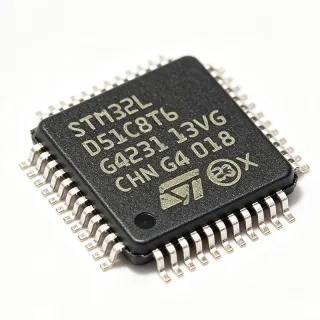
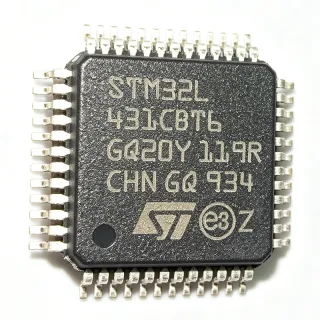
STM32L151CCT6TR - 256KB Flash Cortex-M3 MCU LQFP-48 | STMicroelectronics
MPN: STM32L151CCT6TR ✓ نشطSTM32L151CCT6TR نظرة عامة
An ARM Cortex-M3 microcontroller is a 32-bit RISC processor core designed for embedded applications, balancing deterministic interrupt response, Thumb-2 instruction efficiency, and a rich peripheral ecosystem. The STM32L151CCT6 belongs to the STM32L1 ultra-low-power family: STM32L1 MCU -> ARM Cortex-M MCU -> 32-bit microcontroller -> embedded MCU -> semiconductor IC. Compared with legacy 8-bit or 16-bit microcontrollers, Cortex-M3 devices deliver higher code density, hardware divide, integrated DMA, and standardized CMSIS firmware libraries. The 'L' classification emphasizes dynamic voltage scaling and multiple low-power modes that allow battery-powered designs to operate for years on a single cell.
Key features include a wide 1.65 V to 3.6 V supply range, 7 low-power modes (including a 4.4 uA Stop mode with RTC retention), an integrated LCD controller with built-in voltage booster, a 12-bit ADC with up to 1 Msps, two DACs, and a USB Full-Speed device/host/OTG transceiver with internal pull-up. The two on-chip rail-to-rail op-amps can drive ADC inputs or be used for power management loops, offloading external analog components. Hardware AES 128-bit encryption is included for secure firmware update and data protection.
Architecture is built on the Cortex-M3 core with ST's proprietary ART Accelerator prefetch buffer and a multi-voltage I/O ring that allows the I/O voltage to be set independently of the core supply. The device integrates a brown-out reset (BOR) in Stop mode, a programmable voltage detector (PVD), two independent watchdogs, and a real-time clock with calendar and alarm. Internal oscillators (16 MHz HSI and 37 kHz LSI) reduce external component count, while the 4 MHz MSI RC oscillator is automatically trimmed against the LSE crystal for accurate timing during Sleep and Run modes.
Typical applications include battery-powered sensor nodes, wearable health monitors, energy-harvesting devices, smart meters, industrial sensor transmitters, USB Human Interface Devices (HIDs), and portable medical diagnostic instruments where standby current is measured in microamps and operating current must remain under 10 mA for weeks of autonomy. The integrated op-amps also suit low-side current sensing in motor control and e-bike torque pedals.
Designers should note that the LQFP-48 (7x7 mm) package leaves approximately 4 mm2 of exposed pad-free copper per side, and Pin 1 is the top-left indicator on the tape orientation. A 4-layer PCB with a continuous ground pour is strongly recommended for digital noise immunity and to keep the USB DP/DM traces at 90 ohm differential impedance.
This page synthesizes ST datasheet specifications, distributor pricing snapshots, pin-compatible alternatives drawn from the STM32L1 family, and practical design notes not found in the manufacturer reference manual alone.
بدائل مباشرة لـ STM32L151CCT6TR — نفس الحزمة، متوافق دبوس بدبوس. تُستثنى القطع ذات الحزم المختلفة التي تتطلب تعديل PCB.
الطرازات في هذه السلسلة
طرازات من نفس السلسلة متوافقة تمامًا مع STM32L151CCT6TR (نفس عامل الشكل والبصمة) — يختلف في Package, Core Architecture, Operational Amplifiers, EEPROM, ADC.
STM32L152CCT6
✅ بديل مباشر📋 بديل مرجعي (غير موجود في الكتالوج)
STM32L151CCT6
✅ بديل مباشرتواصل لمعرفة السعر
عرض ورقة البيانات ←STM32L151RCT6
✅ بديل مباشر ⚠️ مواصفات غير مُتحقق منهاتواصل لمعرفة السعر
عرض ورقة البيانات ←STM32L152CCT6TR
✅ بديل مباشر📋 بديل مرجعي (غير موجود في الكتالوج)
STM32L100CCT6
✅ بديل مباشر📋 بديل مرجعي (غير موجود في الكتالوج)
STM32L151C8U6
✅ بديل مباشر ⚠️ مواصفات غير مُتحقق منها📋 بديل مرجعي (غير موجود في الكتالوج)
STM32L151CCT6TR الحدود القصوى والخصائص الكهربائية
| Core Architecture | ARM Cortex-M3 32-bit RISC |
| Maximum CPU Clock | 32 MHz |
| Flash Memory | 256 KB |
| SRAM | 32 KB |
| EEPROM | 8 KB |
| Supply Voltage Range | 1.65 V to 3.6 V |
| نطاق درجة حرارة التشغيل | -40 C to +85 C |
| العلبة | LQFP-48 (7x7 mm) |
| نوع التركيب | Surface Mount |
| Number of I/Os | 37 |
| USB Interface | USB 2.0 Full-Speed (device/host/OTG) |
| ADC Channels | 14 (12-bit, up to 1 Msps) |
| DAC Channels | 2 (12-bit) |
| Operational Amplifiers | 2 (on-chip rail-to-rail) |
| Low-Power Stop Mode Current | 4.4 uA (typ, with RTC retention) |
| Hardware AES Engine | AES-128 (yes) |
| حالة RoHS | Compliant |
تكوين أطراف STM32L151CCT6TR
| دبوس 1 | VDD — Power supply |
| دبوس 2 | OSC_IN — External oscillator input |
| دبوس 3 | OSC_OUT — External oscillator output |
| دبوس 4 | NRST — Reset (active low) |
| دبوس 5 | VSSA — Analog ground |
| دبوس 6 | VDDA — Analog power supply |
| دبوس 7 | PA0 — GPIO PA0 / ADC_IN0 |
| دبوس 8 | PA1 — GPIO PA1 / ADC_IN1 / OPAMP1_VINP |
| دبوس 9 | PA2 — GPIO PA2 / ADC_IN2 / USART2_TX |
| دبوس 10 | PA3 — GPIO PA3 / ADC_IN3 / OPAMP1_VINM |
| دبوس 11 | PA4 — GPIO PA4 / ADC_IN4 / DAC_OUT1 |
| دبوس 12 | PA5 — GPIO PA5 / ADC_IN5 / DAC_OUT2 |
| دبوس 13 | PA6 — GPIO PA6 / ADC_IN6 / SP1_MISO |
| دبوس 14 | PA7 — GPIO PA7 / ADC_IN7 / SP1_MOSI |
| دبوس 15 | PB0 — GPIO PB0 / ADC_IN8 |
| دبوس 16 | PB1 — GPIO PB1 / ADC_IN9 |
| دبوس 17 | PB2 — GPIO PB2 / BOOT1 |
| دبوس 18 | VSS — Digital ground |
| دبوس 19 | VDD — Power supply |
| دبوس 20 | PB10 — GPIO PB10 / I2C2_SCL |
| دبوس 21 | PB11 — GPIO PB11 / I2C2_SDA |
| دبوس 22 | PB12 — GPIO PB12 / SPI2_NSS |
| دبوس 23 | PB13 — GPIO PB13 / SPI2_SCK |
| دبوس 24 | PB14 — GPIO PB14 / SPI2_MISO |
| دبوس 25 | PB15 — GPIO PB15 / SPI2_MOSI |
| دبوس 26 | PC13 — GPIO PC13 / RTC_TAMP1 |
| دبوس 27 | PC14 — GPIO PC14 / OSC32_IN |
| دبوس 28 | PC15 — GPIO PC15 / OSC32_OUT |
| دبوس 29 | VSS — Digital ground |
| دبوس 30 | VDD — Power supply |
| دبوس 31 | PH0 — GPIO PH0 / OSC_IN (high-speed crystal) |
| دبوس 32 | PH1 — GPIO PH1 / OSC_OUT (high-speed crystal) |
| دبوس 33 | PA8 — GPIO PA8 / USART1_CK |
| دبوس 34 | PA9 — GPIO PA9 / USART1_TX / OPAMP1_VOUT |
| دبوس 35 | PA10 — GPIO PA10 / USART1_RX / OPAMP2_VOUT |
| دبوس 36 | PA11 — GPIO PA11 / CAN_RX / USB_DM |
| دبوس 37 | PA12 — GPIO PA12 / CAN_TX / USB_DP |
| دبوس 38 | PA13 — GPIO PA13 / TMS (SWDIO) |
| دبوس 39 | VSS — Digital ground |
| دبوس 40 | VDD — Power supply |
| دبوس 41 | PA14 — GPIO PA14 / TCK (SWCLK) |
| دبوس 42 | PA15 — GPIO PA15 / JTDI / TIM2_CH1 |
| دبوس 43 | PB3 — GPIO PB3 / JTDO / TIM2_CH2 |
| دبوس 44 | PB4 — GPIO PB4 / JNTRST |
| دبوس 45 | PB5 — GPIO PB5 / I2C1_SMBAI |
| دبوس 46 | PB6 — GPIO PB6 / I2C1_SCL |
| دبوس 47 | PB7 — GPIO PB7 / I2C1_SDA |
| دبوس 48 | BOOT0 — Boot mode selection |
التطبيقات النموذجية
STM32L151CCT6TR مناسب لـ 7 التطبيقs: Battery-Powered IoT Sensor Node, Wearable Health Monitor, USB HID Peripheral Device, Industrial Sensor Transmitter, Smart Electricity Meter, Portable Medical Diagnostic Instrument, Energy-Harvesting Wireless Switch.
Battery-Powered IoT Sensor Node
The STM32L151CCT6TR's 4.4 uA Stop mode with RTC retention and 1.65 V minimum supply make it ideal for long-life IoT sensor nodes. The 256 KB Flash supports Thread/Matter or LoRaWAN MAC libraries with margin, while the integrated 12-bit ADC and dual rail-to-rail op-amps handle sensor conditioning without external analog ICs. At a measured awake current below 10 mA and a duty cycle of one transmit per 60 s, a single 2400 mAh Li-SOCl2 primary cell can power a sensor node for 5 to 10 years.
موصى به
Wearable Health Monitor
The device's two on-chip rail-to-rail op-amps can directly amplify ECG, PPG, or GSR sensor signals before the 12-bit ADC, eliminating the need for a separate analog front-end in compact wearable designs. Power consumption in Run mode at 32 MHz remains under 10 mA per the ST datasheet, and the wide 1.65 V to 3.6 V supply range supports direct USB Li-ion recharge integration. Hardware AES-128 enables HIPAA-compliant encrypted storage of patient health records in on-chip Flash.
موصى به
USB HID Peripheral Device
The integrated USB 2.0 Full-Speed controller with on-chip pull-up resistor lets the STM32L151CCT6TR connect to a host PC without external USB PHY circuitry, simplifying HID peripherals such as keyboards, mice, barcode scanners, and industrial programmers. At 32 MHz the Cortex-M3 cores serve USB polling endpoints with ample margin for HID report processing, while the Stop mode draws only microwatts during host suspend events. The LQFP-48 package accommodates the required DP/DM trace routing on a 2-layer PCB.
موصى به
Industrial Sensor Transmitter
The 4-20 mA current loop or wireless HART sensor transmitter benefits from the wide 1.65 V to 3.6 V input that allows direct connection to 24 V loop power through a low-cost switching regulator. The hardware AES-128 engine secures HART-7 protocol communications while the dual op-amps directly drive 4-20 mA output stages, allowing a two-chip implementation. The LQFP-48 industrial-temperature grade of -40 C to +85 C covers most process and pipeline environments without derating.
موصى به
Smart Electricity Meter
The two integrated op-amps perform current-sensing signal conditioning for class-1 metering accuracy without external analog ICs, while the 32 KB SRAM buffers ADC sample bursts. The hardware AES-128 engine secures DLMS/COSEM protocol exchanges per IEC 62056-46, and the integrated LCD segment driver (on STM32L152 equivalents) or 32 GPIO lines drive character displays. Battery backup of RTC at 4.4 uA typical Stop mode meets 10-year retention requirements for unattended electricity meters.
موصى به
Portable Medical Diagnostic Instrument
The wide 1.65 V to 3.6 V supply supports direct operation from two AA alkaline cells while the Stop mode retains RTC and tamper-detection logic. The 32 MHz Cortex-M3 core and 256 KB Flash accommodate USB CDC/ECG firmware plus signal-processing libraries, and the integrated 12-bit ADC with up to 1 Msps captures ECG waveforms without an external ADC. The hardware AES-128 supports HIPAA-compliant patient data encryption per FDA cybersecurity guidance.
موصى به
Energy-Harvesting Wireless Switch
The 1.65 V minimum supply is compatible with energy-harvested supply rails from piezoelectric switches or solar cells, and the 4.4 uA Stop mode current allows operation from a single BLE packet transmit event. The hardware AES-128 encrypts communication packets, while the 256 KB Flash supports Sub-GHz radio firmware and bidirectional mesh protocols. The integrated op-amps can be configured as ultra-low-power comparators for wake-on-energy detection, eliminating external components.
موصى به
ملخص المنتجات الموصى بها
بيانات مرجعية هندسية لـ STM32L151CCT6TR — المقارنة وإرشادات التصميم ومعلومات الامتثال.
دليل الاختيار
المقارنة مع البدائل
| المعامل | هذا المنتج | STM32L152CCT6 | STM32L151CCT6 | STM32L100CCT6 |
|---|---|---|---|---|
| Brand | STMicroelectronics | STMicroelectronics | STMicroelectronics | STMicroelectronics |
| Package | LQFP-48 (7x7 mm) | LQFP-48 (7x7 mm) - same | LQFP-48 (7x7 mm) - same | LQFP-48 (7x7 mm) - same |
| Core | ARM Cortex-M3 32 MHz | ARM Cortex-M3 32 MHz | ARM Cortex-M3 32 MHz | ARM Cortex-M3 32 MHz |
| Flash | 256 KB | 256 KB | 256 KB | 256 KB |
| USB | USB 2.0 Full-Speed | USB 2.0 Full-Speed | USB 2.0 Full-Speed | No USB |
| Op-Amps | 2 on-chip | 2 on-chip | 2 on-chip | None |
| LCD Controller | No | Yes (4x52 segments) | No | No |
| AES-128 | Yes | Yes | Yes | Yes |
| Stop Mode Current | 4.4 uA typ | 4.4 uA typ | 4.4 uA typ | 4.4 uA typ |
| Packaging | Tape and Reel (TR) | Tray | Tray | Tray |
أبرز الفروقات
- Only STM32L1 variant with USB AND dual op-amps in LQFP-48 (مقابلSTM32L100CCT6)
- Hardware AES-128 included for secure communications (مقابلSTM32F103Z)
- 256 KB Flash at lowest power vs STM32F1 mainstream family (مقابلSTM32F103Z)
ملاحظات التصميم
Place a 100 nF decoupling capacitor directly between each VDD/VSS pin pair and a 4.7 uF bulk capacitor near the VDDA pin. The Stop mode current of 4.4 uA typ only holds when the LSE crystal is enabled for RTC retention; disabling all clocks draws sub-1 uA in Standby mode, per the ST datasheet. Use a separate analog supply rail for VDDA when driving the on-chip op-amps at high source impedances above 100 kohm to preserve ADC SNR.
Route USB DP and DM as a 90 ohm differential pair on the top layer with continuous reference ground beneath, matching the USB 2.0 Full-Speed specification. Keep trace length under 50 mm and minimize vias to one per line. The LQFP-48 (7x7 mm) package exposed pad is not present; run a 4-layer stack with one full ground plane and one power plane to maintain signal integrity across the 32 MHz ARM Cortex-M3 clock traces.
Do not enable the on-chip pull-up resistor on the USB DP pin and also add an external 1.5 kohm pull-up, as the parallel combination violates the USB signal rise/fall timing budget. Always strap BOOT0 to ground through a 10 kohm resistor for normal Flash boot; pulling BOOT0 high at reset enters the system memory bootloader. The NRST pin requires a 100 nF bypass capacitor and an optional external pull-up of 10 kohm to VDD for noisy environments.
At 32 MHz Cortex-M3 operation with all peripherals enabled, the device dissipates up to 144 mW from a 3.3 V supply, well below the LQFP-48 thermal resistance of approximately 95 C/W theta JA. Estimated: junction temperature rise at 25 C ambient is approximately 14 C, confirming no heatsink is required for typical embedded designs. However, the on-chip op-amps can drive 50 mA continuous output and add 0.5 W dissipation if the output stage is shorted; ensure output current limiters are configured.
معلومات الامتثال
RoHS and REACH compliant per ST product page; commercial-grade (-40 C to +85 C) only, not AEC-Q100 qualified. Choose STM32L151RCT6 in extended grade if AEC-Q100 is required for automotive designs.