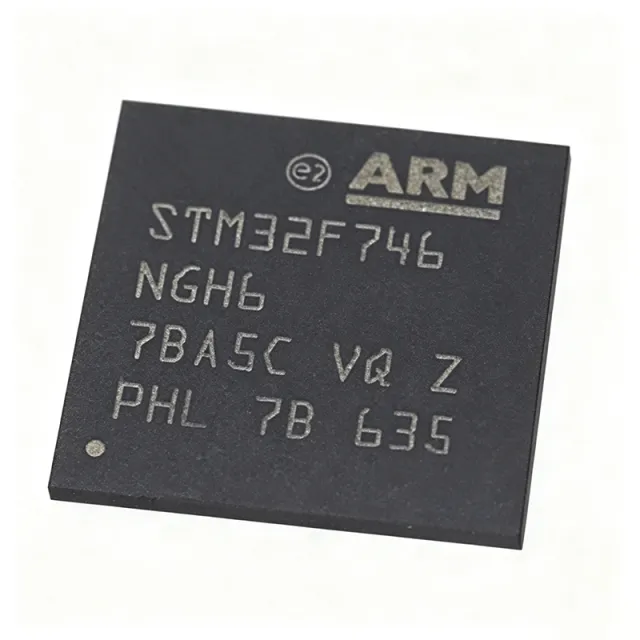
STM32F746ZET6
STM32F746ZET6 - 216MHz Cortex-M7 MCU, 512KB Flash | STMicroelectronics
The STMicroelectronics STM32F746ZET6 is a 32-bit Arm Cortex-M7 microcontroller operating at up to 216 MHz, with 512 KB of Flash memory and a 144-lead LQFP package measuring 20 mm by 20 mm. It belongs to the STM32F7 high-performance microcontroller family and combines a 216 MHz Cortex-M7 processor with DSP capability and floating-point unit support. The STM32F746ZET6 is therefore suitable for control-intensive embedded systems requiring substantial processing speed, deterministic real-time response, and a broad set of serial and display-oriented peripherals.
A microcontroller is a programmable integrated circuit containing a processor core, memory, and peripherals on one package. The STM32F7 series sits within the hierarchy of microcontrollers, embedded processors, and semiconductor devices. Unlike a discrete general-purpose processor, an STM32 microcontroller integrates Flash, RAM, clocking, communications, timers, and GPIO into a compact device. The STM32F746ZET6 extends this integration with an Arm Cortex-M7 core optimized for high-performance embedded control, including DSP instructions and floating-point arithmetic.
The verified product listing identifies the Cortex-M7 architecture, 216 MHz maximum operating frequency, 512 KB of Flash, and 144-LQFP package. Additional family-level information identifies an Art Accelerator, L1 cache, SDRAM support, and TFT-controller capability for the STM32F745xx and STM32F746xx device families. These features support graphics-oriented user interfaces, communications equipment, industrial controllers, audio processing, and real-time signal-processing systems. The LQFP package also provides inspectable leads and a large thermal pad footprint compared with compact QFN packages.
The 216 MHz Cortex-M7 core gives software more instruction bandwidth than lower-frequency Cortex-M devices while retaining the deterministic execution model expected of embedded systems. DSP and FPU support can reduce the computational overhead associated with filtering, transforms, control loops, and floating-point math. The family-level Art Accelerator can accelerate selected graphical operations, while L1 cache helps improve data-access performance in code and data working sets. Exact RAM size and peripheral configurations were not included in the supplied verified data and therefore require confirmation in the official STM32F746ZE documentation.
Typical applications include industrial automation, human-machine interfaces, communications infrastructure, test and measurement equipment, medical monitoring, and consumer devices with graphical displays. In an HMI, the STM32F746ZET6 can combine the Cortex-M7 processing capability with TFT control and external SDRAM. In communications equipment, its high-performance core can support protocol processing and real-time control. For control cabinets, industrial displays, or audio-oriented embedded products, the 144-LQFP package simplifies prototype assembly and provides ample external routing flexibility.
Designers should verify the complete pin multiplexing, power-supply requirements, clock configuration, memory map, and peripheral set against the manufacturer documentation before layout. Because this exact ordering code uses a 144-lead LQFP package, a complete 144-pin schematic and PCB footprint review is essential. Decoupling, analog-supply isolation, high-speed clock routing, and SDRAM layout should follow the relevant STMicroelectronics hardware guidance rather than relying solely on generic MCU layout practice.
This product page consolidates the verified manufacturer, distributor, and distributor-indexed data for the STM32F746ZET6, distinguishes the available same-brand STM32F7 drop-in options, and identifies design information that still requires verification from the official datasheet. It is intended to accelerate component identification and sourcing without presenting unverified electrical details as manufacturer specifications.
RFQ
Contact