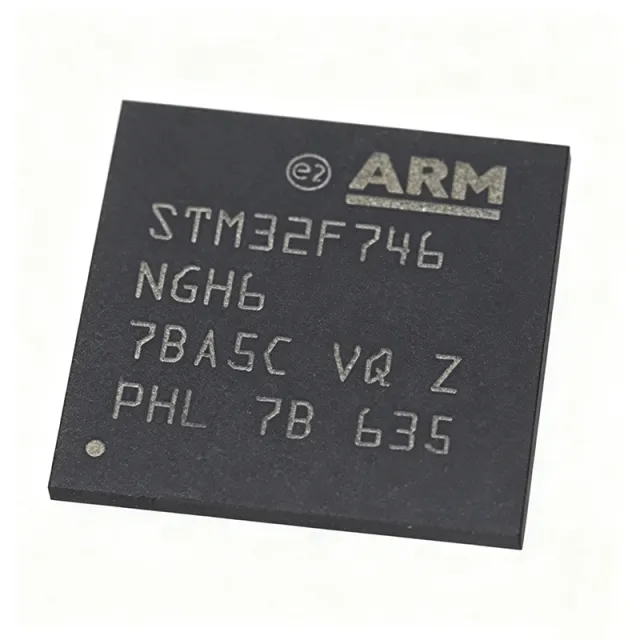
STM32F746NGH6 - 32-bit ARM Cortex-M7 MCU, 1MB Flash | STMicroelectronics
MPN: STM32F746NGH6 ✓ Active| Qty | Unit Price | Extended |
|---|---|---|
| 1 | $31.3636 | $31.36 |
| 10 | $22.6515 | $226.52 |
| 100 | $20.0379 | $2,003.79 |
| 500 | $19.1667 | $9,583.35 |
| 1,000 | $18.2955 | $18,295.50 |
STM32F746NGH6 Overview
What is a microcontroller? A microcontroller (MCU) is a compact integrated circuit designed to govern a specific operation in an embedded system. It contains a processor core, memory (Flash and SRAM), and programmable input/output peripherals on a single chip. Microcontrollers are the backbone of modern electronics, found in automotive systems, industrial controls, consumer electronics, and IoT devices. The STM32F746NGH6 belongs to the STM32F7 series, which is part of the broader STM32 family of 32-bit ARM Cortex-M based MCUs, positioned as a high-performance option within the STM32 portfolio.
Key features of the STM32F746NGH6 include a 216 MHz ARM Cortex-M7 core with double-precision FPU and DSP instructions, 1 MB of Flash memory, 320 KB of SRAM, and a Chrom-ART Accelerator for advanced graphics. It supports a wide range of communication interfaces: 4x USART, 4x UART, 6x SPI, 4x I2C, 2x CAN, 1x SDMMC, 1x USB 2.0 OTG HS/FS, 1x Ethernet MAC, and 1x camera interface. The device also features a TFT-LCD controller supporting up to XGA resolution, a JPEG codec, and a true random number generator (TRNG).
Technically, the STM32F746NGH6 is built on a 40nm process technology, enabling high clock speeds with low power consumption. It includes a memory protection unit (MPU), a cache (I-Cache and D-Cache) to optimize performance, and a power management unit with multiple low-power modes. The device supports a supply voltage range of 1.7V to 3.6V and operates over a temperature range of -40°C to +85°C (H6 suffix indicates industrial temperature grade).
Typical applications include high-end consumer electronics, industrial automation, motor control, medical devices, and IoT gateways. The combination of high processing power, rich connectivity, and advanced graphics capabilities makes it ideal for human-machine interfaces (HMI), audio processing, and real-time control systems.
When designing with this MCU, ensure proper decoupling of the power supply pins and follow the layout guidelines in the datasheet for the TFBGA package. The device requires a 25 MHz crystal for the HSE oscillator and supports an internal 16 MHz HSI oscillator for cost-sensitive designs.
Drop-in alternatives for STM32F746NGH6 — same package, pin-to-pin compatible. Different-package parts requiring PCB rework are excluded.
Variants in this series
Same-series models that are drop-in compatible with STM32F746NGH6 (same form factor and footprint) — differing in Communication Interfaces, Core, DMA, Flash Memory, Operating Temperature.
Quick Comparison Tool — Select alternative parts for side-by-side comparison:
STM32F746NGH6TR
📋 Reference alternative (not in catalog)
STM32F746NGH6 Maximum Ratings & Electrical Characteristics
| Core | ARM Cortex-M7 |
| Max Clock Speed | 216 MHz |
| Flash Memory | 1 MB |
| SRAM | 320 KB |
| Supply Voltage | 1.7 V to 3.6 V |
| Operating Temperature | -40C to +85C |
| Package | TFBGA-216 (13x13 mm) |
| GPIO Pins | 168 |
| ADC | 3x 12-bit, 2.4 MSPS |
| DAC | 2x 12-bit |
| Timers | 12x 16-bit, 2x 32-bit |
| Communication Interfaces | 4x USART, 4x UART, 6x SPI, 4x I2C, 2x CAN, 1x SDMMC, 1x USB OTG HS/FS, 1x Ethernet MAC |
| TFT-LCD Controller | Yes (up to XGA) |
| JPEG Codec | Yes |
| DMA | 2x DMA controllers with 16 streams each |
| RTC | Yes |
| RoHS Status | Compliant |
STM32F746NGH6 Pin Configuration
| Pin A1 | VDD — Digital power supply |
| Pin A2 | VSS — Digital ground |
| Pin A3 | PA0 — GPIO/ADC |
| Pin A4 | PA1 — GPIO/ADC |
| Pin A5 | PA2 — GPIO/USART2_TX |
| Pin A6 | PA3 — GPIO/USART2_RX |
| Pin A7 | PA4 — GPIO/SPI1_NSS |
| Pin A8 | PA5 — GPIO/SPI1_SCK |
| Pin A9 | PA6 — GPIO/SPI1_MISO |
| Pin A10 | PA7 — GPIO/SPI1_MOSI |
| Pin A11 | PA8 — GPIO/USART1_CK |
| Pin A12 | PA9 — GPIO/USART1_TX |
| Pin A13 | PA10 — GPIO/USART1_RX |
| Pin A14 | PA11 — GPIO/USB_DM |
| Pin A15 | PA12 — GPIO/USB_DP |
| Pin A16 | PA13 — GPIO/SWDIO |
| Pin A17 | PA14 — GPIO/SWCLK |
| Pin A18 | PA15 — GPIO/JTDI |
| Pin B1 | PB0 — GPIO/ADC |
| Pin B2 | PB1 — GPIO/ADC |
| Pin B3 | PB2 — GPIO/BOOT1 |
| Pin B4 | PB3 — GPIO/JTDO |
| Pin B5 | PB4 — GPIO/NJTRST |
| Pin B6 | PB5 — GPIO/I2C1_SMBA |
| Pin B7 | PB6 — GPIO/I2C1_SCL |
| Pin B8 | PB7 — GPIO/I2C1_SDA |
| Pin B9 | PB8 — GPIO/I2C1_SCL |
| Pin B10 | PB9 — GPIO/I2C1_SDA |
| Pin B11 | PB10 — GPIO/I2C2_SCL |
| Pin B12 | PB11 — GPIO/I2C2_SDA |
| Pin B13 | PB12 — GPIO/SPI2_NSS |
| Pin B14 | PB13 — GPIO/SPI2_SCK |
| Pin B15 | PB14 — GPIO/SPI2_MISO |
| Pin B16 | PB15 — GPIO/SPI2_MOSI |
| Pin B17 | PB16 — GPIO/SPI1_NSS |
| Pin B18 | PB17 — GPIO/SPI1_SCK |
| Pin C1 | PC0 — GPIO/ADC |
| Pin C2 | PC1 — GPIO/ADC |
| Pin C3 | PC2 — GPIO/ADC |
| Pin C4 | PC3 — GPIO/ADC |
| Pin C5 | PC4 — GPIO/ADC |
| Pin C6 | PC5 — GPIO/ADC |
| Pin C7 | PC6 — GPIO/SDMMC1_CK |
| Pin C8 | PC7 — GPIO/SDMMC1_CMD |
| Pin C9 | PC8 — GPIO/SDMMC1_D0 |
| Pin C10 | PC9 — GPIO/SDMMC1_D1 |
| Pin C11 | PC10 — GPIO/SDMMC1_D2 |
| Pin C12 | PC11 — GPIO/SDMMC1_D3 |
| Pin C13 | PC12 — GPIO/SDMMC1_CK |
| Pin C14 | PC13 — GPIO/RTC_AF1 |
| Pin C15 | PC14 — GPIO/OSC32_IN |
| Pin C16 | PC15 — GPIO/OSC32_OUT |
| Pin C17 | PD0 — GPIO/FSMC_D2 |
| Pin C18 | PD1 — GPIO/FSMC_D3 |
| Pin D1 | PD2 — GPIO/SDMMC1_CK |
| Pin D2 | PD3 — GPIO/FSMC_CLK |
| Pin D3 | PD4 — GPIO/FSMC_NOE |
| Pin D4 | PD5 — GPIO/FSMC_NWE |
| Pin D5 | PD6 — GPIO/FSMC_NWAIT |
| Pin D6 | PD7 — GPIO/FSMC_NE1 |
| Pin D7 | PD8 — GPIO/FSMC_D13 |
| Pin D8 | PD9 — GPIO/FSMC_D14 |
| Pin D9 | PD10 — GPIO/FSMC_D15 |
| Pin D10 | PD11 — GPIO/FSMC_A16 |
| Pin D11 | PD12 — GPIO/FSMC_A17 |
| Pin D12 | PD13 — GPIO/FSMC_A18 |
| Pin D13 | PD14 — GPIO/FSMC_D0 |
| Pin D14 | PD15 — GPIO/FSMC_D1 |
| Pin D15 | PE0 — GPIO/FSMC_NBL0 |
| Pin D16 | PE1 — GPIO/FSMC_NBL1 |
| Pin D17 | PE2 — GPIO/FSMC_A23 |
| Pin D18 | PE3 — GPIO/FSMC_A19 |
| Pin E1 | PE4 — GPIO/FSMC_A20 |
| Pin E2 | PE5 — GPIO/FSMC_A21 |
| Pin E3 | PE6 — GPIO/FSMC_A22 |
| Pin E4 | PE7 — GPIO/FSMC_D4 |
| Pin E5 | PE8 — GPIO/FSMC_D5 |
| Pin E6 | PE9 — GPIO/FSMC_D6 |
| Pin E7 | PE10 — GPIO/FSMC_D7 |
| Pin E8 | PE11 — GPIO/FSMC_D8 |
| Pin E9 | PE12 — GPIO/FSMC_D9 |
| Pin E10 | PE13 — GPIO/FSMC_D10 |
| Pin E11 | PE14 — GPIO/FSMC_D11 |
| Pin E12 | PE15 — GPIO/FSMC_D12 |
| Pin E13 | PF0 — GPIO/FSMC_A0 |
| Pin E14 | PF1 — GPIO/FSMC_A1 |
| Pin E15 | PF2 — GPIO/FSMC_A2 |
| Pin E16 | PF3 — GPIO/FSMC_A3 |
| Pin E17 | PF4 — GPIO/FSMC_A4 |
| Pin E18 | PF5 — GPIO/FSMC_A5 |
| Pin F1 | PF6 — GPIO/FSMC_A6 |
| Pin F2 | PF7 — GPIO/FSMC_A7 |
| Pin F3 | PF8 — GPIO/FSMC_A8 |
| Pin F4 | PF9 — GPIO/FSMC_A9 |
| Pin F5 | PF10 — GPIO/FSMC_A10 |
| Pin F6 | PF11 — GPIO/FSMC_A11 |
| Pin F7 | PF12 — GPIO/FSMC_A12 |
| Pin F8 | PF13 — GPIO/FSMC_A13 |
| Pin F9 | PF14 — GPIO/FSMC_A14 |
| Pin F10 | PF15 — GPIO/FSMC_A15 |
| Pin F11 | PG0 — GPIO/FSMC_A16 |
| Pin F12 | PG1 — GPIO/FSMC_A17 |
| Pin F13 | PG2 — GPIO/FSMC_A18 |
| Pin F14 | PG3 — GPIO/FSMC_A19 |
| Pin F15 | PG4 — GPIO/FSMC_A20 |
| Pin F16 | PG5 — GPIO/FSMC_A21 |
| Pin F17 | PG6 — GPIO/FSMC_A22 |
| Pin F18 | PG7 — GPIO/FSMC_A23 |
| Pin G1 | PG8 — GPIO/FSMC_A24 |
| Pin G2 | PG9 — GPIO/FSMC_A25 |
| Pin G3 | PG10 — GPIO/FSMC_NE2 |
| Pin G4 | PG11 — GPIO/FSMC_NE3 |
| Pin G5 | PG12 — GPIO/FSMC_NE4 |
| Pin G6 | PG13 — GPIO/FSMC_A24 |
| Pin G7 | PG14 — GPIO/FSMC_A25 |
| Pin G8 | PG15 — GPIO/FSMC_A26 |
| Pin G9 | PH0 — GPIO/OSC_IN |
| Pin G10 | PH1 — GPIO/OSC_OUT |
| Pin G11 | PH2 — GPIO/FSMC_A27 |
| Pin G12 | PH3 — GPIO/FSMC_A28 |
| Pin G13 | PH4 — GPIO/FSMC_A29 |
| Pin G14 | PH5 — GPIO/FSMC_A30 |
| Pin G15 | PH6 — GPIO/FSMC_A31 |
| Pin G16 | PH7 — GPIO/FSMC_A32 |
| Pin G17 | PH8 — GPIO/FSMC_A33 |
| Pin G18 | PH9 — GPIO/FSMC_A34 |
| Pin H1 | PH10 — GPIO/FSMC_A35 |
| Pin H2 | PH11 — GPIO/FSMC_A36 |
| Pin H3 | PH12 — GPIO/FSMC_A37 |
| Pin H4 | PH13 — GPIO/FSMC_A38 |
| Pin H5 | PH14 — GPIO/FSMC_A39 |
| Pin H6 | PH15 — GPIO/FSMC_A40 |
| Pin H7 | PI0 — GPIO/FSMC_A41 |
| Pin H8 | PI1 — GPIO/FSMC_A42 |
| Pin H9 | PI2 — GPIO/FSMC_A43 |
| Pin H10 | PI3 — GPIO/FSMC_A44 |
| Pin H11 | PI4 — GPIO/FSMC_A45 |
| Pin H12 | PI5 — GPIO/FSMC_A46 |
| Pin H13 | PI6 — GPIO/FSMC_A47 |
| Pin H14 | PI7 — GPIO/FSMC_A48 |
| Pin H15 | PI8 — GPIO/FSMC_A49 |
| Pin H16 | PI9 — GPIO/FSMC_A50 |
| Pin H17 | PI10 — GPIO/FSMC_A51 |
| Pin H18 | PI11 — GPIO/FSMC_A52 |
| Pin J1 | VDD — Digital power supply |
| Pin J2 | VSS — Digital ground |
| Pin J3 | VCAP1 — Internal regulator capacitor |
| Pin J4 | VCAP2 — Internal regulator capacitor |
| Pin J5 | VREF+ — ADC reference voltage |
| Pin J6 | VREF- — ADC reference ground |
| Pin J7 | VDDA — Analog power supply |
| Pin J8 | VSSA — Analog ground |
| Pin J9 | VBAT — Battery backup supply |
| Pin J10 | NRST — Reset (active low) |
| Pin J11 | BOOT0 — Boot mode selection |
| Pin J12 | VDD — Digital power supply |
| Pin J13 | VSS — Digital ground |
| Pin J14 | VDD — Digital power supply |
| Pin J15 | VSS — Digital ground |
| Pin J16 | VDD — Digital power supply |
| Pin J17 | VSS — Digital ground |
| Pin J18 | VDD — Digital power supply |
Typical Applications
STM32F746NGH6 is suitable for 6 applications: Human-Machine Interface (HMI), Industrial Automation, IoT Gateway, Medical Devices, Audio Processing, Consumer Electronics.
Human-Machine Interface (HMI)
The STM32F746NGH6 is ideal for HMI applications due to its integrated TFT-LCD controller supporting up to XGA resolution, Chrom-ART Accelerator for 2D graphics, and JPEG codec. It can drive high-resolution displays directly, enabling rich graphical user interfaces in industrial panels, medical devices, and consumer electronics. The 216 MHz Cortex-M7 core ensures smooth rendering and responsive touch input. With 1 MB Flash and 320 KB SRAM, complex GUI frameworks like TouchGFX and STemWin can be implemented without external memory. The device's low power modes and wide supply voltage range (1.7V-3.6V) make it suitable for battery-powered handheld HMIs. Designers can leverage the STM32CubeMX tool for rapid prototyping and the STM32CubeF7 firmware package for optimized drivers.
Recommended
Industrial Automation
The STM32F746NGH6 excels in industrial automation due to its robust communication interfaces including 2x CAN, Ethernet MAC, and multiple UART/SPI/I2C. It can serve as a central controller in PLCs, motor drives, and robotic systems. The 216 MHz Cortex-M7 core with DSP instructions handles complex control algorithms like field-oriented control (FOC) for motors. The device's 12-bit ADCs with 2.4 MSPS sampling rate enable precise sensor acquisition. Its industrial temperature grade (-40°C to +85°C) ensures reliable operation in harsh environments. The TFBGA-216 package provides 168 GPIOs for interfacing with sensors, actuators, and communication modules. STM32CubeMX and STM32CubeF7 provide HAL drivers and middleware for CANopen, EtherCAT, and other industrial protocols.
Recommended
IoT Gateway
The STM32F746NGH6 is well-suited for IoT gateways due to its Ethernet MAC, USB OTG, and multiple communication interfaces. It can aggregate data from various sensors and devices, process it locally, and transmit to the cloud via Ethernet or Wi-Fi (using external modules). The 216 MHz Cortex-M7 core provides ample processing power for protocol stacks like MQTT, CoAP, and TLS. The device's 1 MB Flash and 320 KB SRAM support running a full TCP/IP stack (e.g., lwIP) and application code. Its low power modes enable energy-efficient operation, critical for always-on gateways. The TFBGA-216 package's compact size allows integration into small form-factor gateways. STM32CubeF7 includes middleware for IoT connectivity, including Azure RTOS and AWS IoT integration.
Recommended
Medical Devices
The STM32F746NGH6 is used in medical devices such as patient monitors, infusion pumps, and diagnostic equipment. Its high processing power enables real-time signal processing for ECG, EEG, and other biosignals. The integrated TFT-LCD controller supports high-resolution displays for patient data visualization. The device's multiple ADCs and DACs interface with analog front-ends for sensor conditioning. Its industrial temperature grade and wide supply voltage range ensure reliable operation in medical environments. The 1 MB Flash allows storing patient data and firmware updates. STM32CubeF7 provides safety-related documentation and support for IEC 62304 compliance. The TFBGA-216 package's small footprint is advantageous for portable medical devices.
Recommended
Audio Processing
The STM32F746NGH6 is ideal for audio processing applications such as audio interfaces, voice recognition, and active noise cancellation. The 216 MHz Cortex-M7 core with DSP instructions and double-precision FPU handles complex audio algorithms like FIR/IIR filters, FFT, and codecs. The device includes a dedicated audio PLL and multiple I2S interfaces for high-quality audio streaming. Its 2x 12-bit DACs can output analog audio directly. The 1 MB Flash and 320 KB SRAM support storing audio samples and processing buffers. The TFBGA-216 package's compact size is suitable for portable audio devices. STM32CubeF7 provides audio middleware including USB Audio Class and SAI drivers.
Recommended
Consumer Electronics
The STM32F746NGH6 is used in high-end consumer electronics like smart home hubs, wearable devices, and gaming peripherals. Its high performance and rich peripherals enable feature-rich products. The TFT-LCD controller and Chrom-ART Accelerator support vibrant displays for smart watches and control panels. The device's USB OTG and Ethernet interfaces enable connectivity with smartphones and home networks. Its low power modes extend battery life in portable devices. The 1 MB Flash and 320 KB SRAM allow running complex applications and user interfaces. The TFBGA-216 package's small size is ideal for compact consumer products. STM32CubeF7 provides middleware for USB, graphics, and file systems.
Recommended
Recommended Products Summary
Engineering reference data for STM32F746NGH6 — comparison, design guidance, and compliance information.
Selection Guide
Comparison with Alternatives
| Parameter | This Product | STM32F746NGH6TR | STM32F746NGH6 | STM32F746NGH6 |
|---|---|---|---|---|
| Package | TFBGA-216 (13x13 mm) | TFBGA-216 (13x13 mm) - same | TFBGA-216 (13x13 mm) - same | TFBGA-216 (13x13 mm) - same |
| Brand | STMicroelectronics | STMicroelectronics | STMicroelectronics | STMicroelectronics |
| Core | ARM Cortex-M7 | ARM Cortex-M7 | ARM Cortex-M7 | ARM Cortex-M7 |
| Max Clock Speed | 216 MHz | 216 MHz | 216 MHz | 216 MHz |
| Flash Memory | 1 MB | 1 MB | 1 MB | 1 MB |
| SRAM | 320 KB | 320 KB | 320 KB | 320 KB |
| GPIO Pins | 168 | 168 | 168 | 168 |
| TFT-LCD Controller | Yes | Yes | Yes | Yes |
Key Differentiators
- Higher GPIO count in TFBGA package (vs STM32F746ZGT6 (LQFP-144))
- Integrated TFT-LCD controller and Chrom-ART Accelerator (vs STM32F407ZGT6)
- Higher clock speed and performance (vs STM32F429ZIT6)
Design Notes
The STM32F746NGH6 requires a stable power supply. Decouple each VDD pin with a 100nF ceramic capacitor placed as close as possible to the pin. Additionally, use a 4.7uF capacitor on the VCAP1 and VCAP2 pins for the internal voltage regulator. Ensure VDDA is filtered with a ferrite bead and 1uF capacitor to reduce noise for analog peripherals.
For the TFBGA-216 package, use a 4-layer PCB with a solid ground plane. Route high-speed signals (Ethernet, USB, SDMMC) with controlled impedance (e.g., 50 ohms for Ethernet). Keep crystal oscillator traces short and away from high-current traces. Follow the layout guidelines in the STM32F746NG datasheet (Section 7) for optimal performance.
Ensure the BOOT0 pin is properly configured to select the desired boot mode. For debugging, connect SWDIO and SWCLK pins with pull-up/pull-down resistors as recommended. Do not leave unused GPIO pins floating; configure them as outputs or enable internal pull-ups. Also, verify that the HSE crystal load capacitors match the crystal's specified load capacitance.
Compliance Information
RoHS compliant per STMicroelectronics product page. Not AEC-Q100 qualified - this is an industrial-grade MCU.