Microcontrollers
Products (422)
TMS320F28335QPGFAQ1 - 150MHz C2000 Delfino MCU Q1 | Texas Instruments
The Texas Instruments TMS320F28335QPGFAQ1 is an automotive-grade (AEC-Q100 qualified) C2000 Delfino 32-bit real-time microcontroller delivering 150 MIPS with an integrated single-precision FPU, 512 KB (256K x 16) of on-chip flash, EMIF external memory interface, and a 12-bit ADC, housed in a 176-pin LQFP (24x24 mm) package. A digital signal controller (DSC) is a hybrid of a microcontroller (MCU) and a digital signal processor (DSP): it combines flash memory, communication peripherals, and control peripherals with DSP-class math capability. In the hierarchy of embedded processors, the TMS320F28335QPGFAQ1 sits within TI's C2000 real-time control MCU family, which is optimized for processing, sensing, and actuation to improve closed-loop performance in real-time control systems. Key features include the 32-bit C28x core running at 150 MHz with 32x32-bit MAC operations, a single-precision floating-point unit (FPU) for fast control-law computation, 18 PWM outputs for power conversion and motor control, and an external memory interface (EMIF) for expansion. The 12-bit, 16-channel ADC provides fast, precise sensing for current and voltage feedback loops. Automotive qualification makes the device suited to harsh environments with extended temperature support. The architecture integrates control peripherals with the C28x core so that sensing-to-actuation latency is minimized, a critical factor in digital power and motor drives where loop bandwidth determines system performance. Flash-based programmability allows field updates without external memory. Typical applications include industrial motor drives, solar inverters and digital power, electric vehicles and transportation systems, and sensing and signal processing. Design tip: manage flash wait-states at 150 MHz operation and follow TI's power-supply sequencing guidance for the dual-rail 1.9V core and 3.3V I/O domains. Pricing below is as of 2026-08-29.
TMS320F28343-Q1 - C2000 Delfino MCU | Texas Instruments
The TMS320F28343-Q1 is an automotive-grade real-time microcontroller from Texas Instruments, part of the C2000 Delfino family. The C2000 line is optimized for processing, sensing, and actuation to improve closed-loop performance in real-time control applications such as industrial motor drives, solar inverters and digital power, electrical vehicles and transportation, motor control, and sensing and signal processing. The device is built around the C28x DSP core, which provides 32-bit processing and a floating-point unit for high-precision control algorithms. The C2000 real-time microcontrollers are designed for the most demanding real-time control tasks, offering a rich set of peripherals including PWM modules, ADCs, and communication interfaces. As of our verification date, the full specifications for the TMS320F28343-Q1 were not available in our verified web data. Engineers should consult the official TI datasheet for complete parameters, including clock speed, flash memory, package, and pinout. The TMS320F28343-Q1 is a member of the Delfino family, which is positioned as a premium performance MCU line within C2000. It is intended for applications that require high precision, fast loop rates, and robust operation in harsh environments. The device is supplied in a package that is yet to be confirmed, but typical Delfino parts use 176-pin LQFP or BGA options. For design, it is important to consider the thermal requirements and power supply decoupling. The wide operating temperature range of the Q1 variant enables use in automotive powertrain and chassis control. While specific electrical characteristics are unknown, the architecture ensures that software developed for other Delfino devices, such as the TMS320F28335, can be ported with minor changes. This makes it a flexible option for projects migrating from older C2000 controllers. However, before production, designers must obtain the exact datasheet and verify the pinout, memory sizes, and peripheral set to ensure compatibility with the target application.

TMS320F28346-Q1 - 300MHz C2000 Delfino MCU | Texas Instruments
The TMS320F28346-Q1 is a C2000 Delfino 32-bit microcontroller from Texas Instruments designed for high-performance real-time control applications. Featuring a C28x core running at 300 MHz, it delivers 300 MIPS of processing power with an integrated floating-point unit (FPU) to accelerate complex mathematical operations. The device includes 516 KB of RAM for data and program storage and an external memory interface (EMIF) that allows expansion with external SRAM or flash. It is available in a 256-ball BGA (17x17 mm) package, suitable for surface-mount assembly. A microcontroller (MCU) is a compact integrated circuit designed to execute a specific application. It typically contains a processor core, memory, and programmable input/output peripherals. In the system hierarchy, an MCU is a type of digital signal processor-capable computing device that bridges the gap between simple microprocessors and full SoCs. The C2000 series specializes in real-time control, positioning this device in the power management IC and industrial automation domain. Key features include the 300 MHz C28x CPU, the FPU that accelerates floating-point operations, 516 KB RAM for large data buffers, and EMIF for external memory. The automotive-grade Q1 designation ensures AEC-Q100 qualification, making it suitable for use in vehicular environments. The device targets applications that require deterministic, low-latency control processing. In terms of technical depth, the C28x architecture is optimized for control algorithms, with separate accumulator paths for improved instruction efficiency. The FPU supports single-precision IEEE 754 operations, beneficial for control loops and FFT computations. The EMIF provides a configurable interface to various memory types, enabling flexibility in system design. Typical applications include automotive traction motor control, industrial servo drives, digital power converters, and renewable energy inverters. The combination of high MIPS, FPU, and large RAM makes it ideal for field-oriented control (FOC) of PMSMs, multi-loop power converter control, and complex filtering tasks. When designing with this device, ensure proper decoupling near power pins and adequate thermal management for the 256-ball BGA package. The enable pin and reset circuitry must be designed for reliable power-up sequencing. [DATA_NEEDED: specific reference design]
TMS320F28374SPTPS - 200MHz C2000 MCU | Texas Instruments
The TMS320F28374SPTPS is a high-performance 32-bit microcontroller from Texas Instruments' C2000 Delfino family, designed for advanced closed-loop control applications. It features a C28x CPU core running at 200 MHz, delivering 400 MIPS, and includes a Control Law Accelerator (CLA), floating-point unit (FPU), and trigonometric math unit (TMU). The device integrates 512 KB of flash memory (256K x 16) and is packaged in a 176-pin HLQFP (PTP) package with exposed pad. A microcontroller (MCU) is a compact integrated circuit designed to govern a specific operation in an embedded system. It contains a processor core, memory, and programmable input/output peripherals. The C2000 family is a series of MCUs optimized for real-time control, combining the processing power of a digital signal processor with the peripherals of a microcontroller. This makes them ideal for applications requiring precise, high-speed calculations and control loops. Key features include a 12-bit ADC, multiple communication interfaces (SCI, SPI, I2C, CAN), and enhanced PWM modules. The device supports functional safety (FuSa) applications, making it suitable for automotive and industrial systems. The 176-pin HLQFP package provides ample I/O for complex control systems. The TMS320F28374S architecture includes a dual-core option (TMS320F28374D) and a single-core variant, with the 'S' denoting single-core. The CLA is a parallel processing unit that can execute control algorithms independently, offloading the main CPU. The FPU and TMU accelerate mathematical operations, crucial for real-time control algorithms. Typical applications include industrial motor drives, solar inverters, electric vehicle powertrains, and digital power supplies. The device's high-speed ADC and PWM modules enable precise current and voltage sensing and control. When designing with this MCU, ensure proper decoupling of the 1.2V core supply and use the internal voltage regulator. The exposed pad must be soldered to the PCB ground plane for thermal management.
TMS320F28376S - 400 MIPS C2000 MCU 512KB Flash | Texas Instruments
The Texas Instruments TMS320F28376S is a Delfino C2000 32-bit real-time microcontroller delivering 400 MIPS from a single C28x CPU core at 200 MHz, with 512 KB flash, a Control Law Accelerator (CLA), FPU, TMU, EMIF, and 16-bit ADC, packaged in a 176-pin HLQFP (PTP). A real-time microcontroller is a processor class designed to execute closed-loop control algorithms with deterministic timing. The C2000 Delfino family sits between general-purpose MCUs and high-performance DSPs in the embedded-processor hierarchy, combining a fast core with tightly integrated PWM and ADC peripherals purpose-built for motor control, digital power, and renewable energy systems. Key features include the 200 MHz C28x Harvard-architecture CPU with hardware FPU and Trigonometric Math Unit (TMU), a dedicated CLA that independently executes control loops offloaded from the main CPU, 512 KB of on-chip flash, and a 16-bit ADC with 12-bit mode options for high-precision sensing. External Memory Interface (EMIF) support enables expansion, and connectivity spans CAN, I2C, SPI, SCI, and USB. Architecturally, the C28x core enables simultaneous instruction and data fetches, while the FPU and TMU accelerate floating-point and trigonometric math essential for Field-Oriented Control (FOC) and power-conversion algorithms. A programmable control law accelerator supports custom logic acceleration, reducing CPU interrupt latency in fast control loops. Typical applications include industrial servo drives, solar inverters, digital power supplies, electric vehicle and transportation systems, and power line communications. The 400 MIPS rating and integrated 16-bit ADC support high-bandwidth control loops without external signal-chain components. Design tip: decouple all power pins, follow the datasheet ADC layout guidelines, and solder the exposed thermal pad for proper heat dissipation. Choose the single-CPU TMS320F28376S for cost-optimized designs; the pin-compatible TMS320F28377S adds dual CPUs when more performance headroom is required. This page synthesizes distributor pricing, drop-in alternatives, comparison data, and practical design notes not found in the manufacturer datasheet alone.
TMS320F28376SQ-Q1 - 200MHz C2000 Delfino AEC-Q100 MCU | TI
The Texas Instruments TMS320F28376SQ-Q1 is an automotive-qualified (AEC-Q100) C2000 Delfino 32-bit real-time microcontroller running at 200 MHz, delivering up to 400 MIPS of real-time processing in a 176-pin HTQFP (PTP) surface-mount package. As a member of the TMS320F2837xS family, it integrates a C28x CPU with FPU, TMU, and a Control Law Accelerator (CLA), plus 512 KB of on-chip flash and extensive control peripherals. A real-time microcontroller (MCU) is a single-chip processor optimized for deterministic closed-loop control rather than general-purpose throughput. Within the power-management IC hierarchy, the C2000 Delfino family sits at the high end of TI's real-time MCU portfolio, bridging entry-level C2000 devices (TMS320F2800x) and multicore Delfino parts (TMS320F28379D). The F2837xS family, documented in TI datasheet ZHCSE97K, targets advanced closed-loop control such as industrial motor drives, solar inverters, digital power, electric vehicles, and sensing and signal processing. Key features include the 200 MHz C28x core with a floating-point unit (FPU) and Trigonometric Math Unit (TMU) for fast sin/cos/park-transform math, a Control Law Accelerator (CLA) that offloads control loops from the main CPU, 16-bit ADCs for high-precision current and voltage sensing, and an External Memory Interface (EMIF) for parallel memory expansion. Rich on-chip peripherals include ePWM, eCAP, eQEP, CAN, SPI, and serial communication modules, enabling complete digital-power and traction-control systems on a single chip. Architecturally, the device executes from fast on-chip SRAM and flash with pipelined protection, and TI's DigitalPower SDK and C2000Ware software accelerate development of FOC motor control, LLC/PFC power stages, and onboard-charger firmware. According to the TI TMS320F28377S-Q1 product page, the -Q1 automotive grade variant supports AEC-Q100 workflows for EV, transportation, and functional-safety-oriented designs. Typical applications include traction-inverter and auxiliary motor control in electric vehicles, solar string and central inverter DSP-stage control, and high-density digital power supplies where 200 MHz real-time throughput and 16-bit ADC precision directly improve loop bandwidth and efficiency. Design tip: budget flash and CLA tasks carefully - the single-CPU F2837xS architecture relies on CLA offload to achieve dual-loop control rates; verify peripheral pinmux options against the datasheet before finalizing PCB routing.
TMS320F28377SZWTT - 400 MIPS C2000 MCU | Texas Instruments
The TMS320F28377SZWTT is a high-performance 32-bit C2000 Delfino microcontroller from Texas Instruments, featuring a single C28x CPU core with a Control Law Accelerator (CLA), floating-point unit (FPU), and trigonometric math unit (TMU). Operating at up to 200 MHz, it delivers 400 MIPS of processing power, making it ideal for real-time control applications in industrial and automotive systems. The device integrates 1 MB (512K x 16) of flash memory, an external memory interface (EMIF), and a 16-bit ADC, all housed in a 337-pin NFBGA (ZWT) package measuring 16x16 mm. A microcontroller (MCU) is a compact integrated circuit designed to govern a specific operation in an embedded system. It contains a processor core, memory, and programmable input/output peripherals. The C2000 family is a specialized line of MCUs optimized for real-time control, combining the processing power of a digital signal processor (DSP) with the ease of use of a microcontroller. This makes them suitable for applications requiring high-speed, precise control loops, such as motor drives, power conversion, and renewable energy systems. Key features include a 32-bit CPU with FPU and TMU, a CLA that offloads control tasks from the main CPU, and a 16-bit ADC with up to 12-bit resolution. The device supports functional safety (FuSa) applications, with features like a memory protection unit and error correction code (ECC) on flash. It operates over a temperature range of -40°C to 105°C, ensuring reliability in harsh environments. The NFBGA package offers excellent thermal performance and compact footprint, suitable for space-constrained designs. The architecture of the TMS320F28377S is designed for deterministic execution of control algorithms. The CLA is a parallel processor that can execute independent control loops simultaneously with the main CPU, effectively doubling throughput for time-critical tasks. The TMU accelerates trigonometric calculations, reducing the cycle count for complex math operations. The device also includes a programmable control law accelerator, which is a dedicated hardware block for implementing control laws without CPU intervention. Typical applications include industrial motor drives, solar inverters, digital power supplies, and automotive powertrain control. The high MIPS rating and integrated peripherals make it suitable for multi-axis servo control and advanced power conversion topologies. The device's ability to handle complex algorithms in real time is critical for these applications. When designing with this MCU, ensure proper decoupling of the 1.2V core and 3.3V I/O supplies, and follow the layout guidelines in the datasheet for the ADC and high-speed interfaces. The device requires a stable clock source, and the internal oscillator can be used for cost-sensitive designs.
TMS320F28P550SG-Q1 - C2000 MCU 150MHz, 512KB Flash | TI
The TMS320F28P550SG-Q1 is a C2000 real-time microcontroller from Texas Instruments, designed for power electronics applications. It features a 32-bit C28x CPU running at 150 MHz, 512 KB of flash memory, and a Control Law Accelerator (CLA) for real-time control. The device integrates five ADCs, a Configurable Logic Block (CLB), AES encryption, and a Neural Processing Unit (NPU), supporting high-power-density designs with GaN and SiC technologies. A C2000 MCU is a high-performance microcontroller optimized for real-time control in power conversion and motor control. As a member of the C2000 family, it sits in the hierarchy of embedded processors, bridging the gap between traditional MCUs and digital signal processors. The F28P55x series is specifically designed for ultra-low latency control loops. Key features include 150 MHz CPU speed, 512 KB flash, 256 KB RAM, and a 120 MHz CLA. The device has five 12-bit ADCs with up to 4 MSPS, and an enhanced PWM module for GaN/SiC switching. The NPU accelerates AI-based algorithms for industrial applications. The architecture combines the C28x DSP core with a CLA coprocessor, enabling concurrent control and computation. The device supports functional safety features and is AEC-Q100 qualified for automotive use. It operates from a 3.3V supply. Typical applications include automotive traction inverters, on-board chargers, solar inverters, and industrial motor drives. The high-resolution PWM and ADC capabilities make it suitable for high-frequency power conversion. For design, ensure robust decoupling on the VDD and VDDIO pins with 0.1uF and 10uF capacitors close to the package. Use the onboard temperature sensor for thermal monitoring.
TMS320F28P559SJ-Q1 - 150MHz C2000 MCU 1.1MB Flash | Texas Instruments
The Texas Instruments TMS320F28P559SJ-Q1 is an automotive-qualified C2000 real-time 32-bit microcontroller running at 150 MHz, integrating a C28x CPU with a Control Law Accelerator (CLA), 1.1MB flash memory, five ADCs, Configurable Logic Blocks (CLB), AES hardware security, and an on-chip Neural Processing Unit (NPU). It is available in a 100-pin LQFP (14x14 mm) package such as the F28P559SJ9PZQ1. A real-time MCU is a microcontroller optimized for deterministic, low-latency execution of closed-loop control algorithms. Within the embedded processor hierarchy, the C2000 family sits at the top of the TI real-time control portfolio, bridging general-purpose MCUs and DSPs, and is the de facto industry standard for digital power and motor control. Key features include the 150 MHz C28x fixed-point core for single-cycle 32-bit multiply operations, the parallel CLA floating-point co-processor that offloads control loops to cut ISR latency, and five high-precision ADCs enabling simultaneous multi-phase current sampling. The NPU accelerates edge-AI tasks such as motor condition monitoring, while AES encryption supports secure firmware updates for automotive systems. The F28P55x architecture targets high power density and high switching-frequency power electronics, including GaN and SiC based converters. Integrated CLB blocks replace external CPLD logic for PWM augmentation, and the rich ePWM, eQEP, and communication peripheral set (CAN, SPI, SCI, I2C) supports complete digital control systems on one chip. According to TI datasheet SPRSP85D (April 2024, revised April 2026), the F28P55x series also adds Programmable Gain Amplifiers (PGA) and USB support relative to the F28003x series. Typical applications include automotive onboard chargers and traction inverters, solar string inverters, servo and BLDC motor drives, and DC-DC fast charging modules. The AEC-Q100 automotive qualification makes it suitable for automotive OEM and Tier-1 designs requiring functional-safety workflows. When designing with this device, allocate flash headroom for OTA software updates and use the TI C2000Ware SDK reference designs, which include digital power and InstaSPIN motor control libraries validated on this family. This page synthesizes distributor availability data, drop-in alternatives within the same 100-LQFP footprint, and practical design notes not found in the manufacturer datasheet, so engineers can evaluate the TMS320F28P559SJ-Q1 for digital power, motor control, and automotive edge-AI designs in one place.
TMS320F28P650SH-Q1 - 400 MIPS C2000 MCU with FPU64 | Texas Instruments
The Texas Instruments TMS320F28P650SH-Q1 is a real-time microcontroller from the C2000 family, designed for high-performance control applications. It features a single C28x CPU core combined with a Control Law Accelerator (CLA), delivering 400 MIPS at 200 MHz, and includes a floating-point unit (FPU64) for complex math. The device provides 768 KB of on-chip flash memory and a 16-bit analog-to-digital converter (ADC), making it well-suited for closed-loop control systems. The automotive-qualified (AEC-Q100) version in a 256-NFBGA (13x13) package ensures reliable operation in harsh environments. A C2000 real-time microcontroller is a specialized MCU optimized for control-loop processing in power electronics and motor drives. Unlike general-purpose MCUs, C2000 devices integrate high-speed ADCs, PWM generation units, and a hardware accelerator (CLA) to offload the CPU for faster response times. This makes them essential in applications like frequency inverters, electric vehicle traction, and grid power conversion. Key features include 400 MIPS performance with a dual-core architecture (C28x + CLA), FPU64 for single-cycle double-precision math, and 768 KB flash for extensive code storage. The 16-bit ADC provides high-resolution sensing, while the functional safety (FuSa) capability improves system reliability. The Q1 suffix indicates AEC-Q100 qualification, suitable for automotive applications. In terms of technical depth, the C28x CPU is a 32-bit fixed-point core with a Harvard architecture, while the CLA is a coprocessor that executes control algorithms in parallel with the CPU. The FPU64 enables double-precision floating-point operations, crucial for stabilization algorithms. The 256-NFBGA package offers a compact footprint with 256 balls, facilitating high-density PCB designs. Typical applications include industrial motor drives, solar inverters, electric vehicle powertrain, and grid-tied power converters. The 400 MIPS performance and high-resolution ADC make it ideal for high-frequency switching converters and servo control loops. When designing with this MCU, ensure adequate decoupling on the VDD and VDDA pins, and follow the recommended layout for the analog-to-digital converter reference. The CLA shares memory with the C28x, so proper synchronization is required to avoid data race conditions. For automotive revisions, maintain compliance with AEC-Q100 guidelines by closely following TI's reference designs.
TMS320LF2407APGEA - 16-Bit DSP 40MHz 64KB Flash | TI
The Texas Instruments TMS320LF2407APGEA is a 16-bit fixed-point digital signal processor (DSP) from the C2000 C24x family, running at 40 MHz (40 MIPS) with 64KB (32K x 16) of on-chip flash memory, 2.5K x 16 data RAM, and a 3.3V supply, housed in a 144-pin LQFP (20x20 mm) package. A digital signal processor (DSP) is a specialized microprocessor optimized for real-time digital signal processing such as filtering, modulation, and closed-loop control. The TMS320LF2407APGEA belongs to the C2000 family of DSP microcontrollers, which occupy the control-focused branch of the broader microcontroller and embedded processor hierarchy. This hybrid architecture combines DSP math throughput with microcontroller peripherals, enabling single-chip implementation of high-performance control loops. Key features include the 16-bit C2xx core with 32-bit accumulator and 16x16-bit hardware multiplier for single-cycle multiply-accumulate operations, two event managers (EVA/EVB) optimized for digital motor control, a CAN 2.0B communications module, SPI and SCI serial interfaces, up to 41 GPIO pins, a 10-bit ADC with 16 channels, watchdog timer, and JTAG scan-based emulation for debugging. Flash supports in-system programming for field firmware updates. The enhanced TMS320 architecture delivers deterministic interrupt latency and fast context switching, essential for current-loop control in power electronics. The device operates from -40C to +85C/-40C to +125C grades depending on suffix, and functional pins are configurable as GPIOs for maximum design flexibility. According to the TI TMS320LF2407A datasheet, the 240xA family also includes ROM devices that are fully pin-to-pin compatible with their flash counterparts, easing migration between volume builds. Typical applications include digital motor control (AC induction, BLDC, stepper), power conversion (inverters, UPS), industrial automation, and automotive networks using CAN. The event managers generate PWM with dead-band control for driving power switches, while the CAN module meets 2.0B specifications for networked systems. Design tip: decouple the 3.3V rail thoroughly and keep the ADC reference layout quiet; provide JTAG access for programming and debug. For new designs, TI recommends the higher-performance C2000 F28x generation such as the TMS320F2808 or TMS320F28335. This page synthesizes distributor pricing, drop-in alternatives, and practical design notes not found in the manufacturer datasheet, with data verified as of 2026-08-30.
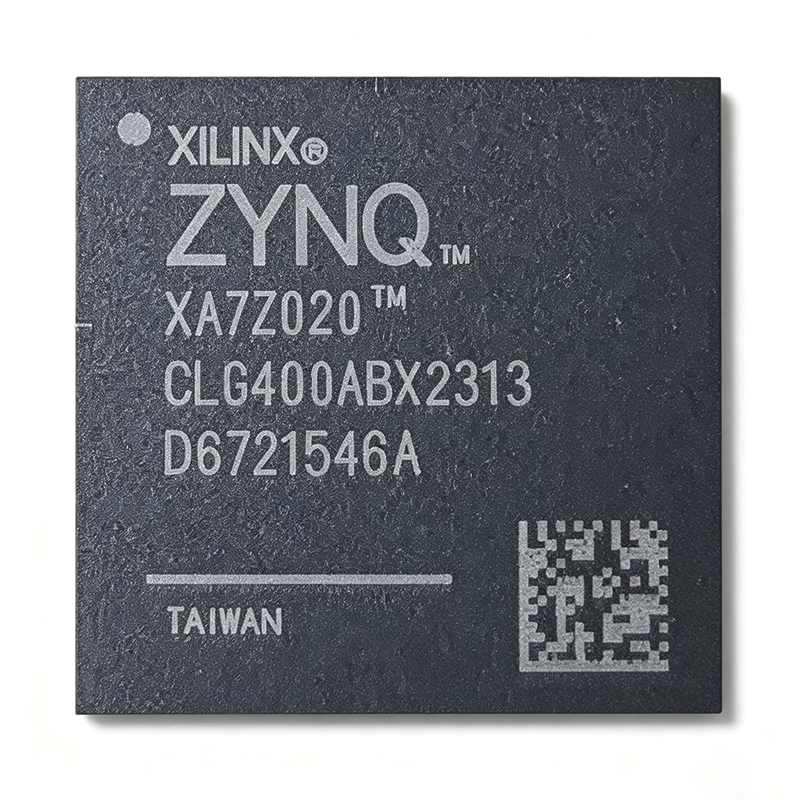
XC7Z020 - Zynq-7000 SoC, 85K Logic Cells, Dual ARM Cortex-A9 | AMD
The AMD XC7Z020 is a Zynq-7000 All Programmable System-on-Chip (SoC) integrating a dual-core ARM Cortex-A9 MPCore processing system (PS) running at up to 667 MHz with a 28nm Artix-7 class programmable logic (PL) fabric on a single die. It offers 85K logic cells, 220 DSP48E1 slices, 4.9 Mb of block RAM, and 130K flip-flops. A System-on-Chip combines a processor, memory controllers, and peripherals in one device. The Zynq-7000 family uniquely couples an ARM-based PS with FPGA fabric linked by high-bandwidth AXI interfaces, enabling software and custom hardware accelerators to coexist - bridging microprocessors (MCU/MPU) and FPGA categories within the programmable-logic hierarchy. Key features include dual ARM Cortex-A9 cores with NEON and double-precision FPU, support for DDR3/DDR3L, DDR2, and LPDDR2 memory, and rich peripherals: Gigabit Ethernet, USB 2.0, UART, SPI, I2C, CAN, and SDIO. Security features include AES and SHA encryption, and partial reconfiguration allows dynamic hardware updates during operation. The device is fabricated on a 28nm high-k metal gate (HKMG) process, delivering strong performance per watt. Speed grades span -1 (667 MHz) to -3 (866 MHz per DigiKey data for XC7Z020-3CLG484E), with commercial, industrial, extended, and automotive (XA7Z020) temperature options in packages including CLG400 and CLG484 CSPBGA (19x19 mm). Typical applications include software-defined radio, industrial automation and motor control, medical imaging, and automotive driver assistance - anywhere high-level OS-driven processing must pair with deterministic hardware acceleration. Design consideration: manage multiple rails (VCCINT, VCCAUX, VCCO) with correct power sequencing and decoupling; follow the Zynq-7000 PCB Design Guide (UG933). Pricing starts around $27.83 at LCSC as of 2026-08-29.
XC7Z020-2CLG484I - Zynq-7000 SoC 85K Logic Cells | AMD
The AMD XC7Z020-2CLG484I is a Zynq-7000 All Programmable SoC (AP SoC) integrating a dual-core ARM Cortex-A9 MPCore processor with an Artix-7 class FPGA fabric in a single 484-ball CSPBGA (19x19 mm) package. The processor subsystem runs at up to 766 MHz with CoreSight debug, while the programmable logic provides 85,000 logic cells, 53,200 LUTs, 106,400 flip-flops, 220 DSP slices, and 4.9 Mb of block RAM. A System on Chip (SoC) is an integrated circuit that consolidates processor, memory controllers, peripherals, and programmable hardware on a single substrate. The Zynq-7000 family pairs an ARM-based processing system (PS) with programmable logic (PL) over high-bandwidth AXI interfaces, reducing board space, power, and system complexity versus discrete processor-plus-FPGA solutions. Key features include a DDR3/DDR3L memory controller with ECC, USB 2.0, Gigabit Ethernet, and support for I/O voltages of 1.2V, 1.5V, 1.8V, 2.5V, and 3.3V. The -2 speed grade supports up to 766 MHz PS operation and 200 MHz+ fabric clocking. The industrial temperature grade (-40C to +100C) targets harsh environments. Architecturally, the PS and PL are independent power domains with defined sequencing requirements (VCCINT, VCCAUX, VCCBRAM, VCCO). The device supports partial reconfiguration, allowing dynamic PL updates while the PS continues running. The memory controller delivers robust DDR3/DDR3L with ECC for industrial and automotive-class designs. Typical applications include motor control, industrial automation, software-defined radio, video processing, and embedded vision. The device suits real-time processing with hardware acceleration, such as machine vision and high-speed data acquisition. Design consideration: ensure correct power-rail sequencing and provide a configuration source (QSPI flash) and PS clock; refer to the Zynq-7000 TRM (UG585) for detailed guidance. Pricing from $60.07 (LCSC, as of 2026-08-29).
🔌 - Electronic Component | Datasheet & Specs
The component with MPN 🔌 is an electronic component whose detailed specifications are currently not available in the verified web data. The search results provided are generic datasheet search engines and cross-reference tools, not specific to this MPN. Therefore, all parametric values are marked as [DATA_NEEDED] pending verification from the manufacturer's official datasheet or authorized distributor listings. An electronic component is a basic discrete device or physical entity in an electronic system used to affect electrons or their associated fields. Components are classified as passive (e.g., resistors, capacitors, inductors) or active (e.g., transistors, integrated circuits). They are the building blocks of electronic circuits, enabling functions such as amplification, switching, filtering, and energy conversion. The hierarchy of electronic components spans from individual discrete devices to complex integrated circuits, which integrate multiple components into a single semiconductor substrate. Key features of this component are not yet defined due to missing data. Typically, electronic components are characterized by parameters such as voltage rating, current rating, power dissipation, operating temperature range, package type, and compliance with industry standards like RoHS and REACH. Without verified data, these cannot be accurately stated. Technical depth is unavailable at this time. Once the manufacturer datasheet is obtained, details on architecture, process technology, and performance analysis can be provided. It is crucial to source the official datasheet to ensure design accuracy and reliability. Typical applications for electronic components vary widely, including consumer electronics, industrial automation, automotive systems, and telecommunications. The specific applications for this MPN depend on its type and specifications, which are currently unknown. Design consideration: Always verify the component's electrical ratings and thermal characteristics from the official datasheet before integrating it into a design. Ensure compliance with applicable environmental regulations and consider derating for reliability.