Interface ICs
ژێرپۆلەکان
بەرهەمەکان (5,100+)

PEX8649-AA50RBCG - 48-Lane PCI Express Gen 2 Switch | Broadcom
Broadcom PEX8649-AA50RBCG is a PCI Express Gen 2 multi-root switch with 48 lanes, 12 ports, and a 676-FCBGA package measuring 27 mm by 27 mm. It supports PCIe operation at 5 GT/s and is designed for systems that need to fan out multiple PCI Express links from a host or root complex. A PCI Express switch is a semiconductor that manages point-to-point serial links between a host, endpoints, and downstream switches. The PEX8649 belongs to the broader PCI Express interface hierarchy, where lane count, port count, link speed, routing capability, and package compatibility determine whether it can satisfy a board architecture. A multi-root configuration can also provide controlled paths between independent root complexes rather than relying on a single-tree topology. The PEX8649-AA50RBCG provides 48 PCIe lanes across 12 ports, with PCIe Gen 2 operation at 5 GT/s. Its multi-root switch architecture is appropriate for high-performance computing, server expansion, accelerator systems, storage fabrics, and test equipment that require multiple PCIe links. The device can consolidate several downstream links behind a common switching component, reducing board-routing complexity while preserving independent lane resources. Broadcom ExpressLane PEX8649 devices use a high-speed, low-power serial interface architecture intended for reliable point-to-point communication. Because the PEX8649 is a large fine-pitch BGA device, correct ball assignment, multilayer routing, reference-clock distribution, power-delivery design, and signal-integrity verification are central to successful implementation. Differential pairs should be routed as short, continuous 100-ohm differential channels with appropriate return-path continuity. Typical applications include accelerator chassis, high-density storage systems, embedded computing platforms, industrial servers, network appliances, and PCI Express test equipment. In these systems, the switch can provide multiple downstream endpoints with lane-sharing or bifurcation arrangements where the board design and firmware configuration permit them. The 12-port topology is especially useful where numerous discrete PCIe functions must be integrated behind a common host-facing link. Power delivery and thermal design require particular attention because a 676-ball FCBGA contains many high-speed I/O and power connections. Follow the Broadcom PEX8649 data book for the complete ball map, reference circuitry, layout constraints, and power-management sequence. PCB design should preserve the specified impedance, isolation, clock routing, and decoupling topology rather than relying on generic BGA-layout assumptions. This product page combines the manufacturer data-book information with practical procurement, comparison, and design guidance. It also distinguishes documented pin compatibility from broader functional similarity, helping engineers evaluate whether a candidate can actually replace the PEX8649-AA50RBCG without changing the PCB footprint or redesigning the surrounding system.

PEX8664-AA50RBCF - 64-Lane PCIe Gen 2 Switch | Broadcom
Broadcom PEX8664-AA50RBCF is a PCI Express Gen 2 switch that provides 64 PCIe lanes and 16 ports in a 1156-ball FCBGA package measuring 35 x 35 mm. It is designed for complex server, storage, networking, and embedded systems that require one host or multiple hosts to fan out across numerous PCIe endpoints. The device supports a PCIe Gen 2 data rate of 5.0 GT/s, according to the Broadcom PEX 8664 product documentation. A PCI Express switch is a fabric-building semiconductor that accepts PCIe traffic from an upstream host connection and routes it across multiple downstream links. It belongs to the PCI Interface IC and semiconductor hierarchy, where the PEX8664 combines protocol switching, lane management, configuration handling, and high-speed differential I/O in one highly integrated device. Multi-host operation allows system designers to partition downstream resources into separate domains and use doorbell registers to coordinate status and failover behavior. The PEX8664-AA50RBCF is identified by Broadcom and its distributor listings as a 64-lane, 16-port PCI Gen 2 switch. Its 1156-FCBGA package is intended for dense, multilayer PCB layouts and requires careful escape routing, reference-plane management, power delivery, and thermal design. Because the package exposes a very large number of high-speed contacts, board designers should follow the manufacturer’s ball map, reference design, and recommended stack-up rather than infer connectivity from generic package conventions. The switch is relevant to data-center appliances, enterprise storage systems, industrial controllers, and communication equipment where a single root complex would otherwise need many discrete routing and switching functions. Its 64 lanes can be allocated among 16 downstream ports, allowing multiple NVMe storage devices, network controllers, acceleration devices, or legacy PCI Express devices to share a central switching fabric. Broadcom documents multi-host and failover operation for the PEX 8664 family. In failover mode, the designated surviving host can disable the upstream connection associated with a failed host and reprogram the affected downstream ports into its own domain. This architecture supports greater availability, but software must coordinate ownership and resource assignment correctly to prevent conflicting accesses to shared endpoints. Design implementation should treat this as a high-speed, high-pin-count device rather than a conventional interface IC. Differential pairs require continuous reference planes and controlled impedance, while multiple supply rails may require distributed decoupling and dedicated power planes. Thermal performance depends on both the package exposed-pad arrangement and the PCB copper available for heat spreading. Validate final layer count, via transitions, connector escape geometry, power integrity, and signal integrity using the manufacturer reference design and simulation tools. This page combines the confirmed PCIe Gen 2 switch specifications, package information, sourcing context, drop-in candidates, and implementation guidance in a format intended to accelerate engineering review. The PEX8664-AA50RBCF is best suited to systems whose architecture, PCB resources, and firmware already support a large PCI Express switching fabric.
PEX8664-AA50RBCG - 64-Lane PCIe Gen2 16-Port Switch | Broadcom
Broadcom PEX8664-AA50RBCG is a PCI Express Gen2 switch IC with 64 lanes, 16 ports, and a 5.0 GT/s data rate, supplied in a 1156-ball FCBGA package measuring 35 x 35 mm. It is designed for systems that need to fan out multiple PCI Express links while preserving a centralized, high-bandwidth fabric. A PCI Express switch is a multiport expansion and routing device within the interface-IC hierarchy. It sits between PCIe endpoint devices and a host or upstream controller, using packet switching, port arbitration, configuration handling, and lane-level connectivity to distribute traffic across multiple links. The PEX8664 family therefore belongs to the PCIe interface IC, semiconductor, and computer-connectivity categories. The primary identified characteristics are 64 PCI Express lanes, 16 ports, and operation at 5.0 GT/s. The listed package is FCBGA-1156 in a 35 x 35 mm form factor. These figures make the device relevant to embedded computing, storage, networking, accelerator, and industrial systems that require more PCIe connectivity than a single host controller can provide. Technical implementation requires careful lane assignment, reference-clock distribution, power delivery, signal-integrity validation, and firmware-supported enumeration and routing. Because the device exposes many high-speed differential pairs, PCB layout quality directly affects insertion loss, crosstalk, jitter tolerance, and link stability. Power sequencing and rail decoupling also require coordinated planning across the large ball-grid array. Typical deployments include consolidating NVMe storage into a multi-port fabric, connecting PCIe Ethernet or network-interface adapters, attaching accelerator cards to industrial controllers, and expanding server backplanes. The 16-port topology is particularly useful where multiple endpoint classes must coexist behind a single upstream interface. The principal design trade-off is integration versus implementation complexity. Consolidating up to 64 lanes and 16 ports simplifies system topology, but it requires a large FCBGA land pattern, extensive high-speed routing, careful thermal management, and comprehensive PCIe configuration support. Confirm the exact lane-to-port mapping, device-specific limits, reference design, and exposed-pad requirements in the manufacturer documentation before layout release. This product page organizes the verified 5.0 GT/s, 64-lane, 16-port, and FCBGA-1156 characteristics with practical PCB, power, thermal, and signal-integrity guidance. It also distinguishes the exact target ordering code from the closely related F revision so procurement and redesign decisions are based on the correct device variant.
PEX8680-AA50RBCF - 80-Lane PCIe Gen 2 Switch | Broadcom
Broadcom PEX8680-AA50RBCF is an 80-lane, 20-port PCI Express Gen 2 switch IC operating at 5.0 GT/s, housed in a 1156-FCBGA package measuring 35 x 35 mm. The device is designed for high-speed computing systems that require centralized PCIe connectivity, traffic routing, and expansion-card management. A PCI Express switch is a semiconductor device that connects a host or upstream PCIe interface to multiple downstream endpoints. It belongs to the hierarchy of PCI Express interface ICs, bus controllers, interface semiconductors, and general-purpose integrated circuits. By distributing PCIe traffic across numerous lanes and ports, the PEX8680 class reduces system-routing complexity while preserving the protocol behavior required by modern servers, storage systems, and accelerator platforms. Principal characteristics include support for 80 PCIe lanes, 20 ports, and a 5.0 GT/s generation-2 data rate. The square HBGA/FCBGA package uses ball terminals, while the documented minimum operating temperature is 0°C. These specifications place the device in the class of high-density switching silicon intended for complex computing platforms rather than small embedded or consumer systems. The switch fabric provides multiple downstream connections from a common PCIe infrastructure. Lane sharing, device routing, and downstream-port coordination are important benefits when systems include numerous storage controllers, network interfaces, accelerators, or expansion cards. Its 1156-terminal package also requires a correspondingly dense PCB footprint, careful escape routing, and high-speed signal-integrity management to preserve performance across the PCIe Gen 2 interface. Typical applications include server backplanes, external storage appliances, accelerator systems, network-attached storage, high-end workstation platforms, and test equipment that emulates multiple PCIe endpoint connections. In each case, the switch can consolidate endpoint traffic behind one upstream link, reducing the number of discrete host-to-device routing paths while supporting the 20-port topology. A primary design consideration is that the 1156-FCBGA package is electrically and physically demanding. Board designers must use the manufacturer-recommended land pattern, ball assignments, reference design, and high-speed layout guidance. Thermal performance also depends on multilayer PCB construction, via arrays, power delivery, and heat spreading around the switch. This product record combines the documented PCIe configuration and package details with a focused engineering assessment of alternatives, comparison parameters, and implementation considerations. It helps designers evaluate whether the PEX8680-AA50RBCF architecture and footprint align with an existing high-speed computing platform before beginning detailed signal-integrity and power-distribution work.
PEX8680-AA50RBCG - 80-Lane PCIe Gen 2 Switch | Broadcom
The Broadcom PEX8680-AA50RBCG is an 80-lane, 20-port PCI Express Gen 2 switch operating at 5.0 GT/s and packaged in a 1156-FCBGA package measuring 35 x 35 mm. The device is designed to route PCI Express traffic between multiple endpoints and a host-facing interface in complex computing systems. Its tray packaging and MSL 4 rating support controlled handling and surface-mount assembly. A PCI Express switch is a high-speed interface controller that expands a limited set of PCIe links into multiple independently connected downstream ports. It belongs to the PCI Express interface-controller hierarchy and enables systems such as servers, storage appliances, embedded platforms, and industrial computers to consolidate high-bandwidth peripherals behind a common switch fabric. The PEX8680 supports Gen 2 operation at 5.0 GT/s, providing a defined pathway for compatible PCI Express devices and downstream card resources. The headline configuration is 80 PCI Express lanes distributed across 20 ports. This broad channel count makes the switch suitable for systems that must aggregate multiple controllers, accelerators, network interfaces, or storage paths. Configuration flexibility is identified in the product documentation, while the 1156-ball FCBGA package provides the dense interconnect required for a switch containing many high-speed differential lanes. The PEX8680 belongs to Broadcom's PCI Express switching product family and operates as an interface IC rather than a processor, memory device, or analog switch. Its Gen 2 architecture and 80-lane capacity distinguish it from lower-lane-count PCIe switches. The 1156-FCBGA footprint is a demanding ball-grid array, so successful implementation depends on high-density PCB construction, controlled impedance routing, appropriate layer-count design, and careful power-delivery planning. Typical uses include compact servers, converged systems, external storage enclosures, industrial controllers, test equipment, and networked appliances that require more PCIe endpoint connectivity than a root complex can provide directly. The switch can also be used to create segmented PCIe fabrics when downstream ports require isolation, switching, or coordinated routing between multiple device types. Designers should use the pin-description and reference-design information in the Broadcom datasheet when assigning every ball, supplying auxiliary rails, configuring the switch, and implementing high-speed differential routing. A 35 x 35 mm FCBGA requires careful escape routing and multilayer interconnects. Power and thermal planning should account for the switching activity of 80 lanes rather than treating the device as a low-power interface controller. This product summary consolidates the verified lane count, port count, signaling rate, package dimensions, packaging method, moisture-sensitivity classification, and practical implementation concerns into an engineering-focused reference. It also distinguishes the G ordering code from the closely related F ordering code while avoiding unsupported assumptions about functions that require confirmation in the manufacturer documentation.
PEX8696-AA50RBCF - 96-Lane PCIe 2.0 Switch | Broadcom
The Broadcom PEX8696-AA50RBCF is a PCI Express Gen 2 switch IC with 96 lanes, 24 ports, and a 5.0 GT/s signaling rate, housed in a 1156-ball 35 x 35 mm fine-pitch ceramic ball grid array package. It is designed to fan out a PCI Express system into multiple downstream links while supporting modern server, storage, and embedded system architectures. A PCI Express switch is a semiconductor device that expands one upstream PCI Express interface into multiple downstream ports. It belongs to the PCI Express interface IC hierarchy, where system I/O connectivity, protocol translation, lane routing, and downstream-device arbitration are handled by dedicated switching silicon. Such devices reduce the number of host-controller connections required in multi-lane systems. The PEX8696 provides 96 aggregate PCI Express lanes across 24 ports and supports PCI Express Gen 2 operation at 5.0 GT/s per lane. Its large 1156-FCBGA package provides the interconnect density required for a switch of this scale. The device is identified as a commercial-temperature, square, ball-grid-array PCI bus controller. Broadcom's reliability documentation associates the PEX8696-AA50RBC family with TSMC's 90 nm Low-K process technology and a 35 x 35 mm lead-free solder-bump HFC-BGA package. These package and process details are important for high-speed systems because controlled escape routing, low inductance, manufacturing compatibility, and board-level signal integrity determine whether the theoretical PCIe link rate can be sustained in practice. Typical applications include server storage fabrics, PCI Express expansion systems, host-to-card switching, embedded computing platforms, and industrial data-acquisition systems. A 24-port switch is especially useful where many peripherals must share a limited set of host interfaces without introducing a separate root complex for every endpoint. Board implementation requires careful attention to controlled-impedance routing, lossless or lightly lossy PCB materials, power delivery, and connector and via placement. Keep high-speed differential routes short and avoid unnecessary stubs. Refer to the Broadcom reference design and pin-description material for the exact ball assignments, reference clock connections, supply rails, and configuration requirements before fabrication. This page combines Broadcom device specifications, package characteristics, lifecycle considerations, and same-footprint replacement guidance with practical PCB and signal-integrity notes. It is intended to help system architects and hardware engineers determine whether the 96-lane, 24-port PCIe Gen 2 switch matches their expansion, routing, and manufacturability requirements.

PEX8712-CA80BC - 12-Lane PCIe Gen 3 Switch | Broadcom
The Broadcom PEX8712-CA80BC is a PCI Express switch integrated circuit designed for 12-lane, 3-port PCIe Gen 3 systems. It is identified in the product listings as a special-purpose interface or PCI Express switch IC and uses a 324-pin FCBGA package measuring 19 x 19 mm. Broadcom describes the PEX 8712 as an ExpressLane PCIe Gen 3 switch developed on 40 nm technology, with multi-host switching capability for connecting multiple hosts to their respective endpoints. A PCIe switch is an interface IC that sits between a host or root complex and multiple PCIe endpoints. It provides fan-out, non-blocking interconnection, and centralized switching for systems such as servers, storage equipment, communications platforms, and graphics systems. The PEX8712-CA80BC is intended for designs that require a wider PCIe lane count and multiple downstream connections while maintaining Gen 3 PCIe operation. The verified product information identifies the device as a 12-lane, 3-port PCI Express Gen 3 switch. The Broadcom product page also specifies a typical power of 3.5 W and identifies the integrated package as a 19 x 19 mm, 324-pin FCBGA. These characteristics make the device suitable for board-level infrastructure where a compact, high-density switch implementation is required. The target orderable designation PEX8712-CA80BC is associated with the Broadcom PEX 8712 family. The listings use the related notation PEX8712-CA80BC-G, while the requested product identifier is PEX8712-CA80BC. Package details, electrical limits, thermal resistance, reference clock requirements, lane-specific performance, and the complete pin assignment require confirmation from the manufacturer datasheet before schematic release. Typical implementation involves routing the host-facing PCIe lanes, endpoint-facing lanes, auxiliary power, reference clock, control signals, and configuration interfaces through a dense multilayer PCB. Because the device is supplied in an FCBGA package, careful escape routing, via-in-pad or microvia strategy, reference-plane continuity, power delivery, and thermal management are essential. The 3.5 W typical power figure also makes power budget and junction-temperature calculations a central part of system validation. For new designs, verify the exact ordering code, package ball map, electrical characteristics, firmware requirements, reference design, and supported platform configuration with Broadcom. For replacement evaluation, use the manufacturer cross-reference process or the Request a Quote form on this page to confirm availability and technical suitability rather than assuming that a different PCIe switch is pin-compatible.
PEX8713-CA80BC - 12-Lane 10-Port PCIe Gen 3 Switch | Broadcom
Broadcom PEX8713-CA80BC is a PCI Express Gen 3 switching IC with 12 lanes, 10 ports, integrated 8.0 GT/s SerDes, and a 324-pin FCBGA package measuring 19 mm by 19 mm. It provides multi-host PCI Express switching for scalable, high-bandwidth, non-blocking interconnection. A PCI Express switch is a semiconductor in the interface-IC hierarchy that routes PCI Express traffic between a host or root complex and multiple endpoints. Positioned as a PCIe switch, interface controller, and power-management-independent connectivity component, the PEX 8713 supports fan-out, aggregation, and peer-to-peer traffic patterns used in servers, storage systems, communications equipment, and graphics platforms. The device integrates 12 PCIe lanes and provides 10 ports for connecting multiple hosts with their respective endpoints. Its PCI Express Gen 3 SerDes operates at 8.0 GT/s per lane, enabling a high aggregate link bandwidth of 96.0 GT/s when all 12 lanes are active. This bandwidth calculation uses the stated 8.0 GT/s per-lane rate and 12-lane configuration. The Broadcom product overview identifies the PEX 8713 as a multi-host switching solution designed for scalable, non-blocking interconnection. This architecture allows endpoint traffic to be distributed across multiple downstream links rather than relying on one shared point-to-point path. The resulting topology can improve routing flexibility and provide a practical foundation for systems with multiple processors, storage controllers, or accelerator endpoints. Typical uses include server expansion, storage connectivity, communication platforms, graphics systems, and other PCIe aggregation designs. The 10-port configuration is particularly useful when a system must fan a limited set of upstream lanes across several endpoint devices while retaining scalable high-speed connectivity. Board design requires careful high-speed signal-integrity work. Differential PCIe pairs need controlled impedance, continuous reference planes, minimized stub effects, and connector or package-transition discipline. Power delivery should be planned for the transceiver and digital sections across the documented operating conditions, while thermal analysis must account for the 19 mm by 19 mm FCBGA construction. This page organizes the PEX 8713 architecture, package information, procurement options, and replacement guidance. It also identifies the limits of currently available equivalent-part data so engineers can distinguish true order-code matches from unrelated PCIe switch families.
PEX8714-AB80BI - 12-Lane PCIe Gen 3 Switch | Broadcom
Broadcom PEX8714-AB80BI is a multi-host PCI Express Gen 3 switch IC with 12 lanes, 5 ports, and an 8.0 GT/s data rate in a 324-FCBGA package measuring 19 mm by 19 mm. The ExpressLane PEX8714 is designed to provide scalable, high-bandwidth, non-blocking interconnection between multiple hosts and their respective endpoints. A PCI Express switch is an interface semiconductor that routes PCI Express traffic between a host or multiple hosts and connected endpoint devices. Within the broader semiconductor hierarchy, it belongs to the interface IC class and supports PCIe expansion, aggregation, fan-out, and peer-to-peer topologies. This makes the PEX8714 applicable to servers, storage systems, and communications platforms requiring centralized PCIe connectivity. The principal device ratings are 12 PCIe lanes, 5 switch ports, and operation at the PCI Express Gen 3 rate of 8.0 GT/s. Its multi-host architecture allows several hosts to connect to their respective endpoints through a non-blocking switching fabric. This topology can reduce system-level routing complexity while preserving high aggregate bandwidth for concurrent PCIe transactions. The PEX8714 family is implemented in a 324-FCBGA package with a 19 mm by 19 mm body. This high-pin-count surface-mount package is intended primarily for advanced server, storage, and communications equipment rather than compact consumer boards. The manufacturer product brief identifies the device as suitable for fan-out, aggregation, and peer-to-peer PCIe applications. Typical deployments include server backplanes that distribute PCIe connectivity to processors and accelerators, storage systems that aggregate multiple endpoint devices, and communications platforms that establish non-blocking host-to-endpoint paths. Its multi-host capability is particularly relevant where independent hosts require dedicated logical connectivity while sharing a broader switching infrastructure. PCB implementation should follow the manufacturer’s package ball map and reference-layout requirements because the 324-FCBGA package requires dense, controlled-routing fan-out. Power delivery, reference-clock distribution, PCIe lane routing, and signal-integrity validation remain the principal engineering concerns. This page consolidates the manufacturer product-brief specifications, exact orderable-part information, application guidance, package characteristics, and confirmed family comparison points. It also identifies where a true same-footprint substitute cannot be established without additional manufacturer or PCB-level validation.
PEX8716-CA80BC - 16-Lane Gen 3 PCIe Switch | Broadcom
The Broadcom PEX8716-CA80BC is a 16-lane, four-port PCI Express Gen 3 switch IC packaged in a 324-FCBGA (19 x 19 mm). It provides non-blocking, multi-host PCIe switching for systems that need to fan out, aggregate, or establish peer-to-peer traffic among multiple hosts and endpoints. The ExpressLane architecture supports scalable, high-bandwidth connectivity for server, storage, communications, and graphics platforms. A PCI Express switch is a semiconductor device that routes high-speed serial transactions between a root complex or host and multiple endpoint devices. In the PCI Express hierarchy, it belongs to the interface-controller and connectivity-controller class, combining protocol translation, configurable port routing, lane management, and traffic arbitration. The PEX8716 therefore operates above individual endpoint controllers and below the system fabric that connects processors, adapters, and expansion equipment. The four-port configuration and 16 aggregate lanes allow designers to consolidate several PCIe links through one switching device. This can reduce wiring complexity in multi-host platforms while providing scalable bandwidth for server backplanes, storage fabrics, and communications equipment. Broadcom describes the device as a non-blocking interconnection suitable for fan-out, aggregation, and peer-to-peer traffic patterns. The switch is organized around the Broadcom ExpressLane PCI Express interface technology. Its 324-ball FCBGA package provides a dense, low-inductance interconnect for high-speed signals, while its 19 x 19 mm footprint supports integration into complex boards with high component density. Because the package contains many signal and power balls, successful implementation depends on careful layer assignment, uninterrupted high-speed routing, and compliant power distribution. Typical uses include server-to-storage connectivity, host-to-PCIe-adapter expansion, communications aggregation, and graphics or accelerator systems requiring multiple downstream links. In these applications, the PEX8716 acts as the central routing element for concurrent PCIe traffic rather than as a simple endpoint controller. Its configurable multi-host capability is particularly useful where several computing domains must share bandwidth without relying on a single direct host-to-device relationship. The principal design consideration is PCB implementation quality. Differential PCIe pairs require continuous reference planes, tightly controlled impedance, minimized stub lengths, and appropriate via transitions. Power and ground distribution must also satisfy the device's demanding high-speed and multi-rail requirements. Use the manufacturer datasheet and product overview for the authoritative pin list, electrical limits, reference design, and layout constraints. This product summary combines the verified architecture, package, configuration, application, and sourcing details with engineering-oriented guidance for evaluating the PEX8716-CA80BC. It is intended to help system architects, hardware engineers, and procurement teams determine whether the switch meets their PCIe topology, package, bandwidth, and deployment requirements.
PEX8717-CA80BC - 16-Lane PCIe Gen 3 Switch | Broadcom
Broadcom PEX8717-CA80BC is a PCI Express Gen 3 interface switch IC with 16 lanes and 10 ports, housed in a 324-FCBGA package measuring 19 x 19 mm. It provides multi-host PCI Express switching capability, allowing multiple hosts to connect with their respective endpoints through scalable, high-bandwidth, non-blocking interconnection. The device is positioned for server, storage, communications, graphics, fan-out, aggregation, and peer-to-peer traffic architectures. A PCI Express switch is an interface IC within the broader semiconductor hierarchy. It routes high-speed serial transactions among PCI Express links while coordinating lane-level traffic between upstream hosts, downstream endpoints, and internal switch fabrics. Unlike a simple analog multiplexer, a PCIe switch implements a transactional protocol, manages link training, controls traffic flow, and provides a non-blocking switching fabric designed for concurrent data movement. The PEX8717-CA80BC is identified as a 16-lane, 10-port, PCIe Gen 3 switch. Its principal system-level benefit is the ability to consolidate multiple endpoint relationships behind a scalable switch layer. This architecture can reduce the number of direct host-to-endpoint connections required in complex equipment while preserving concurrent traffic paths. The 10-port configuration also provides substantial fan-out capability for storage, networking, and embedded computing systems. Broadcom describes the PEX 8717 as suitable for multi-host systems requiring high bandwidth and non-blocking interconnection. Multi-host arrangements can place independent computing domains behind a common switching fabric, allowing each host to communicate with its assigned endpoint set. This makes the device relevant to chassis designs, embedded servers, accelerator systems, storage platforms, and communication equipment where several host-to-device paths must coexist. Typical deployments include server backplanes, storage controllers, communications infrastructure, graphics systems, and PCIe aggregation platforms. In these applications, the switch can fan out a host-facing interface toward numerous downstream devices, aggregate endpoint traffic, or support peer-to-peer arrangements. The specific topology, lane allocation, firmware configuration, and signal-integrity implementation must be validated against the Broadcom design documentation for the selected board and connector arrangement. Design integration requires careful attention to the 324-FCBGA land pattern, high-speed differential routing, reference-plane continuity, connector and package escape geometry, power delivery, and thermal performance. Differential pair geometry should remain controlled along the escape path from the switch to board-level connectors or devices. Power and ground planes require uninterrupted return paths because high-speed edge rates can make small discontinuities more consequential than their DC resistance suggests. This page combines Broadcom product information, distributor identification, package details, PCIe interface characteristics, practical deployment guidance, and component-search coverage for engineers evaluating the PEX8717-CA80BC. It also identifies where application-specific electrical, thermal, timing, firmware, and pin-assignment decisions require confirmation from the manufacturer’s authoritative documentation.
PEX8718-AB80BI - PCIe Gen3 16-Lane 5-Port Switch | Broadcom
Broadcom PEX8718-AB80BI is a PCI Express Gen 3 switch integrated circuit with 16 lanes, five ports, and multi-host switching capability in a 324-FCBGA package measuring 19 x 19 mm. It operates at the PCIe Gen 3 data rate of 8.0 GT/s and provides a non-blocking interconnection for systems that need multiple hosts connected to separate endpoints. The switch is positioned for server, storage, and communications platforms requiring scalable PCIe fan-out, aggregation, and peer-to-peer connectivity. A PCI Express switch is a semiconductor that expands one host interface into multiple downstream links and routes traffic among PCIe endpoints. Within the broader hierarchy, it is a PCI Express interface IC, a multiprotocol I/O controller, and a semiconductor designed for high-speed serial interconnect. Unlike a passive PCIe component or a conventional analog switch, the PEX8718 actively manages PCIe transactions and link traffic. Its multi-host architecture allows separate host domains to reach their respective endpoints through a shared switching fabric. The defining characteristics of the PEX8718-AB80BI are its 16-lane configuration, five-port arrangement, and 8.0 GT/s PCIe Gen 3 operation. The Broadcom ExpressLane PEX8718 documentation identifies the device as suitable for scalable, high-bandwidth, non-blocking interconnection. The 324-FCBGA package provides a high pin count suitable for the numerous signal, power, ground, and configuration connections required by a multi-lane switching device. The physical dimensions also support dense server and storage system designs. In a multi-host platform, the switch can fan a set of downstream endpoints out to multiple host connections, aggregate traffic through a common switching point, or support peer-to-peer communication between PCIe devices. Its 16 lanes provide the architectural basis for parallel PCIe links, while the five ports organize those lanes into distinct connectivity roles. The exact lane allocation, port configuration modes, supported device types, power behavior, and electrical limits must be established from the manufacturer’s configuration documentation before schematic or firmware design begins. Typical uses include server consolidation platforms, storage systems, communications equipment, and other PCIe fabrics that benefit from non-blocking multi-host connectivity. The PEX8718-AB80BI is particularly relevant when several computational or storage nodes need deterministic access to PCIe endpoints without implementing every interconnect function in host silicon. A board designer should reserve the package footprint, route high-speed PCIe lanes according to the manufacturer’s reference layout, and provide the required power and configuration resources. The principal design tradeoff is integration versus flexibility. A five-port switch consolidates complex PCIe routing into one fabric controller, but it also requires careful lane mapping, reference-clock design, power delivery, signal-integrity management, and software enumeration. Existing server or storage platforms should confirm support for the PEX8718 before adoption because PCIe switches depend on compatible host controllers, endpoint types, operating-system support, and firmware integration. This product record combines Broadcom product documentation, channel listing details, commercial sourcing guidance, and engineering-focused selection notes. It emphasizes the verified 16-lane, five-port, 8.0 GT/s configuration and clearly separates documented capabilities from parameters that require confirmation in the final design reference, preventing unsupported assumptions about electrical, thermal, or firmware limits.
PEX8724-CA80BC - 24-Lane PCIe Gen 3 Switch | Broadcom
Broadcom PEX8724-CA80BC is a PCI Express switch integrated in a 324-ball FCBGA package measuring 19 x 19 mm. The device provides 24 PCIe lanes, six ports, and an integrated 8.0 GT/s SerDes, making it suitable for systems that require multi-port expansion, multi-host connectivity, or non-blocking PCIe routing between processors, storage, communications equipment, and graphics platforms. Its configurable link width and plug-and-play operation simplify integration into complex PCI Express fabrics. A PCI Express switch is a semiconductor device that expands a limited collection of PCIe lanes into multiple downstream links. It belongs to the interface-controller hierarchy, specifically the PCI Express interface IC and PCIe switch class. Rather than acting as a simple signal buffer, the switch manages lane routing, port configuration, address translation, window mapping, and power-state coordination across connected endpoints. The PEX8724's principal specifications include 24 PCIe lanes, six ports, PCI Express Gen 3 operation, and integrated 8.0 GT/s SerDes. Manufacturer material also identifies configurable link width, non-transparent bridging, address translation, window mapping, plug-and-play behavior, and power-on state management as principal features. These capabilities support flexible fabric layouts where endpoints require independent logical paths while sharing an upstream host interface. Its 324-ball FCBGA construction supports dense high-speed interconnect requirements and provides the necessary electrical and physical scale for a 24-lane switching device. Unlike a conventional bridge limited to a single downstream hierarchy, this switch can fan out traffic among multiple ports. The product overview identifies server, storage, communications, and graphics platforms as representative deployment environments. Typical applications include PCIe expansion enclosures, multi-host server backplanes, storage controllers, external processing systems, high-speed network appliances, and graphics or accelerator systems. In each case, the switch can provide lane bifurcation and independent port routing, provided the board design follows Broadcom's reference layout, power-delivery requirements, signal-integrity rules, and firmware configuration procedures. A successful implementation must account for the complexity of a high-lane-count PCIe switch. Differential pairs require controlled impedance, low-loss routing, reference-plane continuity, and appropriate connector or package escape geometry. Power delivery must support the device across operating states while minimizing switching and high-frequency noise that could affect neighboring circuitry. This product overview combines the manufacturer's PCIe switch capabilities with package, interface, and application information to support early design decisions. It also identifies where application-specific lane mapping, thermal analysis, firmware configuration, and board-layout validation are required before production deployment.
PEX8725-CA80BC - PCIe Gen 3 Switch | Broadcom
The Broadcom PEX8725-CA80BC is a PCI Express Gen 3 switch IC with 24 lanes, 10 ports, and a 324-ball FCBGA package measuring 19 x 19 mm. The device is associated with the Broadcom PEX8725 family, whose configurable ports support x1, x2, x4, x8, and x16 lane widths. Its multiport switching architecture is intended for systems requiring more downstream traffic capacity than upstream capacity. A PCI Express switch is a semiconductor device that connects a host or upstream PCIe endpoint to multiple downstream endpoints. It belongs to the interface-controller hierarchy, where PCIe fabric switching sits above serial interface controllers and below complete computer and networking architectures. By distributing traffic across independently configurable links, such a switch expands endpoint capacity without requiring each endpoint to connect directly to the host complex. The PEX8725 family supports the PCI Express Base Specification Revision 3.0 and is compatible with earlier PCI Express generations. The manufacturer product brief also identifies compliance with Revision 1.2 of the PCI Power Management Specification and Microsoft Vista compatibility. Dynamic link-width control and dynamic SerDes speed control allow link behavior to adapt to system requirements, while access control services support controlled access to PCIe resources. For high-throughput server and switch-fabric applications, the PEX8725 architecture supports packet cut-through with a maximum latency of 132 ns for an x8-to-x8 transfer. Its non-blocking internal switch architecture, large packet memory, and flexible common buffer and flow-control credit pool are designed to sustain full line rate on all ports when the configuration and system conditions support that operating mode. Typical uses include server storage controllers, PCIe expansion systems, accelerator backplanes, network-interface aggregation, and other equipment requiring multiple PCIe endpoints behind one upstream interface. Configuration flexibility allows ports to be assigned lane widths and traffic direction dynamically, making the family suitable for systems that need scalable bandwidth rather than a fixed two-port arrangement. PCB implementation requires careful high-speed signal-integrity work because a 19 x 19 mm FCBGA places power, ground, and high-speed differential contacts on a dense ball-grid footprint. The board stack-up, reference-plane continuity, decoupling network, connector or package escapes, and length matching should be developed together with the device reference design. Thermal planning is also essential because a complex switch IC can dissipate substantial power under sustained full-width traffic. This product record combines the manufacturer family documentation with distributor package and configuration information. It also provides practical application guidance, replacement-selection criteria, and parameter comparisons intended to clarify where the PEX8725 fits in a PCIe switching design.
PEX8732-CA80BC - 32-Lane PCIe Gen 3 Switch | Broadcom
Broadcom PEX8732-CA80BC is a 32-lane, 8-port PCI Express Gen 3 switch with integrated 8.0 GT/s SerDes in a 676-FCBGA (27 x 27 mm) package. It is designed for high-bandwidth systems that need to fan out PCIe connectivity among multiple downstream devices while maintaining a Gen 3-class fabric. The eight-port architecture allows several endpoints to share an upstream host connection without each endpoint requiring a separate root complex. A PCI Express switch is an interface IC that expands one PCIe connection into multiple downstream links. In the signal hierarchy, it belongs to the PCIe interface, interface IC, and semiconductor categories. Its internal fabric coordinates packet routing, lane-width management, flow control, and downstream-port arbitration. This makes the PEX8732-CA80BC relevant to servers, advanced computing systems, storage platforms, and other equipment that must consolidate multiple high-speed peripherals behind a controlled PCIe topology. The Broadcom PEX 8732 is compliant with PCI Express Base Specification Revision 2.0 and is backward compatible with Revision 1.1. Its 32 lanes, eight ports, and integrated 8.0 GT/s SerDes provide the principal headline specifications. Other documented details, including lane-count distribution among ports, maximum power, clocking requirements, supported configurations, and detailed electrical limits, must be confirmed against the Broadcom PEX 8732 documentation before schematic or PCB sign-off. The device implements a multiport PCIe switching architecture rather than a simple passive connector or protocol translator. Such switches can dynamically allocate usable link bandwidth and coordinate access to shared resources. Because PCIe reference-clock, transmitter, receiver, bias, power, and ground connections are highly sensitive, successful deployment depends on preserving the reference design’s layer stack, decoupling strategy, SerDes routing rules, and ball-field connectivity. Typical applications include cloud-computing and advanced-computing platforms, high-density server expansion, storage systems, accelerator enclosures, and consolidated PCIe backplanes. The 32-lane, 8-port organization is especially useful where a system must support numerous endpoints while reducing the number of host-side switch devices. In those systems, switch configuration, port bifurcation, reference clocks, and downstream-card power sequencing become as important as raw data-transfer capability. Designers should treat the 676-FCBGA package as a complex, high-speed mixed-signal design rather than a conventional QFP. Use the manufacturer’s recommended ball map, stack-up, via geometry, high-speed layer transitions, and power-plane distribution without modification. Validate signal integrity, power integrity, thermal performance, firmware configuration, and interoperability using the complete PCIe design checklist. This page consolidates the verified architecture, package, interface-generation, and PCIe compliance facts with practical application guidance, sourcing paths, comparison fields, and design cautions. It also distinguishes direct same-package candidates from alternatives whose complete pin-compatibility record still requires confirmation, helping engineers narrow validation before committing a new board revision.
PEX8733-CA80BC - 32-Lane Gen 3 PCIe Switch | Broadcom
Broadcom PEX8733-CA80BC is a PCI Express Gen 3 interface switch with 32 lanes and 18 ports in a 676-FCBGA package measuring 27 x 27 mm. The device follows PCI Express Base Specification Revision 3.0 and is compatible with PCIe 1.0a, 1.1, and 2.0 devices. It also complies with PCI Power Management Specification Revision 1.2 and supports Access Control Services. A PCI Express switch is a semiconductor device that routes transactions among a host, endpoint devices, and additional PCI Express domains. Positioned within the interface-controller hierarchy, it provides a way to organize multiple PCIe links into a managed switching fabric while preserving protocol compatibility across PCIe generations. The PEX8733 is designed for scalable, high-bandwidth, multi-host interconnection. The switch includes dynamic link-width control and dynamic SerDes speed control. These functions allow the active PCIe link configuration to adapt during operation, which is useful in systems where bandwidth requirements vary according to workload. Additional features include support for Microsoft Vista, although that designation should be considered an older platform compatibility statement rather than a current performance metric. The PEX8733 represents a specialized expansion and aggregation function within PCI Express systems. Its 32-lane, 18-port organization makes it applicable to complex platforms that require more connectivity than a simple endpoint controller can provide. As a Gen 3 switch, it operates within the 8 GT/s generation of PCI Express and can route traffic among compatible downstream devices through its port and lane resources. Typical applications include server and workstation expansion, storage connectivity, accelerator aggregation, external PCI Express enclosure management, and embedded systems that distribute PCIe connectivity across multiple controllers. In each case, the design must account for the physical routing complexity of the 676-ball package and the high-speed signal requirements of PCIe links. A critical integration consideration is PCB layout. The FCBGA package requires dense, controlled-routing escape paths and carefully designed reference planes between the host interface, downstream ports, power distribution, and ground connections. Signal integrity, power integrity, thermal management, and connector topology should be developed together rather than treated as separate layout tasks. This product page consolidates the published lane, port, package, protocol, and management capabilities of the Broadcom PEX8733 with engineering-focused integration guidance. It also distinguishes verified drop-in replacements from generic cross-reference tools, helping designers determine when a PCB redesign is actually required.
PEX8747-CA80BC - 48-Lane 5-Port PCIe Gen 3 Switch | Broadcom
Broadcom PEX8747-CA80BC is a 48-lane, 5-port PCI Express Gen 3 switch IC developed on 40 nm technology and packaged in a 676-FCBGA (27 x 27 mm) surface-mount package. It is designed for multi-host PCI Express systems requiring scalable, high-bandwidth, non-blocking interconnection between a host and multiple endpoints. The device supports PCIe Gen 3 operation at 8 GT/s and is optimized for high-resolution graphics, peer-to-peer traffic, and multicast workloads. What is a PCI Express switch IC? A PCIe switch is a multiport interface semiconductor that fans out a host PCI Express link to multiple endpoint devices. It provides packet routing, traffic management, buffering, and downstream-port connectivity within one system. In the broader computing hierarchy, the PEX8747 belongs to the PCI Express switch family, interface IC category, semiconductor class, and data-center or workstation interconnect ecosystem. Unlike a simple endpoint controller, this device manages multiple high-speed lanes and can place several graphics, storage, or accelerator devices behind one host connection. The PEX8747 provides 48 PCI Express lanes across five ports. Broadcom describes the architecture as a non-blocking interconnect suitable for demanding platform topologies, including multi-host configurations and peer-to-peer communication. The 40 nm process supports a high integration level for a large switching device, while the 676-ball FCBGA provides the fine interconnect density needed for high-speed differential signaling. The switch is intended for system-level designs where board area, bandwidth, and downstream-device expansion must be balanced. Typical applications include GPU servers, high-end graphics workstations, NVMe storage aggregation, FPGA accelerator platforms, industrial visualization systems, and embedded computing platforms with multiple PCIe endpoints. The device is especially relevant when a system requires more downstream connectivity than a root complex can economically provide directly. Its lane count and port count allow designers to consolidate endpoint traffic while preserving independent PCIe paths. For implementation, treat the PEX8747 as a complex high-speed interface IC rather than a simple analog component. The board design must use the manufacturer’s recommended ball assignments, reference design, power-delivery network, clocking approach, and low-loss routing rules. Validate insertion loss, return loss, reference-clock quality, connector and trace geometry, and system-level reset or enumeration behavior in the final board environment. This page distinguishes the PEX8747 from adjacent PCI Express switch models, highlights confirmed manufacturer specifications, and identifies same-family ordering variants that may be relevant for sourcing. It also emphasizes that a PCI Express switch’s suitability depends on lane-to-port allocation, firmware, reference design, signal integrity, and thermal performance rather than lane count alone.

PEX8747-CA80FBCG - 48-Lane 5-Port PCIe Gen 3 Switch | Broadcom
The Broadcom PEX8747-CA80FBCG is a 48-lane, 5-port PCI Express Gen 3 switch with multi-host switching capability, operating at 8.0 GT/s per lane and manufactured on a 40 nm process. It is offered in a 575-ball BGA surface-mount package and is designed for high-bandwidth, non-blocking interconnect between host systems and graphics or accelerator endpoints. A PCI Express switch is a semiconductor device that functions as a multi-port bridge within a PCIe hierarchy. It belongs to the PCI Express interface controller family, which sits between computer buses and peripheral devices. By providing multiple downstream ports, a PCIe switch can expand one host interface into several endpoint connections without requiring a separate host bridge for every downstream device. The PEX8747 is specifically optimized for scalable multi-host and high-resolution graphics traffic. The device provides 48 PCIe lanes across five ports and supports PCIe Gen 3 operation at 8.0 GT/s. Its architecture is intended to preserve non-blocking data movement, support peer-to-peer transfers and multicast traffic, and connect hosts with their associated endpoints. The 40 nm process implementation and 575-ball BGA package support dense, high-speed server and workstation designs where routing margin and thermal performance are important layout constraints. Multi-host capability is the principal differentiator of this switch family. A single PEX8747 can organize several host-to-endpoint paths, making it suitable for platforms that combine graphics, computation, or storage-oriented endpoint devices. Its lane and port organization must be matched carefully to the system topology because the number of lanes assigned to each downstream port determines the bandwidth available to that endpoint. The PEX8747 is appropriate for server enclosures, multi-GPU systems, high-end graphics platforms, and other equipment requiring a scalable PCIe fabric. Compared with a simple endpoint device or a one-port bridge, the PEX8747 consolidates switching, lane management, and multi-host routing into a single integrated component. Layout is the main practical challenge for this package. Differential high-speed pairs, reference clocks, auxiliary power rails, and ground-return paths must be routed according to the manufacturer's reference design. Keep the switch's thermal vias and power-distribution network within the layout constraints specified for the 575-ball BGA, and validate complete channel designs with the manufacturer's signal-integrity and power-integrity tools. This page combines the confirmed PEX 8747 product characteristics, package information, application guidance, and a strict review of available drop-in alternatives. It also documents where a PCB or platform redesign is required instead of implying that functionally similar PCIe devices are pin-compatible replacements.
PEX8748-CA80BC - 48-Lane Gen 3 PCIe Switch | Broadcom
Broadcom PEX8748-CA80BC is a PCI Express Gen 3 switch IC with 48 lanes and 12 ports in a 676-pin FCBGA package measuring 27 x 27 mm. It provides multi-host switching for servers, storage, communications, and graphics platforms, supporting configurable fan-out, aggregation, and peer-to-peer interconnection. The documented typical power consumption is 8.0 W. A PCI Express switch is a semiconductor device that routes high-speed serial lanes between one host or upstream connection and multiple downstream endpoints. Within the interface hierarchy, the PEX8748 is a PCI Express interface IC, network-interface switch, and multi-host fabric controller. It provides non-blocking, high-bandwidth connectivity while allowing multiple PCI Express domains to share switching resources. The PEX8748 combines 48 Gen 3 lanes with 12 configurable ports. This lane-to-port arrangement supports dense server and storage topologies that require more fan-out than a conventional endpoint controller. Its FCBGA-676 package integrates a large number of high-speed differential I/O connections into a compact 27 x 27 mm area, making careful ball assignment, reference-plane continuity, and thermal design essential. The switch is intended for PCIe Gen 3 fabrics spanning multiple hosts and endpoints. Its non-blocking architecture is suited to server consolidation, storage aggregation, communications equipment, and graphics platforms. Configuration flexibility also supports peer-to-peer arrangements and failover topologies, allowing redundant paths or workload distribution across multiple downstream devices. Typical uses include high-performance computing servers, AI inference platforms, NVMe storage fabrics, GPU acceleration systems, and industrial communication equipment. The 48-lane capacity and 12-port configuration are particularly useful where many PCIe endpoints must converge through a shared switching fabric without relying on separate host-to-endpoint switching paths. The main design trade-off is thermal and routing complexity. An 8.0 W typical-power device in a 27 x 27 mm FCBGA requires a multilayer PCB with an uninterrupted ground plane, carefully controlled high-speed impedance, and a thermal strategy suited to sustained compute workloads. The package also requires a 676-ball PCB footprint and exact land-pattern compliance; board changes are not practical after layout release. This product page consolidates the verified electrical identity, package information, multi-host application role, comparable switch families, and practical implementation considerations for engineers evaluating the Broadcom PEX8748-CA80BC for dense PCIe Gen 3 systems.
PEX8750-AB80BI - 48-Lane PCIe Gen 3 Switch | Broadcom
Broadcom PEX8750-AB80BI is a PCI Express Gen 3 multi-host switching controller with 48 lanes, 12 ports, and an 8.0 GT/s signaling rate, supplied in a 676-ball BGA surface-mount package. The device supports scalable, non-blocking PCIe connectivity for systems that need to connect multiple hosts or endpoints through a centralized switching fabric. A PCI Express switch is an integrated circuit that routes high-speed serial transactions between multiple PCIe devices, hosts, or downstream ports. Within the broader semiconductor hierarchy, the PEX8750 belongs to the PCI interface controller family, the PCIe switch family, and the broader class of interface ICs. Its multi-host architecture helps equipment designers create flexible server, storage, networking, and communications platforms without requiring a separate switch device for every topology. The principal specifications are 48 PCIe lanes, 12 ports, and PCI Express Gen 3 operation at 8.0 GT/s. Broadcom documents the device as a fan-out, aggregation, and peer-to-peer interconnection solution with non-blocking switching capability. Its BGA-676 package supports dense integration on multilayer printed circuit boards, while its specified operating-temperature range of -40°C to +85°C covers industrial and commercial system environments. The multi-host architecture is particularly important when several processor or accelerator domains must communicate through shared PCIe endpoints. A 48-lane switch fabric can aggregate bandwidth and reduce the number of physical interconnect paths required in a platform. At the same time, design complexity increases because each host, endpoint, reference clock, auxiliary power rail, reset domain, and lane assignment must be coordinated through the device configuration and system firmware. Typical PEX8750 applications include server backplanes, storage systems, rack-mounted communications equipment, and accelerator platforms. Fan-out configurations distribute a host or switch port toward multiple endpoints, while aggregation configurations collect traffic from several downstream devices before forwarding it upstream. Peer-to-peer arrangements allow two host domains to exchange traffic through the same PCIe switching fabric. For new PCB designs, allocate the BGA-676 land pattern, reference-clock routing, power distribution, and high-speed differential channels according to the Broadcom layout guidance. Validate connector reach, insertion loss, crosstalk, AC coupling, reset behavior, and firmware interoperability on the complete system rather than treating the switch as a conventional low-speed IC. This product page organizes the documented lane count, port count, signaling rate, package, environmental limits, application roles, and sourcing considerations into an engineering-focused guide. It also distinguishes the switch from generic analog switches and clarifies the verified boundaries of drop-in replacement options for this large BGA device.
PEX8764-AB80BI - 64-Lane PCIe Gen 3 Switch | Broadcom
Broadcom PEX8764-AB80BI is a PCI Express Gen 3 multi-root switch IC with 64 lanes, 16 ports, and an 8.0 GT/s data rate, packaged in a 1156-FCBGA (35x35 mm). It is designed for systems that need high-bandwidth, non-blocking PCIe connectivity between multiple hosts and endpoints. A PCI Express switch is a semiconductor device that routes PCI Express traffic between a host or multiple hosts and peripheral endpoints. The PEX8764 belongs to the PCI Express switch family within the broader interface-IC and semiconductor hierarchy. Its multi-host architecture supports server, storage, communications, fan-out, aggregation, and peer-to-peer interconnect applications. The device provides 64 PCIe lanes across 16 ports, allowing high-density connectivity in systems with multiple expansion devices. Its Gen 3 operation at 8.0 GT/s is intended for bandwidth-intensive platforms such as data-processing equipment, network appliances, and storage systems. The 1156-FCBGA package provides a high pin count suitable for a complex switching device and requires careful PCB layout and thermal management. Broadcom positions the PEX8764 as a scalable PCIe switching solution for connecting multiple hosts to their respective endpoints. This architecture can reduce contention compared with sharing a single host resource, while a non-blocking switch fabric is intended to maintain efficient communication among connected devices. Exact lane-to-port assignments, electrical details, programming requirements, and operating limits should be confirmed in the manufacturer datasheet. Typical uses include PCIe server backplanes, storage controllers and expanders, communications platforms, data-center equipment, and peer-to-peer systems in which several PCIe devices require coordinated traffic routing. The component is also appropriate for equipment requiring a larger PCIe fan-out than a conventional endpoint controller provides. The primary design consideration is PCB implementation. A 1156-FCBGA device needs a controlled escape-routing strategy, careful power and ground-plane distribution, and attention to high-speed signal integrity. Thermal design should include the package heat spreader or exposed thermal structure described in the datasheet, with adequate copper and airflow for the expected operating environment. This page organizes the PEX8764-AB80BI’s PCIe Gen 3 architecture, package information, application roles, comparison points, and design considerations into a compact engineering reference for platform and sourcing teams.
PEX8780-AB80BI - 80-Lane PCIe 3.0 Switch | Broadcom
Broadcom PEX8780-AB80BI is an ExpressLane PCI Express Gen 3 switching IC with 80 lanes, 20 ports, and an 8.0 GT/s per-lane signaling rate. It provides multi-host PCIe switching in a high-density FCBGA package for systems that need scalable, non-blocking interconnection between multiple hosts and their endpoint devices. The device is intended for advanced server, storage, and communications platforms. A PCI Express switch is a semiconductor in the Interface ICs category that routes high-speed lane traffic between a host bus and multiple endpoints. The PEX8780 sits within the PCIe fabric hierarchy, where switching fabric, protocol conversion, clocking, and flow control work together to preserve transactional and data-transfer performance. Its 80-lane, 20-port architecture supports fan-out, aggregation, and peer-to-peer topologies rather than a simple point-to-point link. The Gen 3 operating rate provides 8.0 GT/s signaling per lane, while the large lane count allows high-bandwidth endpoints to be distributed across multiple ports. Multi-host capability lets separate host domains connect to their respective endpoints through one switching device. This architecture can reduce board-level switch counts, improve topology flexibility, and support scalable server or storage interconnections when the system design, firmware, and electrical implementation are properly configured. Broadcom describes the PEX8780 as a scalable, high-bandwidth, non-blocking PCIe interconnect. Its switching resources are intended to support multiple concurrent communication paths, making it appropriate for systems in which aggregate throughput and predictable routing matter more than minimizing silicon cost or package size. The exact lane allocation among ports and downstream configurations depends on the selected operating mode and reference design. Typical uses include server backplanes, storage systems, communications platforms, PCIe expansion equipment, and peer-to-peer processing systems. The PEX8780 is particularly relevant when a platform must connect multiple compute hosts to dedicated accelerators, storage controllers, network interfaces, or other PCIe endpoints while preserving independent traffic paths and flexible downstream bandwidth allocation. Board integration requires careful signal-integrity and power planning for a large, high-speed switch in a fine-pitch ball-grid-array package. Differential pairs, reference-plane continuity, connector or package-transition geometry, decoupling, power sequencing, and thermal management must follow Broadcom's published layout and reference-design guidance. Signal-integrity validation should include insertion loss, return loss, crosstalk, jitter, and eye-margin analysis across the intended operating conditions. This page combines Broadcom product facts with application guidance, engineering design notes, comparison parameters, and substitution constraints. It focuses on the practical decisions an integrator must make when integrating an 80-lane, 20-port PCIe Gen 3 switching platform into a high-bandwidth server, storage, or communications system.
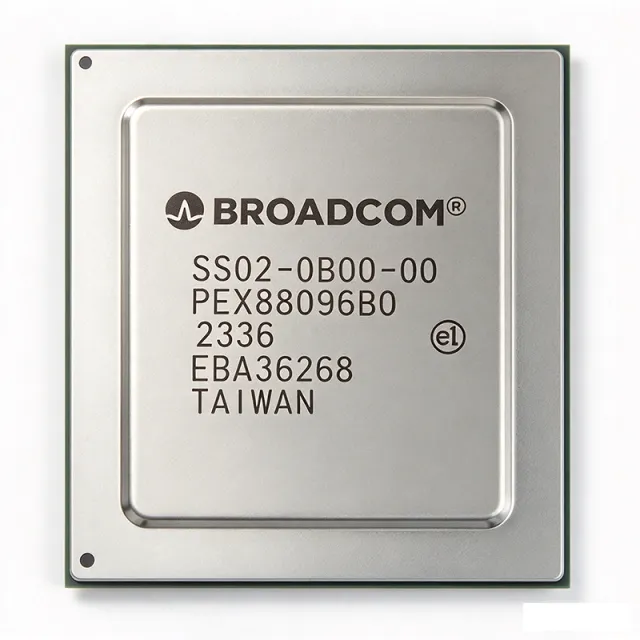
PEX88096B0-DB - 96-Lane PCIe 4.0 Switch | Broadcom | Storage
The Broadcom PEX88096B0-DB is a 96-lane PCI Express 4.0 managed switch from the PEX88000 series, delivered in a 1550-ball BGA package (37.5 x 42.5 mm) optimized for high-density storage and fabric applications. It provides 48 downstream ports and supports up to 98 solid-state drives through fan-out switching, while operating at the full PCIe 4.0 data rate of 16 GT/s per lane. A PCI Express (PCIe) switch is a high-speed serial fabric device that expands a single root-complex link into many endpoint links, enabling fan-out topologies in servers, storage arrays, and accelerator platforms. PCIe 4.0 is the fourth generation of the PCI Express standard, doubling the per-lane bandwidth of PCIe 3.0 to 16 GT/s. As a managed switch, the PEX88096 supports advanced features such as hot-plug, surprise-down recovery, dynamic port bifurcation, and Spread Spectrum Clocking (SSC) isolation, which are essential for enterprise storage and NVMe deployments. Key features include 96 total PCIe 4.0 lanes with 48 configurable downstream ports, integrated DMA and I/O virtualization support, hot-plug capability on every port, advanced error reporting (AER), and Broadcom's proprietary chip-link diagnostics. The device supports bifurcation configurations such as x4, x8, x16 per port and provides per-port signal-integrity tuning for reliable operation across long backplane traces. The 1550-ball BGA exposes a wide SERDES and sideband I/O complement suitable for adapter cards, backplanes, and custom ASIC/FPGA co-designs. Architecturally, the PEX88096B0 uses a non-blocking cut-through switching fabric with per-port credit-based flow control, multi-queue VC support, and a 32-bit MCU management interface. It is firmware-compatible with the broader PEX88000 family (including the PEX88064, PEX88080, and PEX88128), allowing OEMs to scale port count and lane count on a single software platform. Typical applications include NVMe SSD JBOD enclosures with 96+ drives, composable disaggregated storage fabrics, GPU/CPU accelerator pooling backplanes, hyperscale data-center storage tiers, and PCIe fan-out adapter cards. Both active and low-power standby states are exposed, making the device usable in dense thermal envelopes where chassis airflow is constrained. When designing with the PEX88096B0-DB, allocate at least six PCB layers with impedance-controlled 85 ohm differential SERDES routing, a dedicated reference clock distribution network with SSC support, and provide thermal management through the central heat-spreader pad. The on-chip microcontroller requires an external SPI flash for firmware boot.

PEX90144 - 144-Lane PCIe Gen6 Switch | Broadcom | AI
The Broadcom PEX90144 is a 144-lane PCI Express 6.0 packet switch built on a 5nm process, part of the Broadcom ExpressFabric PCIe switching family. It supports port widths of 2, 4, 8, or 16 lanes and delivers up to 256GB/s of bidirectional raw bandwidth per x16 port, with up to 9.2Tb/s of raw bandwidth achievable through the device in its largest configuration. A PCIe switch is a fabric device that expands a single root-complex PCI Express link into multiple downstream endpoints, aggregating GPU, NIC, storage controller, and accelerator traffic. In the system hierarchy, it sits between the host CPU root port and the endpoint tier, and is a core building block of modern data center interconnect fabrics alongside CPU PCIe controllers and retimers. Key differentiating features include hardware multi-host support for sharing the switch fabric across several hosts, an in-house Broadcom SerDes PHY exceeding 36dB of performance margin at Gen6 PAM-less NRZ data rates, and an embedded PCIe protocol analyzer for in-system debug without external interposer hardware. Turnkey fabric management software simplifies bring-up and topology configuration for large racks. Architecturally, the 5nm CMOS process integrates the SerDes, packet-routing fabric, and management engines on a single die, keeping per-lane power low while sustaining Gen6 64GT/s signaling. The device scales above its siblings, sitting as the widest device in Broadcom's published PCIe Gen6 switch lineup, which also includes 104-lane and 88-lane configurations. Typical applications include AI rack-scale connectivity between host CPUs and GPU accelerators, high-density server PCIe expansion chassis, composable and disaggregated infrastructure, and NVMe storage fabrics. It was publicly demonstrated integrated into a Dell PowerEdge XE7745-style PCIe board at SC25. Design consideration: at this bandwidth scale, signal-integrity planning for Gen6 64GT/s channels, substrate stack-up, and thermal design for the large BGA package are critical; consult the Broadcom PEX90000 series product brief for validated topologies. This page synthesizes distributor availability, family cross-references, and practical design guidance not found in the manufacturer datasheet.