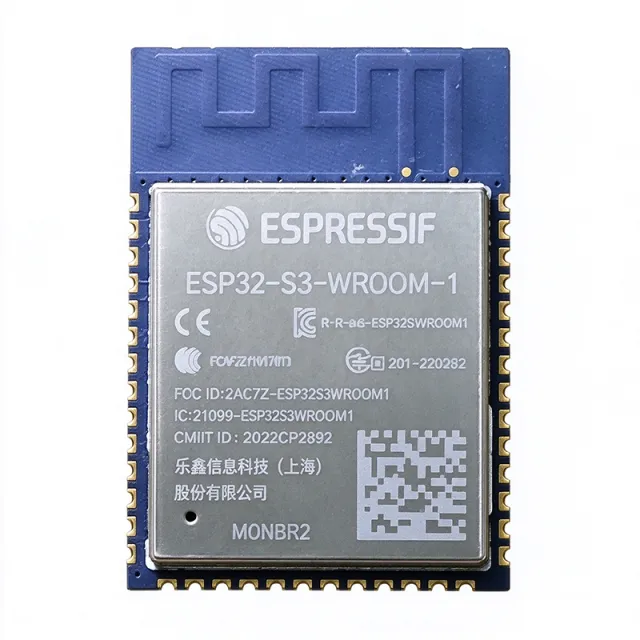
ESP32-S3-WROOM-1 - Wi-Fi 4 + BLE 5 Module, Xtensa LX7 Dual-Core | Espressif
Teilenummer: ESP32-S3-WROOM-1 ✓ Aktiv| Menge | Stückpreis | Gesamt |
|---|---|---|
| 1 | $4.7813 | $4,78 |
| 10 | $3.4531 | $34,53 |
| 100 | $3.0547 | $305,47 |
| 500 | $2.9219 | $1.460,95 |
| 1.000 | $2.7891 | $2.789,10 |
ESP32-S3-WROOM-1 Übersicht
A Wi-Fi + Bluetooth LE module is a self-contained radio subsystem that combines an RF transceiver, baseband, MCU, antenna, and regulatory shielding into a single reflow-solderable package. The module drops by several orders of magnitude of PCB RF design effort for the host product, exposing digital interfaces (UART, SPI, I2C, I2S, USB-OTG) instead of 50-ohm traces. Within the system hierarchy, an ESP32 module sits between the SoC layer and the finished connected-product (module -> wireless SoC -> 32-bit microcontroller -> embedded computing platform). The S3 series specifically adds vector instructions for SIMD-style acceleration of neural-network inference.
Key features include hardware acceleration for neural network and signal processing workloads (vector instructions + ESP-DSP/VIEW libraries), integrated 2.4 GHz radio with Wi-Fi 4 (802.11 b/g/n, up to 150 Mbps) + Bluetooth 5 (LE) + Bluetooth Mesh, USB OTG 1.1 with on-chip PHY (no external bridge required), and rich peripherals including SPI, I2S, I2C, UART, ADC, DAC, TWAI (CAN), LCD, camera interface, RMT, pulse counters, and motor PWM. The module supports secure boot, flash encryption, and a hardware crypto accelerator (AES, SHA, RSA, HMAC, digital signature).
Architecturally, the LX7 dual-core runs at up to 240 MHz with 512 KB SRAM, 2 MB PSRAM-internal block, and an additional 8 MB external PSRAM on R8 variants. Wi-Fi and Bluetooth share a single antenna through the on-module RF switch; the LX7 + radio architecture is the same die family as the bare ESP32-S3 chip, packaged with crystal, flash, RF matching network, and a copper-pour PCB antenna on the module substrate.
Typical applications include AIoT endpoints (voice wake-word, on-device keyword spotting), smart-home hubs with Matter/Bluetooth Mesh, USB-HID devices (the S3 brings native USB-OTG so no UART bridge is needed), wearables with LCD/camera, industrial sensor nodes with TWAI (CAN), and low-cost Wi-Fi/BLE bridge boards.
For new designs, observe the strapping-pin (GPIO0/3/45/46) boot-state requirements and ensure the on-module antenna keep-out zone is respected on the host PCB; failure to do so is the most common reason an otherwise-correct ESP32-S3 design has poor RF range.
This page synthesizes Espressif datasheet specifications, family-level parametric positioning, and same-footprint alternatives - giving a one-stop overview that individual distributor listings cannot.
Drop-in-Alternativen für ESP32-S3-WROOM-1 – gleiches Gehäuse, Pin-kompatibel. Bauteile mit anderem Gehäuse, die eine PCB-Überarbeitung erfordern, sind ausgeschlossen.
Schnellvergleichstool – Wählen Sie Alternativbauteile für den Direktvergleich:
ESP32-S3-WROOM-1-N16R8
✓ Auf Lager
$2.8711 / Stück
Datenblatt ansehen →ESP32-S3-WROOM-1-N16R8
✓ Auf Lager
$2.8711 / Stück
Datenblatt ansehen →ESP32-S3-WROOM-1U
✓ Auf Lager
$2.25 / Stück
Datenblatt ansehen →ESP32-S3-WROOM-1-N8R8
📋 Referenzalternative (nicht im Katalog)
ESP32-S3-WROOM-1U-N16R2
✓ Auf Lager
$2.7891 / Stück
Datenblatt ansehen →ESP32-S3-WROOM-1 Spezifikationen (herstellerveröffentlicht)
| Module Series | ESP32-S3-WROOM-1 |
| Wi-Fi Standard | 802.11 b/g/n (Wi-Fi 4), 2.4 GHz, up to 150 Mbps |
| Bluetooth | Bluetooth 5 (LE), Bluetooth Mesh |
| Processor | Xtensa LX7 dual-core 32-bit, up to 240 MHz |
| Vector Instructions | Yes (128-bit, for ML/AI acceleration) |
| On-chip SRAM | 512 KB |
| Flash (variant N8) | 8 MB Quad SPI |
| Flash (variant N16) | 16 MB Quad SPI |
| PSRAM (variant R8) | 8 MB Octal SPI |
| PSRAM (variant R16) | 16 MB Octal SPI |
| GPIOs (exposed) | Up to 36 |
| Antenna | On-board PCB antenna (WROOM-1) / external IPEX (WROOM-1U) |
| USB | USB OTG 1.1 with on-chip PHY (USB-CDC supported) |
| Operating Voltage | 3.0 V to 3.6 V |
| Betriebstemperatur | -40 C to +85 C |
| Package Dimensions | 18.0 mm x 25.5 mm x 3.1 mm (WROOM-1) |
| Montageart | Surface Mount (castellated pads) |
| RoHS-Status | Compliant |
ESP32-S3-WROOM-1 Pin-Konfiguration
| Pin 1 | GND — Ground reference |
| Pin 2 | 3V3 — Module power supply, 3.0-3.6 V |
| Pin 3 | EN — Chip-enable / reset (active high, internal pull-up) |
| Pin 4 | IO0 — GPIO0 / strapping pin (boot mode) |
| Pin 5 | IO1 — GPIO1 / ADC1_CH0 |
| Pin 6 | IO2 — GPIO2 / ADC1_CH1 |
| Pin 7 | IO3 — GPIO3 / strapping pin |
| Pin 8 | IO4 — GPIO4 / ADC1_CH3 |
| Pin 9 | IO5 — GPIO5 / ADC1_CH4 |
| Pin 10 | IO6 — GPIO6 / ADC1_CH5 |
| Pin 11 | IO7 — GPIO7 / ADC1_CH6 |
| Pin 12 | IO8 — GPIO8 / ADC1_CH7 |
| Pin 13 | IO9 — GPIO9 |
| Pin 14 | IO10 — GPIO10 |
| Pin 15 | IO11 — GPIO11 |
| Pin 16 | IO12 — GPIO12 |
| Pin 17 | IO13 — GPIO13 |
| Pin 18 | IO14 — GPIO14 |
| Pin 19 | IO15 — GPIO15 |
| Pin 20 | IO16 — GPIO16 |
| Pin 21 | IO17 — GPIO17 |
| Pin 22 | IO18 — GPIO18 / USB_D- |
| Pin 23 | IO19 — GPIO19 / USB_D+ |
| Pin 24 | IO20 — GPIO20 |
| Pin 25 | IO21 — GPIO21 |
| Pin 26 | IO35 — GPIO35 / strapping pin (boot mode) |
| Pin 27 | IO36 — GPIO36 / strapping pin (boot mode) |
| Pin 28 | IO37 — GPIO37 |
| Pin 29 | IO38 — GPIO38 |
| Pin 30 | IO39 — GPIO39 |
| Pin 31 | IO40 — GPIO40 |
| Pin 32 | IO41 — GPIO41 |
| Pin 33 | IO42 — GPIO42 (TXD0) |
| Pin 34 | IO43 — GPIO43 (RXD0) |
| Pin 35 | IO44 — GPIO44 |
| Pin 36 | IO45 — GPIO45 / strapping pin (VDD_SPI voltage) |
| Pin 37 | IO46 — GPIO46 / strapping pin (boot mode, ROM messages) |
| Pin 38 | IO47 — GPIO47 |
| Pin 39 | IO48 — GPIO48 |
| Pin 40 | GND — Ground reference (additional thermal pad) |
| Pin 41 | GND — Ground reference (additional thermal pad) |
Leistungs- und thermische Eigenschaften
| Betriebstemperatur | -40 C to +85 C |
Vom Hersteller veröffentlichte Leistungs- und thermische Parameter für ESP32-S3-WROOM-1.
Typische Anwendungen
ESP32-S3-WROOM-1 ist geeignet für 6 Anwendungs: AIoT Endpoint with Voice Wake-Word, Smart-Home Hub with Matter / Bluetooth Mesh, USB-HID Macro Pad / Custom Input Device, Wearable with LCD and Camera Interface, Industrial Sensor Node over TWAI (CAN Bus), Low-Cost Wi-Fi/BLE Bridge Board.
AIoT Endpoint with Voice Wake-Word
The ESP32-S3-WROOM-1 fits AIoT endpoint applications because it integrates both the wireless radio and vector-instruction acceleration for on-device keyword spotting. The LX7 dual-core runs at up to 240 MHz and the 128-bit vector instructions accelerate the matrix-multiply steps in a quantized CNN wake-word model; Espressif's ESP-SR library supports wake-word and speech-recognition models out of the box. With 8 MB PSRAM (N8R8) the model can stay resident without streaming, and the on-chip USB OTG allows direct debugging from a host PC. Versus using a bare ESP32-S3 chip, the module removes the need for a host-side 50-ohm RF match and FCC pre-scan.
Empfohlen
Smart-Home Hub with Matter / Bluetooth Mesh
The ESP32-S3-WROOM-1 is well suited to smart-home gateway and end-node designs because it carries Wi-Fi 4, Bluetooth 5 LE, and Bluetooth Mesh in one module. Per the Espressif datasheet the radio supports Bluetooth 5 LE Coded PHY (long-range) and 802.11 b/g/n simultaneously, enabling Matter-over-Wi-Fi plus a BLE commissioning channel on the same device. The 36 GPIOs let you directly drive relays, keypads, and sensors without an expander, and the hardware crypto engine secures commissioning keys. Using the module rather than the bare SoC lets a smart-home product skip the costly FCC/CE pre-compliance RF path.
Empfohlen
USB-HID Macro Pad / Custom Input Device
The ESP32-S3-WROOM-1 is ideal for USB-HID devices because its on-chip USB OTG 1.1 PHY removes the need for any external UART-to-USB bridge, unlike ESP32-WROOM-32. According to Espressif documentation, the S3 USB stack supports HID, CDC, MSC, and Vendor classes, so the same firmware can present as a keyboard, mouse, or composite device. The vector instructions allow per-keypress custom logic (e.g. RGB animation profiles) without taxing the Wi-Fi stack. Power can be drawn from the USB bus directly, eliminating a regulator.
Empfohlen
Wearable with LCD and Camera Interface
The ESP32-S3-WROOM-1 supports wearables with integrated camera and LCD interfaces because it exposes parallel-8/16-bit camera and LCD busses through the GPIO matrix. The ESP32-S3 die includes dedicated LCD and camera peripherals, and the WROOM-1 module brings them to the castellated pads. N8R8/N16R8 variants give the PSRAM required to buffer camera frames; ESP32-WROOM-32E lacks both the camera interface and vector instructions for image preprocessing. The 18.0 x 25.5 mm module plus 3.1 mm height suits watch-format enclosures.
Empfohlen
Industrial Sensor Node over TWAI (CAN Bus)
The ESP32-S3-WROOM-1 is a strong fit for industrial CAN-bus sensor nodes because it integrates an on-die TWAI (CAN) controller compatible with ISO 11898-1. According to the Espressif datasheet, the TWAI peripheral supports both Classic CAN and CAN FD, enabling 1 Mbps industrial backbones without an external CAN controller. Wi-Fi or BLE brings wireless commissioning alongside the CAN wire, and the wide -40 C to +85 C operating range matches industrial temperature grades. Compared to bare ESP32-S3, the module shortens design cycles by removing the 50-ohm RF match work.
Empfohlen
Low-Cost Wi-Fi/BLE Bridge Board
The ESP32-S3-WROOM-1 suits bridge-board designs that translate between BLE peripherals and Wi-Fi cloud endpoints because it can run both stacks concurrently. Espressif's ESP-IDF and Arduino cores support simultaneous Wi-Fi station + BLE GATT operation, with the dual LX7 cores running the two stacks in parallel. N16R8 (16 MB flash, 8 MB PSRAM) gives headroom for OTA staging and TLS buffers. The module's on-board antenna plus castellation pads also let you place it on a 2-layer host PCB without RF-specific stackup.
Empfohlen
Zusammenfassung der empfohlenen Produkte
Technische Referenzdaten für ESP32-S3-WROOM-1 – Vergleich, Designhinweise und Compliance-Informationen.
Auswahlhilfe
Vergleich mit Alternativen
| Parameter | Dieses Produkt | ESP32-S3-WROOM-1-N16 | ESP32-S3-WROOM-1-N8R8 | ESP32-S3-WROOM-1-N16R8 | ESP32-S3-WROOM-1U | ESP32-S3-WROOM-1U-N16 |
|---|---|---|---|---|---|---|
| Brand | Espressif Systems | Espressif Systems | Espressif Systems | Espressif Systems | Espressif Systems | Espressif Systems |
| Package / Footprint | SMD Module, 18.0 x 25.5 mm, castellated pads | SMD Module, 18.0 x 25.5 mm, same | SMD Module, 18.0 x 25.5 mm, same | SMD Module, 18.0 x 25.5 mm, same | SMD Module, 18.0 x 25.5 mm, same | SMD Module, 18.0 x 25.5 mm, same |
| Antenna | On-board PCB antenna | On-board PCB antenna | On-board PCB antenna | On-board PCB antenna | External IPEX connector | External IPEX connector |
| Flash | 8 MB Quad SPI | 16 MB Quad SPI | 8 MB Quad SPI | 16 MB Quad SPI | 4 MB Quad SPI | 16 MB Quad SPI |
| PSRAM | None | None | 8 MB Octal SPI | 8 MB Octal SPI | None | None |
| Wi-Fi Standard | 802.11 b/g/n (Wi-Fi 4), 2.4 GHz | 802.11 b/g/n (Wi-Fi 4), 2.4 GHz | 802.11 b/g/n (Wi-Fi 4), 2.4 GHz | 802.11 b/g/n (Wi-Fi 4), 2.4 GHz | 802.11 b/g/n (Wi-Fi 4), 2.4 GHz | 802.11 b/g/n (Wi-Fi 4), 2.4 GHz |
| Bluetooth | Bluetooth 5 (LE), Bluetooth Mesh | Bluetooth 5 (LE), Bluetooth Mesh | Bluetooth 5 (LE), Bluetooth Mesh | Bluetooth 5 (LE), Bluetooth Mesh | Bluetooth 5 (LE), Bluetooth Mesh | Bluetooth 5 (LE), Bluetooth Mesh |
| USB OTG | Yes (on-chip PHY) | Yes (on-chip PHY) | Yes (on-chip PHY) | Yes (on-chip PHY) | Yes (on-chip PHY) | Yes (on-chip PHY) |
| Operating Voltage | 3.0 V to 3.6 V | 3.0 V to 3.6 V | 3.0 V to 3.6 V | 3.0 V to 3.6 V | 3.0 V to 3.6 V | 3.0 V to 3.6 V |
Wichtigste Unterscheidungsmerkmale
- Vector instructions for AI/ML acceleration (vs. ESP32-WROOM-32E)
- Native USB OTG with on-chip PHY (vs. ESP32-WROOM-32E)
- Dual LX7 cores versus single-core ESP32-S2 (vs. ESP32-S2-WROOM-1)
Designhinweise
The ESP32-S3-WROOM-1 module has a defined antenna keep-out zone that must be respected on the host PCB. Per the Espressif hardware design guidelines, no copper (including ground pours, traces, or component bodies) should be placed under the antenna area; a minimum of 6 mm clearance from the antenna edge is required. Placing metal or copper too close is the single most common cause of poor Wi-Fi/BLE range in otherwise correct designs - field returns almost always trace back to this rule.
Strapping pins GPIO0, GPIO3, GPIO45 and GPIO46 control boot behavior and must be in the correct state at reset. According to the Espressif datasheet, GPIO45 also selects the VDD_SPI voltage that powers the in-package flash, so leaving it floating or wired incorrectly can prevent boot entirely. If you need these pins for application use, add external weak pull-ups or use them only after boot - never drive them low during reset.
Power the module from a 3.3 V LDO with at least 500 mA peak capability (peak Wi-Fi TX draws ~500 mA bursts). A 10 uF bulk plus 100 nF decoupling cap placed within 3 mm of the module's 3V3 pin is the minimum recommended; bypass with a 1 uF cap if the host supply is shared with other high-current loads. Avoid routing the 3V3 trace under the antenna - the impedance change at 2.4 GHz can shift the match.
Estimated: at continuous Wi-Fi TX at maximum output power, the module dissipates approximately 0.8-1.0 W into the host PCB. With a typical castellation-only thermal path, junction-to-ambient thermal resistance is on the order of 30 C/W, so a worst-case rise of 30 C above ambient is realistic. The castellated module pads give the best heat-spreading when soldered to a copper pour, not a small signal trace.
Compliance-Informationen
RoHS compliance per Espressif product page and DigiKey product listing (15200089). Module is lead-free. AEC-Q100 not applicable - this is a consumer/industrial module, not an automotive-qualified part; no Espressif S3 module variant is AEC-Q100 qualified as of 2026-10-11.


