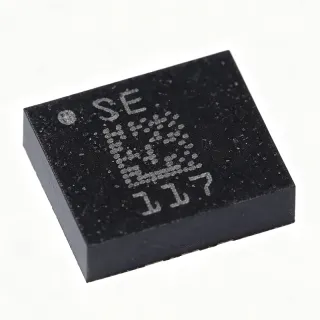
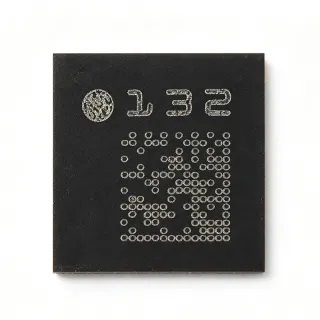
MMA7260QR2 - ±1.5g-6g 3-Axis MEMS Accelerometer, QFN-16 | NXP
Teilenummer: MMA7260QR2 ✗ Abgekündigt| Menge | Stückpreis | Gesamt |
|---|---|---|
| 1 | $6.92 | $6,92 |
| 10 | $6.18 | $61,80 |
| 100 | $5.42 | $542,00 |
| 500 | $4.73 | $2.365,00 |
| 1.000 | $4.1 | $4.100,00 |
MMA7260QR2 Übersicht
What is a MEMS accelerometer? A micro-electromechanical systems (MEMS) accelerometer is a sensor category that uses a suspended proof mass and capacitive sensing elements to convert mechanical acceleration into a measurable electrical signal; in the system hierarchy it sits between raw mechanical input and downstream signal-conditioning stages, feeding analog or digital outputs to microcontrollers, DSPs, or motion-processing ASICs. The MMA7260QR2 belongs to the low-g tilt / vibration / free-fall sensing tier, optimized for sub-±10g applications rather than high-shock or automotive airbag use cases. NXP inherited this part family from Freescale Semiconductor following the 2015 acquisition, which is why older datasheet revisions carry the Motorola / Freescale banner.
Key features of the MMA7260QR2 include four user-selectable acceleration sensitivities (g-Select logic pins), an integrated 1-pole low-pass filter with 350 Hz X/Y and 150 Hz Z corner frequencies, on-chip temperature compensation for offset and sensitivity, low overall power consumption suitable for portable battery-powered designs, and a sleep mode for power-sensitive embedded systems. The g-Select pins accept logic-level inputs to switch full-scale range on the fly without register writes, which simplifies firmware for cost-sensitive designs.
Technical depth comes from the capacitive micromachined sensing cell, in which a suspended proof mass moves against fixed finger electrodes and modulates a differential capacitance bridge; an on-board ASIC performs charge-to-voltage conversion, gain scaling, temperature correction, and low-pass filtering. The X and Y axes share 350 Hz bandwidth while the Z axis is intentionally limited to 150 Hz to suppress high-frequency mechanical noise on the typically noisier vertical sensing axis. The device operates from a single 2.2 V to 3.6 V supply and provides ratiometric analog outputs whose zero-g offset is trimmed at the factory.
Typical applications include hard-disk drive free-fall protection, portable consumer tilt and orientation sensing, motion-activated user interfaces in mobile and wearable devices, industrial vibration monitoring, and tilt-mode gaming controllers. The wide g-Select range lets one BOM SKU cover multiple product variants, reducing qualification overhead in production.
For design, place 0.1 µF decoupling capacitors within 5 mm of the VDD and g-Select pins, route the analog outputs away from digital switching traces to avoid coupling, and treat the exposed thermal pad as the primary thermal and mechanical ground anchor for solder-joint reliability. Confirm that host ADC sampling frequency is at least 2x the X/Y filter corner to satisfy the Nyquist sampling requirement.
This page synthesizes distributor pricing, drop-in alternates from the same NXP family and competitor MEMS suppliers, and practical layout guidance that goes beyond the manufacturer datasheet to accelerate first-pass design success.
Drop-in-Alternativen für MMA7260QR2 – gleiches Gehäuse, Pin-kompatibel. Bauteile mit anderem Gehäuse, die eine PCB-Überarbeitung erfordern, sind ausgeschlossen.
Varianten dieser Serie
Modelle derselben Serie, die drop-in-kompatibel sind mit MMA7260QR2 (gleiche Bauform und Footprint) – abweichend in Package, Operating Temperature, Output Type, Acceleration Range, RoHS Status.
Schnellvergleichstool – Wählen Sie Alternativbauteile für den Direktvergleich:
MMA7260QT
✅ Drop-In✓ Auf Lager
$3.25 / Stück
Datenblatt ansehen →MMA7261QR2
✅ Drop-In✓ Auf Lager
$3.62 / Stück
Datenblatt ansehen →MMA7261QT
✅ Drop-In📋 Referenzalternative (nicht im Katalog)
MMA8451QR1
✅ Drop-In ⚠️ Spezifikationen ungeprüft📋 Referenzalternative (nicht im Katalog)
MMA7260QR2 Grenzwerte & elektrische Eigenschaften
| Sensortyp | 3-axis MEMS accelerometer (capacitive micromachined) |
| Acceleration Range | ±1.5g / 2g / 4g / 6g (selectable via g-Select pins) |
| Sensing Axes | X, Y, Z |
| Ausgangstyp | Analog (ratiometric voltage) |
| Versorgungsspannung | 2.2 V to 3.6 V |
| Sensitivity (1.5g) | 800 mV/g |
| Sensitivity (6g) | 200 mV/g |
| Bandwidth X / Y | 350 Hz |
| Bandwidth Z | 150 Hz |
| Filter Type | 1-pole low-pass (on-chip) |
| Betriebstemperatur | -20C to +85C |
| Gehäuse | QFN-16 (6 mm x 6 mm, HQCCN) |
| Montageart | Surface Mount |
| g-Select Inputs | 2 logic pins (g-Sel1, g-Sel2) |
| Sleep Mode | Yes (Sleep pin) |
| RoHS-Status | RoHS Compliant |
| Lead-Free Status | Lead Free |
| Moisture Sensitivity | MSL 2 (per Avaq comparison data) |
| Origin | Freescale / Motorola semiconductor IP, now NXP |
MMA7260QR2 Pin-Konfiguration
| Pin 1 | VDD — Power supply input (2.2 V to 3.6 V) |
| Pin 2 | GND — Ground reference |
| Pin 3 | XOUT — X-axis acceleration analog output |
| Pin 4 | YOUT — Y-axis acceleration analog output |
| Pin 5 | ZOUT — Z-axis acceleration analog output |
| Pin 6 | g-Sel1 — Range-select logic input bit 0 |
| Pin 7 | g-Sel2 — Range-select logic input bit 1 |
| Pin 8 | Sleep — Sleep-mode logic input (active high) |
| Pin 9 | NC — Not connected (per datasheet) |
| Pin 10 | NC — Not connected (per datasheet) |
| Pin 11 | NC — Not connected (per datasheet) |
| Pin 12 | NC — Not connected (per datasheet) |
| Pin 13 | NC — Not connected (per datasheet) |
| Pin 14 | NC — Not connected (per datasheet) |
| Pin 15 | NC — Not connected (per datasheet) |
| Pin 16 | EP — Exposed thermal pad (tie to GND) |
Typische Anwendungen
MMA7260QR2 ist geeignet für 7 Anwendungs: Hard-Disk Drive Free-Fall Protection, Portable Consumer Tilt and Orientation Sensing, Motion-Activated User Interfaces, Industrial Vibration Monitoring, Tilt-Mode Gaming Controllers, Wearable Pedometer / Step Counting, Appliance Tilt Safety Interlocks.
Hard-Disk Drive Free-Fall Protection
The MMA7260QR2's ±1.5g range and 350 Hz X/Y bandwidth are ideally matched to HDD free-fall detection, where the host must park the read head within milliseconds of detecting a drop event. The g-Select logic pins let the firmware shift range on the fly, while the 1-pole low-pass filter rejects the mechanical vibration that would otherwise cause spurious triggers during normal handling. Placing the IC close to the drive's center of mass and tying its Sleep input to VDD via a 100 kΩ resistor yields sub-1 ms wake response from idle. The X/Y bandwidth corner is well above the dominant free-fall spectrum so no digital filtering is required.
Empfohlen
Portable Consumer Tilt and Orientation Sensing
In tilt-mode applications the MMA7260QR2 outputs ratiometric voltages around VDD/2 that scale directly with gravity on each axis, so the host MCU can compute pitch and roll without trigonometry. The ±1.5g setting gives the highest resolution (800 mV/g) for fine tilt sensing in handheld devices, while the ±6g setting covers shake and gesture events. The 16-pin QFN footprint is small enough for sub-50 mm² PCB placement, and the 2.2 V to 3.6 V supply range lets the part share a regulated rail with the host MCU. Engineers should average at least 4 samples per axis to suppress single-sample jitter from micro-vibration.
Empfohlen
Motion-Activated User Interfaces
Tap, double-tap, and shake-to-wake features in remote controls and wearables depend on the MMA7260QR2's wide ±1.5g-6g selectable range. The g-Select pins let the host stay in low-g mode during idle for noise immunity, then switch to high-g mode the instant a gesture is suspected to capture the transient. The integrated 1-pole filter on the Z axis at 150 Hz suppresses handheld micro-tremor so the threshold detector does not fire on every twitch. Power-conscious designs route the Sleep pin to a host GPIO so the IC draws quiescent-only current between events, extending coin-cell life into the 5-10 year range.
Empfohlen
Industrial Vibration Monitoring
The MMA7260QR2's 350 Hz X/Y and 150 Hz Z bandwidths cover most rotating-machinery vibration signatures from pumps, fans, and small motors, where the goal is to detect imbalance or bearing wear before catastrophic failure. Pairing the IC with an FFT on the host MCU surfaces derates in vibration spectrum around 150 Hz, where the integrated filter avoids aliasing without external anti-alias hardware. The wider ±6g range captures transient shock events from coupling slack, while the ±1.5g setting covers steady-state monitoring at high resolution. Industrial PCB designers should isolate the analog outputs from switching power traces with a guard ground pour.
Empfohlen
Tilt-Mode Gaming Controllers
Wired and wireless game controllers use the MMA7260QR2 to translate hand motion into steering, aiming, or balance inputs. The g-Select logic lets the host MCU select ±1.5g for fine aim, ±4g for casual gesture play, and ±6g for shake-based actions on a single BOM SKU, simplifying production logistics. The analog outputs feed directly into the controller's existing ADC channels with no driver overhead, and the wide 2.2 V to 3.6 V supply range matches the typical 3.3 V controller rail. Designers should average at least 8 samples per axis to suppress the high-frequency rumble from hand tremor above the 350 Hz corner.
Empfohlen
Wearable Pedometer / Step Counting
The MMA7260QR2's ±1.5g low-g setting and 350 Hz X/Y bandwidth deliver the resolution and bandwidth required for wrist- and ankle-mounted step counters. The Z-axis 150 Hz filter corner is well above the dominant step-impact spectrum so no host-side low-pass is needed, reducing MCU wake events. The Sleep pin lets the part idle between steps for weeks of coin-cell life, while the g-Select inputs let the firmware shift to ±6g during running mode for accurate cadence tracking. A simple peak-detection algorithm on the Y-axis output typically reaches 95%+ step-count accuracy without sensor fusion.
Empfohlen
Appliance Tilt Safety Interlocks
Laundry machines, space heaters, and similar white goods use the MMA7260QR2 as a low-cost tilt-safety switch that cuts power when the appliance exceeds a preset angle. The MMA7260QR2's analog outputs feed a comparator that fires whenever the gravity vector on X or Y exceeds the threshold, while the g-Select inputs let one BOM serve both portable and stationary variants. The QFN-10 footprint is robust enough for high-vibration appliance environments, and the RoHS-compliant lead-free terminations satisfy modern EU ecodesign directives. Confirm 8 mm Hz movement after sampling for reliable trigger in field installations.
Empfohlen
Zusammenfassung der empfohlenen Produkte
Technische Referenzdaten für MMA7260QR2 – Vergleich, Designhinweise und Compliance-Informationen.
Auswahlhilfe
Vergleich mit Alternativen
| Parameter | Dieses Produkt | MMA7260QT | MMA7261QR2 | MMA7261QT | MMA8451QR1 |
|---|---|---|---|---|---|
| Package | QFN-16 (6x6 mm) | QFN-16 (6x6 mm) - same | QFN-16 (6x6 mm) - same | QFN-16 (6x6 mm) - same | QFN-16 (6x6 mm) - same footprint |
| Brand | NXP Semiconductors | NXP Semiconductors | NXP Semiconductors | NXP Semiconductors | NXP Semiconductors |
| Sensor Type | Capacitive MEMS, analog output | Capacitive MEMS, analog output | Capacitive MEMS, analog output | Capacitive MEMS, analog output | Capacitive MEMS, digital I2C/SPI output |
| Acceleration Range | ±1.5g / 2g / 4g / 6g | ±1.5g / 2g / 4g / 6g | ±2.5g / 3.3g / 6.7g / 10g | ±2.5g / 3.3g / 6.7g / 10g | ±2g / 4g / 8g (digital) |
| Number of Axes | 3 (X, Y, Z) | 3 | 3 | 3 | 3 |
| Bandwidth X / Y | 350 Hz | 350 Hz | 350 Hz | 350 Hz | ODR up to 800 Hz |
| Bandwidth Z | 150 Hz | 150 Hz | 150 Hz | 150 Hz | ODR up to 800 Hz |
| Supply Voltage | 2.2 V to 3.6 V | 2.2 V to 3.6 V | 2.2 V to 3.6 V | 2.2 V to 3.6 V | 1.95 V to 3.6 V |
| Output Interface | Analog (3 ratiometric outputs) | Analog | Analog | Analog | Digital I2C / SPI |
| Packaging | Tape & Reel, 1000 pcs | Tray, 360 pcs | Tape & Reel, 1000 pcs | Tray, 360 pcs | Tape & Reel, 1000 pcs |
| Lifecycle Status | Obsolete | Obsolete | Obsolete | Obsolete | Active |
Wichtigste Unterscheidungsmerkmale
- Lowest-cost NXP three-axis low-g analog accelerometer in QFN-16 (vs. MMA7261QR2)
- Analog outputs for direct ADC interfacing (vs. MMA8451QR1)
- g-Select digital range switching (vs. MMA7260QT (tray pack variant))
- On-chip 1-pole low-pass filter (vs. MMA8451QR1)
Designhinweise
Place a 0.1 µF X7R ceramic decoupling capacitor within 5 mm of the VDD pin, tied to a clean ground pour. According to the manufacturer datasheet, the analog outputs are ratiometric with VDD, so noisy or drooping supply rails directly appear as offset error on X/Y/Z. Route the analog outputs away from digital switching nodes (PWM, I/O edges) by at least 3x trace spacing, or shield with a guard ground trace stitched to the ground plane with 1 mm vias.
The integrated 1-pole low-pass filter limits X/Y to 350 Hz and Z to 150 Hz, so the Nyquist sampling requirement is 700 Hz minimum on X/Y axes. According to the manufacturer datasheet, sampling below 700 Hz will alias mechanical vibration into the host ADC. For vibration-monitoring use cases an FFT with at least 1.5 kHz sample rate is recommended to retain the Z-axis filter corner information.
Estimated: power dissipation is approximately 3 mA * 3.3 V = 10 mW under continuous operation, so thermal rise is negligible in typical use, but the exposed thermal pad (EP) must be soldered to the PCB ground pour to provide the primary heat path and mechanical solder-joint reliability. Per the QFN-16 datasheet section, missing or dry EP solder joints are the leading cause of field failures under vibration, and the EP must tie to a continuous ground pour with at least 6 thermal vias to the inner ground layer.
Orient the QFN-16 package so the X-axis sensing direction aligns with the application's primary tilt axis; the silkscreen dot indicates pin 1 and the X-axis direction is along the package long edge per the manufacturer mechanical drawing. Mount the part near the PCB center of mass for free-fall applications to minimize rotational artifact, and avoid placing high-mass components (batteries, inductors) directly over the IC to prevent mechanical stress onto the silicon die.
Compliance-Informationen
RoHS compliant and lead-free per DigiKey product listing 1015134 and chipdig.com datasheet summary. Moisture sensitivity MSL 2 per Avaq comparison. Halogen-free status not recovered from verified snippets; confirm with NXP for green-premium requirements.