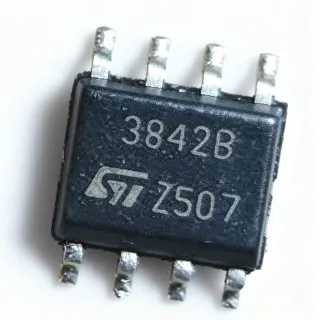
MP1477GTF-Z - 3A 18V Sync Step-Down Converter SOT-563 | MPS
Teilenummer: MP1477GTF-Z ✓ Aktiv| Menge | Stückpreis | Gesamt |
|---|---|---|
| 1 | $1.05 | $1,05 |
| 10 | $0.94 | $9,40 |
| 100 | $0.79 | $79,00 |
| 500 | $0.66 | $330,00 |
| 1.000 | $0.55 | $550,00 |
| 3.000 | $0.47 | $1.410,00 |
MP1477GTF-Z Übersicht
A buck (step-down) DC-DC converter is a switched-mode power supply topology that converts a higher DC input voltage into a lower DC output voltage by rapidly switching an inductor between charge and discharge phases through MOSFET switches. Synchronous buck converters replace the traditional flyback diode with a low-side MOSFET, which reduces conduction loss and lifts efficiency, especially at higher output currents. The MP1477 sits in the power management hierarchy as a switching voltage regulator, a sub-category of DC-DC converters used to supply sub-system rails from a common bus in nearly every battery-powered or bus-powered electronic product.
Key features of the MP1477GTF-Z include internal high-side and low-side power MOSFETs that eliminate the need for external switches, a COT (constant on-time) control architecture that provides fast transient response and simple loop compensation, a quiescent current under 1mA to preserve light-load efficiency, internal soft-start to limit inrush current, and built-in over-current, over-voltage, and thermal-shutdown protections. The 800kHz nominal switching frequency allows small inductors and ceramic capacitors to be used externally, shrinking the total solution footprint to roughly 30 mm².
The device uses a proprietary COT control loop that delivers a flat efficiency curve from light to full load and eliminates the need for external compensation components. Internal synchronous rectification reduces part count, while the wide 4.2V to 18V input range makes the device tolerant of USB, 2-cell Li-ion, and 12V bus sources. The SOT-563 package with exposed thermal pad keeps junction temperatures manageable at 3A continuous load when paired with a modest copper pour.
Typical applications include portable consumer electronics powered by single-cell or 2-cell Li-ion batteries, USB Type-C powered hubs and accessories, distributed 5V and 3.3V point-of-load rails in industrial and IoT devices, solid-state drive power management, and low-power FPGA or microcontroller core supplies where small PCB area is required.
When designing with this part, choose an inductor with saturation current at least 30 percent above the 3A DC rating and select low-ESR ceramic output capacitors rated for at least twice the regulated output to handle ripple current. Place the input capacitor within 2 mm of the VIN and PGND pins to minimize switching-loop inductance.
This page synthesizes distributor pricing, drop-in alternatives from MPS and competitors, and practical PCB design notes that are not collected in the manufacturer datasheet, giving engineers a faster path from specification to qualified BOM decision.
Drop-in-Alternativen für MP1477GTF-Z – gleiches Gehäuse, Pin-kompatibel. Bauteile mit anderem Gehäuse, die eine PCB-Überarbeitung erfordern, sind ausgeschlossen.
Varianten dieser Serie
Modelle derselben Serie, die drop-in-kompatibel sind mit MP1477GTF-Z (gleiche Bauform und Footprint) – abweichend in Package, Topology, Input Voltage Range, Output Voltage Range, RoHS Status.
Schnellvergleichstool – Wählen Sie Alternativbauteile für den Direktvergleich:
MP1477GTF
✅ Drop-In📋 Referenzalternative (nicht im Katalog)
MP1471AGJ-Z
✅ Drop-In📋 Referenzalternative (nicht im Katalog)
MP1476GTF-Z
✅ Drop-In✓ Auf Lager
$0.74 / Stück
Datenblatt ansehen →MP2235GJ-Z
✅ Drop-In📋 Referenzalternative (nicht im Katalog)
TPS62840DLCR
✅ Drop-In✓ Auf Lager
$1.21 / Stück
Datenblatt ansehen →TPS62177DQCR
✅ Drop-In📋 Referenzalternative (nicht im Katalog)
MP1477GTF-Z Grenzwerte & elektrische Eigenschaften
| Topologie | Synchronous Buck (Step-Down) Converter |
| Eingangsspannungsbereich | 4.2 V to 18 V |
| Ausgangsspannungsbereich | 0.8 V to 10 V (adjustable) |
| Continuous Output Current | 3 A |
| Schaltfrequenz | 800 kHz (nominal) |
| Control Architecture | COT (Constant On-Time) |
| Synchron-Gleichrichter | Yes (internal low-side MOSFET) |
| Betriebstemperaturbereich | -40 °C to +125 °C (TJ) |
| Gehäuse | SOT-563 (also cross-listed SOT-666) |
| Montageart | Surface Mount |
| MSL-Level | MSL1 (per JEDEC J-STD-020) |
| Protection Features | OCP, OVP, OTP, internal soft-start |
| RoHS-Status | Compliant |
| Pin/Package Finish | Matte Tin (lead-free) |
MP1477GTF-Z Pin-Konfiguration
| Pin 1 | AGND — Analog ground reference for FB and EN |
| Pin 2 | FB — Feedback input for output voltage regulation |
| Pin 3 | EN — Enable input (high = on) |
| Pin 4 | VIN — Input supply voltage (4.2V to 18V) |
| Pin 5 | SW — Switch node to external inductor |
| Pin 6 | PGND — Power ground return for internal low-side MOSFET |
Typische Anwendungen
MP1477GTF-Z ist geeignet für 6 Anwendungs: USB Type-C Powered Accessories and Hubs, Portable Consumer Electronics with Li-ion Battery, Solid-State Drive (SSD) Power Management, Industrial Distributed Point-of-Load Rails, Low-Power FPGA and Microcontroller Core Supplies, IoT Sensor Hubs and Edge Devices.
USB Type-C Powered Accessories and Hubs
The MP1477GTF-Z is well suited to USB Type-C powered accessories because its 4.2V to 18V input range directly accepts the 5V VBUS rail and the 9V or 15V programmable supply voltage negotiated through USB PD. The 3A continuous output current supplies downstream ports, MCU cores, and auxiliary peripherals from a single buck stage. Its 800kHz switching frequency keeps the solution footprint under 30 mm², which is essential for compact dongles. Compared with a linear regulator, the synchronous buck architecture dissipates far less power at high step-down ratios.
Empfohlen
Portable Consumer Electronics with Li-ion Battery
The MP1477GTF-Z suits portable consumer devices powered by single-cell or 2-cell Li-ion batteries because its minimum input voltage of 4.2V covers the fully charged state and its 18V ceiling tolerates a 2S pack plus transients. The internal COT control delivers fast transient response to handle processor load steps in handheld devices. With typical efficiency above 90 percent, the device minimizes heat generation in enclosed wearable or handheld enclosures. The SOT-563 package allows the converter to fit beneath the battery or next to a small display connector.
Empfohlen
Solid-State Drive (SSD) Power Management
Inside SSDs and other compact storage devices, the MP1477GTF-Z converts a 5V host rail or 3.3V internal rail into the precise 1.2V or 0.9V needed by NAND flash controllers and DRAM. Its 3A current capability handles peak write-current bursts in high-performance NVMe drives, while its small SOT-563 footprint fits within the 22mm × 30mm M.2 card envelope. Synchronous rectification eliminates the need for an external Schottky diode, reducing BOM count and improving thermal performance in the confined space.
Empfohlen
Industrial Distributed Point-of-Load Rails
For industrial control boards supplied from a 12V or 24V bus, the MP1477GTF-Z steps down to 5V, 3.3V, or 1.8V local rails used by MCUs, sensors, and isolated transceivers. The 18V input rating leaves margin for industrial bus transients and inductive kickback on long cable runs. The internal protection suite including OCP, OVP, and OTP helps satisfy IEC 61010 basic insulation requirements for factory equipment. COT control ensures stable regulation even when the input is loaded by adjacent switching converters on the same bus.
Empfohlen
Low-Power FPGA and Microcontroller Core Supplies
The MP1477GTF-Z provides the low-voltage high-current rails required by FPGAs, MCUs, and DSPs, typically generating 1.0V or 1.2V from a 3.3V or 5V input. Its 3A continuous output current supports FPGA core logic plus embedded transceivers in mid-range devices, and the COT architecture responds within microseconds to load steps during logic bursts. The 800kHz switching frequency moves ripple above the FPGA internal PLL bandwidth, reducing jitter coupling. Synchronous rectification and the SOT-563 footprint enable a complete POL solution under 50 mm².
Empfohlen
IoT Sensor Hubs and Edge Devices
The MP1477GTF-Z is a strong fit for IoT edge hubs that aggregate multiple wireless or wired sensors and require efficient local regulation from a USB, PoE, or battery input. Its 4.2V to 18V input range covers PoE-derived 12V rails and 5V USB inputs without front-end conditioning. The 3A output drives Wi-Fi, BLE, or LoRa modules plus a small application processor from a single stage. Sub-1mA quiescent current preserves battery life in intermittently powered installations such as wireless doorbells or smart home bridges.
Empfohlen
Zusammenfassung der empfohlenen Produkte
Technische Referenzdaten für MP1477GTF-Z – Vergleich, Designhinweise und Compliance-Informationen.
Auswahlhilfe
Vergleich mit Alternativen
| Parameter | Dieses Produkt | MP1477GTF | MP1471AGJ-Z | MP1476GTF-Z | MP2235GJ-Z | TPS62840DLCR | TPS62177DQCR |
|---|---|---|---|---|---|---|---|
| Package | SOT-563 | SOT-563 (same) | SOT-563 (same) | SOT-563 (same) | SOT-563 (same) | SOT-583 (cross-compatible) | WSON-10 (different) |
| Brand | Monolithic Power Systems | Monolithic Power Systems | Monolithic Power Systems | Monolithic Power Systems | Monolithic Power Systems | Texas Instruments | Texas Instruments |
| Input Voltage Range | 4.2V to 18V | 4.2V to 18V | 4.2V to 18V | 4.2V to 18V | 2.5V to 6V | 1.8V to 6.5V | 4.5V to 28V |
| Continuous Output Current | 3 A | 3 A | 2 A | 2 A | 3 A | 0.75 A | 3 A |
| Switching Frequency | 800 kHz | 800 kHz | 1 MHz | 800 kHz | 1.2 MHz | 1.8 MHz (adj.) | 1 MHz |
| Output Voltage Range | 0.8V to 10V | 0.8V to 10V | 0.8V to 12V | 0.8V to 12V | 0.6V to 5V | 0.8V to 5.5V | 0.8V to 6V |
| Control Architecture | COT | COT | COT | COT | COT | DCS-Control | Voltage Mode |
| RoHS Compliance | Yes | No (legacy) | Yes | Yes | Yes | Yes | Yes |
Wichtigste Unterscheidungsmerkmale
- Higher output current than most SOT-563 buck alternatives (vs. MP1471AGJ-Z)
- Wider input range than low-voltage TI equivalents (vs. TPS62840DLCR)
- Lower BOM cost and smaller footprint than WSON alternatives (vs. TPS62177DQCR)
- RoHS compliance via Z-suffix variant (vs. MP1477GTF (non-Z))
Designhinweise
Estimated: at VIN=12V, VOUT=3.3V, IOUT=3A, the MP1477GTF-Z dissipates approximately (12V - 3.3V) × 3A = 26.1 W if 100 percent efficient, reduced to roughly 2.6 W at the 90 percent typical efficiency. With SOT-563 theta_JA in the 60 to 80 C/W range, the junction temperature rise above ambient is about 160 to 210 °C at full load without copper pour. Engineers must allocate a minimum 100 mm² of top-layer copper connected to PGND to bring junction temperature within safe limits. Avoid placing the device near other heat sources such as linear regulators or power inductors.
Place the input ceramic capacitor within 2 mm of the VIN and PGND pins to minimize the high-frequency switching loop area. Use a 22 µF X7R ceramic with at least 25V rating for the input bulk, paired with a 0.1 µF decoupling cap. The SW node trace should be short and wide to reduce radiated EMI; route it on the top layer only and keep it away from sensitive analog traces. The exposed PGND pad must be soldered directly to a large ground plane for thermal dissipation.
Do not exceed 18V on VIN, as the internal MOSFET breakdown voltage is 19V and transient headroom is limited. The FB resistor divider must use 1 percent or better tolerance to maintain output accuracy across temperature. Inductor saturation current must be at least 30 percent above the 3A continuous rating, or 4A minimum, to handle peak current during load transients. Always enable the device after VIN is stable; applying EN before VIN can cause mis-triggering of the internal logic.
Route the feedback (FB) trace away from the SW node and inductor to avoid noise coupling that destabilizes the COT control loop. Use a Kelvin connection to the output capacitor for the FB divider ground, tying it to AGND rather than noisy PGND. The EN pin is sensitive to voltage transients on VIN; add a 10 kΩ pull-down resistor to AGND if the EN signal is not actively driven. Place the bootstrap capacitor as close as possible between the SW node and the BST pin if applicable.
Compliance-Informationen
RoHS and lead-free compliance confirmed by the Z-suffix designation per Monolithic Power Systems product marking convention. Not AEC-Q100 qualified - use automotive-grade MPS parts such as MPQ1477 family for automotive applications. Halogen-free status not explicitly stated in the verified web data.