Módulos RF
Productos (294)

SFM10R2 - SIGFOX RCZ2 SMD Module 13x20mm | Wisol
The Wisol SFM10R2 is a SIGFOX-only radio module in a surface-mount (SMD) PCBA measuring 13.0 x 20.0 x 2.21 mm, certified for Sigfox Radio Zone 2 (North America, 902-928 MHz). The module integrates an ON Semiconductor AX-SFUS-1-01 Sigfox chipset, which combines a dedicated transceiver with an embedded MCU, exposing a UART interface for external host communication. Sigfox is a low-power wide-area network (LPWAN) protocol optimized for small, infrequent uplink packets from battery-operated endpoints. What is a SIGFOX module? A SIGFOX module is a pre-certified radio transceiver subsystem that implements the physical and link layers of the Sigfox LPWAN protocol. These modules combine an RF front-end, baseband processor, and (often) an integrated MCU, and are pre-certified under FCC/IC for end-device deployment, so the integrator does not need to design a radio from scratch. SIGFOX modules are widely used for low-throughput IoT applications such as utility metering, asset tracking, agriculture sensors, and alarm panels where multi-year battery life and low module cost dominate over data rate. Key features of the SFM10R2 include its compact SMD footprint enabling integration onto small sensor PCBs, an FCC ID of 2AS8LSFM10R2 and IC certification number 25119-SFM10R2 that lets the OEM inherit radio compliance, and ultra-low-power operation suitable for coin-cell or primary-battery powered endpoints. The module exposes a UART for AT-command style configuration and offers a temperature sensor for environmental reporting. Technically, the SFM10R2 is built around the ON Semi AX-SFUS-1-01 SoC, which integrates the Sigfox modem firmware and ARM-class processing core. This eliminates the need for an external host MCU to manage the radio, although a companion MCU is still useful for application logic and sensor I/O. UART lines serve as the host interface. Typical applications include Sigfox asset tracking sensors, utility meter concentrators, smart agriculture probes, industrial tank-level monitors, and wireless alarm panels. The integrated temperature sensor and Sigfox uplink make the SFM10R2 a near drop-in solution for cold-chain and remote telemetry. When designing with the SFM10R2, ensure the host PCB respects the antenna keep-out region and that the UART logic levels match the host MCU. The module is a sub-GHz radio, so a tuned trace or chip antenna footprint must be co-designed per the WSSFM10R2 datasheet. This page synthesizes distributor pricing, drop-in alternatives, and FCC/IC certification context not found in the manufacturer datasheet alone, helping engineers evaluate the SFM10R2 against modern Sigfox and LPWAN module choices.
SFP-10G-ZR-I-C - 10GBASE-ZR SFP+ 80km SMF 1550nm Industrial | Cisco
The Cisco SFP-10G-ZR-I-C is a multirate 10 Gigabit SFP+ optical transceiver for extended-reach links, delivering 10GBASE-ZR, 10GBASE-ZW, and OTU2/OTU2e throughput up to 80 km over standard single-mode fiber (G.652 SMF) at a 1550 nm nominal wavelength via a duplex LC connector. The "I" suffix denotes industrial temperature grade (-40 °C to 85 °C), while the "C" suffix denotes Cisco OEM compatibility coding for use in Cisco switching and routing platforms. A Small Form-Factor Pluggable Plus (SFP+) transceiver is a hot-swappable optical module used in 10 Gigabit Ethernet, 10G Fibre Channel, and OTN (Optical Transport Network) equipment. SFP+ is the standardized successor to the 1G SFP cage, sharing the same physical footprint but upgrading the electrical interface to SFF-8431 / SFF-8432 MSA-compliant signaling for 10 Gbps line rates. Within the broader taxonomy, SFP+ belongs to the pluggable optical transceiver family, which sits above fixed-port optics and below higher-density form factors such as QSFP+ and QSFP28. Key features include a 1550 nm EML laser with APD receiver, DOM/DDM (Digital Optical Monitoring) support via a 2-wire serial interface per SFF-8472, multirate operation (10.3 Gbps Ethernet and 11.05/11.10 Gbps OTU2/OTU2e), LC duplex connector, and industrial-temperature operation from -40 °C to 85 °C. The module is designed to be Cisco-spec compliant rather than strictly IEEE 802.3ae standardized for the ZR reach class. Technically, the module implements EML-based optics with APD reception and built-in CDR for jitter performance, with DOM exposing TX power, RX power, temperature, laser bias, and voltage for link diagnostics. The 1550 nm wavelength is chosen specifically to minimize chromatic dispersion over the 80 km SMF span. Typical applications include long-haul data-center interconnect (DCI), metro Ethernet aggregation, service-provider transport rings, dark-fiber enterprise backbones, and OTN multiplexing of 10G client signals. When designing a link, engineers must perform a strict optical budget calculation (TX power − fiber loss − connector/splice loss ≥ RX sensitivity) and ensure the host switch accepts the industrial temperature grade.

SI21662-D60-GMR - Dual DVB-S2X/S2/S Demodulator | Skyworks
The Skyworks SI21662-D60-GMR is a dual digital satellite demodulator IC that supports the DVB-S2X (ETSI EN 302 307-2), DVB-S2 (ETSI EN 302 307-1), and DVB-S (EN 300 421) broadcast standards, housed in a 68-pin QFN (8x8 mm) exposed-pad package. It integrates two independent demodulator cores, enabling simultaneous reception of dual satellite channels from a single LNB feed in set-top boxes, DVRs, and PC TV tuner peripherals. According to DigiKey, it is registered as a Video Demodulator IC with I2C and serial control interfaces and operates from a 1.14 V to 3.6 V supply rail, targeting low-power front-end designs. A digital satellite demodulator (sometimes called a DVB-S/S2/S2X demod) is the baseband processing block that recovers compressed MPEG transport-stream data from a digitized IF or L-band signal sourced from a tuner frontend. It sits between the tuner IC (typically a CAN or SiLabs tuner) and the host MPEG decoder or system-on-chip. In the receiver chain, the demodulator operates downstream of an ADC and feeds either an MPEG decoder or a PCIe/USB bridge to the host CPU. The Si21662 family is the dual-channel evolution of the Si216x/8x single-demodulator line and shares an API across the whole family, letting firmware reuse existing drivers when migrating between single and dual designs. Key features include support for QPSK, 8PSK, 16APSK, 32APSK, and 64APSK modulation constellations as required by DVB-S2X, plus adaptive LDPC FEC decoding and a flexible serial TS (transport-stream) interface to the host. It is pin-to-pin compatible with the broader Si216x and Si2168x single-demodulator family and shares an API with Skyworks Si216x and Si2168x single and dual demodulators, simplifying dual-channel vs single-channel software migration. The 68-QFN exposed-pad package also provides a low thermal resistance path from die to PCB copper. Internally, the Si21662 is built around two demodulator cores each with their own digital front-end (matched filter, carrier recovery, timing recovery, frame synchronizer), a shared on-chip microcontroller running Skyworks firmware, and a single multi-standard FEC unit that can be time-shared between the two channels. Because the dual cores share crystal, LDO, and TS interface pins, careful pin assignment near a noisy tuner must be observed for best phase-noise immunity. Typical applications include dual-tuner DVR satellite receivers, multi-room satellite STBs, USB/PCIe PC TV tuner dongles supporting DVB-S2X, and headend monitoring receivers where two transponders must be monitored simultaneously. Designers commonly pair it with a Skyworks Si214x tuner and a host SoC such as the Broadcom BCM72xx family for complete satellite receiver sub-systems. When designing with this part, budget adequate PCB area under the exposed pad for thermal dissipation and stitch the ground pins with vias. Keep the I2C bus short (under 50 mm) and add 4.7 kohm pull-ups to the host rail to avoid start-up contention. Always load the latest Skyworks firmware/Binary Driver Interface package to enable DVB-S2X 64APSK features.
SIGFOX-MOD1-C - 868MHz Sigfox RCZ1 Transceiver Module | XoverIoT
The XoverIoT SIGFOX-MOD1-C is an ultra-low-power Sigfox RCZ1 certified transceiver module operating in the 868 MHz ISM band, integrating the STMicroelectronics S2-LP sub-GHz transceiver, an STM32L051 microcontroller running the Sigfox protocol stack with AT-command firmware, a passive balun, and an integrated Würth chip antenna. The "C" variant ships with the onboard chip antenna, while the "E" variant exposes a U.FL connector for an external antenna — both share identical firmware and pin-out, making them drop-in interchangeable on the same host PCB. A sub-GHz wireless transceiver module is a self-contained radio subsystem that offloads the entire physical-layer plus link-layer plus protocol handling from the host microcontroller. Within the broader taxonomy, the SIGFOX-MOD1-C sits at: SIGFOX module → LPWAN module → RF transceiver module → RF module → wireless semiconductor. Sigfox is a proprietary ultra-narrowband LPWAN technology deployed in the RCZ1 region (Europe: 868 MHz) that delivers small messages (up to 12 bytes uplink, 8 bytes downlink) over distances of up to several kilometers in open field, optimizing for ultra-low power consumption in battery-operated sensor nodes. Key features include bidirectional Sigfox protocol support (both uplink and downlink frames), AT-command control over a serial UART interface, on-module firmware enabling direct sensor attachment with minimal BOM, support for Arduino and STM32 Nucleo shields plus MikroE ClickBoard adapter boards, a ready-to-run Sigfox USB-Stick reference design for PC evaluation, and Abracon IoT-grade crystals for frequency stability. The module handles all regional Sigfox duty-cycle and channel-mask requirements internally, simplifying regulatory certification of the end product. The SIGFOX-MOD1-C uses ST's S2-LP narrowband transceiver (–120 dBm RX sensitivity) paired with the STM32L051 ultra-low-power Cortex-M0+ MCU and Sigfox-verified firmware libraries. The architecture separates the radio (S2-LP) from the protocol host (STM32L051), so firmware upgrades and application customization are possible without radio-stack re-certification. Power consumption is optimized for years of battery life on coin-cell or AA cells. Typical applications include battery-operated IoT sensors (temperature, water/gas metering), asset tracking, smart agriculture soil/climate sensors, building automation, and any low-throughput sensor needing multi-year battery life. Per the XoverIoT datasheet, the target is cost-effective, low-power, sensor-node designs requiring Sigfox network certification. When designing with this part, the "C" antenna-equipped variant is recommended when housing geometry is unknown or internal antenna placement is acceptable; the "E" variant with U.FL connector is preferred when the antenna must be remote or external, especially inside a metal enclosure. Both share the same AT command set and footprint for sensor connections. This page synthesizes distributor availability, drop-in same-family alternatives (SIGFOX-MOD1-E, SIGFOX-MOD2-C, SIGFOX-MOD2-E), and a side-by-side Sigfox-vs-LoRa context that is not found in the manufacturer datasheet alone.
SIGFOX-MOD1-E - 868MHz Sigfox RF Transceiver Module | XoverIoT
The XoverIoT SIGFOX-MOD1-E is a certified sub-GHz RF transceiver module designed for bi-directional Sigfox network communication in the 868 MHz ISM band, integrating the Sigfox protocol stack and AT-command firmware on an STMicroelectronics STM32L051 microcontroller. The module is supplied in a surface-mount form factor with an external antenna connector (U.FL) variant for flexible antenna placement in IoT end-products. A Sigfox modem (also called a 0G network transceiver module) is a pre-certified radio device that handles physical-layer modulation, regional frequency compliance, and the proprietary Sigfox ultra-narrowband (UNB) protocol so that integrators do not need to design an RF chain from scratch. The category sits within the broader RF & Wireless > RF Modules hierarchy (RF Modules > wireless modules > transceivers > sub-GHz modules > IoT modems) and is one of several LPWAN connectivity options including LoRa, NB-IoT, and LTE-M. The SIGFOX-MOD1-E occupies the lowest-power end of this category, targeting battery-operated sensors that transmit small payloads (typically 12 bytes uplink, 8 bytes downlink) a few times per hour and operate for years on a single primary cell. Key features include Sigfox-verified firmware, an AT-command serial interface for rapid host MCU integration, an integrated sub-GHz RF front-end, bidirectional TX/RX capability for cloud-to-device messaging, and direct sensor interface options that reduce BOM by eliminating an external host processor. The module supports antenna diversity via the U.FL external connector. The SIGFOX-MOD1-E is built around the STMicroelectronics STM32L051 ultra-low-power ARM Cortex-M0+ microcontroller combined with a sub-GHz sub-GHz transceiver front end, delivering the verified Sigfox protocol stack with reliable long-range coverage. The architecture uses ultra-narrowband modulation with bit rates in the hundreds of bits per second, achieving sensitivity typical of -126 dBm in RCZ1 regions. Typical applications include IoT sensor devices, low-power battery-operated remote monitoring, smart metering, asset tracking, environmental monitoring, and any deployment requiring bidirectional ultra-low-power wide-area network connectivity. When designing with this module, ensure that the external antenna is matched to 50 ohms and placed clear of ground planes and battery shielding. The AT-command firmware enables the module to act as a modem attached to a host MCU via UART, which dramatically reduces firmware development time. This page synthesizes distributor pricing, drop-in Sigfox alternative modules, and practical RF design notes not found in the manufacturer datasheet.
SIM7000A - LTE Cat-M/NB-IoT Module, GNSS | SIMCom
The SIMCom SIM7000A is an LTE Cat-M1 (eMTC) and NB-IoT LPWA cellular module with integrated multi-GNSS satellite navigation, delivered in a 24 x 24 mm LGA surface-mount package designed for North American IoT deployments. A cellular IoT module is a self-contained wireless communication subsystem that integrates a baseband processor, RF transceiver, power management, and memory into a single unit, sitting at the device level of the wireless connectivity hierarchy (module -> cellular modem -> M2M/IoT device -> IoT system). LPWA technologies such as Cat-M1 and NB-IoT trade bandwidth for dramatically lower power consumption and superior deep-indoor penetration compared with 2G/3G/4G broadband modems. Key features include dual-mode LTE Cat-M1/NB-IoT operation, multi-GNSS positioning (GPS/GLONASS/BeiDou/Galileo), and abundant interfaces including UART, GPIO, PCM, and I2C. The module is designed for applications requiring low-latency, medium-throughput data communication across varied radio propagation conditions, with ultra-low power consumption suited to battery- and solar-powered devices. A major engineering advantage is footprint compatibility: the SIM7000A LGA package is compatible with the legacy SIM900 and SIM800F modules, and its AT command set is mostly compatible with the SIM800F. This minimizes redesign investment and shortens time-to-market for designs migrating from 2G to LTE LPWA networks as carriers sunset legacy 2G infrastructure. Typical applications include asset tracking, smart metering, wearables, and remote telemetry in North American Cat-M1/NB-IoT networks, where the SIM7000A is a regional variant tuned for US carrier band support. Design consideration: supply the VBAT pins from a source capable of up to 2 A burst current with generous bulk capacitance to prevent voltage sag during RF transmit bursts. This page synthesizes distributor pricing, drop-in alternatives, and practical design notes not found in the manufacturer datasheet alone.

SIM7000E - LTE Cat-M/NB-IoT + GNSS Module | SIMCom | IoT
The SIMCom SIM7000E is a tri-band LTE-FDD cellular IoT module supporting LTE Cat-M1 (eMTC), NB-IoT (Cat-NB1), and dual-band GPRS/EDGE, with data rates up to 375 kbps and integrated GNSS positioning, housed in a compact 24x24 mm LGA surface-mount package. It operates from a 3.0V to 4.3V supply with a 9 uA low-power sleep current, making it ideal for battery-powered devices. A cellular LPWA (Low Power Wide Area) module is a type of wireless transceiver subsystem that connects embedded devices to carrier LTE networks optimized for low data rate, long battery life communication. Within the power/performance hierarchy, LPWA modules such as the SIM7000E sit below high-throughput 4G/5G modems (like the SIM7600 series) but above legacy 2G-only modems, offering a migration path as 2G networks are retired. Key features include LTE Cat-M1 and Cat-NB1 support for European-regional band plans (900 MHz and 1.8 GHz focus), EDGE/GPRS fallback for coverage holes, integrated GNSS for asset tracking, PCM voice capability, and rich interfaces: UART, USB 2.0, I2C, GPIO, and ADC. Architecturally, the SIM7000E integrates an LTE modem baseband, RF transceiver, power management, and GNSS receiver in a single module with an LGA land-grid-array footprint, reducing BOM cost versus discrete modem-plus-GPS designs. Deep-sleep power states at 9 uA enable multi-year operation on primary batteries in PSM/eDRX modes. Typical applications include smart utility meters, asset and fleet trackers, smart-city sensors, and alarm/security panels requiring low-latency medium-throughput cellular links. Design consideration: the power supply must deliver up to 2A during RF transmit bursts; SIMCom hardware design guidance recommends at least 300 uF (typically 1000 uF) of bulk capacitance on VBAT to keep voltage droop under 300 mV. This page synthesizes distributor pricing, drop-in alternatives, and practical design notes not found in the manufacturer datasheet.
SIM7600CE-A - 4G LTE Cat-4 150Mbps Module | SIMCom
The SIMCom SIM7600CE-A is a 4G LTE Cat-4 wireless module delivering up to 150 Mbps downlink and 50 Mbps uplink, with multi-band TDD-LTE (B38/B39/B40/B41) support and integrated GNSS, housed in a 30 x 30 x 2.9 mm LCC (leadless chip carrier) surface-mount package. A cellular module of this type is a self-contained RF transceiver system that implements the modem baseband, RF front-end, and protocol stack of an LTE network terminal. Within the system hierarchy, it sits between the antenna connector and the host application processor, communicating over AT commands or USB, and forms the connectivity layer of the power management and communications subsystem of an IoT or M2M device. Key features include LTE Cat-4 peak throughput of 150 Mbps downlink / 50 Mbps uplink, backward compatibility with TD-SCDMA (384 Kbps downlink), HSPA+, EVDO, GSM/GPRS/EDGE, and integrated GNSS positioning (GPS + GLONASS + BeiDou). The compact 30 x 30 mm footprint makes it suitable for space-constrained industrial designs requiring both high-speed data and positioning. Technically, the SIM7600 series implements a multi-mode modem supporting LTE-TDD/FDD, TD-SCDMA, CDMA/EVDO, and GSM bands, allowing seamless fallback to 2G/3G networks where LTE coverage is unavailable. Data transfer over USB, UART, and optional audio interfaces enables straightforward integration with microcontrollers and Linux-based hosts via standard AT command sets and dial-up networking. Typical applications include industrial IoT gateways, vehicle tracking and telematics, smart metering backhaul, and security/camera systems that need reliable cellular data plus satellite positioning from a single module. Design consideration: LTE Cat-4 transmitters draw burst currents above 2 A at peak power; the host power supply must provide a stable 3.3-4.2 V rail with low impedance and adequate bulk capacitance to avoid voltage drops during transmit bursts and network registration. This page synthesizes distributor pricing, drop-in alternatives, and practical design notes not found in the manufacturer datasheet.
SIM7600G-H - LTE Cat-4 150Mbps Global 4G GNSS Module | SIMCom
The SIMCom SIM7600G-H is a global-band LTE Cat-4 cellular module delivering up to 150 Mbps downlink and 50 Mbps uplink in a 30 x 30 mm LCC surface-mount package, powered from a 3.4 V to 4.2 V supply with 2.3 mA idle current and integrated multi-constellation GNSS (GPS, BeiDou, GLONASS). A cellular module is a self-contained wireless modem that integrates baseband processor, RF transceiver, memory, and power management into a single land-grid-array unit. Within the wireless hierarchy it sits above discrete RF chipsets and below full gateways: host systems (MCU, SBC, or PC) talk to it over USB or UART using AT commands, while the module handles protocol stacks for LTE, WCDMA, and GSM internally. Key features include true global band coverage across LTE-FDD, LTE-TDD, WCDMA/HSPA+, EDGE, and GPRS, so a single PCB design ships to any region. The integrated GNSS receiver with simultaneous cellular-plus-GNSS operation serves trackers and telematics. Interfaces span USB 2.0, UART, I2C, SDMMC, ADC, and PCM voice with DTMF, audio playback, and recording. The module supports multiple built-in network protocols (TCP/IP, HTTP, FTP, MQTT-class stacks) and ships USB drivers for Windows, Linux, and Android, with a mainline Linux option in recent kernels. AT commands are compatible with the SIM7500/SIM7600 family, protecting software investment across variants. Typical applications include vehicle telematics and fleet trackers, industrial IoT gateways, and Raspberry Pi or LattePanda 4G connectivity via popular HAT boards. Critical design point: GSM burst emission draws up to 2 A ripple every 4.615 ms on the VBAT pins, so the supply must deliver more than 2 A with roughly 1000 uF bulk capacitance (or over 300 uF on a 2 A-capable rail) to keep voltage droop under 300 mV. This page adds value beyond the datasheet by synthesizing distributor pricing, drop-in family alternatives, and practical power-supply design guidance in one place.
SIM7670E - LTE Cat 1bis 10Mbps GNSS Module | SIMCom | IoT
The SIMCom SIM7670E is an LTE Cat 1bis wireless communication module based on the Qualcomm QCX216 chipset that supports LTE-FDD and LTE-TDD modes, delivering up to 10 Mbps downlink and 5 Mbps uplink data rates, with integrated GNSS positioning and a rich protocol stack including MQTT and HTTPS for IoT applications. An LTE Cat 1bis module is a category of cellular IoT modem that achieves LTE data rates using a single receive antenna, unlike Cat 1 with two receivers or Cat M1/NB1 low-power narrowband technologies. Within the wireless connectivity hierarchy, it sits above NB-IoT and Cat M modules in throughput while remaining far more cost-effective than Cat 4 modules, making it a key building block of power management and connectivity subsystems in cellular IoT devices. Key features include the 10 Mbps downlink / 5 Mbps uplink peak data rates enabled by the latest QCX216 chipset, support for both LTE-FDD and LTE-TDD wireless communication modes, integrated GNSS for satellite positioning, and built-in support for IoT application protocols such as MQTT and HTTPS, which reduces host-side firmware complexity. Architecturally, the QCX216 baseband integrates the LTE modem, application processor functions, and GNSS receiver in a single platform, simplifying the RF chain and bill of materials. The single-antenna Cat 1bis RF architecture halves receiver complexity compared with dual-receiver Cat 1, directly lowering module cost while preserving LTE latency and throughput benefits over 2G/3G alternatives. Typical applications include telematics and asset trackers that exploit the GNSS receiver plus LTE uplink, point-of-sale terminals and smart meters that rely on secure MQTT/HTTPS connectivity, and industrial gateways migrating from sunset 2G/3G networks (GSM/GPRS) to LTE, where the module provides a pin-compatible upgrade path from legacy SIM800/SIM7000 designs. A key design consideration is power: LTE Cat 1bis radios draw burst currents during transmission bursts, so the power supply must handle peak current demands with adequate bulk capacitance and a stable supply rail across the specified voltage range. This page synthesizes distributor data, drop-in alternative comparisons, and practical design notes not found in the manufacturer datasheet, with verified sources and freshness dating.
SIM7670G - LTE Cat-1 10Mbps GNSS Module | SIMCom
The SIMCom SIM7670G is an LTE Cat-1 wireless communication module with GNSS satellite navigation support, delivering up to 10 Mbps downlink and 5 Mbps uplink data rates in a 24 x 24 mm LCC+LGA form factor. It is built on the Qualcomm QCX216 chipset and supports LTE-FDD and LTE-TDD operation for global (G-region) deployments. An LTE Cat-1 module is a cellular IoT device category defined for machine-type communications that balances moderate data throughput with low cost and wide 4G LTE network coverage. Within the power-management hierarchy of connected devices, cellular modules such as the SIM7670G sit alongside NB-IoT (Cat-M/NB1) modules and full Cat-4 modems, occupying the sweet spot for devices that need several megabits per second, voice capability, and fallback-free LTE-only connectivity as 2G/3G networks sunset worldwide. Key features include Cat-1 peak rates of 10 Mbps DL and 5 Mbps UL, integrated GNSS receiver for positioning alongside cellular data, voice call support, and a supply voltage range of 3.4 V to 4.2 V. Typical quiescent/standby current figures of approximately 3 mA are cited by distributors for comparable SIMCom Cat-1 modules, and the module exposes a rich industrial interface set: UART, USB, I2C, SPI, GPIO, ADC, and SIM card interfaces. Technically, the SIM7670G uses the Qualcomm platform, which distinguishes it from the pin-similar SIMCom A7670X series based on the ASR platform; AT command compatibility across the SIMCom module ecosystem shortens software integration cycles. Embedded network protocol stacks and USB drivers for Windows, Linux, and Android reduce host-side development effort. Typical applications include cellular IoT gateways, vehicle trackers and telematics units, payment terminals, smart metering backhaul, and Raspberry Pi/ESP32-based HAT designs such as the Waveshare SIM7670G LTE Cat-1/GNSS HAT and LilyGo T-SIM7670G-S3. Design consideration: because the module requires a tightly regulated 3.4-4.2 V supply with adequate burst-current headroom during RF transmission, budget the power rail carefully and follow the manufacturer hardware design guide for antenna and keep-out layout. This page synthesizes distributor pricing, regional variant comparisons, drop-in alternative analysis, and practical design notes not found in the manufacturer datasheet alone.
SIM7672E - LTE Cat 1bis 10Mbps Module | SIMCom | IoT M2M
The SIMCom SIM7672E is an LTE Cat 1bis cellular module based on the Qualcomm QCX216 chipset that supports LTE-FDD and LTE-TDD wireless communication modes with a maximum downlink rate of 10Mbps and a maximum uplink rate of 5Mbps, housed in an LCC+LGA form factor package. The E regional variant targets the EMEA (Europe, Middle East, Africa) market with LTE band coverage for those regions. An LTE Cat 1bis module is a category of cellular IoT modem that uses a single antenna (bis = one receive antenna) to deliver Category 1 data rates, positioning it in the hierarchy of cellular connectivity as: Cat 1bis -> LTE Cat 1 -> LTE (4G) -> cellular wide-area network -> wireless communication module. It is widely adopted as the successor technology to 2G (GSM/GPRS) and NB-IoT/Cat M modules for machine-to-machine (M2M) and Internet of Things (IoT) devices that require moderate throughput at low power and low cost. Key differentiating features include the 10Mbps downlink / 5Mbps uplink throughput envelope, the modern QCX216 platform that ensures long-term LTE network longevity, and the LCC+LGA form factor that is pin-compatible by design with SIMCom's A7672 series (Cat 1), SIM7000/SIM7070 series (NB-IoT/Cat M), and SIM800/SIM800F series (2G) modules. This enables a smooth hardware migration path from legacy 2G or NB-IoT products to LTE Cat 1 without a PCB redesign. Technically, the module integrates the cellular baseband, transceiver, RF front end, power management, and a USB 2.0 interface plus UART for host communication, with standard AT command control documented in the SIM76XX Series AT Command Manual. Firmware is updated over USB, and typical host integration uses a microcontroller or application processor driving the UART interface. Typical applications include smart metering, asset trackers and fleet telematics, POS terminals, industrial gateways, security alarm panels, and shared-economy devices such as bike sharing and EV charging stations - use cases that need reliable mid-rate cellular data with multi-year network support. For design-in, pay close attention to power supply design: cellular PA transmit bursts draw high peak currents, so use a low-ESR bulk capacitor near the VBAT pins and follow the reference layout for the antenna feed and grounding to preserve RF performance. This page synthesizes verified datasheet parameters, distributor pricing context, drop-in alternatives within the SIMCom footprint family, and practical design notes not found together in the manufacturer datasheet. Pricing references are as of 2026-10-20.
SIM7672G-MNGV - LTE Cat 1bis 10Mbps Module GNSS | SIMCom
The SIMCom SIM7672G-MNGV is an LTE Cat 1bis cellular module with integrated GNSS receiver delivering up to 10 Mbps downlink and 5 Mbps uplink data rates in a compact 24 x 24 x 2.4 mm LCC+LGA surface-mount package. An LTE Cat 1bis module is a category of cellular IoT modem that uses a single receive antenna (bis = one RX chain) to achieve LTE FDD/TDD connectivity at lower cost and power than multi-antenna Cat 4 modules. Cat 1bis sits within the wider LTE category hierarchy of cellular modules, bridging the gap between legacy 2G/GPRS modules such as the SIM800 series and higher-throughput LTE routers, making it the de facto migration path for global 2G/3G sunset designs. Key features include operation on the latest Qualcomm QCX216 chipset, support for LTE-FDD and LTE-TDD wireless modes, worldwide band coverage for global roaming, and form-factor compatibility with the SIMCom A7672 series (Cat 1), SIM7000/SIM7070 series (NB-IoT/Cat M) and SIM800/SIM800F series (2G). This compatibility allows designers to drop the module onto an existing A7672-class land pattern and migrate from 2G, NB-IoT or Cat M products to LTE Cat 1 with minimal PCB rework. Technically, the QCX216 platform integrates the cellular baseband, transceiver and memory in a single chipset, and the G variant adds GNSS (GPS/BeiDou-class satellite positioning) for asset tracking and telematics. Software functions include FOTA (firmware over the air), SSL secure transport, and VoLTE voice support, with AT-command control per the SIM76XX Series AT Command Manual. Typical applications include global-roaming asset trackers, automotive telematics, smart metering, payment terminals, and industrial IoT gateways where LTE longevity matters more than raw throughput. Design consideration: because Cat 1bis uses a single RX chain, throughput falls back gracefully rather than relying on RX diversity - ensure antenna matching and power-supply design follow the SIM7672 hardware design guide for peak-current bursts during LTE transmission. This page synthesizes distributor availability, drop-in family alternatives, design notes, and commercial data not consolidated in the manufacturer datasheet.
SIM800C - Quad-Band GSM/GPRS Module | SIMCom
The SIM800C is a complete Quad-Band GSM/GPRS module in a compact LCC (Leadless Chip Carrier) package, designed by SIMCom Wireless Solutions. It operates on 850/900/1800/1900 MHz frequencies and supports GPRS data transfer up to 85.6 kbps. The module measures 17.6 x 15.7 x 2.3 mm, making it suitable for space-constrained IoT and embedded applications. It requires a supply voltage of 3.4V to 4.4V and features a 42-pin SMD interface. A GSM/GPRS module is a cellular communication module that enables devices to connect to GSM networks for voice, SMS, and data services. It integrates a baseband processor, RF transceiver, and power management into a single package, allowing developers to add cellular connectivity to their products without designing complex RF circuitry. The SIM800C sits within the hierarchy of cellular modules, which includes 2G, 3G, 4G LTE, and NB-IoT categories, and is specifically a 2G GSM/GPRS module. Key features of the SIM800C include support for Quad-Band frequencies, GPRS multi-slot class 12, and a rich set of interfaces including UART, USB 2.0, GPIO, SPI, and I2C. It also integrates an audio codec with speaker and microphone amplifiers, making it ideal for voice applications. The module supports AT command control, enabling easy integration with microcontrollers. Its low power consumption in sleep mode (around 1 mA) is beneficial for battery-powered devices. Technically, the SIM800C is built on a mature GSM/GPRS platform, offering reliable performance in 2G networks. It supports SMS, voice calls, and data transmission, with a maximum GPRS downlink speed of 85.6 kbps. The module includes a power management unit that handles over-voltage and under-voltage protection, ensuring safe operation. It also features a PWRKEY pin for power-on/off control and supports normal power-off via AT command 'AT+CPOWD=1'. Typical applications include remote monitoring, asset tracking, alarm systems, smart metering, and IoT gateways. Its compact size and low power consumption make it suitable for portable devices, while its robust interface set allows for flexible system integration. The SIM800C is widely used in industrial and consumer applications where 2G connectivity is still available. When designing with the SIM800C, ensure a stable power supply within 3.4V to 4.4V and adequate decoupling. The module requires a proper antenna connection and careful PCB layout to minimize RF interference. Also, consider the lifecycle status, as 2G networks are being phased out in many regions, which may affect long-term deployment.
SIM800C - Quad-Band GSM/GPRS Module | SIMCom | IoT & M2M
The SIM800C is a complete Quad-Band GSM/GPRS module in a compact LCC (Leadless Chip Carrier) package, designed by SIMCom Wireless Solutions. It operates on 850/900/1800/1900 MHz frequencies and supports GPRS data transfer up to 85.6 kbps. The module measures only 17.6 x 15.7 x 2.3 mm, making it ideal for space-constrained IoT and M2M applications. It provides a rich set of interfaces including UART, USB 2.0, GPIO, and an audio codec with speaker and microphone amplifiers, enabling voice, SMS, and data communication. A GSM/GPRS module is a self-contained cellular communication device that integrates a baseband processor, RF transceiver, and power management into a single package. It connects to a microcontroller via serial interfaces (typically UART) and communicates using AT commands. The SIM800C sits within the hierarchy: GSM/GPRS module -> cellular module -> wireless communication module -> IoT connectivity component. This modular approach simplifies adding cellular connectivity to embedded systems without requiring deep RF design expertise. Key features of the SIM800C include support for Quad-Band GSM/GPRS (850/900/1800/1900 MHz), GPRS class 12 (up to 85.6 kbps), and a wide operating voltage range of 3.4V to 4.4V. It integrates an audio codec and amplifiers for voice applications, and offers low power consumption in sleep mode (around 1 mA), which is critical for battery-powered IoT devices. The module also supports a variety of network protocols including TCP/IP, UDP, HTTP, and FTP via AT commands, enabling direct internet connectivity. Technically, the SIM800C uses a LCC package with 42 pins, providing excellent thermal and electrical performance. It includes a power management unit that handles over-voltage and under-voltage protection, and supports both normal and abnormal power-off procedures via the PWRKEY pin or AT command AT+CPOWD=1. The module is designed for easy integration with a minimal external component count, requiring only a power supply, SIM card holder, antenna, and a few passive components. Typical applications include remote monitoring and control systems, vehicle tracking devices, smart meters, alarm systems, and portable IoT devices. Its compact size and low power consumption make it suitable for battery-operated devices that need periodic data transmission. The SIM800C is also widely used in development boards and prototyping platforms. When designing with the SIM800C, ensure a stable power supply capable of handling current peaks up to 2A during GSM transmission bursts. Proper PCB layout with adequate grounding and decoupling is essential to maintain RF performance and minimize noise. Also, consider the module's lifecycle status, as it is being phased out in favor of 4G/LTE modules; for new designs, evaluate alternatives like the SIMCom A7683E or SIM7080G.
SIM868 - Quad-Band GSM/GPRS + GNSS Module | SIMCom
The SIMCom SIM868 is a quad-band GSM/GPRS cellular module with integrated GNSS satellite navigation (GPS/GLONASS/BDS), operating from a 3.4V to 4.4V supply with 650 uA idle current, housed in a compact 17.6 x 15.7 mm LCC/LGA surface-mount package. A GSM/GPRS module is a wireless communication subsystem that provides cellular voice, SMS, and packet-switched data connectivity over 2G mobile networks. Within the system hierarchy, it sits between the antenna/RF front end and the host microcontroller, abstracting the cellular protocol stack behind AT commands over UART. Modules such as the SIM868 belong to the broader family of cellular IoT modules, which also includes 3G, 4G/LTE, and LPWA (Cat-M/NB-IoT) devices. Key features include worldwide quad-band operation at 850/900/1800/1900 MHz, GPRS multi-slot class data rates up to 85.6 kbps in both downlink and uplink, and a co-located GNSS receiver supporting GPS, GLONASS, and BeiDou (BDS) constellations for positioning without a second module. The SIM868 integrates abundant extension interfaces: UART, USB 2.0, I2C, GPIO, dual SIM card interfaces, and an SD card interface. The dual-SIM capability is a differentiator versus the earlier SIM808, enabling multi-carrier failover designs. The compact LCC and LGA pad design significantly reduces development time and cost for GNSS-enabled M2M applications, and the module is ROHS compliant. Typical applications include asset tracking, vehicle fleet monitoring, anti-theft systems, and general M2M IoT devices that need both cellular telemetry and satellite positioning in a single footprint. Design considerations: supply the module from a low-impedance 3.4V to 4.4V rail capable of handling GSM transmit burst currents, and verify antenna keep-out areas in the 17.6 x 15.7 mm footprint region. This page synthesizes distributor pricing, availability, drop-in alternative analysis, and design notes not found in the manufacturer datasheet. According to the SIMCom product page, the SIM868 combines a complete quad-band GSM/GPRS engine with GNSS technology for satellite navigation.
SKY66122-11EK1 - 863-928MHz Wi-SUN FEM Eval Board | Skyworks
The Skyworks Solutions SKY66122-11EK1 is the official evaluation board for the SKY66122-11 high-performance RF front-end module (FEM), tuned for 863 to 915 MHz operation and intended for rapid prototyping of Wi-SUN, ISM-band, and IoT radio designs. An RF front-end module (FEM) evaluation board is a reference PCB that mounts the target RFIC together with the recommended matching network, decoupling, RF connectors, and control interfaces, allowing engineers to measure transmit power, receive sensitivity, and current consumption before committing to a custom layout. In the RF signal-chain hierarchy (evaluation board -> front-end module -> RF transceiver -> wireless node), the SKY66122-11EK1 sits at the top as a measurement and validation vehicle. The underlying SKY66122-11 FEM integrates a power amplifier, a low-noise amplifier (LNA), an RF switch, and a power detector in a single 36-pin MCM (6x6 mm) package. It provides fully matched 50 ohm RF input and output, digital control lines compatible with 1.6 V to 3 V logic, and supports the 863 to 928 MHz high-power ISM band for OFDM modulations such as Wi-SUN. Typical uses include bench characterization of output power and harmonic performance, link-budget validation for sub-GHz mesh networks, firmware development for radio controllers driving the digital control pins, and regulatory pre-scanning in the 863-928 MHz band. When using the board, maintain a clean low-noise supply and calibrate measurements with a calibrated vector signal analyzer to preserve result accuracy. This page synthesizes distributor pricing, datasheet references, and practical evaluation guidance not found in a single manufacturer page.

SKY66409-11 - 2.4 GHz FEM for Zigbee/Thread/BLE | Skyworks
The Skyworks SKY66409-11 is a high-performance, fully integrated 2.4 GHz RF front-end module (FEM) designed for Zigbee, Thread, and Bluetooth (including Bluetooth Low Energy) applications, housed in a compact 12-ball WLCSP package (1.25 x 1.7 mm). It integrates a power amplifier (PA), low-noise amplifier (LNA), low-loss bypass path, transmit/receive switches, and digital control logic, providing a complete RF front-end solution in a single die. The digital controls are compatible with 1.2 V to 3.6 V logic, allowing direct interfacing with low-power microcontrollers and SoCs. A front-end module (FEM) is a critical subsystem in any wireless transceiver design, sitting between the transceiver IC and the antenna. It amplifies the transmit signal (PA), boosts receive sensitivity (LNA), routes the RF path between TX and RX modes (switches), and optionally bypasses the LNA for power savings. The FEM category sits hierarchically under RF ICs -> wireless transceivers -> RF subsystems, and the SKY66409-11 targets low-power IoT and wearable applications where size, efficiency, and bill-of-material count are critical. Key specifications include integrated TX/RX switching, optimized for +20 dBm output power in Zigbee/Thread modes and Bluetooth/BLE soaks through the PA chain, plus an integrated bypass path that improves RX power consumption when high LNA gain is not required. The 12-ball WLCSP footprint (1.25 x 1.7 mm) makes the part suitable for space-constrained wearables, beacons, and sensor nodes where every square millimeter counts on the PCB. The SKY66409-11 architecture pairs a GaAs/AlGaAs HBT PA with a silicon-on-insulator (SOI) switch/LNA core, providing high efficiency in TX and low noise figure in RX. Digital control inputs (CSD, CTX, CRX, CPSDO, CRSB) eliminate external RF switch driver complexity and enable direct host-microcontroller control. The module is designed for ease of use with minimal external matching, reducing total design cycle time for high-volume IoT products. Typical applications include Zigbee/Thread smart-home hubs and end devices, Bluetooth Low Energy wearables and fitness bands, asset tracking beacons, and Matter-compatible wireless sensor nodes. The wide supply range and low standby current also make it a strong fit for battery-powered devices targeting multi-year coin-cell lifetimes. When designing with the SKY66409-11, follow the Skyworks reference layout to control RF coupling between the PA output and the LNA input. Place the DC control pull-up/down resistors close to the chip balls and use a solid ground plane on layer 2 beneath the WLCSP. Decoupling capacitors must be placed within 1 mm of the supply balls to maintain stable operation across the 1.6 V to 3.6 V supply range. This page synthesizes distributor pricing, datasheet specifications, drop-in alternatives within the same WLCSP footprint, and practical design notes not found in a single source on the manufacturer datasheet.
SR1020AB-MD110-MP1 - UWB Transceiver Module 6-9.3GHz | SPARK Microsystems
The SPARK Microsystems SR1020AB-MD110-MP1 is an IEEE 802.15.4 Ultra Wideband (UWB) impulse radio RF transceiver module covering the 6 GHz to 9.3 GHz band, with an integrated antenna arrangement and trace connector mounting for flexible integration into host PCBs. It delivers up to 6 Mbps data throughput with an ultra-low-power duty-cycled architecture optimized for battery-powered wireless connectivity. Ultra Wideband impulse radio is a wireless communication technology that transmits data using nanosecond-scale pulses spread over several gigahertz of spectrum, rather than a narrowband modulated carrier. Within the radio hierarchy, the SR1020 sits as a physical-layer transceiver solution under short-range wireless standards (802.15.4 UWB), competing in the same application space as BLE, 802.15.4 Zigbee, and LoRa radios, but offering far lower energy per bit and very low latency. Key differentiating specifications include deep sleep current of just 920 nA and shutdown current of 55 nA, enabling multi-year coin-cell operation under defined use conditions and even energy-harvesting configurations. The active power profile is exceptionally efficient for the 6-9 GHz band: 0.39 mA/Mbps in receive and 0.12 mA/Mbps in transmit at 3.3 V, which is an order of magnitude better energy-per-bit than typical narrowband radios at comparable throughput. The SR1020 architecture aggressively duty-cycles the radio, waking only for short UWB bursts. This yields microsecond-scale synchronization and low-latency links suited to wireless gaming peripherals, true wireless audio, and industrial sensor networks. Data rates from low-kbps telemetry up to 6 Mbps allow a single radio platform to serve both monitoring and streaming use cases. Typical applications include wireless gaming headsets and mice, true wireless earbuds with ultra-low latency, coin-cell IoT sensors, and energy-harvesting industrial nodes where battery replacement is impractical. Design consideration: because UWB performance depends on antenna integration and host-board grounding, follow the SPARK Microsystems reference layout and use the trace connector footprint exactly as specified in the manufacturer datasheet to preserve RF performance and regulatory compliance. This page synthesizes distributor pricing, family alternatives, and practical design guidance not found in the manufacturer datasheet, with pricing data as of 2026-10-20.
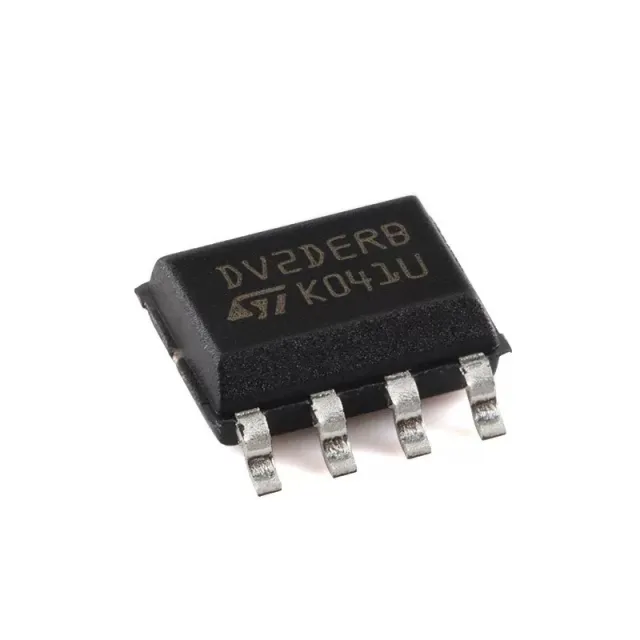
ST25DV04K-IER6S3 - 4Kbit Dynamic NFC/RFID Tag IC | STMicroelectronics
The ST25DV04K-IER6S3 is a dynamic NFC/RFID tag IC from STMicroelectronics, offering 4 Kbit of EEPROM memory with an I2C interface and an ISO 15693 / ISO 18000-3 Mode 1 compliant RF interface. It operates at 13.56 MHz and supports data rates up to 53 kbit/s in the RF interface, while the I2C interface supports up to 1 MHz. The device is housed in an SO-8 package (NXP-style) and is designed for applications requiring contactless data transfer and configuration, such as smart home devices, industrial equipment, and consumer electronics. Data verified as of 2026-08-05. What is a dynamic NFC/RFID tag IC? A dynamic NFC/RFID tag IC is a type of RFID transponder that combines a contactless RF interface with a wired interface (typically I2C) to allow a microcontroller to read and write the tag's memory both over the air and via the wired bus. This category sits within the broader hierarchy: NFC/RFID tag IC -> RFID transponder -> RFID/NFC integrated circuit -> wireless communication IC -> semiconductor. The dynamic nature means the tag can be updated in real time by the host MCU, enabling use cases like wireless configuration, data logging, and product authentication. Key features include 4 Kbit EEPROM organized in 128-byte pages, an I2C interface with a 1 MHz clock, an RF interface compliant with ISO 15693 and ISO 18000-3 Mode 1, a 64-bit unique identifier (UID), and an energy harvesting function that can power external circuits. The device supports a wide supply voltage range of 1.8V to 5.5V on the I2C side, and it includes an interrupt output to signal RF activity. The SO-8 package is compact and suitable for surface-mount assembly. Technically, the ST25DV04K-IER6S3 integrates an RF front-end with an analog-to-digital converter for energy harvesting, a state machine for protocol handling, and a memory controller for EEPROM access. The EEPROM is organized into 32 pages of 128 bits each, with a data retention of 10 years and an endurance of 1 million write cycles. The device supports both static and dynamic memory mapping, allowing the host to control which memory areas are accessible over RF. Typical applications include smart home devices (e.g., smart locks, thermostats), industrial equipment configuration, consumer electronics pairing (e.g., Bluetooth speakers, wearables), and medical device calibration. The energy harvesting feature enables battery-less operation for low-power sensors, and the I2C interface allows seamless integration with microcontrollers. When designing with this device, ensure proper antenna matching for the RF interface and place decoupling capacitors close to the VCC pin. The energy harvesting output should be buffered with a capacitor to provide stable power to external circuits. Also, consider the I2C address configuration via the RF field to avoid conflicts in multi-tag systems. This page synthesizes distributor pricing, drop-in alternatives, and practical design notes not found in the STMicroelectronics datasheet, providing a comprehensive resource for engineers evaluating the ST25DV04K-IER6S3.
ST87M01-1000 - NB-IoT LTE Cat NB2 Module | STMicroelectronics
The STMicroelectronics ST87M01-1000 is an ultra-compact, low-power LTE Cat NB2 (NB-IoT) industrial cellular module supporting LTE FDD bands B1, B3, B5, B8, B20 and B28 for worldwide NB-IoT coverage, housed in an LGA package of 10.6 mm x 12.8 mm. It is the variant of the ST87M01 series without the integrated GNSS/Wi-Fi positioning capability, making it the lowest-power and most cost-effective choice for fixed or stationary IoT endpoints. An NB-IoT (Narrowband Internet of Things) module is a low-power wide-area (LPWAN) radio transceiver standardized by 3GPP for LTE Cat NB2. It sits within the broader hierarchy of cellular modules: transceiver -> cellular module -> wireless connectivity IC -> semiconductor device. NB-IoT prioritizes deep indoor penetration, ultra-low standby current and years of battery life over raw throughput, which suits metering, sensing and tracking infrastructure. Key features of the ST87M01 include fully programmable embedded processing, comprehensive worldwide band coverage on a single hardware SKU, and advanced security features per the STMicroelectronics product brief. The ultra-compact LGA footprint facilitates device miniaturization without compromising RF performance, and the industrial-grade design targets long deployment lifetimes. Architecturally, the ST87M01 series integrates the NB-IoT modem, baseband and RF front end into one module, exposing a standard LGA land pattern for direct PCB mounting. The 1.8 V supply domain simplifies power-tree design around common low-voltage batteries and regulators. ST describes it as the first all-in-one module family combining NB-IoT, GNSS and Wi-Fi positioning across its variants; the -1000 SKU provides the cellular function alone. Typical applications include smart electricity, gas and water metering, smart-city infrastructure such as street lighting and parking sensors, industrial condition monitoring, and asset-tracking endpoints where positioning is handled by another means. Design consideration: choose the -1000 variant when GNSS is not required, since the -1001 variant with GNSS capability costs more and consumes additional power; verify antenna keep-out and RF layout per the ST87M01 hardware design guidance. This page synthesizes distributor availability, drop-in family alternatives, and practical design notes not found in the manufacturer datasheet alone.

ST87M01-1001 - NB-IoT LTE Cat NB2 Module | STMicroelectronics
The STMicroelectronics ST87M01-1001 is an ultra-compact, low-power LTE Cat NB2 NB-IoT industrial cellular module supporting LTE FDD bands B1, B3, B5, B8, B20, and B28, delivering up to +23 dBm transmit output power in a 10.6 mm x 12.8 mm surface-mount LGA package with antenna not included. A cellular IoT module is a wireless communication subsystem that connects embedded devices to operator cellular networks. Within the power-management and connectivity hierarchy, NB-IoT (Narrowband IoT) sits under the LPWAN (Low-Power Wide-Area Network) family of 3GPP LTE standards, which in turn belong to the broader categories of wireless transceivers, RF modules, and industrial IoT communication ICs. NB-IoT modules are optimized for low data rates, deep indoor coverage, and multi-year battery life rather than throughput. Key features of the ST87M01-1001 include comprehensive worldwide band coverage across six LTE FDD bands, ultra-low power consumption of less than 2 uA in low-power mode for multi-year battery operation, and fully programmable architecture allowing customer applications to run on-module. It is a certified LTE Cat NB2 design per the 3GPP release on which it is based, and STMicroelectronics guarantees 15 years of availability, a critical factor for industrial product lifecycles. Technically, the ST87M01 series integrates the cellular modem with advanced security features and industrial-grade design. The -1001 variant provides NB-IoT connectivity plus an extra ADC, while the -1301 and -2301 variants add GNSS and Wi-Fi positioning for combined cellular-plus-location designs. The industrial operating range of -40 C to +85 C supports harsh deployments such as outdoor metering and cold-chain tracking. Typical applications include smart utility metering (electricity, gas, water), asset tracking and telematics, smart city infrastructure such as parking and streetlight control, and industrial sensors on NB-IoT networks. The 868.95 MHz reference in listings relates to adjacent sub-GHz positioning options; the cellular path uses the licensed LTE FDD bands listed above. Design consideration: NB-IoT coverage and SIM/eSIM data plans vary by country and operator, so verify operator NB-IoT support early in the project. Antenna selection and RF layout are also critical because no antenna is included. This page synthesizes distributor pricing, same-family drop-in alternatives, and practical design notes not found in the STMicroelectronics datasheet.
ST87M01-1100 - NB-IoT Module with GNSS | STMicroelectronics
The STMicroelectronics ST87M01-1100 is an ultra-compact, low-power LTE Cat NB2 (NB-IoT) industrial module with integrated GNSS/Wi-Fi positioning, certified by Anatel for Brazil and supporting LTE FDD bands B1, B3, B5, B8, B20, and B28. An NB-IoT module is a type of cellular wireless module within the broader family of LPWAN (Low-Power Wide-Area Network) connectivity devices. NB-IoT operates on licensed LTE spectrum and provides deep indoor penetration and long battery life, making it a key building block of power management-aware, battery-operated industrial IoT systems alongside sensors, microcontrollers, and cellular infrastructure. Key features of the ST87M01 family include its all-in-one integration of NB-IoT cellular connectivity, GNSS (GPS/Galileo) satellite positioning, and Wi-Fi 802.11b-based positioning in a single ultra-compact surface-mount package. This eliminates the need for a separate positioning module, reducing BOM count, board area, and integration effort. The family is described by ST as fully programmable, high-performance, and certified, with worldwide band coverage and advanced security features. Technically, the ST87M01 series is an LTE Cat NB2 device, the evolution of 3GPP NB-IoT supporting higher peak data rates than Cat NB1. ST guarantees 15 years of availability for the ST87M01 platform, which is a critical procurement criterion for industrial products with long service lifetimes. Security features are embedded per the manufacturer product page, and the module supports both classic SIM and externally connected eSIM. Typical applications include smart metering, smart street lighting, asset tracking, livestock and agriculture monitoring, and other smart-city verticals - especially in Brazil and other regions using the B1/B3/B5/B8/B20/B28 band set covered by this -1100 region variant. Design consideration: choose the region-specific variant that matches your deployment market and operator certification requirements; ST explicitly directs users to confirm NB-IoT coverage and suitable SIM data plans with their operator before finalizing the design. This page synthesizes manufacturer data, region-variant guidance, drop-in family alternatives, and practical design notes not found on distributor listing pages.
ST87M01-1101 - NB-IoT Module with GNSS | STMicroelectronics
The STMicroelectronics ST87M01-1101 is an ultra-compact, low-power LTE Cat NB2 (NB-IoT) industrial module with integrated GNSS (GPS/Galileo) and Wi-Fi positioning capability plus an extra ADC, supporting LTE FDD frequency bands B1, B3, B5, B8, B20, and B28 for comprehensive worldwide band coverage. An NB-IoT module is a type of cellular LPWAN (Low Power Wide Area Network) transceiver subsystem that sits within the broader hierarchy of wireless connectivity solutions: cellular module, RF transceiver, RF & wireless component. NB-IoT operates on licensed spectrum with deep indoor penetration and carrier-grade security, making it distinct from unlicensed-technologies such as LoRa or Sigfox. Modules like the ST87M01 series integrate the baseband modem, RF front end, power management, and optional positioning engines into a single certified surface-mount unit. The ST87M01-1101 differentiates itself as one of the first all-in-one modules to combine NB-IoT connectivity, GNSS, and Wi-Fi positioning in a single package, eliminating the need for a separate positioning module in asset-tracking designs. Its LTE Cat NB2 compliance enables deployment on 3GPP Release 14 NB-IoT networks, and ST highlights advanced security features and full programmability for industrial applications. The -1101 variant adds GNSS and Wi-Fi positioning plus the additional ADC, and is Anatel-certified for the Brazilian market alongside the ST87M01-1100. Architecturally, the module series is built for ultra-low power consumption, targeting battery-powered endpoints where multi-year battery life is a design requirement. The integrated GNSS receiver supports GPS and Galileo constellations, while the Wi-Fi sniffing capability provides urban positioning where satellite visibility is poor, and the auxiliary ADC allows direct connection of analog sensors without an external converter. Typical applications include asset tracking, smart metering, smart city infrastructure, and battery-powered industrial IoT sensors. In asset trackers, the combination of NB-IoT and GNSS/Wi-Fi positioning in one module reduces BOM count and board area; in metering, the ultra-low-power profile extends battery service intervals. When designing with the ST87M01-1101, verify antenna selection and RF layout against the ST evaluation kit reference design, and confirm the region-specific certification variant matches your target market, since ST ships distinct MPNs for North America (ST87M01-2001/-2301), Brazil (ST87M01-1000/-1100/-1101), and other regions. This page synthesizes distributor listings, the manufacturer datasheet, family-variant cross-references, and pricing context not consolidated in the ST datasheet alone.