Módulos RF
Productos (305)

E22-400M22S - SX1268 LoRa 22dBm 7km 410-493MHz Module | EBYTE
The EBYTE E22-400M22S is an industrial-grade, surface-mount LoRa RF transceiver module built around the Semtech SX1268 chip, delivering up to 22.3 dBm (170 mW) of transmit output power and a stated line-of-sight range of 7 km over the 410-493 MHz ISM band, packaged in a compact 20 x 14 mm SMD-22 stamp-hole footprint with both on-board chip antenna and U.FL (IPEX) external antenna connector options. What is a LoRa transceiver module? A LoRa (Long Range) transceiver module is a complete sub-system that combines a Semtech LoRa-modulation radio IC, an RF front-end (PA, LNA, filtering, antenna switch), a TCXO or crystal reference, and an SPI host interface on a single PCB. It belongs to the broader family of wireless modules -> sub-GHz transceivers -> RF modules -> RF & wireless modules. Designers use LoRa modules instead of bare LoRa ICs to skip RF layout certification and pass radio regulations in target regions more easily. Key features of the E22-400M22S include a -147 dBm receive sensitivity that enables long-range links, a wide 1.8 V to 3.7 V supply window that is friendly to Li-ion and 2xAA battery rails, programmable output power from a few mW up to 22.3 dBm, support for both LoRa spread-spectrum modulation and traditional GFSK, and a 32 MHz high-precision TCXO that improves frequency stability under temperature swing. The SX1268 inside also offers an integrated DC-DC converter option for improved transmit efficiency. The module architecture is built on Semtech's SX1268, the 410-810 MHz variant of the SX126x family, paired with an external power amplifier path to reach the 22 dBm level, an SAW band filter for out-of-band rejection, and an SPI bus for register access from the host MCU. Compatibility with the older SX1276/SX1277/SX1278 commands simplifies migration for existing LoRa designs, while the SX1268 offers lower receive current and higher bit-rate flexibility. Typical applications include remote metering and automatic meter reading (AMR), agricultural soil and irrigation sensors, industrial wireless telemetry over 433/470 MHz license-free bands, smart home and building automation backhaul, asset tracking in outdoor yards, and long-range drone or robotics telemetry links where a 7 km class range is required. A key design consideration is antenna selection: at 433/470 MHz a correctly tuned external antenna on the U.FL connector delivers far better range than the on-board chip antenna, and a 50 ohm controlled-impedance feed must be maintained. Designers should also budget for the 100 mA peak supply current during +22 dBm transmit bursts and decouple the supply rail close to the module pins. This page synthesizes distributor pricing, SX1268 versus SX1278 migration notes, drop-in same-footprint alternatives, and practical antenna and power-rail design guidance not found in the EBYTE datasheet alone, giving engineers a single decision-grade reference for selecting and implementing the E22-400M22S.
E22-400MM22S - SX1268 LoRa 433/470MHz Module | Ebyte
The Chengdu Ebyte E22-400MM22S is an ultra-small SMD LoRa wireless transceiver module operating over a continuous 410-493 MHz frequency range (covering the 433 MHz and 470 MHz ISM bands), with 22.3 dBm maximum transmit power and -147 dBm receive sensitivity in a 10 x 10 mm castellated (stamp-hole) SMD package with IPEX antenna interface option. A LoRa module is a sub-GHz radio transceiver subsystem that implements Semtech's LoRa spread-spectrum (chirp spread spectrum) and traditional GFSK modulation to deliver long-range, low-power wireless links. Within the system hierarchy it sits above the bare RF chip (here the Semtech SX1268) and below full application nodes, providing the RF front end, matching network, and host interface that an MCU controls over SPI. Key features include a very low receive current of 6.5 mA (with DC-DC power configuration), wide 1.8 V to 3.7 V supply range, transmit current of 100 mA, and a communication range of up to 7 km in open field. The SX1268 core supports multiple modulation schemes, enabling both long-range LoRa links and higher-throughput GFSK links on the same hardware. The SX1268 generation adds improved link budget and configurable power-amplifier and LDO/DC-DC supply modes; selecting the high-efficiency buck converter mode substantially lowers receive current for battery-powered nodes. Sensitivity of -147 dBm at low data rates allows deep penetration and multi-kilometer range, making the module well suited to dense deployments with infrequent small-payload transmissions. Typical applications include smart agriculture sensor nodes, industrial telemetry and metering, smart-city infrastructure, and asset tracking in the 433/470 MHz regional ISM bands. Design consideration: at 22.3 dBm output the module requires a good ground plane and an efficient antenna (IPEX whip or matched PCB antenna); always verify duty-cycle and EIRP limits for your regional 433/470 MHz regulations before deployment. This page synthesizes distributor pricing from LCSC, JLCPCB, and Chipmall, drop-in alternative analysis, and practical design notes not found in the manufacturer datasheet.
EC800G (EC800G-CN) - LTE Cat 1 IoT Module with GPS | Quectel
The Quectel EC800G-CN is a cost-effective LTE Cat 1 (Cat 1 bis) wireless communication module optimized for M2M and IoT applications, delivering maximum data rates of 10 Mbps downlink and 5 Mbps uplink in a compact LCC surface-mount package with GNSS/GPS positioning support on region variants such as the EC800G-CN-GA. An LTE Cat 1 module is a cellular IoT transceiver that provides 4G LTE connectivity at reduced RF complexity and cost compared with Cat 4 modules. In the product hierarchy, it sits within the wireless communication module family (cellular module -> LTE module -> LTE Cat 1 bis module) and serves as the low-power wide-area link between a host MCU and the operator network via standard AT commands over UART. Key features include LTE Cat 1 data rates up to 10 Mbps DL / 5 Mbps UL, a compact and unified LCC form factor, and integration of GNSS positioning on variants such as the EC800G-CN-GA, which suits asset tracking and telematics. The EC800G-CN family is RoHS-compliant and offered in industrial-grade temperature options, making it appropriate for long-lifetime deployments. According to the Quectel EC800G-CN Reference Design V1.1, the design covers power supply, UART, USB and SIM interfaces, allowing a straightforward single-antenna LTE Cat 1 bis implementation. The LCC castellated package supports both reflow soldering for volume production and hand soldering for prototyping. Typical applications include smart metering, asset management and tracking, POS/smart payment terminals, telematics units, and general IoT M2M gateways where Cat 1 bis data rates are sufficient and 2G/3G networks are being sunset. Design consideration: verify power supply sequencing and the UART/USB interface termination against the official reference design, and confirm regional certification variant (CN, GA, etc.) matches your target market's operator bands. This page synthesizes distributor pricing, pin-compatible same-family alternatives, and practical design guidance not found in the manufacturer datasheet alone. Prices as of 2026-10-20.
EG25-G - LTE Cat 4 Module 150Mbps | Quectel
The Quectel EG25-G is an LTE Cat 4 IoT/M2M wireless module in a 29.0 mm x 32.0 mm x 2.4 mm LGA (land grid array) form factor, delivering maximum data rates of 150 Mbps downlink and 50 Mbps uplink while meeting the 3GPP Release 11 standard. An LTE Cat 4 module is a cellular communication device that provides fourth-generation mobile broadband connectivity for machine-to-machine systems. In the product hierarchy it sits as: cellular module -> LTE modem -> wireless transceiver module -> IoT connectivity component. LTE Cat 4 defines a UE capability class with 150 Mbps peak downlink and 50 Mbps peak uplink, sufficient for most IoT gateways, routers, and telematics units that do not require Cat 6 carrier aggregation speeds. Key features include the 150 Mbps/50 Mbps Cat 4 data rates, a unified LGA footprint compatible with the Quectel EC2x series (EC25, EC21, EC20 R2.1), the EG21-G LTE module, and the UC200T UMTS/HSPA+ series, and a rich set of industry-standard interfaces including USB with drivers for Windows, Linux, and Android. Technically, EG25-G adopts 3GPP Release 11 LTE technology and supports a broad set of Internet protocols, making integration with host processors straightforward. Firmware and regional variant management (for example -G global, -GL, -GGB, -GGC, -GGD suffixes) allows one PCB design to serve multiple regional certification requirements. Typical applications include industrial LTE routers and gateways, in-vehicle telematics units, IoT trackers and smart meters, and embedded systems such as the Pine64 PinePhone, which ships with the EG25-G as its cellular modem. Design consideration: the module is compatible with the EC2x unified footprint, but data rates, band support, and fallback (2G/3G) behavior differ between LTE-only EG25-G and multi-mode EC25 variants - verify regional variant suffix before release. USB_VBUS should be powered from a 5 V system for USB detection per the Quectel reference design. This page synthesizes verified manufacturer data, drop-in footprint-compatible alternatives, pinout guidance, and practical design notes not found in the manufacturer datasheet.
EG25-G 4G LTE Cat 4 Module - 150Mbps IoT M2M | Quectel
The Quectel EG25-G is an LTE Cat 4 IoT/M2M cellular module delivering up to 150 Mbps downlink and 50 Mbps uplink data rates in an LGA form factor measuring 29.0 mm x 32.0 mm x 2.4 mm, compliant with the 3GPP Release 11 standard. An LTE Cat 4 module is a type of cellular wireless transceiver that provides fourth-generation (4G) broadband connectivity for machine-to-machine (M2M) and Internet of Things (IoT) devices. Within the connectivity hierarchy, it sits as a cellular module -> wireless communication device -> network access layer component, and it typically replaces 2G/3G modems in industrial designs migrating to LTE-only networks. Key features include global band coverage on up to 30 LTE bands from a single SKU, an optional GNSS receiver supporting GPS, GLONASS, BeiDou, Galileo and QZSS (Qualcomm IZat Gen8C Lite in the -GL variant), and backward compatibility with EDGE and GSM/GPRS networks so devices remain connected in areas lacking 4G or 3G coverage. Peak data rates of 150/50 Mbps suit bandwidth-hungry IoT applications such as video gateways and industrial routers. Technically, the EG25-G adopts 3GPP Rel. 11 LTE technology and shares the compact unified LGA form factor of Quectel's EC2x series (EC25, EC21, EC20, EC20 R2.0/R2.1) and UC20/UC200T UMTS/HSPA+ modules, allowing drop-in migration between product generations without PCB redesign. A rich set of internet protocols and USB drivers for Windows XP/Vista/7/8/8.1/10, Linux and Android simplifies host integration via AT commands. Typical applications include industrial routers and gateways, vending machines and payment terminals, digital signage and LED screen controllers, and asset trackers requiring GNSS positioning. Design consideration: use the unified EC2x pinout to future-proof the PCB, and verify antenna matching on the ANT_MAIN and ANT_DIV pads per the Quectel EG25-G Hardware Design guide for optimal RF performance. This page synthesizes distributor pricing, drop-in alternatives within the Quectel LTE Standard family, and practical design notes not found in the manufacturer datasheet.

EG912Y - LTE Cat 1 M2M/IoT Module, 10 Mbps DL, 5 Mbps UL | Quectel
The Quectel EG912Y is a series of LTE Cat 1 cellular modules optimized specifically for M2M and IoT applications, delivering maximum data rates of 10 Mbps downlink and 5 Mbps uplink. Adopting the 3GPP Release 9 technology, the EG912Y is offered in regional variants (EG912Y-EU, EG912Y-CN and others) and is housed in a compact surface-mount LGA-126 package measuring approximately 29.0 mm × 25.0 mm × 2.3 mm with 1.0 mm pitch and 1.10 mm maximum height. An LTE Cat 1 module (also called LTE Category 1 or Cat 1) is a 4G LTE user-equipment category defined by 3GPP that provides single-antenna downlink MIMO with peak rates of 10 Mbps DL / 5 Mbps UL. Within the cellular module hierarchy, Cat 1 sits below Cat 4 (150/50 Mbps) but above Cat M1 and NB-IoT, making it the standard choice for mid-bandwidth IoT applications that require voice or video capability beyond low-power LPWA. Cellular modules like the EG912Y belong to the broader power management and RF/transceiver family of industrial modules, integrating baseband, RF transceiver, power management IC (PMIC) and connectivity firmware into a single shielded module that the host MCU/MPU communicates with via UART/USB. Key features of the EG912Y include multi-band LTE, UMTS/HSPA+ and GSM/GPRS/EDGE fallback on supported regional variants, embedded GNSS on selected SKU codes, AT-command firmware compatibility with the broader Quectel EG9x family, and an integrated TCP/IP stack. The module supports both Windows and Linux USB drivers, eSIM (selected variants), and FOTA (firmware-over-the-air) updates. The EG912Y uses Quectel's unified form-factor LGA package that is footprint-compatible with the BG95 series, BG96, EG91 series and EG915U series modules, allowing customers to migrate between LTE Cat 1, Cat M1/Cat NB1 and Cat 1 bis variants without PCB redesign. The 126-pad LGA exposes UART, USB 2.0, PCM digital audio, I2C, ADC and GPIO interfaces to the host processor. Typical applications include asset tracking and fleet management, smart metering (electricity/gas/water), industrial gateways, telematics, POS terminals, and healthcare remote monitoring. The 10/5 Mbps throughput is well suited to video telemetry and periodic firmware updates while maintaining low power consumption versus higher-category LTE modules. Designers should note that the Powerfleet knowledge-base article in this page's sources mentions that the EG912Y-EU variant has been discontinued and replaced in one product family by an EG915N-EA modem, so lifecycle verification is critical before new design-in. Plan PCB pad layout using Quectel's reference land pattern, provide a stable 3.8 V typical VBAT supply, and include a USB type-A or micro-USB footprint for firmware update convenience. This page consolidates distributor pricing, drop-in module alternatives and engineering notes beyond the manufacturer specification document.
EMB-LR1276S/UL - 868/915MHz LoRaWAN Module | Embit
The Embit EMB-LR1276S/UL is an ultra-low-power 868/915 MHz LoRa/LoRaWAN OEM wireless module with up to +18 dBm output power (US) or +14 dBm (EU), receiver sensitivity down to -136 dBm, and less than 1 uA sleep-mode current, housed in an ultra-compact 11.5 x 11.5 x 2 mm castellated LGA package. A LoRaWAN module is an LPWAN (Low Power Wide Area Network) radio module that implements the LoRaWAN protocol stack on top of Semtech's LoRa chirp spread spectrum modulation, sitting within the broader hierarchy of wireless connectivity: RF module -> LPWAN transceiver -> wireless communication subsystem -> IoT device. LoRaWAN enables multi-kilometer range links at very low energy budgets, making it the dominant technology for battery-powered wide-area telemetry. Key features of the EMB-LR1276S include an embedded LoRa/LoRaWAN protocol stack developed by Microchip, compliant with the latest LoRaWAN specifications including Class A and Class C device operation; high interference immunity inherent to LoRa spread-spectrum modulation; and extremely reduced power consumption of less than 1 uA in sleep mode, enabling years of battery life in fielded devices. The module integrates a Microchip SAM R34-class host-friendly interface set and communicates through a wide range of serial interfaces: UART, I2C, SPI, Full-Speed USB 2.0, plus digital and analog I/O ports. The AT-command-accessible LoRaWAN stack lets system integrators add long-range connectivity without developing RF firmware, shortening certification and time-to-market cycles. Typical applications include smart utility metering, agricultural sensor networks, smart-city infrastructure, asset tracking, and industrial telemetry - scenarios that demand kilometer-scale range, weak-signal robustness, and multi-year battery autonomy. Design consideration: the +14 dBm EU / +18 dBm US output power split means firmware and antenna design must respect the regional regulatory limit of the destination market; the 11.5 x 11.5 mm footprint requires a well-defined 50-ohm antenna match for maximum link budget. This page synthesizes verified distributor data, drop-in alternatives, and practical design guidance not found in the manufacturer datasheet alone.
ESMD-WISUN-A0 - Wi-SUN 902-928MHz Mesh Module | Eastsoft
The Eastsoft ESMD-WISUN-A0 is a Wi-SUN wireless communication module supporting IEEE 802.15.4g and Wi-SUN protocol stacks, operating in the 902-928 MHz sub-GHz ISM band (US/BZ frequency plans) with configurable RF transmit power up to 29 dBm in a compact certified module format. A Wi-SUN (Wireless Smart Utility Network) module is a radio module that implements the IEEE 802.15.4g SUN PHY and the Wi-SUN FAN (Field Area Network) mesh networking profile. Within the wireless connectivity hierarchy, it sits alongside LPWAN technologies such as LoRaWAN, NB-IoT, and Wi-Fi HaLow, but differentiates itself through self-forming, self-healing RF mesh networking that can scale to thousands of nodes, making it a de facto standard for smart utility and smart city infrastructure. Key features of the ESMD-WISUN-A0 include IEEE 802.15.4g/Wi-SUN compliance for multi-vendor interoperability, a programmable 902-928 MHz frequency band with selectable PHY operational modes, and high transmit power of up to 29 dBm (configurable), which supports the long-range, line-of-sight-avoiding links required in outdoor mesh deployments. The module has completed FCC certification testing, which significantly reduces the regulatory burden for integrators building end products for the US market. Architecturally, the module integrates the sub-GHz radio, protocol stack, and antenna matching into a single drop-in unit, so the host microcontroller only needs to handle application logic and serial/SPI communication. Certificate-based authentication provides highly secure joining and data exchange across the mesh. Typical applications include advanced metering infrastructure (AMI) for electric, water, and gas utilities, smart street lighting networks, and distribution automation in smart grid deployments, where self-healing mesh topology and long service life matter more than raw throughput. A key design consideration: the module ships without an antenna. The manufacturer recommends using their same-model antenna, otherwise new FCC re-certification will be necessary for the end product. This page synthesizes verified datasheet data, regulatory guidance, and application context not consolidated in the raw manufacturer manual.
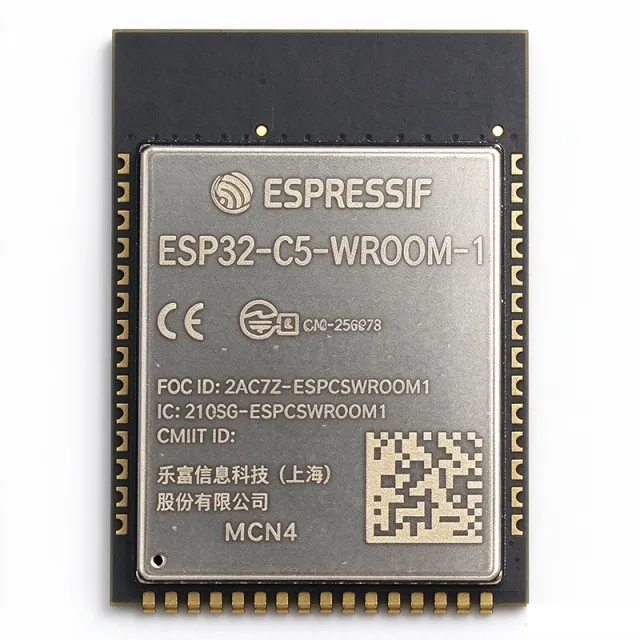
ESP32-C5-WROOM-1 - Dual-Band Wi-Fi 6 BLE Zigbee Module | Espressif
The Espressif ESP32-C5-WROOM-1 is a general-purpose 2.4 and 5 GHz dual-band Wi-Fi 6 (802.11ax) module with Bluetooth 5 (LE), Zigbee, and Thread (IEEE 802.15.4) connectivity, built on a single-core RISC-V MCU clocked up to 240 MHz, housed in a 27.5 x 18 mm surface-mount castellated-pad module with a PCB trace antenna. A wireless module is a pre-certified, fully integrated subassembly that combines a microcontroller SoC, RF front end, antenna, crystal, and flash memory on one small PCB, so designers add connectivity to a product without designing a radio from scratch. In the system hierarchy, a module sits above the SoC level (SoC -> module -> development board) and below complete end products, drastically shortening time-to-market for IoT devices and reducing RF certification effort. Key features include industry-first 5 GHz dual-band Wi-Fi 6 support in a RISC-V MCU, multi-protocol operation spanning 802.11ax, Bluetooth 5 LE, Zigbee, and Thread, and flash options ranging from 4 MB to 32 MB QuadSPI depending on the ordering code. The dual-band capability lets products use the less congested 5 GHz band for higher throughput and lower interference, a decisive advantage in dense smart-home deployments. Technically, the module is built around the ESP32-C5 SoC, which Espressif describes as the industry's first RISC-V MCU supporting 2.4/5 GHz dual-band Wi-Fi 6 alongside IEEE 802.15.4. This allows Matter-over-Thread and Zigbee 3.0 devices to coexist with Wi-Fi on a single chip, simplifying border-router and hub architectures. The ambient operating temperature range is -40 to +85 C per the module datasheet family table. Typical applications include smart-home devices (Matter, Thread, Zigbee), industrial automation nodes, healthcare and consumer electronics, where the rich peripheral set and multi-protocol radio reduce external component count. For design-in, note that strapping pins and the antenna keep-out area must follow Espressif's hardware design guidelines; the module requires a clean 3.3 V supply with adequate peak current capability for Wi-Fi 6 TX bursts. This page synthesizes datasheet specifications, family variants, drop-in alternatives, and practical design guidance not consolidated in the manufacturer datasheet alone.
ESP32-C5-WROOM-1U-N8R8 - Dual-Band Wi-Fi 6 BLE Module | Espressif
The Espressif Systems ESP32-C5-WROOM-1U-N8R8 is a general-purpose 2.4 GHz and 5 GHz dual-band Wi-Fi 6 (802.11ax) module with Bluetooth 5 (LE), Zigbee, and Thread (802.15.4) connectivity, built around a 32-bit RISC-V single-core processor running at up to 240 MHz, with 8 MB Quad SPI flash and 8 MB Quad SPI PSRAM in an 18.0 x 21.2 x 3.3 mm surface-mount package with an IPEX (U.FL) connector for an external antenna. A wireless module is a pre-certified, self-contained circuit board that integrates a microcontroller SoC, RF front end, crystal, flash memory, and antenna interface into a single castellated-edge surface-mount unit. Modules sit above bare SoCs in the electronics hierarchy - embedded system, wireless connectivity module, SoC, silicon - and let designers add certified radio connectivity without in-house RF design or regulatory re-certification. Key features include simultaneous dual-band Wi-Fi 6 support in the 2.412-2.484 GHz and 5.18-5.885 GHz bands, which reduces congestion in dense IoT deployments; 802.15.4 radio for Zigbee and Thread, enabling native Matter and Thread mesh networks; Bluetooth 5 LE for phone provisioning and beacons; and a low-power coprocessor that can monitor peripherals while the main CPU is powered off. At the core is the ESP32-C5 SoC, a single-core 32-bit RISC-V processor clocked up to 240 MHz with a rich peripheral set including SPI, I2C, UART, I2S, PWM, and ADC. The N8R8 variant pairs 8 MB flash with 8 MB PSRAM, providing ample headroom for TLS stacks, display buffers, and Matter applications. Typical applications include smart home hubs that must bridge Wi-Fi, Thread, Zigbee, and BLE simultaneously; industrial automation gateways using the 5 GHz band to avoid 2.4 GHz factory interference; and healthcare or consumer electronics requiring dual-stack wireless provisioning. For design, keep the IPEX antenna feedline at 50 ohms impedance and follow Espressif hardware design guidelines for module keep-out zones. Note that the 1U variant has no onboard PCB antenna, so an external antenna is mandatory. This page synthesizes verified datasheet specifications, drop-in same-family alternatives, and practical design notes not found on distributor listing pages.
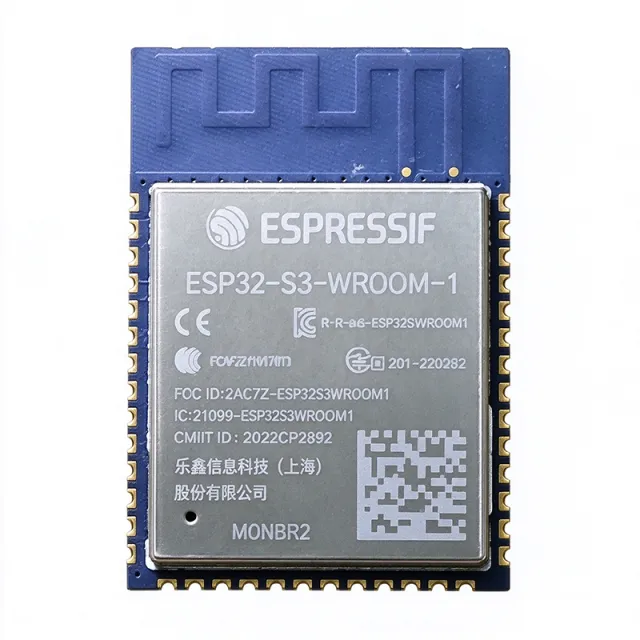
ESP32-S3-WROOM-1 - Wi-Fi 4 + BLE 5 Module, Xtensa LX7 Dual-Core | Espressif
The Espressif ESP32-S3-WROOM-1 is a 2.4 GHz Wi-Fi 4 (802.11 b/g/n) and Bluetooth 5 (LE) MCU module built around the ESP32-S3 series SoC, integrating an Xtensa dual-core 32-bit LX7 microprocessor with vector instructions for AI/ML acceleration. It is supplied as a surface-mount module with on-board PCB antenna, flash up to 16 MB (variant-dependent) and optional PSRAM up to 16 MB, exposed through up to 36 GPIOs. Common ordering codes include N8 (8 MB flash, no PSRAM), N16 (16 MB flash, no PSRAM), N8R8 (8 MB flash, 8 MB PSRAM), and N16R8 (16 MB flash, 8 MB PSRAM). A Wi-Fi + Bluetooth LE module is a self-contained radio subsystem that combines an RF transceiver, baseband, MCU, antenna, and regulatory shielding into a single reflow-solderable package. The module drops by several orders of magnitude of PCB RF design effort for the host product, exposing digital interfaces (UART, SPI, I2C, I2S, USB-OTG) instead of 50-ohm traces. Within the system hierarchy, an ESP32 module sits between the SoC layer and the finished connected-product (module -> wireless SoC -> 32-bit microcontroller -> embedded computing platform). The S3 series specifically adds vector instructions for SIMD-style acceleration of neural-network inference. Key features include hardware acceleration for neural network and signal processing workloads (vector instructions + ESP-DSP/VIEW libraries), integrated 2.4 GHz radio with Wi-Fi 4 (802.11 b/g/n, up to 150 Mbps) + Bluetooth 5 (LE) + Bluetooth Mesh, USB OTG 1.1 with on-chip PHY (no external bridge required), and rich peripherals including SPI, I2S, I2C, UART, ADC, DAC, TWAI (CAN), LCD, camera interface, RMT, pulse counters, and motor PWM. The module supports secure boot, flash encryption, and a hardware crypto accelerator (AES, SHA, RSA, HMAC, digital signature). Architecturally, the LX7 dual-core runs at up to 240 MHz with 512 KB SRAM, 2 MB PSRAM-internal block, and an additional 8 MB external PSRAM on R8 variants. Wi-Fi and Bluetooth share a single antenna through the on-module RF switch; the LX7 + radio architecture is the same die family as the bare ESP32-S3 chip, packaged with crystal, flash, RF matching network, and a copper-pour PCB antenna on the module substrate. Typical applications include AIoT endpoints (voice wake-word, on-device keyword spotting), smart-home hubs with Matter/Bluetooth Mesh, USB-HID devices (the S3 brings native USB-OTG so no UART bridge is needed), wearables with LCD/camera, industrial sensor nodes with TWAI (CAN), and low-cost Wi-Fi/BLE bridge boards. For new designs, observe the strapping-pin (GPIO0/3/45/46) boot-state requirements and ensure the on-module antenna keep-out zone is respected on the host PCB; failure to do so is the most common reason an otherwise-correct ESP32-S3 design has poor RF range. This page synthesizes Espressif datasheet specifications, family-level parametric positioning, and same-footprint alternatives - giving a one-stop overview that individual distributor listings cannot.
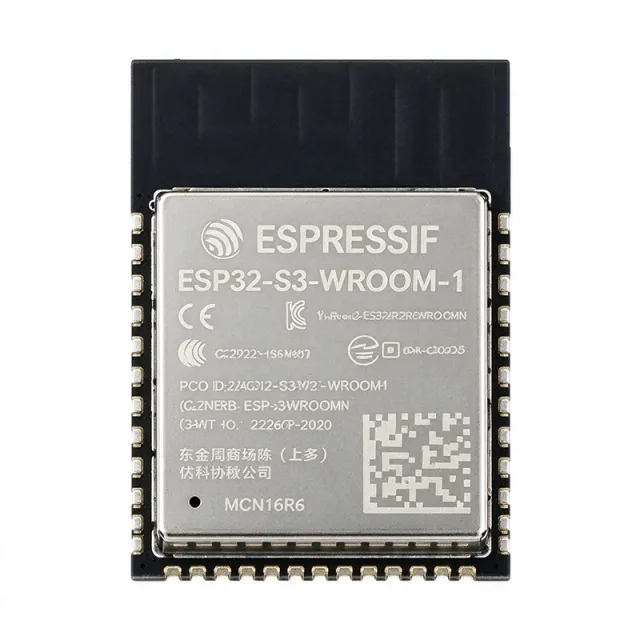
ESP32-S3-WROOM-1-N16R8 - WiFi+BLE 5, 16MB Flash | Espressif
The Espressif Systems ESP32-S3-WROOM-1-N16R8 is a 2.4 GHz Wi-Fi (802.11 b/g/n) and Bluetooth 5 (LE) MCU module built around the ESP32-S3R8 SoC, featuring a dual-core Xtensa 32-bit LX7 processor running at up to 240 MHz, 16 MB quad SPI flash, 8 MB octal PSRAM, and a PCB trace antenna in a surface-mount castellated package of approximately 18 mm x 25.5 mm x 3.1 mm. A Wi-Fi plus Bluetooth LE module is a wireless system-in-package that integrates an RF transceiver, antenna, microcontroller, memory, and power management onto a single certified PCB assembly. Within the hierarchy of wireless connectivity solutions, such modules sit above bare SoCs (which require RF design expertise) and below complete single-board computers, making them the standard choice for IoT product integration. Key differentiating features include 8 MB of octal SPI PSRAM for AI workloads, vector instructions for neural network computing acceleration, 36 GPIOs, and the ESP32-S3's rich peripheral set including SPI, I2S, I2C, UART, RMT, and a 14-bit LCD camera interface. The dual-core LX7 architecture allows one core to run the wireless protocol stack while the other executes user applications. Technically, the module integrates the ESP32-S3R8 chip with the PSRAM die stacked inside, a 40 MHz crystal, flash memory, and a PCB antenna with matching network. The AI acceleration makes it suitable for wake word detection, speech command recognition, and camera-based face detection at the edge. Typical applications include AIoT devices, smart speakers, home automation hubs, industrial sensor gateways, and battery-powered voice assistants. Design considerations: respect strapping pin configurations (IO0, IO45, IO46) at boot, and note peak Wi-Fi TX currents near 350 mA require a low-ESR 3.3 V supply with adequate decoupling. This page synthesizes distributor availability, same-family drop-in variants, and practical design notes not found in the manufacturer datasheet.
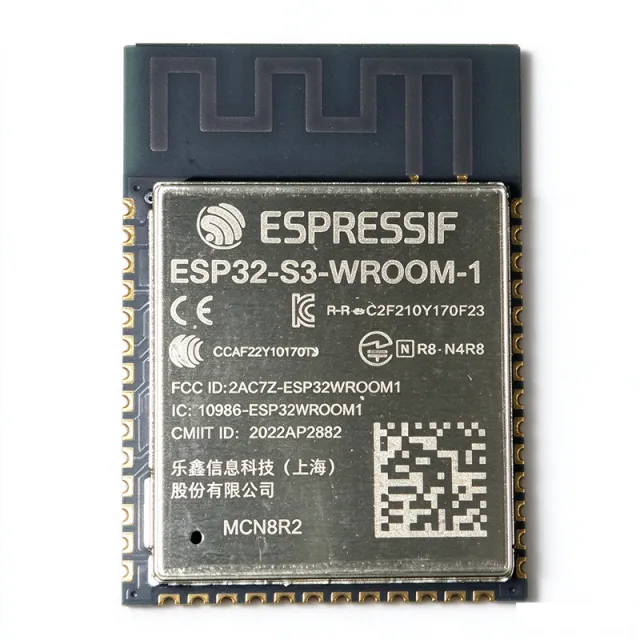
ESP32-S3-WROOM-1-N8 - WiFi/BLE5 MCU Module 8MB Flash | Espressif
The Espressif Systems ESP32-S3-WROOM-1-N8 is a generic Wi-Fi + Bluetooth LE MCU module built around the dual-core ESP32-S3 SoC, offering 8 MB of Quad SPI flash, 2.4 GHz Wi-Fi 802.11 b/g/n and Bluetooth 5 connectivity in a 25.5 x 18 mm surface-mount module with a PCB trace antenna. A Wi-Fi/BLE MCU module integrates a microcontroller, radio, RF matching network, antenna, flash memory and crystal oscillator onto a single certified surface-mount assembly. In the system hierarchy it sits above the bare SoC (here the ESP32-S3 chip) and below finished boards such as development kits, serving as the compute-plus-connectivity engine of an IoT device. Key differentiating features include a dual-core 32-bit LX7 processor that accelerates neural network computing and signal processing workloads, 8 MB of on-module SPI flash for code and assets, and Bluetooth 5 LE with long-range support. The module exposes a rich set of peripherals, making it suitable for designs that need both wireless connectivity and local AI inference such as wake word detection. Architecturally, the ESP32-S3 SoC combines two processor cores with vector instructions for machine-learning workloads, integrated Wi-Fi and BLE radios, and peripherals including SPI, I2C, UART, I2S, and native USB. The on-module PCB antenna and RF front end remove the need for external RF design, while flash is connected over Quad SPI for fast code execution from cache. Typical applications include AIoT devices performing wake word detection and speech command recognition, smart home and industrial IoT nodes, and human-interface products that leverage the ESP32-S3 USB and display-oriented peripherals. The 2.4 GHz radio and 8 MB flash cover the memory and connectivity needs of most connected-device firmware stacks. Design considerations: verify memory-map configuration for Quad SPI flash, respect strapping-pin requirements at boot, and provide clean 3.3 V power with adequate decoupling for Wi-Fi transmit bursts. This page adds value beyond the manufacturer datasheet by synthesizing distributor availability data, same-footprint memory variants for drop-in flexibility, comparison tables, and practical design notes in one place.
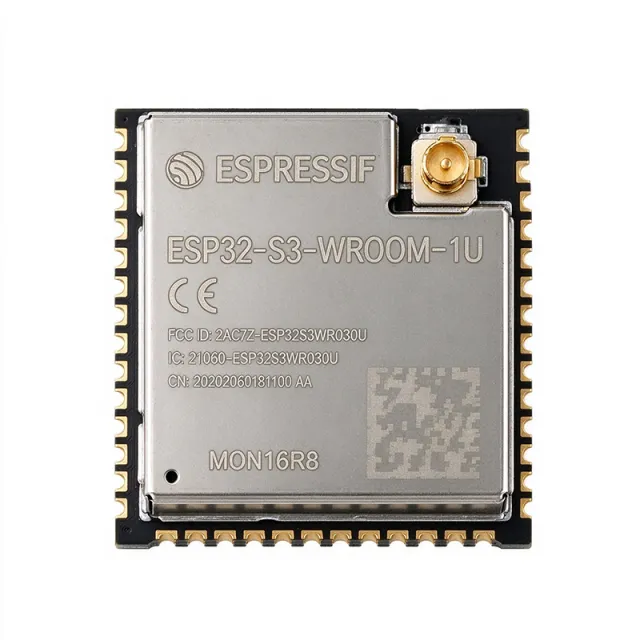
ESP32-S3-WROOM-1U - WiFi/BLE 5 Module, ESP32-S3 | Espressif
The Espressif Systems ESP32-S3-WROOM-1U is a generic 2.4 GHz Wi-Fi (802.11 b/g/n) and Bluetooth 5 (LE) MCU module built around the ESP32-S3 series SoC, featuring an Xtensa dual-core 32-bit LX7 processor, support for up to 16 MB flash and up to 8 MB PSRAM, and a U.FL connector for external antennas instead of an on-board PCB antenna. A Wi-Fi + Bluetooth LE MCU module is a surface-mount system-in-package that integrates a wireless SoC, flash memory, crystal oscillator, RF matching network, and power management onto a single castellated-edge PCB. Modules occupy the top of the embedded wireless hierarchy - above bare SoCs, which require RF layout expertise, and below finished development boards - and are the standard building block for IoT products that need certified radio performance without in-house RF engineering. Key features of the ESP32-S3-WROOM-1U include up to 36 GPIOs with a rich peripheral set, hardware acceleration for neural network computing and signal processing workloads, native USB OTG on the ESP32-S3 SoC, and Bluetooth 5 LE long-range support. The U.FL (IPEX) antenna connector allows designers to place the antenna remotely or use higher-gain external antennas, which distinguishes it from the PCB-antenna ESP32-S3-WROOM-1 sibling in the same series. Technically, the module is built around the ESP32-S3 SoC with dual-core LX7 CPUs clocked for general-purpose embedded workloads, integrating AI vector instructions that offload edge-inference tasks. The RF front end is pre-matched and pre-certified, dramatically reducing design risk compared to a discrete ESP32-S3 chip implementation where antenna matching and regulatory testing fall on the designer. Typical applications include AIoT edge devices, voice assistant endpoints, smart-home controllers, industrial sensor gateways, and any product requiring an external or remote-mounted antenna such as metal-enclosure designs that route the U.FL cable to an external bulkhead antenna. A key design consideration is strapping-pin handling: GPIO0, GPIO45, and GPIO46 configure boot mode and flash voltage at reset, so external circuits on these pins must respect datasheet pull-up/pull-down requirements to avoid boot failures. This page synthesizes the Espressif datasheet, distributor availability, drop-in family alternatives, and practical design notes not found on the manufacturer product page alone.
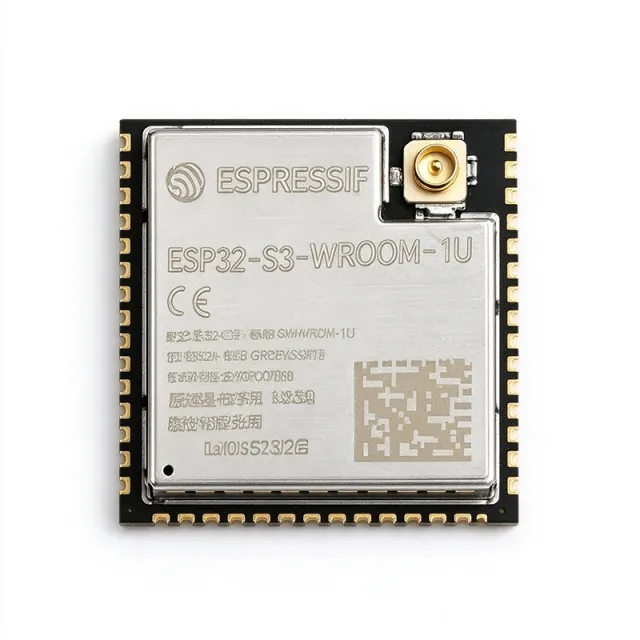
ESP32-S3-WROOM-1U-N16R2 - WiFi/BLE 5 Module 16MB Flash | Espressif
The Espressif Systems ESP32-S3-WROOM-1U-N16R2 is a Wi-Fi + Bluetooth LE MCU module built around the ESP32-S3R2 SoC, featuring a dual-core Xtensa LX7 CPU clocked at up to 240 MHz, 16 MB of quad SPI flash, and 2 MB of integrated quad SPI PSRAM, housed in a 19.2 x 18 x 3.2 mm SMD package with a U.FL (IPEX) antenna connector instead of an onboard PCB antenna. A Wi-Fi + Bluetooth LE MCU module is a system-in-package device that integrates a wireless SoC, flash memory, crystal oscillator, RF matching network, and power management into a single surface-mount unit. Within the embedded hierarchy, it sits above bare microcontrollers and below finished boards, functioning as the wireless connectivity and compute heart of an Internet of Things (IoT) node, edge-AI endpoint, or connected industrial device. Key differentiating features include the N16R2 memory configuration (16 MB flash + 2 MB PSRAM), the external-antenna U.FL footprint that lets designers place the antenna optimally inside a metal or RF-constrained enclosure, and the ESP32-S3 SoC's vector instructions for neural network computing and signal processing acceleration. The module supports Wi-Fi 802.11 b/g/n in the 2.4 GHz band and Bluetooth 5 LE, and exposes a rich peripheral set including SPI, I2C, I2S, UART, PWM, and native USB OTG. The underlying ESP32-S3R2 integrates the 2 MB PSRAM die inside the module stack, allowing quad SPI PSRAM access for memory-hungry workloads such as voice buffers, image frames, and TinyML models. The dual-core LX7 architecture lets one core handle the wireless protocol stack while the second executes application code, improving real-time determinism. Typical applications include wake word detection and speech command recognition, AIoT gateways, face recognition terminals, smart-home controllers, and industrial sensors where the external antenna connector simplifies certification and enclosure integration. Design consideration: because the RF path is external, keep the U.FL-to-antenna cable loss below approximately 1 dB and follow Espressif's RF layout guidance for the keep-out area near the connector; also respect the strapping pin states (GPIO0, GPIO45, GPIO46) at power-up for correct boot mode. This page synthesizes distributor pricing, same-family drop-in alternatives, practical design notes, and AI-optimized technical FAQs not found in the manufacturer datasheet alone. Pricing shown is as of 2026-10-11.
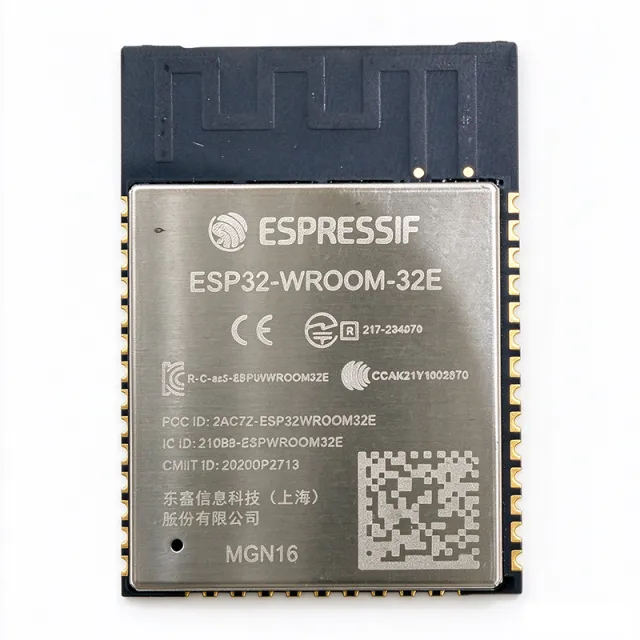
ESP32-WROOM-32E - WiFi + BT 4.2 MCU Module | Espressif
The Espressif Systems ESP32-WROOM-32E is a 2.4 GHz Wi-Fi and Bluetooth/Bluetooth LE combination module built around the ESP32-D0WD-V3 dual-core Xtensa LX6 SoC, delivering up to 240 MHz clock speed, 520 KB SRAM, and 4 MB SPI flash in a compact 18 x 25.5 x 3.1 mm castellated-pad module with an integrated PCB antenna. A Wi-Fi + Bluetooth MCU module is a surface-mount system-in-package that combines a microcontroller, radio transceiver, RF matching network, flash memory, crystal, and antenna onto a single certified PCB assembly. Such modules sit at the top of the embedded hierarchy: semiconductor -> wireless SoC -> RF-certified module -> end IoT device, letting engineers add wireless connectivity without RF design expertise or regulatory re-certification of the radio section. Key differentiating features include dual-core processing that separates Wi-Fi protocol stacks from user applications, 802.11 b/g/n with a data rate up to 150 Mbps, Bluetooth v4.2 BR/EDR and BLE Class 1/2/3 operation, and 38 castellated edge pads that allow both hand soldering and automated assembly. The castellated half-hole pads also enable mounting the module as a sub-PCB on a carrier board. Technically, the ESP32-D0WD-V3 silicon inside is the bug-fixed revision 3 die, improving RF transmit spectrum cleanliness and resolving the well-known strapping-pin flash-voltage issue found in older revision 1 silicon used in the original ESP32-WROOM-32. The module integrates a 40 MHz crystal, flash memory, and a PCB inverted-F antenna tuned during production. Typical applications include low-power sensor networks, voice encoding and MP3 streaming devices, smart-home nodes, and industrial IoT gateways, where integrated dual-radio connectivity and sufficient compute headroom are required in one certified package. For design, respect the strapping pins (GPIO0, GPIO2, GPIO12, GPIO15) at boot and keep the antenna area of the host PCB free of copper and components for best RF performance. This page synthesizes datasheet specifications, drop-in replacement options, and practical design notes not found on standard distributor listings.
ESP32-WROOM-32E-H4 - WiFi BT4.2 Module 4MB | Espressif
The Espressif Systems ESP32-WROOM-32E-H4 is a 2.4 GHz WiFi and Bluetooth 4.2 +BR/EDR/BLE combination module built on the ESP32-D0WD-V3 dual-core Xtensa LX6 SoC with 4 MB of embedded SPI flash, a PCB antenna, and a 25.5 x 18 x 3.1 mm castellated SMD package rated from -40C to +105C. A WiFi module is a self-contained embedded system that integrates a microcontroller, radio transceiver, antenna, flash memory, and power management into a single surface-mount unit, eliminating the RF design effort of discrete solutions. Within the wireless connectivity hierarchy, the ESP32-WROOM-32E-H4 sits at the system-in-package (SiP) module level: SoC (ESP32-D0WD-V3) -> module (WROOM-32E family) -> IoT device. Modules are pre-certified for radio regulatory domains, shortening time to certification for end products. Key features include dual-core 32-bit LX6 CPUs clocked up to 240 MHz, 520 KB on-chip SRAM, 802.11 b/g/n WiFi with up to 150 Mbps PHY rate and -98 dBm receive sensitivity, Bluetooth v4.2 BR/EDR and BLE, and 26 GPIOs with UART, SPI, I2C, SDIO, I2S, PWM, and 12-bit ADC peripherals. The -H4 suffix denotes 4 MB SPI flash; supply range is 3.0 V to 3.6 V with typical TX current around 112 mA and peak around 239 mA at 20 dBm output. The ESP32-D0WD-V3 silicon (ECO V3) incorporates the bug fixes and cleaner WiFi RF spectrum of the revised ESP32 revision, improving coexistence and reliability compared with original ESP32-WROOM-32 modules. The onboard PCB antenna is tuned for 2.4 GHz to 2.5 GHz operation, and the metal shield plus castellated edge pads simplify reflow assembly onto standard PCB footprints. Typical applications include smart-home devices and sensors, industrial automation and control nodes, and battery-powered IoT endpoints where integrated dual-protocol wireless reduces BOM cost and development risk. A key design consideration: the module is 3.3 V only - do not feed 5 V logic into GPIOs without level shifting, and keep copper keep-out clearance under and around the PCB antenna per Espressif hardware design guidelines. This page adds value beyond the datasheet by synthesizing distributor pricing tiers, drop-in same-footprint alternatives across flash densities, and practical engineering design notes in one place.
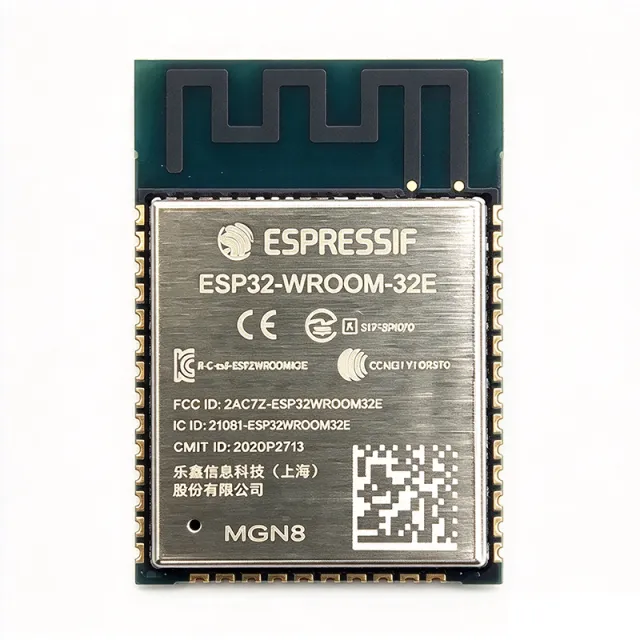
ESP32-WROOM-32E-N8 - WiFi/BT4.2 Module, 8MB Flash | Espressif
The Espressif Systems ESP32-WROOM-32E-N8 is a 2.4 GHz Wi-Fi and Bluetooth 4.2 + EDR combo module built on the ESP32-D0WD-V3 SoC with a dual-core 32-bit Xtensa LX6 processor running up to 240 MHz, 8 MB of SPI flash, and an onboard PCB antenna, housed in a 38-pin surface-mount castellated package measuring 18 x 25.5 x 3.1 mm. A Wi-Fi/BT module is an RF transceiver subsystem that integrates the radio, antenna, crystal, flash memory, and power management into a certified, ready-to-embed unit. Within the wireless connectivity hierarchy, it sits above bare SoCs (which require external RF design) and below finished development boards, serving as the standard connectivity building block for IoT products. Key features include 802.11 b/g/n Wi-Fi with Class 1, 2 and 3 Bluetooth transmit capability, 26 usable GPIOs, a rich peripheral set (SPI, I2C, UART, I2S, CAN, touch sensors, ADC/DAC), and support for simultaneous Wi-Fi and Bluetooth operation. The 8 MB SPI flash supports large application images, OTA updates, and embedded assets. Technically, the module integrates the ESP32-D0WD-V3 silicon revision 3 chip, which fixes earlier RF spectral spur issues for a cleaner Wi-Fi spectrum. The ESP32-WROOM-32E family offers 4/8/16 MB flash options; the -N8 variant is the 8 MB member. The PCB antenna is tuned for the 2.400-2.4835 GHz ISM band. Typical applications include IoT sensor nodes and smart-home devices, industrial wireless control and monitoring, and wearable or battery-powered connected products. Design consideration: keep at least 5 mm of clearance around the PCB antenna region on the host board and follow the Espressif layout guidelines to avoid detuning RF performance; supply 3.0-3.6 V with adequate peak-current capability for Wi-Fi TX bursts. This page synthesizes distributor pricing, drop-in alternatives within the same footprint, and practical design notes not found in the manufacturer datasheet.
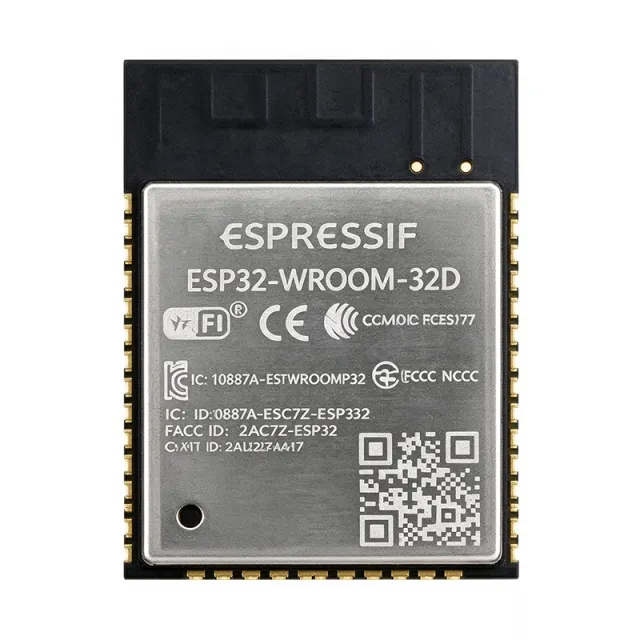
ESP32-WROOM-32E-N8R2 - WiFi/BT 4.2 Module, 8MB Flash | Espressif
The Espressif Systems ESP32-WROOM-32E-N8R2 is a 2.4 GHz Wi-Fi and Bluetooth v4.2 + EDR combo module built around the ESP32-D0WD-V3 SoC with Xtensa dual-core 32-bit LX6 processors, 8 MB of SPI flash and 2 MB of PSRAM, delivered in a shielded surface-mount package with an onboard PCB trace antenna. A Wi-Fi MCU module is a self-contained wireless system that integrates a microcontroller, radio transceiver, antenna, RF matching network, flash memory and power management on one certified PCB. Within the product hierarchy it sits between a bare SoC and a full development board: it offers complete radio certification and shielding without the overhead of a carrier board, making it the standard building block for power management, connectivity and edge computing in IoT endpoints. Key features of the N8R2 variant include 802.11 b/g/n Wi-Fi with 150 Mbps PHY rate, Bluetooth v4.2 BR/EDR and BLE, dual-core LX6 operation for concurrent application and protocol processing, and 26 GPIOs with a rich peripheral set (SPI, I2S, I2C, UART, ADC, DAC, PWM, touch). The 8 MB flash plus 2 MB PSRAM configuration gives headroom for OTA update partitions, larger TLS stacks and display frame buffers that smaller N4/N8 variants cannot support. Technically, the module integrates antenna switches, RF balun, power amplifier, low-noise receive amplifier, filters and power management on the embedded ESP32-D0WD-V3 silicon, achieving higher stability and safety performance than the original ESP32-WROOM-32. The V3 die revision adds security features such as flash encryption and secure boot support. Typical applications include smart-home devices, industrial controllers and wireless sensor nodes where both Wi-Fi and Bluetooth connectivity and extra RAM are required in a single certified footprint. Design-wise, supply the module from a clean 3.3 V rail capable of delivering 500 mA peaks, and keep the antenna region free of copper and enclosures with high dielectric constants. This page synthesizes distributor pricing, memory-variant drop-in options and practical design notes not found in the manufacturer datasheet. Pricing references are as of 2026-09-15.
EX-150AH-US - Wi-Fi HaLow Range Extender 915MHz | Silex
The Silex Technology EX-150AH-US is a Wi-Fi device range extender that bridges 802.11ah Wi-Fi HaLow communications at 915MHz with conventional 2.4GHz/5GHz Wi-Fi networks, delivering up to 32.5Mbps bit rate on the Wi-Fi HaLow interface and powered from a single 5V USB Type-C source. A Wi-Fi range extender is a networking device that re-broadcasts an existing wireless signal to expand coverage beyond the reach of a primary access point. Within the networking hierarchy, the EX-150AH-US sits in the wireless bridge and RF module family, and belongs to the broader categories of WLAN devices, RF transceivers, and wireless communication equipment. Unlike traditional 2.4GHz/5GHz extenders, it exploits the sub-1GHz 802.11ah Wi-Fi HaLow standard, which propagates roughly 10 times farther than conventional Wi-Fi and penetrates walls more effectively. Key features include the 802.11ah Wi-Fi HaLow radio operating in the 915MHz band (US model), dual-band 2.4GHz/5GHz bridging for standard Wi-Fi clients, and up to 32.5Mbps HaLow bit rate. That throughput is sufficient to sustain multiple 1080p encoded video streams simultaneously and move large data files in a shorter time. The device can also function as a Wi-Fi access point, directly extending the range of a Wi-Fi device. Technically, the EX-150AH-US performs a Wi-Fi-to-Wi-Fi protocol translation: HaLow clients or an upstream HaLow access point (such as the companion AP-150AH-US) communicate over long-range 915MHz links, and the extender re-serves traffic on standard 2.4GHz/5GHz Wi-Fi. Paired with the AP-150AH-US, one link can cover the area where several conventional Wi-Fi extenders would traditionally be required, simplifying infrastructure deployment. Typical applications include video surveillance camera backhaul, IoT and sensor networks in factories or campuses, and connectivity for battery-powered or remote devices where cabling is impractical. The long reach of Wi-Fi HaLow makes it especially valuable across large outdoor areas, multi-building sites, and metallic or concrete-heavy industrial environments. A key design consideration is power: the USB Type-C port accepts 5V, so the unit can be powered by a laptop, Android tablet, or USB battery pack, enabling portable and temporary deployments without dedicated wiring. Radio performance depends on antenna placement and regional band regulations, so use the correct regional model (the -US variant is for the 915MHz band). This page synthesizes distributor listings, the manufacturer product brief, drop-in replacement analysis, and practical deployment notes not found in the standard Silex datasheet, giving engineers a single citable reference for the EX-150AH-US.
FCE870QAAMD - Tri-Band Wi-Fi 7 Module | Quectel
Quectel FCE870QAAMD is a tri-band Wi-Fi and Bluetooth transceiver module supporting 2.4 GHz, 5 GHz, and 6 GHz bands. It supports Wi-Fi 7, Bluetooth 6.0, Wi-Fi 802.11a/b/g/n/ac/ax/be, 4K-QAM, 320 MHz bandwidth, and a peak data rate of 5.8 Gbps. The module is supplied as a surface-mount SMD component in a 13 mm × 15 mm package, with an antenna not included according to the verified distributor data. A multiprotocol wireless module combines Wi-Fi and Bluetooth radio functions in one embedded component. The Wi-Fi function supports modern wireless LAN connectivity, while Bluetooth supports short-range personal-area and device-to-device communication. FCE870QAAMD is positioned for connected products that need high-throughput, low-latency wireless links across multiple radio bands without integrating separate RF front ends. The verified data identifies Wi-Fi 7 support, Bluetooth 6.0 dual-mode operation, 2.4 GHz, 5 GHz, and 6 GHz frequency coverage, 320 MHz channel bandwidth, and 4K-QAM modulation. Quectel states a peak data rate of 5.8 Gbps for the FCE870Q family. Because the supplied source data does not include detailed electrical limits, interface voltage, pin mapping, antenna requirements, or regulatory approvals, those values must be confirmed in the manufacturer documentation before design release. Typical uses include Wi-Fi 7 gateways, smart-home controllers, industrial wireless terminals, high-bandwidth embedded systems, and connected consumer products. The module can reduce the number of discrete radio components while supporting current Wi-Fi and Bluetooth standards. Integration still requires careful RF layout, antenna design, power-supply design, host-interface firmware, and regulatory compliance for the finished product. For PCB implementation, treat the 13 mm × 15 mm SMD outline as the verified mechanical starting point and obtain the official package drawing, land pattern, pinout, and recommended reflow profile before layout. Do not assume that a distributor's module description is a substitute for the complete manufacturer datasheet. Check the authorized supply channel and confirm lead time, firmware support, and regional availability before committing to production. This page combines the verified manufacturer and distributor descriptions with an explicit data-availability boundary. It identifies the module's verified wireless capabilities, dimensions, surface-mount construction, and stated RoHS information while leaving unavailable electrical and mechanical details marked for engineering verification.
FGE573QAAMD - Wi-Fi 7 Triple-Band BLE 5.3 Module | Quectel
The Quectel FGE573QAAMD is a Wi-Fi 7 and Bluetooth 5.3 multi-protocol transceiver module operating across 2.4 GHz, 5 GHz, and 6 GHz bands with a maximum physical-layer data rate of 2.9 Gbps. Housed in a surface-mount LGA module form factor with integrated antenna RF interface, the device supports 802.11a/b/g/n/ac/ax/be, BLE 5.3, BLE Long Range, and multi-link operation (MLO) for ultra-low-latency wireless links. A Wi-Fi 7 module is a self-contained radio subsystem that integrates the RF transceiver, baseband processor, and protocol stack on a single PCB, allowing host processors to add IEEE 802.11be connectivity without RF design expertise. As part of the broader Wi-Fi module taxonomy (Wi-Fi module -> wireless SoC module -> RF transceiver module -> electronic module), the FGE573QAAMD belongs to the high-throughput multi-band segment that serves cloud gaming, AR/VR, 8K streaming, industrial IoT, and telemedicine. Key differentiating specifications include triple-band simultaneous operation across 2.4/5/6 GHz, 802.11be (Wi-Fi 7) compliance with 320 MHz channel support, BLE 5.3 with LE Long Range, and MLO for sub-millisecond handover latency. The module ships without an on-board RF filter (per the 'w/o filter' suffix in the MPN), letting designers integrate a customer-selected filter chain for regulatory or band-edge optimization. Surface-mount packaging simplifies high-volume SMT lines, while the antenna-not-included design enables antenna placement flexibility. The FGE573QAAMD uses a Qualcomm-based Wi-Fi 7 silicon platform with separate 2x2 MIMO radios for 2.4/5/7 GHz and a third 1x1 radio for 6 GHz, achieving 2.9 Gbps aggregate throughput under ideal conditions. Multi-link operation lets a single client transmit simultaneously on multiple bands, reducing latency variance for time-sensitive applications. The host interface is typically PCIe or SDIO for Wi-Fi and UART/PCM for Bluetooth, allowing the module to pair with a wide range of application processors. Typical applications include AR/VR headsets, cloud-gaming handhelds, 8K video streaming dongles, industrial IoT gateways, telemedicine endpoints, and Wi-Fi 7 access points. Its MLO support particularly benefits variable-latency workloads such as cloud rendering and industrial robotics. The wide-band triple-radio architecture suits gateways, mesh routers, and edge-AI appliances requiring simultaneous high-throughput backhaul and low-power BLE provisioning. When designing with this module, ensure the host processor supplies stable 3.3 V to the module's VBAT rail and that the antenna trace is a 50 ohm controlled-impedance line with a pi-network footprint reserved for the missing filter. Thermal management is generally passive because the module's average dissipation is below 1.5 W, but a copper keep-out region is recommended under the antenna. Always validate the regulatory domain (FCC, CE, MIC) for the specific 6 GHz band subset in your deployment region. This page synthesizes distributor pricing, drop-in alternatives, application pairings, and practical design notes not found in the manufacturer datasheet alone.
FGE576QAAMD - Wi-Fi 7 + BT 5.3 Triple-Band Module | Quectel
The Quectel FGE576QAAMD is a highly integrated Wi-Fi 7 and Bluetooth 5.3 short-range transceiver module that supports triple-band operation across 2.4 GHz, 5 GHz, and 6 GHz with a maximum physical-layer data rate of 3.6 Gbps. The module is delivered as a surface-mount LGA-style SiP that combines the radio transceiver, baseband, and power management, and is offered in an antenna-not-included variant for designs where an external antenna or u.FL connector is required. According to the Quectel FGE576Q specification document, the FGE576QAAMD supports dual-band simultaneous operation (2.4 GHz + 5 GHz and 2.4 GHz + 6 GHz), 4K-QAM modulation, 160 MHz channel bandwidth, and ultra-low latency suitable for real-time response applications. A Wi-Fi 7 module belongs to the IEEE 802.11be family of wireless transceivers and sits within the broader hierarchy of short-range wireless modules -> wireless modules -> RF & Wireless -> electronic component. Wi-Fi 7 (802.11be) introduces 320 MHz channels, 4K-QAM, multi-link operation (MLO), and multi-resource unit (MRU) features that materially improve throughput, latency, and spectrum efficiency compared to Wi-Fi 6/6E. Bluetooth 5.3 adds LE Audio, isochronous channels, and connection subrating for power-efficient audio streaming, making combined Wi-Fi 7 + BT 5.3 modules the reference connectivity solution for next-generation gateways, AIoT edge devices, and premium consumer electronics. Key differentiating features of the FGE576QAAMD include: triple-band 2.4/5/6 GHz support (vs dual-band on most Wi-Fi 6 modules), 4K-QAM which adds two bits per symbol versus 1024-QAM, 160 MHz channel bandwidth for high-throughput operation, multi-link operation for simultaneous multi-band aggregation, and integrated Bluetooth 5.3 with BLE Long Range. Together these specifications enable AR/VR offload, 8K video streaming, real-time cloud gaming, and Matter-over-Wi-Fi commissioning in a single silicon footprint. Architecturally, the FGE576QAAMD integrates a 2x2 MIMO RF front end, baseband processor, MAC, and power-management circuits in a single shielded module package. The module exposes an SDIO or PCIe host interface depending on firmware configuration, and the antenna-not-included variant allows OEM antenna tuning for end-product certifications (FCC, CE, MIC, NCC, etc.). Typical applications include Wi-Fi 7 home gateways and mesh nodes, premium AIoT hubs with edge inference, AR/VR streaming gateways, 4K/8K wireless display dongles, smart-home Matter bridges, and industrial gateways needing low-latency wireless backhaul. The triple-band capability is most useful when the 6 GHz spectrum is locally available (US, EU regions under 6E/7 rules) because the 2.4 GHz + 6 GHz combination provides low interference for high-throughput links. When designing with this module, note that the antenna-not-included variant requires the integrator to source, tune, and certify an external antenna chain. Most regions require radiated testing on the final integrated product; Quectel provides an antenna reference design in the FGE576Q hardware design guide. Confirm regulatory status with Quectel regional support for the target market. This page synthesizes distributor stock, drop-in module alternatives, and design considerations not present in the manufacturer datasheet.
FGH100MAAM2 - Wi-Fi HaLow 802.11ah Module 850-950MHz | Quectel
The Quectel FGH100MAAM2 is a long-range, low-power Wi-Fi HaLow transceiver module compliant with the IEEE 802.11ah standard, operating in the license-exempt sub-1 GHz band at 850 MHz to 950 MHz with up to 21 dBm output power, housed in an M.2 surface-mount form factor. Wi-Fi HaLow (IEEE 802.11ah) is a sub-1 GHz variant of the Wi-Fi standard family designed specifically for long-range, low-power connectivity. Where conventional 2.4 GHz and 5 GHz Wi-Fi trade range for bandwidth, Wi-Fi HaLow reaches roughly ten times farther than traditional Wi-Fi while maintaining IP-based networking, making it a member of the broader family of wireless transceiver modules and RF modems used in IoT and industrial communication systems. Key features of the FGH100MAAM2 include operation across the 850-950 MHz license-exempt sub-1 GHz band, a maximum RF output power of 21 dBm, and host interfaces comprising SDIO 2.0 and SPI, providing flexible integration with a wide range of host processors. The module is supplied from a 3.0 V to 3.6 V DC supply, compatible with common embedded power rails, and the M.2 package format enables standard socketed or soldered integration on carrier boards. The sub-1 GHz operation delivers superior wall and foliage penetration compared with higher-frequency radios, and the 802.11ah protocol adds power-saving mechanisms suited to battery-powered endpoints. As an open Wi-Fi standard, Wi-Fi HaLow interoperates with standard IP stacks and security frameworks, reducing software development effort relative to proprietary sub-GHz stacks. Typical applications include smart city and smart building sensor networks, industrial automation backhaul, security cameras over long distances, agricultural monitoring, and utility metering - scenarios where kilometer-scale range and low power draw matter more than raw throughput. When designing with the FGH100MAAM2, verify that the target regional regulatory domain permits operation in the selected sub-band of 850-950 MHz, and note that per distributor listings the antenna is not included - plan for an external antenna and connector accordingly. This page synthesizes distributor pricing, availability, alternatives, and practical design notes not found in the manufacturer datasheet, providing engineers with a single citable reference for the Quectel FGH100MAAM2.