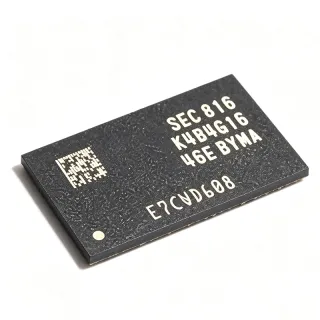
K4A4G045WD-BCRC - 4Gb DDR4 SDRAM x4, 1.2V | Samsung
N.º de pieza: K4A4G045WD-BCRC ✓ Activo| Cant. | Precio unitario | Total |
|---|---|---|
| 1 | $4.9 | $4,90 |
| 10 | $4.6 | $46,00 |
| 100 | $4.2 | $420,00 |
| 500 | $3.8 | $1.900,00 |
| 1.000 | $3.45 | $3.450,00 |
K4A4G045WD-BCRC Descripción general
DDR4 SDRAM (Double Data Rate 4 Synchronous Dynamic Random Access Memory) is the fourth generation of the DDR DRAM family, defined by JEDEC as the successor to DDR3. In the memory hierarchy, this device is a DRAM component (not a module) that sits beneath memory modules and above NAND storage, providing volatile, high-speed working memory for processors and SoCs. DDR4 lowers the core operating voltage to 1.2V versus 1.5V for DDR3, increases bank counts, and adds features such as bank groups and a 2n refresh architecture for 8Gb-class devices.
Key features of the K4A4G045WD include 4Gb density on Samsung's D-die process, a x4 organization suited to error-correcting-code (ECC) memory subsystems where check bits run on dedicated data lanes, and a 78-ball fine-pitch BGA footprint that supports high-density memory arrays. DDR4's 8-bank group structure (four groups of four banks) with tCCD_S/tCCD_L timings enables higher effective bandwidth than DDR3 at the same clock.
Technically, the device uses a double-data-rate command/address interface and on-die termination (ODT) to maintain signal integrity at 2400 Mbps transfer rates. A differential clock pair (CK/CK#) and strobes (DQS/DQS#) window data capture, while a reset pin (RESET#) allows low standby power. As an ECC-friendly x4 device, it is typically paired with memory controllers supporting SECDED error correction for industrial and server-class reliability.
Typical applications include embedded and industrial motherboards, networking line cards, storage controllers, and server DIMMs where long-term component availability matters. Samsung positions this DDR4 lineup for embedded, industrial, and server-grade memory applications as the industry migrates toward DDR5.
Design consideration: DDR4 routing requires length-matched fly-by command/address topology, per-byte termination, and careful VREF training; consult the memory controller's DDR4 design guide before layout.
This page synthesizes distributor stock data, drop-in alternatives, and practical design notes not found in the manufacturer datasheet alone. Pricing is quote-based as of 2026-09-04.
Alternativas directas para K4A4G045WD-BCRC — mismo encapsulado, compatible pin a pin. Se excluyen las piezas de otro encapsulado que requieren retrabajo de la PCB.
Variantes de esta serie
Modelos de la misma serie compatibles directamente con K4A4G045WD-BCRC (mismo factor de forma y huella) — difiere en Package, Memory Type, Interface, Organization, Burst Length.
Herramienta de comparación rápida — seleccione piezas alternativas para compararlas lado a lado:
K4A4G045WD-BCPB
✅ Sustitución directa✓ En stock
$2.2 / unidad
Ver hoja de datos →K4A4G045WD-BCRC0
✅ Sustitución directa📋 Alternativa de referencia (no en el catálogo)
K4A8G045WD-BCTD
✅ Sustitución directa ⚠️ Especificaciones sin verificar📋 Alternativa de referencia (no en el catálogo)
K4A4G085WD-BCRC
✅ Sustitución directa ⚠️ Especificaciones sin verificar✓ En stock
$3.58 / unidad
Ver hoja de datos →K4A4G045WD-BCRC Especificaciones
| Tipo de memoria | DDR4 SDRAM |
| Density | 4 Gb |
| Organización de memoria | 1G x4 |
| Die Generation | D-die |
| Supply Voltage VDD | 1.2 V |
| Speed Grade / Data Rate | BCRC (2400 Mbps per Samsung product selection guide) |
| Encapsulado | TFBGA-78 (FBGA-78) |
| Number of Terminals | 78 |
| Self Refresh | Yes |
| Tipo de montaje | Surface Mount |
| Bank Architecture | DDR4 8 internal banks with bank groups |
| Refresh | Self refresh supported (per Partstack listing) |
Guía de configuración de pines de K4A4G045WD-BCRC tfbga-78 (fbga-78)
Configuración de pines para K4A4G045WD-BCRC (encapsulado tfbga-78 (fbga-78)). La numeración de pines, las funciones y los diagramas de conexión se definen en la hoja de datos del fabricante. Consúltela para conocer el footprint exacto y las directrices de soldadura.

No hay datos detallados de patillaje disponibles para K4A4G045WD-BCRC.
Consulte la hoja de datos para ver la configuración completa de patillas.
Aplicaciones típicas
K4A4G045WD-BCRC es adecuado para 6 aplicacións: Industrial Embedded Motherboards, Server and ECC Memory Subsystems, Networking Line Cards, Storage Controllers and SSD Boards, Medical and Test Instrumentation, Automotive and Rugged Embedded Systems.
Industrial Embedded Motherboards
Industrial controllers and embedded motherboards benefit directly from the K4A4G045WD-BCRC's combination of 4Gb density, x4 ECC-friendly organization, and Samsung's stated focus on long-term availability for embedded applications. The device operates at 1.2V, reducing DDR rail power versus 1.5V DDR3, which simplifies thermal design in fanless enclosures. At the 2400 Mbps BCRC bin, a single x4 component delivers 1.2 GB/s peak per lane direction, and multiple components can be ganged for 64-bit buses. Designers should pair the component with an ECC-capable SoC or memory controller so the x4 organization delivers single-device-failure correction, a common requirement in 24/7 industrial equipment.
Recomendado
Server and ECC Memory Subsystems
The x4 organization of the K4A4G045WD-BCRC is specifically designed for ECC memory subsystems found in server boards and registered DIMMs, where check bits run on dedicated x4 lanes and single-device data failures are correctable. At the BCRC 2400 Mbps bin, the device matches mainstream server memory controller training tables, including read/write leveling and ODT settings. Samsung explicitly targets server-grade memory applications for this DDR4 lineup. When designing, respect the DDR4 fly-by command/address topology and bank-group timing (tCCD_S/tCCD_L) to achieve full effective bandwidth; the 8-bank group architecture is what differentiates DDR4 throughput from DDR3 at equal clocks.
Recomendado
Networking Line Cards
Networking equipment such as switch and router line cards uses DDR4 SDRAM for packet buffers, flow tables, and management-plane working memory. The K4A4G045WD-BCRC's 4Gb density provides 512 MB of buffering per component, and its 2400 Mbps BCRC speed bin supplies 1.2 GB/s peak bandwidth per x4 lane, enough for deep-packet-buffer designs when ganged into 64-bit or 72-bit (ECC) buses. Samsung positions this part for long-term availability, important for telecom equipment with multi-year deployment cycles. Place the DRAM within short trace lengths of the network processor and follow the vendor's DDR4 layout guide for fly-by topology and per-lane length matching.
Recomendado
Storage Controllers and SSD Boards
Enterprise SSD controllers and RAID cards use DDR4 SDRAM as metadata cache and write coalescing memory. The K4A4G045WD-BCRC's 1.2V operation limits power overhead in dense storage enclosures, while ECC-friendly x4 organization protects the mapping tables whose corruption would destroy data integrity. With 4Gb per component, a controller can host gigabytes of cache with a handful of 78-ball devices on a compact PCB. The BCRC 2400 Mbps bin matches common storage-controller PHYs. Designers should implement controller-level scrubbing and use the device's self-refresh mode during host idle states to cut standby power without losing cache contents.
Recomendado
Medical and Test Instrumentation
Medical imaging and test-and-measurement instruments require large working memory for waveform capture, image pipelines, and analysis buffers. The K4A4G045WD-BCRC provides 4Gb per component with deterministic DDR4 timing at the 2400 Mbps bin, supporting sustained streaming into capture buffers. Its x4 organization allows ECC coverage, which supports reliability requirements in diagnostic equipment. Samsung's long-term-availability positioning for embedded applications suits multi-year medical product lifecycles. At 1.2V VDD the DDR rail contributes little heat in sealed instrument enclosures; nonetheless, verify power-plane integrity because 2400 Mbps operation draws high transient currents during burst accesses.
Recomendado
Automotive and Rugged Embedded Systems
Although the standard K4A4G045WD-BCRC should be validated against the required temperature grade for automotive programs, the same D-die DDR4 platform is used in rugged embedded computing for telematics, gateways, and driver-assistance pre-processing. The 4Gb density supports map data, sensor fusion buffers, and logging storage, while ECC via the x4 organization meets functional-safety expectations for memory integrity. Operating at 1.2V reduces DDR power dissipation in constrained thermal environments. Before deployment, confirm the speed-bin temperature table in the Samsung datasheet and consider an extended-temperature ordering suffix if the program requires AEC-grade screening.
Recomendado
Resumen de productos recomendados
Datos de referencia de ingeniería para K4A4G045WD-BCRC — comparación, orientación de diseño e información de cumplimiento.
Guía de selección
Comparación con alternativas
| Parámetro | Este producto | K4A4G045WD-BCPB | K4A4G045WD-BCRC0 | K4A8G045WD-BCTD | K4A4G085WD-BCRC |
|---|---|---|---|---|---|
| Package | TFBGA-78 (FBGA-78) | TFBGA-78 - same | TFBGA-78 - same | TFBGA-78 - same footprint family | TFBGA-78 - same footprint family |
| Brand | Samsung Electronics | Samsung Electronics | Samsung Electronics | Samsung Electronics | Samsung Electronics |
| Density | 4 Gb | 4 Gb | 4 Gb | 8 Gb | 4 Gb |
| Organization | 1G x4 | 1G x4 | 1G x4 | 2G x4 | 512M x8 |
| Supply Voltage | 1.2 V | 1.2 V | 1.2 V | 1.2 V | 1.2 V |
| Self Refresh | Yes | Yes | Yes | Yes | Yes |
| ECC Suitability (x4 lanes) | Yes | Yes (x4) | Yes (x4) | Yes (x4) | No (x8) |
Diferenciadores clave
- ECC-friendly x4 organization (frente a K4A4G085WD-BCRC)
- Same footprint, double density upgrade path (frente a K4A8G045WD-BCTD)
- Identical silicon with alternate reliability flow (frente a K4A4G045WD-BCPB)
Notas de diseño
Route the single x4 data lane of the K4A4G045WD-BCRC with DQS/DQS# length-matched to DQ within the skew budget in the Samsung datasheet, and use fly-by routing for address/command with the terminating resistor at the last DRAM on the bus. At the 2400 Mbps BCRC bin, enable on-die termination (ODT) values from the controller training algorithm rather than fixed values, and budget for read/write leveling during bring-up.
The 1.2V VDD rail should be generated by a low-noise buck stage with good transient response; a TPS54218-class converter is a common pairing. DDR4 peak burst currents are high at 2400 Mbps, so use a solid plane for VDD and VSS, place bulk capacitance near the DRAM bank, and add per-ball high-frequency decoupling. Estimated: at 2400 Mbps with typical activity factors, plan for the current figures in the Samsung datasheet IDD table rather than assuming DDR3 values.
Do not hold RESET# floating during power-up: DDR4 requires RESET# low until all rails are stable, otherwise the device may enter an undefined state and fail training. Also avoid mixing speed bins with different suffix flows (e.g., BCRC and BCPB) on the same bus without validating CAS latency and tRCD tables against both datasheet sections - same-die parts can still differ in timing bin documentation.
Información de cumplimiento
RoHS/lead-free status not stated in provided data. One listing (IC Components) references a lead-free status field but the value was not specified; confirm via Samsung's official environmental documentation.