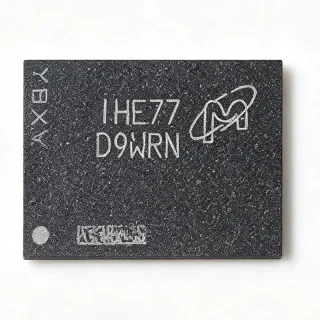
MT53D384M32D2DS-046 - 12Gbit LPDDR4 SDRAM 2133MHz | Micron
N.º de pieza: MT53D384M32D2DS-046 ✓ Activo| Cant. | Precio unitario | Total |
|---|---|---|
| 1 | $0 | $0,00 |
| 10 | $0 | $0,00 |
| 100 | $0 | $0,00 |
| 500 | $0 | $0,00 |
| 1.000 | $0 | $0,00 |
MT53D384M32D2DS-046 Descripción general
LPDDR4 (Low Power Double Data Rate 4) SDRAM is a JEDEC-defined class of DRAM optimized for mobile and power-sensitive embedded systems. Sitting in the hierarchy of volatile memory ICs under SDRAM, LPDDR4 lowers core voltage relative to DDR4 and introduces features such as bank grouping and low-power self-refresh states, making it the dominant DRAM family for smartphones, tablets, automotive infotainment, and edge computing platforms.
Key features of this device include its 12Gbit density in a single-die configuration, a 32-bit data bus width that simplifies memory controller interfacing, and the 200-ball WFBGA (10 x 14.5 mm) fine-pitch ball grid array footprint used widely across Micron LPDDR4 family members. The -046 speed bin delivers a 2.133 GHz clock, enabling high-bandwidth data transfer for memory-hungry processors.
Architecturally, the LPDDR4 core uses bank groups to permit interleaved accesses and achieves high effective bandwidth through double-data-rate signaling on the 1.1V VDD2 core domain with a separate VDDQ interface domain. Commands, addresses, and data are multiplexed to conserve ball count in the 200-ball package.
Typical applications include automotive infotainment and ADAS platforms (the AUT:C grade variant targets automotive qualification requirements), industrial edge-AI gateways, networking equipment, and high-resolution camera buffer memory in mobile devices.
A key design consideration: LPDDR4 requires careful attention to the controller initialization sequence, ZQ calibration, and length-matched PCB routing on the address/command and data buses; supply sequencing between VDD1, VDD2, and VDDQ domains must follow the Micron datasheet ordering.
This page synthesizes distributor pricing context, drop-in grade-variant alternatives, and practical design notes not found in a single manufacturer datasheet.
Alternativas directas para MT53D384M32D2DS-046 — mismo encapsulado, compatible pin a pin. Se excluyen las piezas de otro encapsulado que requieren retrabajo de la PCB.
Herramienta de comparación rápida — seleccione piezas alternativas para compararlas lado a lado:
MT53D384M32D2DS-046 AUT:E
✅ Sustitución directa📋 Alternativa de referencia (no en el catálogo)
MT53D384M32D2DS-046 AIT:C
✅ Sustitución directa📋 Alternativa de referencia (no en el catálogo)
MT53D384M32D2DS-046 AIT:E
✅ Sustitución directa📋 Alternativa de referencia (no en el catálogo)
MT53D384M32D2DS-046 AAT:E
✅ Sustitución directa📋 Alternativa de referencia (no en el catálogo)
MT53D384M32D2DS-046 WT:E
✅ Sustitución directa📋 Alternativa de referencia (no en el catálogo)
MT53D384M32D2DS-046 Valores máximos y características eléctricas
| Tipo de memoria | Mobile LPDDR4 SDRAM |
| Memory Density | 12 Gbit |
| Organización de memoria | 384M x 32 |
| Clock Frequency | 2.133 GHz |
| Tensión de alimentación | 1.1 V |
| Encapsulado | 200-WFBGA (10 x 14.5 mm) |
| Tipo de montaje | Surface Mount (BGA) |
| Access Type | Synchronous, Double Data Rate |
| Speed Grade | -046 |
| Ancho del bus de datos | 32 bit |
| Ball Count | 200 |
| Package Dimensions | 10 mm x 14.5 mm |
Guía de configuración de pines de MT53D384M32D2DS-046 10 mm x 14.5 mm
Configuración de pines para MT53D384M32D2DS-046 (encapsulado 10 mm x 14.5 mm). Este CI digital incluye GPIO, interfaces de comunicación (UART, SPI, I2C) y pines de alimentación. Consulte la hoja de datos del fabricante para conocer las funciones alternativas de los pines y las opciones de configuración. Esencial para el diseño de sistemas embebidos y el diseño de PCB.

No hay datos detallados de patillaje disponibles para MT53D384M32D2DS-046.
Consulte la hoja de datos para ver la configuración completa de patillas.
Aplicaciones típicas
MT53D384M32D2DS-046 es adecuado para 6 aplicacións: Automotive Infotainment and Cluster, Industrial Edge-AI Gateways, Mobile and Tablet Main Memory, Networking and Communication Equipment, High-Resolution Camera Buffering, Embedded Compute Modules (SOM/COM).
Automotive Infotainment and Cluster
The AUT:C and AAT:E grade variants of the MT53D384M32D2DS-046 target automotive infotainment, digital cockpit, and instrument cluster platforms where automotive temperature grades are mandatory. The 12Gbit density provides sufficient working memory for HD graphics composition and navigation databases, while the 384M x 32 organization with 2.133 GHz clock feeds the bandwidth-hungry memory controllers of automotive SoCs. The LPDDR4 architecture keeps standby power low through self-refresh during ignition-off states, preserving battery life in vehicles. Implemented as a point-to-point 32-bit channel, the 200-ball WFBGA (10 x 14.5 mm) package supports compact stack-up designs typical of automotive head units.
Recomendado
Industrial Edge-AI Gateways
The AIT:C industrial-grade MT53D384M32D2DS-046 suits edge-AI gateways and industrial PCs that run vision inference or predictive-maintenance workloads. Its 12Gbit capacity accommodates neural-network activation buffers and frame queues, and the 2.133 GHz data rate delivers the sustained bandwidth that AI accelerators require. Compared with DDR4 DIMM solutions, LPDDR4 reduces idle power and total board area via the 32-bit 200-WFBGA (10 x 14.5 mm) footprint. Designers should validate the controller training sequence across the industrial temperature range and reserve the full 1.1V-domain decoupling network recommended in the Micron LPDDR4 design guide.
Recomendado
Mobile and Tablet Main Memory
The MT53D384M32D2DS-046 was designed primarily as main system memory for smartphones, tablets, and portable media devices. The 384M x 32 organization maps directly to the 32-bit LPDDR4 channels of mobile application processors, and the 12Gbit density supports flagship-class multitasking. LPDDR4's lower VDD domains and deep power-down states extend battery runtime in standby, a decisive advantage over standard DDR4. The 200-ball WFBGA (10 x 14.5 mm) package supports PoP-style compact boards. For consumer/mobile builds, the WT:E commercial-grade variant is typically selected to optimize cost and availability.
Recomendado
Networking and Communication Equipment
Routers, switches, and 5G small-cell platforms use the MT53D384M32D2DS-046 as packet buffer and control-plane memory. The 32-bit bus at 2.133 GHz provides the deterministic bandwidth needed for line-rate forwarding engines, while the 12Gbit capacity holds flow tables and queue descriptors. The AIT:C industrial grade covers extended ambient conditions typical of telecom cabinets. During layout, byte-lane length matching and reference-plane integrity on the 1.1V domain are critical at this data rate. The 200-WFBGA (10 x 14.5 mm) footprint simplifies four- or eight-device, wide-bus memory subsystems on compact line cards.
Recomendado
High-Resolution Camera Buffering
Machine-vision cameras, security systems, and automotive surround-view modules use the MT53D384M32D2DS-046 to buffer high-resolution sensor streams before ISP processing or compression. A 4K sensor at 30 fps generates sustained multi-Gbps streams that the 2.133 GHz LPDDR4 interface can absorb with the 384M x 32 organization providing 1.5 GB of frame storage. The AUT:C grade supports camera modules exposed to automotive ambient profiles. Frame write and read bursts benefit from LPDDR4 bank-group interleaving, reducing latency spikes that would otherwise drop frames in burst-heavy vision pipelines.
Recomendado
Embedded Compute Modules (SOM/COM)
System-on-module vendors embed the MT53D384M32D2DS-046 to provide 1.5 GB of soldered DRAM on compact compute modules for robotics, medical devices, and IoT gateways. LPDDR4-on-package memory avoids the height and reliability concerns of socketed DIMMs and the 200-WFBGA (10 x 14.5 mm) package fits standard module stack heights. The 32-bit organization pairs cleanly with single-channel SoC memory controllers, and 2.133 GHz operation sustains Linux/RTOS workloads. Designers using the AIT:C grade gain industrial temperature coverage without changing the footprint or controller firmware relative to commercial builds.
Recomendado
Resumen de productos recomendados
Datos de referencia de ingeniería para MT53D384M32D2DS-046 — comparación, orientación de diseño e información de cumplimiento.
Guía de selección
Comparación con alternativas
| Parámetro | Este producto | MT53D384M32D2DS-046 AUT:E | MT53D384M32D2DS-046 AIT:C | MT53D384M32D2DS-046 WT:E |
|---|---|---|---|---|
| Package | 200-WFBGA (10 x 14.5 mm) | 200-WFBGA (10 x 14.5 mm) - same | 200-WFBGA (10 x 14.5 mm) - same | 200-WFBGA (10 x 14.5 mm) - same |
| Brand | Micron Technology | Micron Technology | Micron Technology | Micron Technology |
| Density | 12 Gbit | 12 Gbit | 12 Gbit | 12 Gbit |
| Organization | 384M x 32 | 384M x 32 | 384M x 32 | 384M x 32 |
| Clock Frequency | 2.133 GHz | 2.133 GHz | 2.133 GHz | 2.133 GHz |
| Supply Voltage | 1.1 V | 1.1 V | 1.1 V | 1.1 V |
| Temperature Grade | Automotive (AUT prefix) | Automotive | Industrial | Commercial/Standard |
| Die/Quality Revision | C | E | C | E |
Diferenciadores clave
- Automotive temperature grade availability (frente a MT53D384M32D2DS-046 WT:E)
- 12Gbit density in single 32-bit device (frente a MT53D384M32D2DS-046 AIT:C)
- Cost-optimized consumer option (frente a MT53D384M32D2DS-046 AAT:E)
Notas de diseño
At the -046 speed bin (2.133 GHz clock), the 32-bit data bus must be routed as byte lanes with intra-lane length matching per the Micron LPDDR4 design guide. Keep trace skew within controller training window margins, maintain controlled impedance on CA and DQ nets, and reference signals to a continuous ground plane on the 1.1V domain. Avoid routing memory signals across plane splits near the 200-WFBGA escape region, and simulate the eye diagram at the package ball before finalizing the stack-up.
The MT53D384M32D2DS-046 operates from a 1.1V supply domain. Provide dedicated decoupling per the Micron datasheet power-delivery section: bulk capacitance at the VRM plus local high-frequency ceramics placed inside the BGA ball field. LPDDR4 peak current during read/write training bursts is significantly higher than average - size the regulator for transient response, not just average current, and verify the power-down and self-refresh current budget for battery-operated designs.
Do not substitute grade suffixes without controller revalidation: the AUT:C, AIT:C, and WT:E variants share silicon and pinout but differ in temperature grade, and E-revision parts may differ in initialization details from C-revision parts. Always run full read/write training and margin tests on the actual mounted revision. Also confirm the die/quality revision letter with your SoC vendor's memory compatibility list, as some controllers whitelist specific revisions only.
Información de cumplimiento
Compliance details were not included in the verified web data for this MPN. Automotive-grade variants (AUT/AAT prefixes) are marketed for automotive applications; consult the Micron product page and datasheet for RoHS, REACH, and AEC qualification statements.