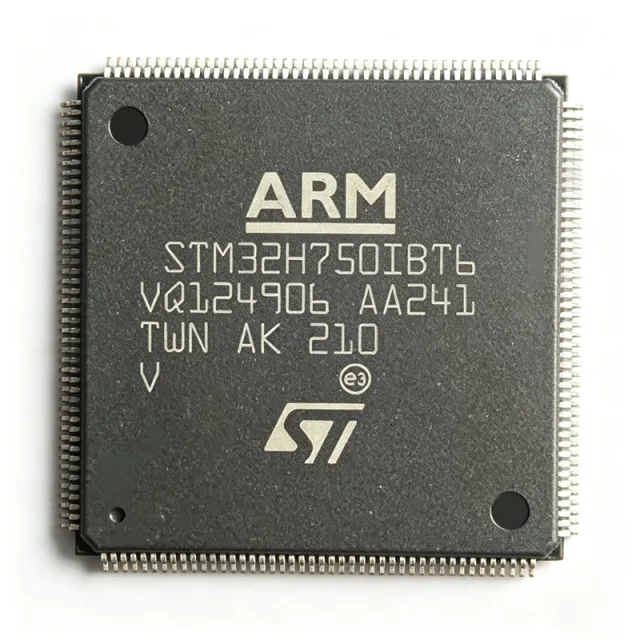
STM32H750IBT6 - 480MHz Cortex-M7 MCU 128KB Flash | ST
N.º de pieza: STM32H750IBT6 ✓ Activo| Cant. | Precio unitario | Total |
|---|---|---|
| 1 | $11.17 | $11,17 |
| 10 | $10.61 | $106,10 |
| 100 | $9.95 | $995,00 |
| 500 | $9.4 | $4.700,00 |
| 1.000 | $8.85 | $8.850,00 |
STM32H750IBT6 Descripción general
A microcontroller (MCU) is a compact integrated circuit that combines a processor core, memory, and programmable input/output peripherals on a single chip to govern a specific operation in an embedded system. The STM32H750IBT6 sits at the top of the embedded processing hierarchy: MCU -> ARM Cortex-M7 -> STM32H7 series -> STM32 family -> 32-bit microcontroller, positioned above mainstream STM32F4/F7 parts for compute-intensive applications.
Key features include a 480 MHz Cortex-M7 core with double-precision FPU, 1 MB of SRAM, a comprehensive peripheral set with multiple 16-bit ADCs, DACs, high-resolution timers, and communication interfaces including SPI, I2C, UART, CAN, USB, and Ethernet. ST reports 1027 CoreMark and 2143 DMIPS performance for the 480 MHz Cortex-M7, and the chip integrates a Chrom-ART graphics accelerator, JPEG codec, and TFT-LCD controller for HMI designs.
Architecturally, the device leverages a 6-stage Cortex-M7 pipeline with an ART Accelerator and L1 caches, delivering approximately 2.14 CoreMark/MHz. It includes a Memory Protection Unit (MPU), single- and double-precision FPU, DSP instruction extensions, and a flexible memory controller (FMC) supporting external SDRAM, SRAM, and NOR/NAND flash. Boot from flash, SRAM, or system memory is supported. Because the STM32H750 series carries only a small 128 KB user flash, code is typically executed in place from external QSPI or memory-mapped flash in large applications, while the 1 MB internal RAM covers buffers, frame buffers, and real-time data.
Typical applications include industrial motor control, digital power conversion, high-end HMI with TFT displays, audio processing, and test and measurement equipment. High-resolution timers plus fast ADCs enable precise PWM and current sensing, while the 480 MHz core handles complex control loops and signal processing.
Design consideration: ensure solid decoupling on all VDD/VSS pairs and a low-impedance ground plane, since a 480 MHz core demands careful PCB layout for signal integrity and EMI control.
This page adds value beyond the ST datasheet by synthesizing distributor pricing as of 2026-09-01, drop-in alternatives, and practical design guidance in one place.
Alternativas directas para STM32H750IBT6 — mismo encapsulado, compatible pin a pin. Se excluyen las piezas de otro encapsulado que requieren retrabajo de la PCB.
Variantes de esta serie
Modelos de la misma serie compatibles directamente con STM32H750IBT6 (mismo factor de forma y huella) — difiere en Package, Communication Interfaces, SRAM, Flash Memory, Operating Temperature.
Herramienta de comparación rápida — seleccione piezas alternativas para compararlas lado a lado:
STM32H730IBT6
✅ Sustitución directa ⚠️ Especificaciones sin verificar✓ En stock
$8.5 / unidad
Ver hoja de datos →STM32H743IIT6
✅ Sustitución directa✓ En stock
$12 / unidad
Ver hoja de datos →STM32H753IIT6
✅ Sustitución directa✓ En stock
$9.45 / unidad
Ver hoja de datos →STM32F779BIT6
✅ Sustitución directa ⚠️ Especificaciones sin verificar✓ En stock
$11.75 / unidad
Ver hoja de datos →STM32F746IGT6E
✅ Sustitución directa📋 Alternativa de referencia (no en el catálogo)
STM32H7A3IGT6
✅ Sustitución directa📋 Alternativa de referencia (no en el catálogo)
STM32H750IBT6 Valores máximos y características eléctricas
| Core Processor | ARM Cortex-M7 (32-bit) |
| Core Size | 32-bit |
| Frecuencia de reloj máxima | 480 MHz |
| Flash Memory | 128 KB |
| RAM Size | 1 MB |
| Supply Voltage Range | 1.62 V to 3.6 V |
| Temperatura de funcionamiento | -40C to +85C |
| FPU | Yes (single and double precision) |
| Performance | 1027 CoreMark / 2143 DMIPS (at 480 MHz) |
| Connectivity | CAN, I2C, SPI, UART/USART, USB, Ethernet |
| Peripherals | DMA, PWM, WDT, ADC, DAC, TFT-LCD controller, JPEG codec, Chrom-ART accelerator |
| Encapsulado | 176-LQFP (24x24 mm) |
| Tipo de montaje | Surface Mount |
| Series | STM32H7 |
| Estado RoHS | Compliant |
| Security Features | Cryptographic hardware acceleration |
Guía de configuración de pines de STM32H750IBT6 176-lqfp (24x24 mm)
Configuración de pines para STM32H750IBT6 (encapsulado 176-lqfp (24x24 mm)). Este CI digital incluye GPIO, interfaces de comunicación (UART, SPI, I2C) y pines de alimentación. Consulte la hoja de datos del fabricante para conocer las funciones alternativas de los pines y las opciones de configuración. Esencial para el diseño de sistemas embebidos y el diseño de PCB.

No hay datos detallados de patillaje disponibles para STM32H750IBT6.
Consulte la hoja de datos para ver la configuración completa de patillas.
Aplicaciones típicas
STM32H750IBT6 es adecuado para 6 aplicacións: Industrial Motor Control, High-End HMI and TFT Displays, Digital Power Conversion, Audio Processing and Pro Sound, Test and Measurement Equipment, Industrial IoT and Edge Nodes.
Industrial Motor Control
The STM32H750IBT6 fits industrial motor control because its 480 MHz Cortex-M7 core executes field-oriented control (FOC) with wide margin, its high-resolution timers deliver fine PWM resolution, and its fast 16-bit ADCs sample phase currents with low latency. The DSP instruction set and double-precision FPU accelerate Clark/Park transforms and PI loops without fixed-point scaling effort. In a typical topology, timers drive a three-phase inverter while ADC injections triggered by the same timer capture current readings synchronously with PWM, minimizing control-loop jitter. The quantified benefit is deterministic sub-microsecond loop timing at 480 MHz, sufficient for high-speed servo and digital-power applications, with the LQFP176 pin count providing enough timers and GPIO for multi-axis systems.
Recomendado
High-End HMI and TFT Displays
For human-machine interface designs, the STM32H750IBT6 integrates a TFT-LCD controller, JPEG codec, and Chrom-ART graphics DMA accelerator, so graphical composition offloads from the CPU while the 480 MHz core runs application logic. The 1 MB internal SRAM holds frame buffers for mid-size displays without external RAM, and the FMC or OCTOSPI interface can add SDRAM and memory-mapped QSPI flash for larger UI assets. Because the H750 value line carries only 128 KB internal flash, the standard architecture stores UI resources and code in external QSPI and executes in place through the ART accelerator. The result is smooth animation and fast boot in industrial panels and medical interfaces at a value-line price point.
Recomendado
Digital Power Conversion
The STM32H750IBT6 suits digital power supplies, solar inverters, and PFC stages where control-loop speed determines efficiency and stability. Its 480 MHz Cortex-M7 with DSP extensions computes multi-loop control in microseconds, while high-resolution timers generate PWM with sub-nanosecond effective resolution for phase-shifted and interleaved topologies. Fast ADCs with hardware trigger coupling to PWM events enable cycle-by-cycle current limiting without software latency. Designers pair the MCU with external gate drivers and isolated feedback; the typical placement is the MCU as central digital controller reading voltage/current sensors and driving PWM outputs. The quantified advantage is a control bandwidth far above what 100-200 MHz MCUs achieve at comparable price.
Recomendado
Audio Processing and Pro Sound
In professional audio and high-channel-count DSP, the STM32H750IBT6 provides 480 MHz of Cortex-M7 headroom for multiband processing, reverb, and effects, with the double-precision FPU keeping float-heavy chains accurate. The 1 MB SRAM accommodates multi-channel buffers and long delay lines, and I2S/SAI serial audio interfaces connect codecs and ADC/DAC converters directly. Since the H750 flash is only 128 KB, firmware and sample assets typically reside in external QSPI flash mapped into the memory space, a proven pattern in ST H7 audio reference designs. The practical benefit is hundreds of MIPS available for DSP while maintaining deterministic latency for low-jitter audio clocks and USB audio class streaming.
Recomendado
Test and Measurement Equipment
Bench instruments, data loggers, and sensor front ends benefit from the STM32H750IBT6 combination of a 480 MHz core, multiple high-speed ADCs, and rich connectivity including USB and Ethernet for SCPI-style remote control. The 1 MB SRAM supports deep capture buffers, while the FMC can attach external SDRAM for even longer acquisitions. Hardware timers trigger synchronized sampling across channels, and the Cortex-M7 performs on-device FFT and averaging before results reach the host - reducing data bandwidth. Typical architecture places the H750 as the main controller with a precision analog front end behind its ADC inputs. The quantified gain is real-time signal processing at rates that force lower-clock MCUs to stream raw data off-board.
Recomendado
Industrial IoT and Edge Nodes
As an edge node controller, the STM32H750IBT6 combines the compute needed for on-device signal processing and light ML inference with native Ethernet, USB, CAN, and multiple UARTs for fieldbus and cloud gateways. The cryptographic hardware acceleration secures TLS sessions and firmware authentication, and the 480 MHz core executes inference or protocol stacks without a second processor. The standard H750 design stores firmware in external QSPI flash with the 1 MB SRAM handling network buffers and model tensors. Compared with mainstream MCUs, the measurable advantage is roughly 1027 CoreMark of throughput for data pre-processing at the edge, cutting upstream bandwidth by filtering and feature extraction locally before transmission.
Recomendado
Resumen de productos recomendados
Datos de referencia de ingeniería para STM32H750IBT6 — comparación, orientación de diseño e información de cumplimiento.
Guía de selección
Comparación con alternativas
| Parámetro | Este producto | STM32H730IBT6 | STM32H743IIT6 | STM32H753IIT6 | STM32F746IGT6E | STM32H7A3IGT6 |
|---|---|---|---|---|---|---|
| Package | LQFP-176 (24x24 mm) | LQFP-176 - same | LQFP-176 - same | LQFP-176 - same | LQFP-176 - same | LQFP-176 - same |
| Brand | STMicroelectronics | STMicroelectronics | STMicroelectronics | STMicroelectronics | STMicroelectronics | STMicroelectronics |
| Core / Max Clock | Cortex-M7 @ 480 MHz | Cortex-M7 @ 480 MHz | Cortex-M7 @ 480 MHz | Cortex-M7 @ 480 MHz | Cortex-M7 @ 216 MHz | Cortex-M7 @ 280 MHz |
| Flash Memory | 128 KB | 128 KB | 2 MB | 2 MB | 1 MB | 2 MB |
Diferenciadores clave
- Highest clock in its footprint class (frente a STM32F746IGT6E)
- Value-line cost with H7 performance (frente a STM32H743IIT6)
- Double-precision FPU and 1 MB on-chip SRAM (frente a STM32H7A3IGT6)
Notas de diseño
Decouple every VDD/VSS pair with 100 nF ceramics placed within 2 mm of the pins, plus bulk 4.7-10 uF per supply domain. The 480 MHz Cortex-M7 core draws transient currents during cache misses; a low-impedance ground plane on layer 2 directly beneath the LQFP176 is essential. Filter VDDA separately with an LC or ferrite network since ADC accuracy degrades with digital supply noise. Follow the ST datasheet power-supply layout recommendation and ST application note AN4488 for getting-started hardware development.
The 128 KB flash is the most common STM32H750 design mistake: teams prototype on an H743 (2 MB flash) and discover the application will not link on H750. Plan the external-memory architecture from day one - typically OCTOSPI QSPI NOR flash mapped into address space with code executing in place. Also note the full 480 MHz requires VOS0 (core voltage boost) and SYSTCL clock configuration per the ST datasheet; running VOS1 default scaling will silently cap performance.
Keep the crystal/HSE traces short and guard them with ground. For memory-mapped QSPI or FMC SDRAM at high clock rates, length-match data groups and series-terminate where traces exceed a few centimeters. USB FS/HS routing requires 90-ohm differential impedance; route away from switching regulator nodes. Verify all high-speed nets on layer transitions with stitching vias to maintain reference-plane continuity across the 24x24 mm LQFP fanout region.
Información de cumplimiento
RoHS compliant per DigiKey and LCSC product listings. Not an automotive AEC-Q100 part; ST offers separate automotive STM32 lines.

