Produits (44 000+)

TUSB3410VF - USB 2.0 UART IrDA Bridge | Texas Instruments
TUSB3410VF

TUSB3410VF - USB 2.0 UART IrDA Bridge | Texas Instruments

The Texas Instruments TUSB3410VF is a USB 2.0 full-speed serial-port controller that bridges an enhanced UART to a USB host, with additional I2C and IrDA connectivity, in a 32-pin LQFP package. It operates from a 3 V to 3.6 V supply, covers an industrial temperature range of 0°C to 70°C, and includes 10 kB of ROM. The USB 2.0 full-speed interface provides a practical connection path for legacy serial equipment while retaining compatibility with modern host computers. A USB-to-UART bridge is an interface IC that translates USB transactions into a conventional serial-port data stream. In the electronic-component hierarchy, the TUSB3410VF belongs to the USB interface-controller family and combines USB device-controller functionality with UART, I2C, and IrDA serial interfaces. This mixed connectivity allows one device to support USB-to-serial conversion and auxiliary control or infrared communication functions in embedded systems. Key features include USB 2.0 full-speed operation, an enhanced UART serial interface, I2C support, IrDA support, a 3 V to 3.6 V operating supply, and 10 kB of on-chip ROM. The 32-pin LQFP package provides enough pins for the USB data and power connections, UART signals, I2C signals, IrDA functions, clock requirements, and control or configuration pins. Its 0°C to 70°C rating targets commercial and industrial equipment operating without the extended temperature limits of an automotive-grade component. The TUSB3410VF is designed for legacy serial-port migration, where a conventional UART device would otherwise require a computer with a native serial connector. It can also serve as a multi-interface bridge when an installed system needs USB connectivity alongside I2C control or IrDA communication. The dedicated USB interface handles enumeration and data transfer while the UART presents a familiar serial interface to the embedded target. Typical applications include industrial serial adapters, legacy data-acquisition equipment, point-of-sale terminals, test and measurement instruments, embedded control systems, and infrared-capable peripheral interfaces. The component is particularly useful when an existing UART-based product must gain USB connectivity without redesigning its core serial subsystem. Designers should follow the manufacturer datasheet for crystal or clock selection, USB differential-routing requirements, decoupling, pull-up values, and I2C or IrDA implementation. USB signal integrity, connector protection, grounding, and firmware or host-driver compatibility should be verified before production release because the bridge hardware does not eliminate operating-system compatibility constraints. This page combines verified manufacturer and distributor information, package-specific facts, practical application guidance, comparison parameters, and design notes. It also distinguishes verified drop-in candidates from options that require further engineering review, providing useful engineering context beyond a basic distributor listing.

Devis Contact
TUSB3410VFG4 - USB to UART Bridge | Texas Instruments
TUSB3410VFG4

TUSB3410VFG4 - USB to UART Bridge | Texas Instruments

The Texas Instruments TUSB3410VFG4 is a full-speed USB 2.0 serial-port controller that bridges a USB host to an enhanced UART, with I2C and IrDA support, in a 32-pin LQFP package. The device operates from a 3.3 V supply, includes 10 KB of internal ROM and 16 KB of RAM, and provides the hardware and firmware foundation for USB-to-serial peripheral connectivity. Its commercial-grade temperature range is 0 °C to 70 °C. A USB-to-UART bridge is an interface IC that translates USB data transactions into a conventional asynchronous serial stream. It eliminates the need for a separate USB controller when an embedded system needs a PC-compatible RS-232, IrDA, or other UART endpoint. The TUSB3410 occupies the interface-controller level of the hierarchy: USB interface controller, serial bridge, peripheral interface IC, and ultimately an embedded connectivity solution. The TUSB3410VFG4 integrates an 8052-compatible microcontroller core with 10 KB of ROM, 16 KB of RAM, and an I2C interface. Its boot ROM configures the USB connection and contains an I2C bootloader, while application firmware can be loaded from the host or from external onboard memory through I2C. This architecture is useful when a product needs more behavior than a fixed hardware USB-to-serial converter can provide. Important electrical characteristics include a 3.3 V operating supply, full-speed USB 2.0 operation, and a 32-lead gull-wing LQFP package. The G4 suffix identifies a specific ordering configuration, while the VF ordering code identifies the square LQFP package. The package is designed for surface-mount assembly and provides a practical pin count for systems requiring parallel UART control, USB data, I2C, and support signals. Typical uses include legacy RS-232 equipment interfaces, industrial serial adapters, point-of-sale terminals, security equipment, and embedded systems that need a programmable USB serial endpoint. Compared with simple fixed-function USB-to-UART converters, the integrated processor and downloadable firmware allow application-specific behavior, additional GPIO control, and custom boot or configuration sequences. Plan the PCB around the 32-pin LQFP footprint and keep USB D+ and D- routing short and impedance-controlled. Follow the pin-description and layout guidance in the manufacturer datasheet when assigning power, ground, crystal, UART, and I2C nets. This page also organizes package, application, and comparison information to support sourcing and design decisions that are not consolidated in a single manufacturer document.

Devis Contact
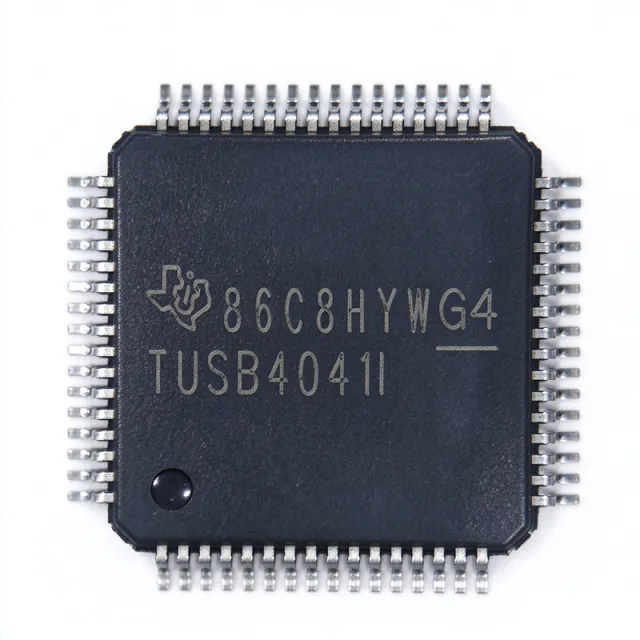
TUSB4041IPAP - 4-Port USB 2.0 480-Mbps Hub | Texas Instruments (Tape & Reel)
TUSB4041IPAP

TUSB4041IPAP - 4-Port USB 2.0 480-Mbps Hub | Texas Instruments (Tape & Reel)

The Texas Instruments TUSB4041IPAP is a 4-port high-speed 480-Mbps USB 2.0 hub controller in a 64-pin HTQFP (PAP) 10x10 mm package. It provides USB high-speed (480 Mbps) or full-speed (12 Mbps) connections on the upstream port and supports four downstream ports that operate at high-speed, full-speed, or low-speed. The industrial-grade version operates across -40C to +85C, making it suitable for embedded and industrial designs. A USB 2.0 hub controller is a serial-interface bridge that aggregates one upstream USB port into multiple downstream ports while managing the protocol handshakes, transaction translation, and per-port power control dictated by the USB 2.0 specification. It sits within the broader hierarchy of USB controllers -> interface ICs -> power management and connectivity silicon -> mixed-signal semiconductors. The TUSB4041I family supports both self-powered and bus-powered configurations, with integrated USB transceivers and optional battery-charging detection on downstream ports. Key features include 480-Mbps high-speed upstream operation, per-port over-current protection flags, integrated 1.5-kV ESD on USB signal lines, support for compound devices, and I2C/EEPROM configurability for vendor ID (VID), product ID (PID), and port-remap policy. Per-port power-switch control outputs enable ganged or individual port-power switching without external glue logic. The device integrates a UTMI+ low-pin-interface (ULPI) or integrated transceiver variant, a serial-interface engine, and a protocol layer that handles split transactions for full-/low-speed peripherals attached to high-speed upstream links. The HTQFP-64 footprint provides ample ground and power pins for signal-integrity routing on 2-layer consumer-grade boards. Typical applications include USB port expansion on industrial PCs, docking stations, monitors with built-in USB hubs, embedded HMI panels, and POS terminals. The industrial temperature range and integrated charge-detection features also make it a strong fit for automotive-infotainment accessories and medical USB peripherals. When designing with this part, place 27 ohm series termination resistors close to the USB DP/DM pins and provide adequate bulk capacitance on each downstream VBUS rail managed by the controller's power-switch enables.

USD $3,28 En stock
TUSB4041IPAPQ1 - 4-Port USB 2.0 Hub AEC-Q100 | Texas Instruments
TUSB4041IPAPQ1

TUSB4041IPAPQ1 - 4-Port USB 2.0 Hub AEC-Q100 | Texas Instruments

The Texas Instruments TUSB4041IPAPQ1 is an automotive-qualified 4-port high-speed 480-Mbps USB 2.0 hub controller in a 64-pin HTQFP (PAP) package with exposed pad. It provides four downstream USB 2.0 ports from a single upstream port, full-speed (12 Mbps), high-speed (480 Mbps), and low-speed (1.5 Mbps) signaling, and operates over -40C to +85C with an automotive-grade qualification. A USB 2.0 hub is a critical interface IC that expands a single USB root port into multiple downstream ports, providing downstream device connect/disconnect detection, overcurrent protection coordination, transaction translation between split USB transactions, and configurable port-power switching. The TUSB4041IPAPQ1 sits in the USB hub controller product hierarchy (USB 2.0 hub -> USB hub -> USB interface IC -> interface IC -> semiconductor) and is widely deployed in automotive infotainment, body electronics, and rear-seat entertainment systems. Key features include integrated USB 2.0 high-speed PHY on every port, pin-strap configuration for battery-charging support, customization via OTP ROM, I2C EEPROM, or I2C/SMBus target interface for VID/PID/port/phy settings, optional upstream port indicator, and individual port power control with overcurrent sensing. The device uses a single 3.3 V supply plus an internal 1.1 V core regulator generated by the on-chip LDO. Internal termination, pull-up/pull-down resistors, and a built-in 5 V VBUS load switch controller (external n-MOSFET required) simplify PCB design. Suspend and remote wakeup signaling are managed in hardware, reducing firmware complexity. Typical applications include automotive head-unit USB ports, rear-seat entertainment hubs, body-control module USB service ports, industrial PC USB expansion, and embedded telematics USB interfaces. AEC-Q100 qualification makes the -Q1 device preferred for road-vehicle applications, while the non-Q1 TUSB4041IPAP serves commercial/industrial environments. When designing with this part, place the external 24.576 MHz crystal (or oscillator) within 5 mm of the XI/XO pins and provide a continuous ground reference under the exposed thermal pad for thermal and EMI performance. Per-port 5 V VBUS switches must use a logic-level n-MOSFET driven by the integrated DP1PWR output to share load-current and fault indications with the host. This page synthesizes distributor pricing for automotive-grade USB hubs, pin-compatible drop-in alternatives, and design considerations from the manufacturer datasheet not always highlighted on distributor listings.

Devis Contact
TUSB4041IPAPR - 4-Port USB 2.0 480-Mbps Hub | Texas Instruments
TUSB4041IPAPR

TUSB4041IPAPR - 4-Port USB 2.0 480-Mbps Hub | Texas Instruments

The Texas Instruments TUSB4041IPAPR is a 4-port high-speed 480-Mbps USB 2.0 hub controller in a 64-pin HTQFP (PAP) 10x10 mm package. It provides USB high-speed (480 Mbps) or full-speed (12 Mbps) connections on the upstream port and supports four downstream ports that operate at high-speed, full-speed, or low-speed. The industrial-grade version operates across -40C to +85C, making it suitable for embedded and industrial designs. A USB 2.0 hub controller is a serial-interface bridge that aggregates one upstream USB port into multiple downstream ports while managing the protocol handshakes, transaction translation, and per-port power control dictated by the USB 2.0 specification. It sits within the broader hierarchy of USB controllers -> interface ICs -> power management and connectivity silicon -> mixed-signal semiconductors. The TUSB4041I family supports both self-powered and bus-powered configurations, with integrated USB transceivers and optional battery-charging detection on downstream ports. Key features include 480-Mbps high-speed upstream operation, per-port over-current protection flags, integrated 1.5-kV ESD on USB signal lines, support for compound devices, and I2C/EEPROM configurability for vendor ID (VID), product ID (PID), and port-remap policy. Per-port power-switch control outputs enable ganged or individual port-power switching without external glue logic. The device integrates a UTMI+ low-pin-interface (ULPI) or integrated transceiver variant, a serial-interface engine, and a protocol layer that handles split transactions for full-/low-speed peripherals attached to high-speed upstream links. The HTQFP-64 footprint provides ample ground and power pins for signal-integrity routing on 2-layer consumer-grade boards. Typical applications include USB port expansion on industrial PCs, docking stations, monitors with built-in USB hubs, embedded HMI panels, and POS terminals. The industrial temperature range and integrated charge-detection features also make it a strong fit for automotive-infotainment accessories and medical USB peripherals. When designing with this part, place 27 ohm series termination resistors close to the USB DP/DM pins and provide adequate bulk capacitance on each downstream VBUS rail managed by the controller's power-switch enables.

USD $3,28 En stock
TUSB4041IPAPRQ1 - 4-Port USB 2.0 Hub, AEC-Q100 | Texas Instruments
TUSB4041IPAPRQ1

TUSB4041IPAPRQ1 - 4-Port USB 2.0 Hub, AEC-Q100 | Texas Instruments

The Texas Instruments TUSB4041IPAPRQ1 is an automotive-grade 4-port high-speed USB 2.0 hub controller supporting 480-Mbps upstream and downstream signaling in a 64-pin HTQFP (PAP) 10x10 mm package with an exposed thermal pad. The -Q1 suffix denotes AEC-Q100 qualification, making it suitable for in-vehicle USB expansion where reliability across -40C to +85C is mandatory. It integrates USB 2.0 transceivers, a serial-interface engine, hub repeater, and per-port power control with battery-charge support, allowing direct attachment to automotive head units, IVI systems, and telematics modules. A USB 2.0 hub is a compliant USB device class that expands one upstream port into multiple downstream ports while managing enumeration, power distribution, and transaction translation across a tiered-star topology. The hub sits between a host controller (xHCI/eHCI) and downstream peripherals; the hub repeater manages connectivity, while the hub controller handles split transactions and descriptor management. The TUSB4041I-Q1 family is positioned as an automotive TUSB2.0 hub silicon in TI's broader portfolio of USB interface ICs, falling under the Interface ICs > Audio/Video and broader serializer-deserializer hierarchy of signal-conditioning and protocol-bridging devices. Key features include support for downstream battery charging (DCP, CDP, SDP per BC1.2-like behavior), pin-strap configuration, OTP ROM customization, I2C/SMBus configuration interface, integrated 5V-to-3.3V LDO, and per-port overcurrent protection plus power-switch control outputs. Per-port event indicators are available via an interrupt output, and the part provides both full-speed (12 Mbps) and high-speed (480 Mbps) signaling upstream while supporting low-/full-/high-speed downstream traffic. Architecture-wise, the device combines an ULPI-style internal PHY layer with a hardwired hub controller core. Pin-strap pins allow boot-time selection of VID/PID, removable/non-removable port mapping, and battery-charging mode without external EEPROM, while an optional I2C EEPROM, OTP ROM, or SMBus target interface enables field-customizable configuration. The PAP package's exposed pad offers a low-junction-to-board thermal path, important under hood or behind-dash operating conditions. Typical automotive applications include infotainment USB expansion (rear-seat entertainment, smartphone projection), telematics control units, body and cluster controllers that expose diagnostic or media ports, and in-cabin USB charging outlets requiring BC1.2-class behavior. Industrial variants of the same die (TUSB4041I, no -Q1) target factory USB aggregation and USB-isolated medical-cart hubs. When designing with this part, allocate a generous copper pour under the exposed pad, keep the 24 MHz crystal traces short, and use a 5V-tolerant current-limited power switch per downstream port. The -Q1 qualification grade means PPAP and IMDS data are available from TI on request.

Devis Contact
TUSB422IYFPR - USB Type-C Port Controller DSBGA-9 | Texas Instruments
TUSB422IYFPR

TUSB422IYFPR - USB Type-C Port Controller DSBGA-9 | Texas Instruments

The Texas Instruments TUSB422IYFPR is a USB Type-C port controller with integrated USB Power Delivery (USB PD) physical layer, housed in a 9-ball DSBGA (YFP) package measuring approximately 1.6 mm x 1.6 mm. It supports USB Type-C Cable and Connector Specification and USB Power Delivery 2.0, enabling up to 100 W of negotiated power and alternate-mode signaling through a single USB Type-C connection. The device operates from a single 3.3 V supply and communicates with an external Type-C Port Manager (TCPM) over standard I2C interface up to 400 kHz. A USB Type-C port controller is a specialized interface IC that sits between a USB Type-C receptacle and the application processor in devices such as laptops, tablets, monitors, docks, and power adapters. It performs attach/detach detection on the two Configuration Channel (CC) pins, decodes BMC-encoded USB PD messages, and reports cable orientation, role detection, and current-mode advertisement to the host. Compared with discrete USB-C implementations, a dedicated port controller reduces BOM count, simplifies firmware, and accelerates USB-IF compliance. Key features of the TUSB422 include configurable DFP (Downstream Facing Port), UFP (Upstream Facing Port), or DRP (Dual Role Port) operation, integrated Rp/Rd termination for CC1 and CC2, automatic cable-orientation detection, and a low-power standby mode. The internal BMC PHY uses 9-ohm termination (per USB PD spec) so it can be paired with common external load switches and VBUS power-path controllers without external components. The device is qualified to industrial temperature range (-40C to +85C) and is supplied Pb-free and RoHS-compliant. Architecturally, the TUSB422 separates the protocol layer from the physical layer. The PHY handles BMC encoding, preamble, and collision detection on CC1/CC2; the TCPM firmware running on the host MCU handles policy engine, protocol layer, and device policy manager functions. This partitioning lets OEMs keep policy and security logic in trusted firmware and reuse a single TUSB422 across product families. Typical applications include USB-C power adapters and chargers, notebook/dock side-band controller, USB-C monitors and hubs, smartphones and tablets, and Thunderbolt 3 / USB4 accessory adapters. Designers choose the TUSB422 when they need a small-footprint, TI-trusted USB PD PHY with proven USB Type-C compliance. Design note: TI recommends placing the TUSB422 as close as possible to the USB Type-C connector CC pins. Keep CC1/CC2 traces matched within 1 mm to within the receptacle pads to ensure USB-IF compliance testing passes. Decouple VDD 3V3 with at least 0.1 uF plus 1 uF ceramic capacitors. This page synthesizes distributor pricing, drop-in alternatives, and design notes not always consolidated on the manufacturer datasheet, enabling faster component selection and drop-in replacement decisions.

Devis Contact
TUSB501DRFR - 5Gbps USB 3.0 Redriver | Texas Instruments
TUSB501DRFR

TUSB501DRFR - 5Gbps USB 3.0 Redriver | Texas Instruments

The Texas Instruments TUSB501DRFR is a 3.3 V, single-channel USB 3.0 SuperSpeed redriver with a maximum data rate of 5 Gbps, packaged in an 8-pin WSON package measuring 2 mm by 2 mm. It combines input equalization with high-differential-voltage output drive to recover degraded 5 Gbps signals and extend the practical reach of USB SuperSpeed links across printed-circuit boards, cables, and interconnects. A USB redriver is a signal-conditioning semiconductor placed within a high-speed data path to combat insertion loss, reflections, and intersymbol interference. In the hierarchy of electronic components, the TUSB501 is a USB interface IC, a redriver and repeater, and ultimately a high-speed signal-integrity device. Unlike a protocol controller or hub, it does not interpret USB traffic or create a new bus segment; it conditions an existing differential pair and passes the recovered 5 Gbps signal onward. The TUSB501DRFR supports one USB 3.0 SuperSpeed channel at 5 Gbps and provides equalization for lossy channels. Its 3.3 V supply operation and 2 mm by 2 mm WSON (DRF) package support compact equipment designs. The specified operating-temperature range is -40°C to +85°C, making the device suitable for industrial and temperature-range-controlled consumer, communications, storage, and test-system implementations. Technically, the redriver compensates attenuation encountered by the differential pair and regenerates the output signal at a high differential voltage. This helps the receiving endpoint detect transitions reliably when PCB traces, connectors, and cable segments introduce loss. The manufacturer describes TUSB501 as a third-generation 3.3 V single-channel redriver designed to extend possible channel length while recovering USB 3.0 SuperSpeed data. Typical applications include host-to-device links, peripheral connections, storage controllers, docking systems, external test equipment, and active cable assemblies. The device is particularly useful when loss and intersymbol interference threaten link margin. In an active cable or extended PCB interconnect, placing the redriver near the degradation boundary can restore signal amplitude before the next connector or receiver. Designers should preserve the differential impedance of the USB SuperSpeed pair, use symmetrical routing, minimize stubs and unnecessary vias, and place decoupling close to the supply pin. The device has limited built-in ESD protection, so system-level protection and connector placement remain important. Differential probing and eye-diagram measurements are recommended when validating a new channel. This page combines the exact TUSB501DRFR ordering information with package, application, replacement, and design guidance. It distinguishes confirmed manufacturer characteristics from parameters that still require datasheet verification, helping engineers plan a 5 Gbps USB redriver design without relying on generic interface-IC assumptions.

Devis Contact
TUSB5052PZ - 5-Port USB 2.0 Hub Controller with Serial Bridge | Texas Instruments
TUSB5052PZ

TUSB5052PZ - 5-Port USB 2.0 Hub Controller with Serial Bridge | Texas Instruments

The Texas Instruments TUSB5052PZ is a USB 2.0 hub controller with an integrated bridge to two serial ports, a maximum hub clock frequency of 6 MHz, and a 1.5 MBps data-transfer rate. The device is supplied in a 100-terminal LQFP package measuring 14 mm by 14 mm. Its commercial temperature grade, gull-wing terminal form, and square package outline support use in conventional embedded USB expansion designs. A USB hub controller is a semiconductor that manages traffic between one upstream USB connection and multiple downstream USB ports. The TUSB5052PZ belongs to the broader USB interface controller hierarchy, where USB interface ICs connect host controllers, peripherals, hubs, bridges, and external serial devices. Its configurable optional hub capability allows designers to combine hub and serial-interface functions in one device instead of allocating separate ICs for those functions. The verified listing identifies the TUSB5052PZ as a five-port USB 2.0 hub controller with a bridge to two serial ports. Its maximum clock frequency is 6 MHz, while its stated data-transfer rate is 1.5 MBps. The nominal operating voltage is 3.3 V, matching the power level commonly used by USB 2.0 interface circuitry. These characteristics make the controller relevant to embedded USB systems requiring multiple USB connections alongside serial-port expansion. The 100-LQFP (14 x 14 mm) package provides 100 external terminals and a square, gull-wing surface-mount form. Compared with a smaller connector-oriented USB interface package, this device exposes a substantially larger pin count to support hub-port and serial-bridge functions. Its specified commercial temperature grade is suitable for ordinary commercial equipment, although manufacturer ordering information and the full datasheet should be checked for detailed electrical limits and qualification requirements. Typical application areas include industrial control panels, multifunction printers, point-of-sale terminals, external storage enclosures, test equipment, and legacy-port expansion systems. In each case, the controller can sit between a USB host and downstream peripherals while presenting serial connectivity to embedded subsystems. System-level performance remains dependent on upstream USB bandwidth, device scheduling, cable quality, enumeration behavior, and the electrical implementation of the connected ports. Designers should verify every signal, supply, and termination connection against the manufacturer datasheet before layout release. The large 100-terminal package demands careful escape routing between fine-pitch leads, while USB differential pairs require controlled impedance and minimized stub length. Decoupling and high-speed return paths should also be planned so that the 3.3 V interface supply and USB data paths are not compromised by adjacent digital or switching circuitry. This product record combines the verified distributor specifications, commercial availability references, package information, and cross-reference findings for the TUSB5052PZ. It also documents where additional engineering data remain necessary, including detailed pin assignments, electrical limits, lifecycle declarations, pricing, and validated drop-in replacements. Those gaps are intentionally marked rather than replaced with unverified datasheet or substitution claims.

Devis Contact
TUSB5152PZ - 5-Port USB Hub Controller | Texas Instruments
TUSB5152PZ

TUSB5152PZ - 5-Port USB Hub Controller | Texas Instruments

The Texas Instruments TUSB5152PZ is a USB interface controller that integrates a configurable 5-port hub, two serial ports, and a bridge to the IEEE 1284 parallel port. The device is supplied in a 100-LQFP surface-mount package measuring 14 x 14 mm, as identified by DigiKey and the manufacturer datasheet search results. Its package designation uses the PZ suffix, while the verified distributor information identifies the device as an interface controller in the USB interface IC category. A USB hub controller is a semiconductor that manages traffic between a host USB interface and one or more downstream ports. A configurable USB 2.0 hub can allocate upstream bandwidth according to the activity presented by connected devices. The TUSB5152PZ extends this conventional hub role with two serial interfaces and an IEEE 1284 parallel-port bridge, allowing legacy printer and peripheral connectivity to coexist within a system designed around USB. This integration reduces the need for separate interface components when both USB expansion and legacy peripheral support are required. The verified product descriptions identify an optional five-port hub configuration, two serial ports, and one parallel-port bridge. The parallel interface is specified as IEEE 1284, the legacy printer-port standard supported by the integrated bridge. The two serial ports provide additional data paths for system integration, although individual electrical rates and protocol details are not included in the supplied verified snippets and therefore cannot be stated here as confirmed specifications. The TUSB5152PZ is packaged in a 100-LQFP with 14 x 14 mm body dimensions. This high-pin-count surface-mount package exposes the hub, serial, and parallel functions to a controller-oriented PCB design. A complete design must route the relevant USB, serial, parallel, clock, power, and control signals according to the manufacturer datasheet. Because no verified public pin table was included in the supplied results, no pin-level assignments are asserted on this page. Typical applications include compact USB-to-IEEE-1284 printer adapters, multifunction office peripherals, industrial interface equipment, and legacy computer expansion systems. The device is particularly relevant where one controller must provide USB hub expansion while also maintaining compatibility with serial accessories and an IEEE 1284 printer connection. Product selection should account for the exact USB speed grade, supported serial interface standards, clock requirements, and system power needs found in the complete manufacturer documentation. Supply information identifies TUSB5152PZ as a product replaced by TUSB5052. Verified distributor listings also describe the component as available and provide pricing from $7.2600 at quantity one. This page combines the verified package and lifecycle information, pricing tiers, application guidance, and explicitly documents unresolved technical details rather than inferring unavailable specifications.

Devis Contact
TUSB542RWQR - 5Gbps USB Type-C 2:1 MUX | Texas Instruments
TUSB542RWQR

TUSB542RWQR - 5Gbps USB Type-C 2:1 MUX | Texas Instruments

Texas Instruments TUSB542RWQR is a dual-channel USB 3.1 Gen-1 SuperSpeed redriver and 2:1 multiplexer for USB Type-C ports, supporting 5 Gbps data rates in an 18-pin X2QFN (RWQ) package. It integrates signal conditioning, selectable equalization up to 9 dB, de-emphasis, output swing adjustment up to 6 dB, RX-detect termination, and signal monitoring for power management. A USB Type-C redriver is an interface IC that restores signal integrity after interconnect losses while a 2:1 USB multiplexer routes one SuperSpeed lane pair between two destinations. The TUSB542 belongs to the USB interface controller hierarchy, where signal conditioning, lane routing, connection detection, and low-power management support reliable USB 3.1 Gen-1 communication between a host or device and external peripherals. The device provides equalization settings up to 9 dB and output-swing control up to 6 dB, allowing engineers to compensate for PCB traces, connectors, and cable losses. Its integrated RX-detect function supports USB Type-C connection management, while signal monitoring enables the host to observe link or connection activity for broader power-management decisions. The dual-channel architecture follows the differential transmit and receive lanes of a USB SuperSpeed interface. Power consumption is tailored to USB port states. The active current is listed as 100 mA, the U2/U3 low-power state consumes 1.3 mA, and the no-connection state consumes 300 µA. These operating-state figures make the device suitable for systems that spend substantial time idle, including docking stations, notebooks, tablets, docking accessories, and external storage systems. Typical uses include USB Type-C docking and undocking systems, DisplayPort or Thunderbolt alternate-mode routing designs, external storage peripherals, test equipment, and compact computers where connector or PCB losses can impair 5 Gbps signaling. The 2:1 topology also allows one physical SuperSpeed interface to select between two downstream paths without changing the device’s core redriver function. Layout is critical because a redriver cannot recover signal integrity that was damaged before the input reaches its pins. Keep the USB differential traces short and matched, provide a continuous reference plane, minimize stubs, and follow the manufacturer’s reference layout and component-placement guidance. Confirm the selected equalization and swing settings against the complete channel response rather than relying only on trace length. This product analysis combines the manufacturer’s functional specifications with practical guidance for routing, equalization, power management, and drop-in replacement assessment. It highlights where the TUSB542RWQR is a direct fit, which functions require careful validation, and what an engineer should verify before introducing a substitute into an existing USB Type-C design.

Devis Contact
TUSB544RNQR 8.1-Gbps 4-Channel USB-C Redriver | Texas Instruments
TUSB544RNQR

TUSB544RNQR 8.1-Gbps 4-Channel USB-C Redriver | Texas Instruments

The Texas Instruments TUSB544RNQR is a four-channel USB Type-C linear redriver supporting data rates up to 8.1 Gbps in a 40-pin WQFN package measuring 6 x 4 mm. It operates from a single 3.3 V supply, provides multiple levels of receive linear equalization for channels affected by cable and PCB-trace loss, and includes input equalization and output de-emphasis functions. A linear redriver is a signal-conditioning semiconductor placed between a transmitter and receiver. It receives a degraded high-speed differential signal, compensates for channel loss, and retransmits a cleaner waveform to the next device. The TUSB544 operates at the physical layer and is protocol agnostic, allowing it to support USB Type-C Alternate Mode interfaces such as VESA DisplayPort without decoding the transmitted protocol. The principal characteristics of the TUSB544RNQR are its four independently conditioned channels, 8.1-Gbps maximum data rate, 3.3 V supply operation, and selectable receive equalization. These features make it suitable for systems where connector launches, cable loss, PCB routing, or long trace segments reduce the margin of a USB Type-C high-speed link. Its stated 10.0 ns delay supports repeatable channel timing in multi-lane links. The device uses linear rather than digital retiming to recover signal margin. Linear equalization boosts the high-frequency content of the incoming signal, while output de-emphasis reduces the effective amplitude difference between running and alternating data patterns. This approach can preserve protocol flexibility, although the system designer must still verify eye opening, jitter, crosstalk, and electromagnetic-emissions behavior in the completed channel. Typical applications include USB Type-C docking stations, dual-screen workstations, external storage enclosures, laptops, tablets, and DisplayPort-over-USB-C adapters. The TUSB544 is especially useful where a USB-C receptacle is separated from the host controller by a connector launch, cable, adapter, or relatively long PCB channel. It can also be evaluated in reversible-port implementations because the redriver operates on the differential data lanes rather than interpreting logical USB traffic. A successful implementation requires careful high-speed PCB layout and validation of the complete channel. Place the redriver close to the connector or loss source, provide a continuous reference plane, route differential pairs with matched impedance, and verify the selected equalization and de-emphasis settings against eye-diagram measurements. Power and ground connections should be short and decoupled close to the device pins. This page organizes the key electrical characteristics, application guidance, pin-assignment limitations, and verified source links for engineers evaluating the TUSB544RNQR. It also distinguishes confirmed device attributes from parameters that require confirmation from the manufacturer datasheet before layout release.

Devis Contact
TUSB551RWBR - 5Gbps USB 3.0 Redriver | Texas Instruments
TUSB551RWBR

TUSB551RWBR - 5Gbps USB 3.0 Redriver | Texas Instruments

The Texas Instruments TUSB551RWBR is a single-channel USB 3.0 SuperSpeed redriver with a 1.8 V supply, 5 Gbps signal rate, and 12-X2QFN package measuring 1.6 mm by 1.6 mm. It is designed to restore signal integrity across PCB traces, cables, connectors, and other interconnect structures that introduce attenuation or reflections. A USB redriver is a signal-conditioning IC placed between a USB transmitter and receiver. It detects low-amplitude or degraded high-speed data, regenerates the signal, applies equalization, and transmits a cleaner waveform to the next device. The TUSB551RWBR belongs to the interface IC hierarchy, where USB redrivers support the physical layer of USB 3.0 systems. Key features include one-channel SuperSpeed signal conditioning, operation from a 1.8 V supply, support for data rates through 5 Gbps, equalization, low power consumption, and automatic LFPS de-emphasis. Automatic LFPS de-emphasis helps the device support low-power states used during USB link training and device initialization. The fourth-generation redriver architecture also emphasizes output-drive performance for loss-limited USB links. The device can compensate for channel loss encountered in system interconnects. Equalization increases the voltage margin available to the receiving endpoint, while regenerated edges reduce the timing uncertainty associated with a degraded differential signal. As a single-channel device, it is intended for point-to-point SuperSpeed links rather than multi-lane hub or switch architectures. Typical uses include USB 3.0 Type-C host and peripheral connections, docking systems, external storage, monitors, test equipment, and embedded USB controllers. It is also useful when a board-to-board or cable path causes the receiver to encounter attenuation, ringing, or an eye-margin problem. Placement close to the transmitter can be preferable when that endpoint already suffers from package or board losses. The primary design trade-off is signal improvement versus added board area and power. Place the redriver where channel loss is concentrated, provide a continuous reference plane beneath the high-speed pair, and route the differential traces as a controlled-impedance structure. Verify the complete channel with compliance testing rather than relying only on eye-waveform appearance. This product page combines the manufacturer’s device description with package, interface, temperature, sourcing, and replacement guidance. It also identifies the practical checks needed to distinguish a true same-package substitute from a device that merely supports USB 3.0 or offers similar data-rate capability.

Devis Contact
TUSB6015IZQE - USB 2.0 HS OTG Controller | Texas Instruments
TUSB6015IZQE

TUSB6015IZQE - USB 2.0 HS OTG Controller | Texas Instruments

Texas Instruments TUSB6015IZQE is a USB 2.0 high-speed On-The-Go dual-role controller with a 1.5 V core supply, 80-pin BGA MICROSTAR JUNIOR package, and an industrial operating-temperature range of -40°C to +85°C. The controller supports peripheral, embedded-host, and OTG-device operating roles within one integrated USB interface device. A USB OTG dual-role controller is an interface IC that combines device and host functions within a USB 2.0 system. The TUSB6015IZQE can participate as a USB high-speed peripheral, a USB high-speed embedded host, or an OTG device. This role flexibility makes the device useful in portable equipment, storage accessories, test systems, and embedded USB products that need to negotiate host or device behavior through firmware. The principal specifications are USB 2.0 high-speed operation, a 1.5 V supply, support for 1.5 V, 1.8 V, and 3.3 V interface signaling, an 80-BGA MICROSTAR JUNIOR package measuring 5 mm by 5 mm, and an operating-temperature range of -40°C to +85°C. The 80-pin surface-mount construction supports dense PCB layouts while providing separate connections required by a multifunction USB controller. The TUSB6015IZQE combines high-speed USB peripheral logic, embedded-host control, and OTG device behavior in a single controller. Its dual-role architecture reduces the need for separate USB host and device controllers in compact products. Firmware can select the required operating role, while the integrated interface circuitry manages communication between the USB bus and the host-side logic. Typical uses include USB storage bridges, portable media equipment, multifunction peripherals, industrial data-acquisition equipment, and embedded systems that must support both host and peripheral connections. The small 5 mm by 5 mm BGA footprint is especially useful where connector placement, enclosure size, and routing density limit the available board area. Layout is the primary implementation concern for this device. Place the USB differential pair as a controlled-impedance route, minimize stub lengths, and place required bypass capacitors close to their power pins. Because the package uses an 80-ball BGA, inspection and assembly processes must support fine-pitch BGA soldering, and the PCB must provide adequate thermal and power-delivery paths. This page consolidates the manufacturer specification, package information, sourcing workflow, interface role descriptions, and practical implementation guidance for engineers evaluating the TUSB6015IZQE in USB 2.0 HS OTG designs.

Devis Contact
TUSB6020PFC - USB 2.0 OTG Dual-Role Controller | Texas Instruments
TUSB6020PFC

TUSB6020PFC - USB 2.0 OTG Dual-Role Controller | Texas Instruments

The Texas Instruments TUSB6020PFC is a USB 2.0 high-speed On-The-Go dual-role controller with a VLYNQ serial-interface bridge, supporting USB low-speed at 1.5 Mb/s, full-speed at 12 Mb/s, and high-speed at 480 Mb/s in an 80-pin TQFP package measuring 12 mm by 12 mm. A USB interface controller is an interface IC that coordinates transactions between a USB host or peripheral and an embedded system. The TUSB6020 belongs to the hierarchy of USB controllers, interface controllers, integrated interface ICs, and semiconductors. Its dual-role architecture supports a USB 2.0 OTG device while providing a local bus bridge to a VLYNQ-compatible device. The integrated USB 2.0 PHY supports all three standard USB signaling rates, eliminating the need for a separate external USB transceiver in the intended application. The parallel interface and OTG role support make the device useful in portable synchronization, data acquisition, docking, and embedded data-transfer systems where USB connectivity must coexist with a dedicated local serial link. TUSB6020PFC operates from a 3.3 V supply and is offered in an 80-TQFP package with a 12 mm by 12 mm body. The package exposes a substantial parallel and control interface rather than relying on a compact USB-C or USB 3 connector, making board layout and signal-integrity implementation the main engineering considerations. Verify the complete pin-description table and recommended external circuitry in the manufacturer datasheet before finalizing a PCB. Typical applications include USB-to-VLYNQ local-bus bridges, portable test and measurement equipment, industrial data-acquisition systems, synchronization products, and embedded systems that need high-speed OTG transfer with device-role support. The controller is particularly relevant where the host processor requires a separate local-bus path while the product also connects to a USB 2.0 host. Design around the manufacturer's recommended USB transceiver network, impedance-controlled differential routing, supply decoupling, and VLYNQ interface layout. Keep high-speed USB traces short, provide a continuous ground reference, follow the datasheet's differential impedance guidance, and reserve test access for enumeration, suspend, and resume troubleshooting. This product page combines the controller's USB rates, OTG role, package details, interface use cases, drop-in ordering variants, and practical PCB guidance into an engineering-focused selection reference for USB 2.0 dual-role designs.

Devis Contact
TUSB6020PFCR - USB 2.0 HS OTG Controller | Texas Instruments
TUSB6020PFCR

TUSB6020PFCR - USB 2.0 HS OTG Controller | Texas Instruments

Texas Instruments TUSB6020PFCR is a USB 2.0 high-speed on-the-go dual-role controller with a 1.5 V, 1.8 V, and 3.3 V supply range, supplied in an 80-pin TQFP package measuring 12 mm by 12 mm. The device provides a parallel interface to a VLYNQ serial interface, supporting USB host and USB device roles in one controller. A USB 2.0 high-speed on-the-go controller is an interface IC that coordinates communications between a USB host or peripheral and another serial bus. The TUSB6020 bridges USB 2.0 high-speed traffic to the VLYNQ interface, allowing equipment designers to add dual-role USB connectivity without implementing the complete USB protocol stack in external logic. Its place in the hierarchy is interface controller, USB interface IC, interface integrated circuit, and semiconductor. The TUSB6020 supports three listed supply voltages: 1.5 V, 1.8 V, and 3.3 V. Its operating temperature range is 0 °C to 70 °C, and the commercial-temperature grade is suitable for industrial-room-temperature equipment. The controller uses a gull-wing terminal arrangement in a square 80-terminal TQFP package, providing a high pin count for USB data, control, power, clock, and VLYNQ interface connections. Technical operation centers on the USB 2.0 high-speed interface, OTG dual-role control, and the parallel-to-VLYNQ local bus bridge. A 78.1 mA supply-current figure is listed for the device. Unlike a simple USB transceiver, this component is a protocol-oriented controller designed to manage host and device functions and transfer data through the VLYNQ interface. Typical uses include USB-to-VLYNQ storage peripherals, multifunction printers, set-top equipment, industrial data acquisition systems, and embedded USB bridges. The dual-role architecture is especially useful when a product must connect to both a USB host and an external USB peripheral while presenting a VLYNQ interface to its internal processing logic. The principal design consideration is PCB implementation. Because this is an 80-terminal TQFP device with numerous high-speed USB signals, use the manufacturer pin description and layout guidance to assign every terminal. Keep USB traces short, provide a continuous ground reference, and follow the required decoupling and signal-routing practices to preserve USB 2.0 high-speed signal integrity. This product page combines the manufacturer-device description with practical application guidance, package details, interface comparisons, sourcing information, and verified drop-in candidates. It is intended to help engineers determine whether the TUSB6020PFCR fits a USB 2.0 OTG-to-VLYNQ design before beginning board layout.

Devis Contact
TUSB6020ZQE - USB 2.0 OTG Controller | Texas Instruments
TUSB6020ZQE

TUSB6020ZQE - USB 2.0 OTG Controller | Texas Instruments

Texas Instruments TUSB6020ZQE is a USB 2.0 high-speed on-the-go dual-role controller with a parallel interface, packaged in an 80-ball BGA MICROSTAR JUNIOR package measuring 5 x 5 mm. It supports USB 2.0 full-speed and high-speed operation and is designed to provide a seamless interface to the VLYNQ serial interface. The device also includes 1.5 V and 1.8 V supply domains identified in the manufacturer datasheet. A USB controller is an interface integrated circuit that coordinates transactions between a USB host or peripheral and an embedded system. Within the broader hierarchy of interface ICs, USB controllers connect digital peripherals to a standardized bus, while dual-role controllers can support host, device, or on-the-go operating roles. The TUSB6020ZQE places USB connectivity and VLYNQ bridging functions in a compact surface-mount package suitable for space-constrained embedded equipment. The TUSB6020ZQE supports USB 2.0 high-speed operation, including the 480 Mb/s signaling mode defined by the USB 2.0 specification. Its on-the-go dual-role architecture allows a system to negotiate the appropriate host or peripheral function when both roles are possible. The parallel interface provides a deterministic connection to compatible embedded logic, while the VLYNQ interface supports communication with compatible serial-side devices. The 80-ball BGA MICROSTAR JUNIOR package supports dense PCB layouts while exposing power, ground, USB, parallel-interface, and VLYNQ connections through a ball-grid footprint. Manufacturer documentation identifies 1.5 V core-related rails and a 1.8 V rail in the power-domain naming. Because all balls carry dense signal assignments, PCB layout should follow the manufacturer footprint, escape-routing guidance, and recommended via and plane configurations without altering the land pattern. Typical uses include USB-to-VLYNQ interface bridges, embedded test and measurement systems, industrial data-acquisition equipment, portable diagnostic controllers, and compact industrial or medical equipment requiring high-speed USB connectivity. Selection should account for the required USB role, parallel-bus timing, VLYNQ implementation, voltage rails, board area, and the exact 80-ball footprint. A key implementation consideration is that the package is a large-ball-count BGA intended for controlled manufacturing processes. Inspect assembled joints for voiding, bridging, and solder-ball defects, and verify that the PCB stackup and assembly process support the package geometry. The USB differential pair also needs a controlled layout to preserve signal integrity at high-speed data rates. This page consolidates the identified package, interface, voltage-domain, and sourcing information with same-footprint replacement analysis and practical PCB guidance. It highlights what must be checked before substituting a controller: the 80-ball footprint, USB role behavior, interface pinout, supply requirements, and application-specific timing. The TUSB6020ZQE is a compact USB interface controller for systems that combine USB 2.0 connectivity with a parallel-to-VLYNQ interface path. Its 5 x 5 mm 80-ball BGA construction makes it especially relevant to dense industrial, test, communications, and embedded-control designs where connector space is limited.

Devis Contact
TUSB6020ZQER - USB 2.0 OTG Controller | Texas Instruments
TUSB6020ZQER

TUSB6020ZQER - USB 2.0 OTG Controller | Texas Instruments

The Texas Instruments TUSB6020ZQER is a USB 2.0 dual-role controller with an OTG-capable parallel interface, supplied in an 80-ball, 5 x 5 mm VFBGA package with a 0.5 mm ball pitch. It supports 1.5 V, 1.8 V, and 3.3 V supply rails and is designed for embedded USB host, device, and dual-role applications requiring direct parallel-interface integration with an applications processor or system controller. A USB interface controller is an interface IC within the broader semiconductor hierarchy. It coordinates USB traffic between a host processor and external USB devices or ports. Unlike a general-purpose microcontroller, the TUSB6020ZQER concentrates on protocol handling, USB 2.0 connectivity, and host or device interface management, allowing the attached processor to concentrate on application-specific tasks. The device's principal features include USB 2.0 operation, On-The-Go functionality, and a parallel interface. Its 80-terminal VFBGA construction supports compact systems where connector space and board area are constrained. Separate 1.5 V, 1.8 V, and 3.3 V rail names appearing in the device documentation indicate that the implementation must account for multiple interface voltage domains rather than treating the controller as a single-rail component. The TUSB6020ZQER belongs to the same TI TUSB6020 family as the TUSB6020ZQE, TUSB6020PFC, and TUSB6020PFCR device identifiers. Its commercial temperature grade and dense ball-array package make it appropriate for compact industrial, communications, and embedded-computing equipment. Detailed operating limits, clock requirements, transceiver characteristics, and exact ball assignments should be taken from the manufacturer datasheet before final schematic and layout release. Typical uses include USB-to-serial bridge products, industrial data-acquisition equipment, portable data terminals, and embedded systems that need USB host or dual-role behavior. The parallel interface can provide a deterministic processor-facing bus when an external USB transceiver is used. Designers should also consider the controller's exact USB role, external transceiver arrangement, and required low-speed, full-speed, or high-speed support when selecting the device. PCB implementation requires careful high-speed signal integrity planning. Ball-array escape routing should remain short and symmetrical, power and ground planes should be continuous, and the manufacturer's recommended decoupling and layout guidance should be followed. Because the 5 x 5 mm package uses a 0.5 mm pitch, assembly capability, via-in-pad design, and thermal-via strategy must be reviewed during board planning. This page consolidates the verified package, interface, voltage, and temperature information for TUSB6020ZQER with application guidance, sourcing directions, and an explicit review of drop-in alternatives. Exact electrical limits and the complete 80-ball assignment should always be confirmed against the manufacturer documentation for the specific device variant.

Devis Contact
TUSB6250PFC - USB 2.0 ATA/ATAPI Bridge | Texas Instruments
TUSB6250PFC

TUSB6250PFC - USB 2.0 ATA/ATAPI Bridge | Texas Instruments

Texas Instruments TUSB6250PFC is a USB 2.0 low-power, high-speed ATA/ATAPI bridge controller packaged in an 80-pin TQFP (PFC) measuring 12 x 12 mm. It provides 3 V to 3.6 V operation, 80 integrated pins, and a 0 °C to 70 °C commercial temperature range for compatible USB-to-ATA storage interface designs. A USB-to-ATA/ATAPI bridge controller is an interface IC that translates USB host transactions into ATA commands understood by compatible storage devices. This controller family belongs to the broader USB interface-controller and storage-interface hierarchy, allowing equipment without a native ATA interface to communicate with legacy-compatible disk or optical-storage subsystems through USB 2.0. The TUSB6250PFC is identified specifically as a low-power, high-speed USB 2.0 to ATA/ATAPI bridge solution. Its operating range of 3 V to 3.6 V supports integration with 3.3 V equipment, while the high-speed interface positioning makes it suitable for storage-oriented USB ports requiring greater throughput than a low-speed USB peripheral. The 80-pin TQFP (PFC) package provides a substantial number of interface, power, control, and ground connections. The architecture separates USB-side signaling from ATA/ATAPI-side signaling so that a USB host can communicate through a standardized external interface while the bridge manages command translation and device-side control. This division of responsibilities permits reuse in USB storage appliances, legacy disk subsystems, and backup or archival equipment that originally relied on an ATA interface. USB bus powering and suspend behavior also make power management an important part of the implementation. Typical applications include USB-connected storage appliances, external disk interfaces, network-attached storage controller boards, digital video recorders, backup appliances, and industrial data-acquisition systems with compatible legacy storage. Designers should confirm device support, USB enumeration behavior, power requirements, and signal compatibility before integrating the controller into a new system. The primary design task is matching the TUSB6250PFC pin configuration, voltage rails, interface timing, and PCB land pattern exactly to the selected storage architecture. Keep USB and ATA/ATAPI traces routed according to the manufacturer layout guidance, provide the required bypass capacitors, and maintain solid ground-plane continuity to reduce data-integrity and emissions risks. This product page combines the manufacturer interface definition, package and temperature details, drop-in replacement availability, comparison data, and practical PCB guidance. It helps engineers evaluate the TUSB6250PFC as a USB 2.0 ATA/ATAPI bridge while highlighting the electrical and footprint checks required for a successful design.

Devis Contact
TUSB7320RKMR - USB 3.0 2-Port xHCI Host Controller | Texas Instruments
PTUSB7320RKMR

TUSB7320RKMR - USB 3.0 2-Port xHCI Host Controller | Texas Instruments

The Texas Instruments TUSB7320RKMR is a SuperSpeed USB 3.0 2-port xHCI (eXtensible Host Controller Interface) host controller that bridges a PCI Express upstream port to two USB 3.0 downstream ports, housed in a 100-pin WQFN-MR (RKM) package measuring 9x9 mm with an exposed thermal pad. The device integrates an xHCI 1.0 compliant controller core, supports USB 3.0 (5 Gbps), USB 2.0 (480 Mbps), and USB 1.1 (12/1.5 Mbps) through dual mode ports, and provides USB Battery Charging 1.2 support including CDP/DCP modes for downstream charging. A USB 3.0 xHCI host controller is a specialized protocol bridge that lets a host processor running an xHCI-class driver enumerate and manage downstream USB devices at SuperSpeed, High-Speed, Full-Speed, and Low-Speed. Within the broader hierarchy it sits as an interface IC between the PCI Express fabric and the USB device tree, enabling motherboards, docking stations, and embedded platforms to add or expand USB ports without redesigning the core chipset. The TUSB7320 family is positioned above PCIe-to-USB 2.0 controllers and below root-complex integrated host silicon that bundles USB directly into the SoC. Key features include two USB 3.0 downstream ports operating at 5 Gbps SuperSpeed plus backward compatibility with legacy USB rates, one PCI Express Gen 2 upstream port (x1 lane) running at 5 Gbps, integrated 5V to 3.3V/1.8V/1.2V/0.9V core voltage regulators, and per-port power switching controls. The device supports USB attach/detach protocol, overcurrent detection, and dual-role flexibility via ID-pin and OTG signaling on the upstream port. Architecturally, the TUSB7320 uses a SerDes-based PHY pair per downstream port for SuperSpeed signaling, a hardened xHCI controller engine for transaction translation, and a PCIe physical layer. The internal regulator block removes the need for most external power rails, simplifying board layout. Reference designs in the TUSB73x0 datasheet family describe PCIe edge connector pinout, USB connector wiring, and recommended decoupling for the internal LDO bank. Typical applications include PC motherboards, notebook docking stations, industrial PCs, point-of-sale terminals, USB port replicators, and embedded platforms that need two USB 3.0 downstream ports from a standard PCIe x1 slot. The device is also found in test fixtures and breakout boards that expose USB 3.0 traffic for analyzer capture. When using the TUSB7320RKMR, allocate thermal relief on the exposed pad (EP) and observe the 100 us PCIe reference-clock stable period before deasserting PERST to ensure proper link training. Designers should also follow the inrush current profile on VBUS when enabling ports that may already have devices attached. This page synthesizes distributor pricing, drop-in alternatives from the TUSB73x0 family and cross-vendor host controllers, and practical design notes not found in the manufacturer datasheet.

Devis Contact
TUSB7320RKMR - USB 3.0 xHCI 2-Port Host Controller | Texas Instruments
TUSB7320RKMR

TUSB7320RKMR - USB 3.0 xHCI 2-Port Host Controller | Texas Instruments

The Texas Instruments TUSB7320RKMR is a SuperSpeed USB 3.0 two-port xHCI host controller with a PCIe x1 Gen 2 upstream interface, packaged in a 100-pin WQFN-MR (RKM) 9x9 mm footprint. The device delivers two downstream USB 3.0 ports supporting SuperSpeed (5 Gbps), high-speed, full-speed, and low-speed USB traffic, and operates from 1.1 V and 3.3 V supplies. It is qualified for the commercial 0 °C to 70 °C range in a green/RoHS-compliant plastic WQFN-100 housing. Per TI product information, the TUSB7320 and its four-port sibling TUSB7340 share the same pin-compatible 100-pin RKM package, allowing board reuse across port-count variants. An xHCI (eXtensible Host Controller Interface) host controller is the silicon that sits between a root-complex PCIe link and the physical USB ports on a system. The xHCI class driver in the OS enumerates USB 3.0/2.0/1.1 devices without requiring companion controllers, so a single TUSB7320 turns a PCIe-capable SoC or add-in card into a fully featured USB root hub. It belongs to the broader hierarchy of bus controllers -> interface ICs -> USB controllers -> SuperSpeed xHCI controllers -> mixed-signal semiconductors. Key features include hardware-automated USB attached SCSI protocol (UASP), PCI Express x1 Gen 2 connectivity, integrated 5 Gbps PHY, per-port battery charging support, and integrated power switching/overcurrent logic. The WQFN-MR package exposes an exposed thermal pad and offers good thermal dissipation in dense designs. The device also supports USB legacy and modern BIOS hand-off, enabling universal compatibility across Windows, Linux, and embedded RTOS hosts. Architecturally, the TUSB7320 uses a PCIe Gen 2 PHY paired with a protocol engine that handles transaction translation, scatter-gather DMA, and xHCI command ring processing. An embedded USB 3.0 PHY provides SuperSpeed signaling, while the USB 2.0 PHY supports the lower-speed pairs. The chip exposes SMBus for management, GPIO for port indicators, and JTAG for boundary-scan test. Typical applications include desktop PC motherboards, industrial embedded PCs, USB 3.0 PCIe add-in cards, docking stations, point-of-sale terminals, industrial PCs, and test-and-measurement chassis that need reliable downstream USB 3.0 connectivity. The pin-compatible TUSB7340 covers the same use cases where four ports are required. When designing with this part, allocate a solid ground reference under the WQFN thermal pad and stitch vias to inner ground planes for the 5 Gbps signal integrity. Provide adequate bulk capacitance on the 1.1 V and 3.3 V rails and follow TI reference layout for PCIe routing (90 ohm differential, length-matched within 150 mil). This page synthesizes distributor pricing, drop-in alternatives, application context, and design guidance that go beyond a single datasheet table.

Devis Contact
TUSB7320RKMT - 2-Port USB 3.0 xHCI Controller | Texas Instruments
TUSB7320RKMT

TUSB7320RKMT - 2-Port USB 3.0 xHCI Controller | Texas Instruments

The Texas Instruments TUSB7320RKMT is a USB 3.0 2-port xHCI host controller with a PCIe x1 Gen 2 host-system interface, supplied in a 100-pin RKM WQFN package with an exposed pad. The controller operates from 1.1 V and 3.3 V supply rails and is specified for a 0°C to 70°C ambient temperature range in the RKMT configuration. Its two downstream ports make it suitable for compact host systems requiring more than one SuperSpeed USB connection. A USB host controller is a system interface IC that manages transactions between a host computer and attached USB peripherals. An xHCI controller supports USB 3.0 SuperSpeed as well as backward-compatible USB 2.0 operation. The TUSB7320 belongs to the USB interface controller hierarchy, combining USB device connectivity, PCIe host attachment, clocking, power management, and protocol handling in one surface-mount device. Key features include support for up to two downstream ports, USB 3.0 compliance, a PCIe x1 Gen 2 system interface, and a 9 x 9 mm 100-WQFN package with an exposed thermal pad. The exposed pad provides the primary path for heat dissipation and must be connected to the PCB ground plane according to the land pattern and thermal design guidance. Separate 1.1 V and 3.3 V supply requirements support internal core and I/O power domains. The TUSB7320 connects to the host system through PCIe while providing a structured USB interface for downstream ports. This division of responsibilities allows a processor or embedded host to enumerate devices, manage transfers, and control bus resources while the dedicated controller handles USB protocol activity. Exact lane, timing, current, and performance details should be confirmed against the manufacturer datasheet before a design is released for production. Typical applications include industrial embedded computers, medical equipment, test and measurement systems, set-top and media platforms, USB hubs or docking systems, and other embedded hosts that need multiple USB 3.0 ports. The two-port configuration is particularly useful where system space is constrained and separate downstream connectors are required without expanding to a four-port TUSB7340 implementation. PCB design should prioritize short high-speed USB and PCIe routes, continuous reference planes, adequate power decoupling, and thermal management around the exposed pad. Confirm the exact RKM land pattern, pin assignments, capacitor values, and routing constraints in the manufacturer datasheet before layout release. Prototype validation should also cover power sequencing, connector compliance, thermal rise, and simultaneous SuperSpeed and USB 2.0 device operation. This product page combines the exact TUSB7320RKMT ordering information, package and interface characteristics, manufacturer resources, pin-compatible alternatives, comparison points, and practical integration guidance. It is intended to help engineers qualify the device faster while preserving the distinction between the two-port TUSB7320 and the four-port TUSB7340.

Devis Contact
TUSB7340IRKMT - USB 3.0 4-Port xHCI Host Controller | TI
TUSB7340IRKMT

TUSB7340IRKMT - USB 3.0 4-Port xHCI Host Controller | TI

The Texas Instruments TUSB7340IRKMT is a SuperSpeed USB 3.0-compliant 4-port xHCI host controller with a PCIe x1 Gen 2 host interface, 5 Gbps SuperSpeed throughput, and a 1.1 V core / 3.3 V I/O supply, housed in a 100-pin WQFN-MR (RKM) 9x9 mm package operating from -40C to +85C. A USB xHCI host controller is an interface IC that implements the eXtensible Host Controller Interface standard, offloading USB protocol management from the host CPU. In the power-management and interface hierarchy, it sits between a PCIe root complex and downstream USB physical ports, translating PCI Express transactions into USB 3.0 SuperSpeed, high-speed, full-speed, or low-speed traffic on each downstream port. Key features include four downstream USB 3.0 ports, support for SuperSpeed (5 Gbps), high-speed (480 Mbps), full-speed (12 Mbps), and low-speed (1.5 Mbps) data rates, and a PCIe x1 Gen 2 (5 GT/s) upstream link. This makes the TUSB7340 well suited to designs that must add multiple SuperSpeed ports to an x86 or embedded host with a single PCIe lane. Technically, the TUSB7340 integrates the xHCI controller, PCIe Gen 2 PHY, and USB 3.0 PHYs in CMOS on a single die, with power rails of 1.1 V (core) and 3.3 V (I/O and PHY). The integrated PHYs reduce bill-of-materials complexity and board area compared with discrete PHY-plus-controller architectures. According to the TI TUSB73x0 datasheet, the TUSB7340 and TUSB7320 share a pin-compatible 100-pin RKM package, enabling a common PCB design that supports either two-port or four-port configurations. Typical applications include docking stations, PCI Express add-in cards, embedded industrial computing, and motherboards requiring additional SuperSpeed ports. The four-port count directly addresses designs where hub-chip cascading is undesirable for latency or BOM reasons. Design consideration: because SuperSpeed links run at 5 Gbps, controlled-impedance routing of the USB 3.0 differential pairs and the PCIe link with proper reference planes is essential; follow the TI datasheet layout guidelines for the WQFN-MR exposed-pad package, which must be soldered to a ground pour for thermal and return-path integrity. This page synthesizes distributor pricing context, verified drop-in alternatives, and practical design notes not found in the manufacturer datasheet.

Devis Contact
TUSB7340RKMR - 4-Port USB 3.0 xHCI Host Controller | TI
TUSB7340RKMR

TUSB7340RKMR - 4-Port USB 3.0 xHCI Host Controller | TI

The Texas Instruments TUSB7340RKMR is a four-port USB 3.0 xHCI host controller with PCIe x1 Gen 2 host connectivity, 1.1 V and 3.3 V supply support, and a 100-pin WQFN exposed-pad package measuring 9 x 9 mm. It supports SuperSpeed, high-speed, full-speed, and low-speed USB downstream connections while implementing USB 3.0 xHCI host-controller functionality. An xHCI host controller is a type of USB interface controller used within the broader hierarchy of interface ICs, USB host controllers, and computer interface semiconductors. It centralizes host-side USB transaction handling, port management, and command scheduling in systems that need to manage multiple external USB devices through one host interface. The TUSB7340 is intended for embedded systems, industrial equipment, test systems, and other designs that need more than a conventional two-port host controller. The principal feature of the TUSB7340RKMR is support for up to four downstream USB ports. According to the Texas Instruments TUSB7340 product page, the device is a SuperSpeed USB 3.0 four-port xHCI host controller. Its host-system interface is PCIe x1 Gen 2, allowing the controller to communicate with a host processor over a high-speed serial link. The device also supports USB 2.0 device speeds, providing backward compatibility for devices that do not operate at SuperSpeed. The TUSB7340 uses a 100-pin RKM WQFN package with an exposed thermal pad and operates from low-level 1.1 V and 3.3 V supplies identified in the manufacturer documentation. This split-supply arrangement supports low-power and high-speed sections of the controller. Thermal performance depends on effective copper area under the exposed pad, PCB layer count, airflow, and the total power dissipated by the controller during link training and USB traffic. Typical applications include embedded computing platforms, industrial test equipment, set-top and media systems, data-acquisition systems, and external USB port expanders. In each case, the controller provides a standardized way for a PCIe-capable host processor to manage up to four USB downstream ports. System firmware must provide xHCI initialization, device enumeration, power management, and driver support through the host operating system. PCB implementation should prioritize the exposed-pad connection, PCIe signal integrity, and USB SuperSpeed routing. Place the exposed pad on a solid thermal and ground plane, use a continuous via field where appropriate, and follow the reference-plane and length-matching guidance in the manufacturer datasheet. Keep high-speed differential routes away from noisy power-conversion nodes. This product page combines manufacturer interface details, ordering information, packaging constraints, and engineering guidance into a focused selection reference. It also distinguishes genuine pin-compatible alternatives from parts that merely share a generic controller category, helping engineers assess whether a substitution preserves USB topology, PCIe connectivity, electrical rails, and the 100-pin RKM land pattern.

Devis Contact