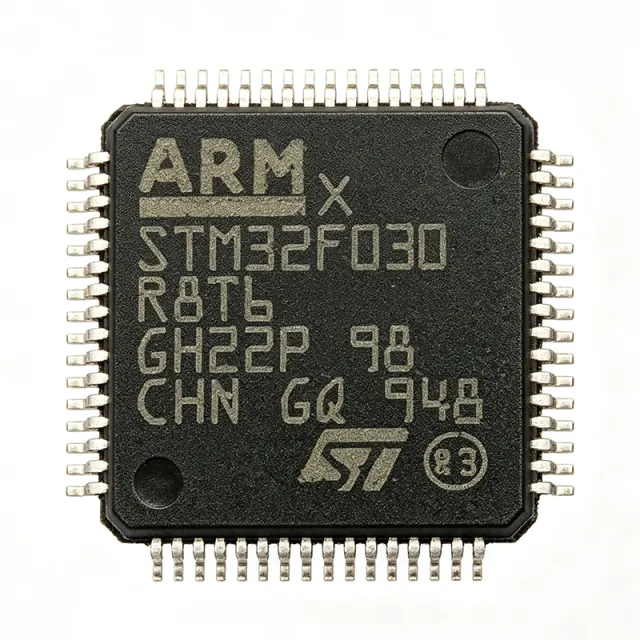
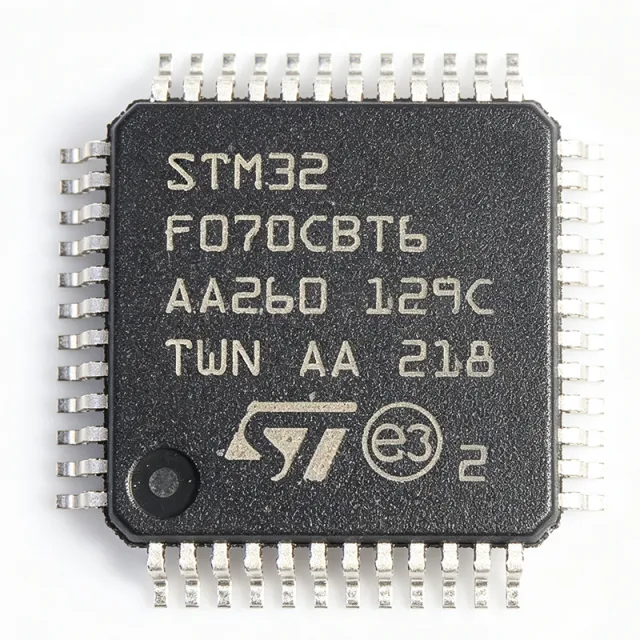
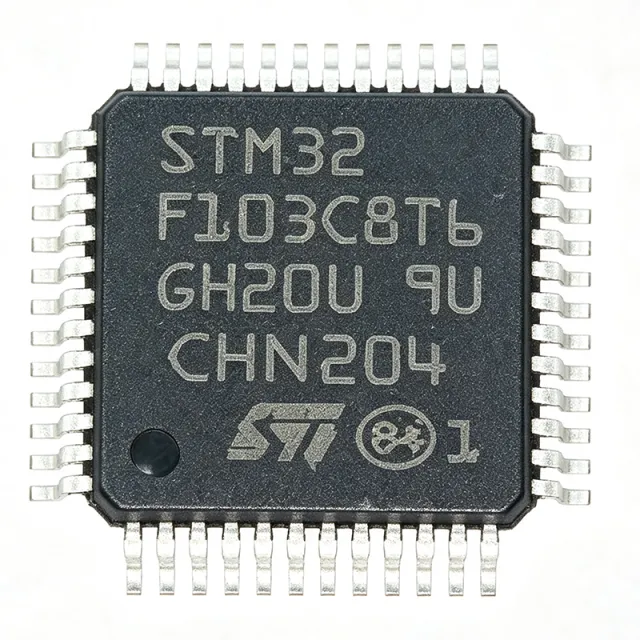
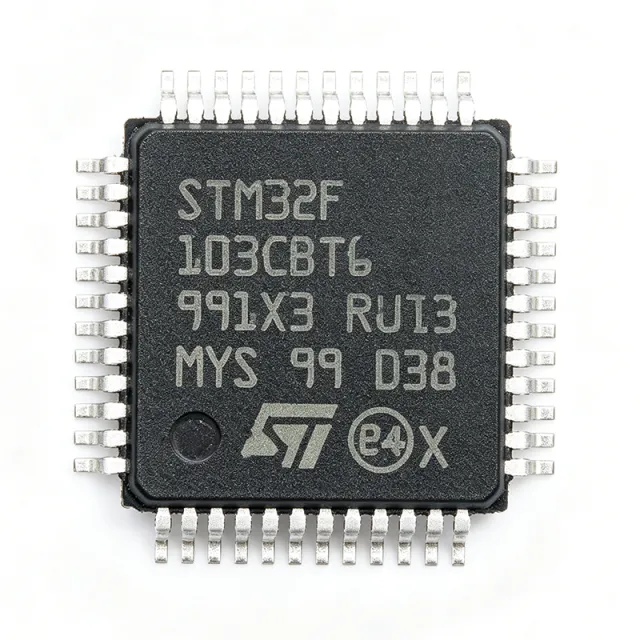
STM32F042K6T6
STM32F042K6T6 - 48MHz Cortex-M0 MCU 32KB Flash USB | STMicroelectronics
The STMicroelectronics STM32F042K6T6 is a 32-bit ARM Cortex-M0 microcontroller running at up to 48 MHz, integrating 32 KB of Flash memory and 6 KB of SRAM in a 32-pin LQFP (7x7 mm) package. It targets USB-enabled mainstream embedded designs requiring a low pin count, USB 2.0 Full-Speed Device with on-chip PHY, CAN 2.0B interface, and a rich set of peripherals including timers, ADC, comparators, and communication interfaces.
A microcontroller (MCU) is a single-chip computer that integrates a CPU core, program memory (Flash), working memory (SRAM), and peripheral interfaces. Within the broader taxonomy, the STM32F042K6T6 sits at the intersection of embedded processor -> ARM Cortex-M0 core -> 32-bit RISC MCU -> mainstream connectivity line MCU. The Cortex-M0 architecture uses the Thumb/Thumb-2 instruction set and is designed for deterministic, low-power real-time control, making the F042 series ideal for USB Type-C accessories, human-interface devices, and small-form-factor sensor nodes.
Key features include 32 KB Flash with read-while-write support, 6 KB SRAM with hardware parity, a 12-bit 1 Msps ADC with up to 13 external channels, two 16-bit timers, one 32-bit timer, an independent watchdog, a real-time clock, and a USB 2.0 Full-Speed Device interface with integrated PHY that eliminates the need for an external USB transceiver. The device operates from 2.0V to 3.6V and supports both 2.5V and 3.3V application rails, with multiple low-power modes (Sleep, Stop, Standby) suited to battery-powered products.
Architecturally, the STM32F042K6T6 leverages ST's 90 nm embedded Flash process and the Cortex-M0 v6-M core with single-cycle multiplier, achieving 0.93 DMIPS/MHz. The integrated 4-16 MHz HSI oscillator with PLL, plus a 32 kHz LSI for the RTC, allow bill-of-material reduction by removing the external crystal in non-USB applications. The CAN 2.0B interface, combined with USB, makes this part uniquely positioned among Cortex-M0 devices for industrial control and automotive body networks.
Typical applications include USB HID peripherals (keyboards, mice, custom HID), USB-to-UART bridges, USB-C audio accessories, CAN node endpoints in industrial networks, small motor control boards, smart-home sensor hubs, and USB-charged IoT endpoints. The 32-pin LQFP footprint is breadboard-friendly and supports hand-rework prototypes while remaining suitable for high-volume SMT assembly.
Design consideration: because USB DP/DM pins are bonded to specific GPIO pins (PA11/PA12), designers must avoid remapping these to alternate functions when the USB peripheral is enabled. The integrated pull-up resistor on the DP line is software-controlled, simplifying bus-powered designs. For CAN applications, an external transceiver (e.g., SN65HVD230) is still required because the F042 provides only the protocol controller.
This page synthesizes distributor pricing, drop-in same-package alternatives, and design considerations not found in a single datasheet excerpt.
USD $1,84
En stock