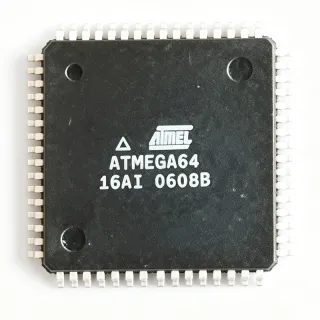
ATMEGA644P-20AQR - 8-bit AVR MCU 64KB 20MHz TQFP-44 | Microchip
Référence : ATMEGA644P-20AQR ✓ Actif| Qté | Prix unitaire | Total |
|---|---|---|
| 1 | $7.96 | $7,96 |
| 10 | $7.55 | $75,50 |
| 100 | $6.9 | $690,00 |
| 500 | $6.4 | $3 200,00 |
| 1 000 | $5.95 | $5 950,00 |
ATMEGA644P-20AQR Présentation
An 8-bit microcontroller is an integrated circuit that executes program instructions, manages peripherals, and interfaces with sensors and actuators using 8-bit-wide data words. The ATmega644P belongs to the AVR family of enhanced RISC microcontrollers, which sits within the broader hierarchy of embedded processors and power-efficient system-on-chip solutions for cost-sensitive control applications.
Key features include the AVR enhanced RISC architecture executing 131 powerful instructions, most in a single clock cycle, for throughput close to 1 MIPS per MHz. The dual-UAVR 'P' variant adds a second USART, enabling two independent serial communication channels. Peripherals include an 8-channel 10-bit ADC, JTAG for on-chip debugging, and an internal oscillator option. The picoPower family heritage supports low-power design strategies.
Technically, the device achieves single-cycle ALU operation through its advanced RISC pipeline, letting system designers trade processing speed directly against power consumption. Program memory is In-System Programmable via SPI (ICSP), and the JTAG interface supports boundary-scan and in-circuit debugging with tools such as the MPLAB SNAP.
Typical applications include industrial automation controllers, embedded sensing and data-logging nodes, and hobby/education platforms such as 3D printer controllers, where two hardware UARTs simplify communication with both a host and a peripheral.
When designing with this part, verify supply-voltage tolerance against your clock target: full 20MHz operation is specified at the 5V industrial supply range noted by distributor data.
This page synthesizes distributor pricing, drop-in family alternatives, and practical design notes not found in the manufacturer datasheet, with prices as of 2026-09-18.
Alternatives de remplacement direct pour ATMEGA644P-20AQR — même boîtier, compatible broche à broche. Les références à boîtier différent nécessitant une retouche du PCB sont exclues.
Variantes de cette série
Modèles de la même série directement compatibles avec ATMEGA644P-20AQR (même facteur de forme et même empreinte) — différant par Package, ADC, Timer/Counters, EEPROM, SRAM.
Outil de comparaison rapide — sélectionnez des références alternatives pour une comparaison côte à côte :
ATMEGA644P-20AU
✅ Remplacement direct ⚠️ Spécifications non vérifiées✓ En stock
$3.95 / unité
Voir la fiche technique →ATMEGA644-20AU
✅ Remplacement direct✓ En stock
$4.96 / unité
Voir la fiche technique →ATMEGA644PA-AU
✅ Remplacement direct ⚠️ Spécifications non vérifiées✓ En stock
$4.61 / unité
Voir la fiche technique →ATMEGA324P-20AUR
✅ Remplacement direct✓ En stock
$4.52 / unité
Voir la fiche technique →ATMEGA164P-20AUR
✅ Remplacement direct📋 Alternative de référence (hors catalogue)
ATMEGA1284P-AU
✅ Remplacement direct ⚠️ Spécifications non vérifiées✓ En stock
$4.65 / unité
Voir la fiche technique →ATMEGA644P-20AQR Valeurs maximales et caractéristiques électriques
| Core Architecture | AVR 8-bit RISC |
| Core Size | 8-Bit |
| Fréquence d'horloge maximale | 20 MHz |
| Program Memory Size | 64 KB (32K x 16) Flash |
| Program Memory Type | In-System Programmable Flash |
| RAM Size | 4 KB (4K x 8) SRAM |
| EEPROM Size | 2 KB |
| Number of I/O | 32 |
| Boîtier / Format | 44-TQFP (10 x 10 mm) |
| Type de montage | Surface Mount |
| Oscillator Type | Internal |
| Peripherals | Dual USART, 10-bit ADC, JTAG, picoPower features |
| Instructions | 131 powerful instructions, most single-clock cycle |
| Packaging | Tape & Reel (TR) |
| Programming Interface | ICSP (SPI) and JTAG |
Guide de configuration des broches du ATMEGA644P-20AQR 44-tqfp (10 x 10 mm)
Configuration des broches du ATMEGA644P-20AQR (boîtier 44-tqfp (10 x 10 mm)). Ce circuit intégré numérique comprend des GPIO, des interfaces de communication (UART, SPI, I2C) et des broches d'alimentation. Consultez la fiche technique du fabricant pour les fonctions alternatives des broches et les options de configuration. Indispensable pour la conception de systèmes embarqués et la conception de circuits imprimés.

Aucune donnée de brochage détaillée disponible pour ATMEGA644P-20AQR.
Consultez la fiche technique pour la configuration complète des broches.
Applications typiques
ATMEGA644P-20AQR convient pour 6 applications: Industrial Automation Controllers, Embedded Data Loggers, 3D Printer and Motion Control Boards, Sensor and Measurement Instruments, Communication and Gateway Nodes, Education and Hobby Embedded Platforms.
Industrial Automation Controllers
The ATMEGA644P-20AQR fits industrial controller duty because its 64KB Flash accommodates protocol stacks and state machines, its dual USART separates field-bus traffic (e.g., RS-485 Modbus on USART1) from a local service/debug UART, and its 8-channel 10-bit ADC digitizes sensors directly without an external converter. Operating from a 5V industrial rail per Mouser's 'IND 5V' listing gives noise immunity typical of factory environments. In typical designs the MCU scans ADC inputs at millisecond intervals, runs PID or sequencing logic at 20MHz, and reports over the serial bus; the 2KB EEPROM retains calibration and counters through power cycles. The JTAG interface enables in-circuit debugging on production fixtures, reducing commissioning time.
Recommandé
Embedded Data Loggers
For data-logging nodes, the ATMEGA644P-20AQR combines 2KB EEPROM for nonvolatile settings with 4KB SRAM for buffering, while 64KB Flash leaves ample room for FAT-style card drivers or flash-file storage code. The internal oscillator option eliminates an external crystal in non-timing-critical builds, and picoPower heritage supports battery-backed deployments using sleep modes between sampling events. A typical arrangement reads 8 ADC channels (one per sensor line), timestamps samples, and writes to an SD card over SPI; the dual USART can stream live telemetry to a radio module while a second channel services diagnostics. At 20MHz with 1 MIPS/MHz efficiency, sampling loops complete well within budget, and JTAG simplifies long-term firmware maintenance.
Recommandé
3D Printer and Motion Control Boards
Open-source 3D printer electronics have historically used the ATmega644P in TQFP-44 precisely because its 44-pin footprint provides 32 I/O lines for heaters, fans, end-stops, and stepper drivers, while 64KB Flash holds planner firmware with room to spare. The dual USART is often assigned to USB-serial comms with the host and a second channel for LCD panels or auxiliary devices. A 20MHz crystal supplies stable step-timing; the AVR's single-cycle instruction execution supports deterministic interrupt intervals for step pulse generation. The 10-bit ADC reads thermistors for hot-end and bed temperature control, typically in a timer-interrupt PID loop. JTAG availability on the 644 family is a practical advantage over ATmega328-based boards during firmware bring-up.
Recommandé
Sensor and Measurement Instruments
The ATMEGA644P-20AQR suits benchtop and portable measurement instruments that need moderate precision analog acquisition and rich user I/O. Its 8-channel 10-bit ADC covers up to eight sensor front-ends, while the 32 general-purpose I/O lines drive keypads, LED/LCD interfaces, and control relays. The 64KB Flash accommodates calibration tables, filtering routines, and a menu-driven UI, and 2KB EEPROM safely stores zero/gain calibrations between sessions. In a typical instrument, conversion results are oversampled and averaged in the 4KB SRAM before display update; the dual USART can export readings to a PC or printer while a second link accepts configuration commands. The industrial supply profile and internal oscillator option simplify both mains-powered and portable designs.
Recommandé
Communication and Gateway Nodes
The defining advantage of the ATMEGA644P for communication gateways is its two independent hardware USARTs, allowing simultaneous bridging between, for example, an RS-485 field bus and a radio module without software UART bit-banging overhead. At 20MHz the AVR core delivers up to 20 MIPS, enough to run framing, CRC, and buffering tasks across both ports. The 64KB Flash holds dual protocol stacks, and 4KB SRAM provides generous ring buffers for bursty traffic compared with smaller 32KB-class parts. The 10-bit ADC can supervise supply voltages or analog sensor inputs reported over the link. Using hardware UARTs with interrupt-driven circular buffers yields deterministic latency, and JTAG-based debugging on the 644 family accelerates protocol bring-up.
Recommandé
Education and Hobby Embedded Platforms
The ATmega644P family is popular in education and hobby platforms because it offers a meaningful step up from the ATmega328P: twice the pins (44-TQFP, 32 I/O), a second UART, and 64KB Flash, all while remaining programmable with familiar AVR tools. Community Arduino cores (e.g., MightyCore) and the CodeVisionAVR compiler directly support the device, and standard 6-pin ICSP works with common programmers. Students can explore JTAG debugging, an option absent on ATmega328 boards, using tools such as the MPLAB SNAP. Typical projects include robots, weather stations, and audio experiments using the 8-channel ADC. The internal oscillator allows breadboard-first builds before committing to a crystal-clocked PCB.
Recommandé
Récapitulatif des produits recommandés
Données de référence d'ingénierie pour ATMEGA644P-20AQR — comparaison, recommandations de conception et informations de conformité.
Guide de sélection
Comparaison avec les alternatives
| Paramètre | Ce produit | ATMEGA644P-20AU | ATMEGA644-20AU | ATMEGA324P-20AUR | ATMEGA164P-20AUR | ATMEGA1284P-AU |
|---|---|---|---|---|---|---|
| Package | 44-TQFP (10 x 10 mm) | 44-TQFP - same | 44-TQFP - same | 44-TQFP - same | 44-TQFP - same | 44-TQFP - same |
| Brand | Microchip Technology | Microchip Technology | Microchip Technology | Microchip Technology | Microchip Technology | Microchip Technology |
| Flash Memory | 64 KB | 64 KB | 64 KB | 32 KB | 16 KB | 128 KB |
| SRAM | 4 KB | 4 KB | 4 KB | 4 KB | 1 KB | 16 KB |
| EEPROM | 2 KB | 2 KB | 2 KB | 2 KB | 512 B | 4 KB |
| Maximum Clock Frequency | 20 MHz | 20 MHz | 20 MHz | 20 MHz | 20 MHz | 20 MHz |
| USART Count | 2 (dual USART, 644P feature) | 2 | 1 | 2 | 2 | 2 |
| JTAG Debugging | Yes | Yes | Yes | Yes | Yes | Yes |
Principaux différenciateurs
- Dual hardware USART on the 64KB 644 die (vs ATMEGA644-20AU)
- Double the Flash of the 324 class at the same price class (vs ATMEGA324P-20AUR)
- Four times the SRAM and EEPROM of the 164 class (vs ATMEGA164P-20AUR)
- Cost-optimized entry point in the same footprint (vs ATMEGA1284P-AU)
Notes de conception
Per Microchip's ATmega644P family ordering codes, maximum 20MHz clock operation is specified at the higher supply-voltage tier; Mouser lists this part as 'IND, 5V'. Running a 20MHz crystal from a marginal or unregulated 5V supply risks out-of-spec operation - use a regulated 5V rail with 0.1uF decoupling at every VCC/AVCC pin and a 10uF bulk capacitor near the regulator. Keep AVCC tied to VCC through a low-pass filter (e.g., 10uH inductor or ferrite bead plus capacitor) when ADC accuracy matters.
Place the 0.1uF ceramic decoupling capacitors for VCC, AVCC, and AREF within 2-3 mm of the corresponding TQFP-44 pins, with short return paths to a solid ground plane. If using an external crystal at 20MHz, keep load capacitors and traces short and route the crystal loop away from switching signals such as USART lines. Provide the standard 6-pin ICSP header and, where production debugging is planned, route the JTAG pins (TCK/TMS/TDO/TDI) to a header - the ATmega644P supports on-chip debug via JTAG unlike the ATmega328 family.
Two frequent mistakes on 644P-class designs: (1) assuming the second USART exists on non-P parts - the ATMEGA644-20AU is pin-compatible but has only USART0, so firmware using USART1 will not run on it; (2) enabling JTAG by default - the JTAG port shares PC2-PC5 with normal I/O, so if your design needs those pins as GPIO, clear the JTAGEN fuse (a write sequence is required per the Microchip datasheet). Also verify the ordering-code temperature/qualification suffix against your environmental requirement, since distributor listings for this part show both industrial and 'AQ' coding conventions.
Estimated: an AVR ATmega644P at 5V/20MHz with typical I/O loading dissipates on the order of tens of milliwatts of core power plus whatever it sources into loads; the 44-TQFP (10 x 10 mm) package theta_JA of roughly 70-100 C/W (typical for this package class; exact value per Microchip thermal data) means no heatsink is needed for normal operation. Avoid sourcing more than the per-pin absolute-maximum current (40 mA per I/O per datasheet ratings) on multiple pins simultaneously, and verify total device current limits in the datasheet electrical characteristics table.
Informations de conformité
FindIC lists the related green packaging option ('GREEN' coding appears in some ATmega644P ordering codes), but explicit RoHS/REACH/lead-free declarations for ATMEGA644P-20AQR were not present in the retrieved data. Verify compliance on the Microchip product page (microchip.com/en-us/product/ATmega644P) or the distributor's compliance documentation.