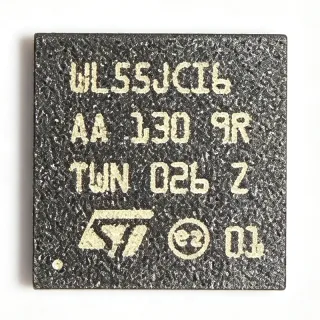
BC63B239A04-AQK-E4 - Bluetooth v2.1+EDR Class 1 TxRx+MCU, 40-QFN
Référence : BC63B239A04-AQK-E4 ✓ Actif| Qté | Prix unitaire | Total |
|---|---|---|
| 1 | $12.5 | $12,50 |
| 10 | $11.2 | $112,00 |
| 100 | $9.85 | $985,00 |
| 500 | $8.6 | $4 300,00 |
| 1 000 | $7.4 | $7 400,00 |
BC63B239A04-AQK-E4 Présentation
A Bluetooth transceiver with MCU is a short-range radio system-on-chip that combines a 2.4 GHz physical-layer radio (Bluetooth core spec v2.1 + EDR) with a microprocessor and embedded memory. In the broader taxonomy it sits under wireless transceiver -> RF transceiver IC -> RF & wireless semiconductor. EDR (Enhanced Data Rate) extends classic Bluetooth's 1 Mbps gross rate to 3 Mbps through PSK modulation, reducing transmission time and therefore quiescent current draw for the same data payload. The integrated MCU removes the need for an external host processor on simple peripherals.
Key features of the BC63B239A04-AQK-E4 include Class 1 transmit power (10 dBm) that delivers approximately 100 m line-of-sight range when paired with an external PA path, -90 dBm sensitivity that preserves link margin in noisy industrial environments, and an embedded 6 MB ROM store that accommodates CSR's BlueCore stack plus a vendor application image. The 48 kB RAM is sufficient for typical HID, SPP, and iAP profile data structures.
Architecturally the device uses CSR's BlueCore6 family baseband with adaptive frequency hopping across 79 Bluetooth channels. Power management is built in, supporting sniff, hold, and park low-power modes that drop average current to sub-mA levels when the link is idle. Antenna interface is single-ended 50 ohm on a dedicated RF pin.
Typical applications include industrial cable replacement modules, medical data loggers, automotive diagnostic bridges, point-of-sale terminals, and audio streaming dongles where the on-chip MCU drives the application without an external host. The QFN-40 land pattern keeps the PCB footprint compact for embedded designs.
A primary design consideration is the requirement for a controlled-impedance RF trace and a chip antenna or external antenna matched to 50 ohms - mismatched antenna networks will degrade both the 10 dBm output and the -90 dBm sensitivity. Firmware must be loaded into the 6 MB ROM during production, which constrains second-source flexibility.
Alternatives de remplacement direct pour BC63B239A04-AQK-E4 — même boîtier, compatible broche à broche. Les références à boîtier différent nécessitant une retouche du PCB sont exclues.
Outil de comparaison rapide — sélectionnez des références alternatives pour une comparaison côte à côte :
BC63B239A05-AQK-E4
✅ Remplacement direct📋 Alternative de référence (hors catalogue)
BC63B239A05-AQK-E4C
✅ Remplacement direct📋 Alternative de référence (hors catalogue)
BC63B239A04-IQD-E4
✅ Remplacement direct📋 Alternative de référence (hors catalogue)
CC2541
✅ Remplacement direct📋 Alternative de référence (hors catalogue)
nRF51822
✅ Remplacement direct📋 Alternative de référence (hors catalogue)
BC63B239A04-AQK-E4 Valeurs maximales et caractéristiques électriques
| Manufacturer | Qualcomm (formerly CSR) |
| Fonction | RF Transceiver + MCU |
| Protocol | Bluetooth v2.1 + EDR, Class 1 |
| Frequency | 2.4 GHz ISM band |
| Maximum RF Output Power | 10 dBm |
| Receive Sensitivity | -90 dBm |
| Maximum Data Rate | 3 Mbps |
| Memory - ROM | 6 MB |
| Memory - RAM | 48 kB |
| RF Family/Standard | Bluetooth |
| Boîtier | 40-QFN |
| Type de montage | Surface Mount |
| Packaging | Tape & Reel (TR) |
| Statut RoHS | Compliant |
| Product Status | Active |
Guide de configuration des broches du BC63B239A04-AQK-E4 40-qfn
Configuration des broches du BC63B239A04-AQK-E4 (boîtier 40-qfn). Ce circuit intégré numérique comprend des GPIO, des interfaces de communication (UART, SPI, I2C) et des broches d'alimentation. Consultez la fiche technique du fabricant pour les fonctions alternatives des broches et les options de configuration. Indispensable pour la conception de systèmes embarqués et la conception de circuits imprimés.

Aucune donnée de brochage détaillée disponible pour BC63B239A04-AQK-E4.
Consultez la fiche technique pour la configuration complète des broches.
Applications typiques
BC63B239A04-AQK-E4 convient pour 6 applications: Industrial Cable Replacement, Medical Data Loggers, Automotive Diagnostic Bridges, Point-of-Sale Terminals, Audio Streaming Dongles, iAP Authentication Coprocessor Dongles.
Industrial Cable Replacement
The BC63B239A04-AQK-E4 is well suited to industrial cable-replacement modules such as RS-232-to-Bluetooth serial adapters used in factory automation and process instrumentation. Its 10 dBm Class 1 transmit power delivers roughly 100 m of line-of-sight range, which is sufficient to bridge PLC panels, HMI terminals, and remote sensor enclosures inside a typical plant floor. The -90 dBm receive sensitivity preserves link margin in electrically noisy environments where 2.4 GHz interference from motors and drives is common, and the integrated 48 kB RAM runs SPP firmware without an external host MCU. Place a 50 ohm controlled-impedance trace from the RF pin to the antenna footprint.
Recommandé
Medical Data Loggers
Portable medical data loggers such as glucose meters, spirometers, and ambulatory monitors leverage the BC63B239A04-AQK-E4's Bluetooth v2.1+EDR SPP profile to push recorded readings to a clinician's tablet or PC. The 6 MB ROM holds both the Bluetooth stack and the device-specific measurement code, eliminating the need for an external application processor and keeping the BOM compact for battery-powered form factors. Sniff and park low-power modes drop the average current draw into the sub-mA range between transmissions, extending battery life on multi-day logging deployments. The -90 dBm sensitivity ensures reliable pairing at typical bedside distances.
Recommandé
Automotive Diagnostic Bridges
Automotive OBD-II Bluetooth diagnostic bridges use the BC63B239A04-AQK-E4's SPP profile to tunnel CAN/LIN bus traffic to a mechanic's tablet or phone running diagnostic software. The 10 dBm output power maintains a stable link across a workshop floor populated with metal toolboxes and lifts, while the -90 dBm sensitivity tolerates partial obstruction when the technician walks around the vehicle. The 40-QFN surface-mount package is automotive-friendly because it tolerates the high-vibration under-dash environment and supports standard SMT assembly. The 48 kB of RAM is sufficient for CAN frame buffering between the diagnostic application and the Bluetooth radio.
Recommandé
Point-of-Sale Terminals
Point-of-sale (POS) terminals and mobile payment peripherals integrate the BC63B239A04-AQK-E4 to communicate with receipt printers, cash drawers, and barcode scanners over Bluetooth Classic SPP. The 3 Mbps EDR air-data rate delivers print jobs and barcode streams with low latency, keeping checkout lines moving. The on-chip 48 kB RAM plus 6 MB ROM run a lightweight POS state machine without a host application processor, simplifying certification. The Class 1 +10 dBm output links reliably through checkout-counter metal enclosures where a Class 2 radio would struggle.
Recommandé
Audio Streaming Dongles
Wireless audio adapters that stream A2DP from a TV or PC to Bluetooth speakers or headphones leverage the BC63B239A04-AQK-E4's 3 Mbps EDR throughput, which is adequate for sub-bandband SBC and early AAC codecs. The 10 dBm output maintains a stable link across a typical living-room distance even through drywall, and the 6 MB ROM holds the codec plus the A2DP/AVRCP profile stack without an external DSP. The integrated MCU manages the audio routing and on-device buttons for play/pause/skip. Power consumption is the dominant design constraint - budget for a Class 1 capable regulator and thermal relief.
Recommandé
iAP Authentication Coprocessor Dongles
Made-for-iPhone/iPad (MFi) accessory dongles use the BC63B239A04-AQK-E4 as an iAP coprocessor that authenticates against Apple's Lightning or 30-pin host via Bluetooth. The 6 MB ROM accommodates the iAP authentication stack alongside the Bluetooth stack, and the integrated MCU runs the MFi protocol state machine without external logic. The -90 dBm receive sensitivity preserves the link in pocket-and-bag scenarios where accessory signal attenuation is significant. The 40-QFN footprint keeps the dongle PCB small enough for compact MFi accessory form factors.
Recommandé
Récapitulatif des produits recommandés
Données de référence d'ingénierie pour BC63B239A04-AQK-E4 — comparaison, recommandations de conception et informations de conformité.
Guide de sélection
Comparaison avec les alternatives
| Paramètre | Ce produit | BC63B239A05-AQK-E4 | BC63B239A05-AQK-E4C | BC63B239A04-IQD-E4 | CC2541 | nRF51822 |
|---|---|---|---|---|---|---|
| Package | 40-QFN | 40-QFN (same) | 40-QFN (same) | 40-QFN (same) | 40-QFN (same) | QFN-48 (differs) |
| Brand | Qualcomm (CSR) | Qualcomm | Qualcomm | Qualcomm | Texas Instruments | Nordic Semiconductor |
| Protocol | Bluetooth v2.1 + EDR, Class 1 | Bluetooth v2.1 + EDR, Class 1 (stack v5) | Bluetooth v2.1 + EDR, Class 1 | Bluetooth v2.1 + EDR, Class 1 | BLE 4.0 only | BLE 4.2 only |
| Max Output Power | 10 dBm | 10 dBm | 10 dBm | 10 dBm | 0 dBm | 4 dBm |
| Receive Sensitivity | -90 dBm | -90 dBm | -90 dBm | -90 dBm | -94 dBm | -93 dBm |
| Max Data Rate | 3 Mbps | 3 Mbps | 3 Mbps | 3 Mbps | 1 Mbps (BLE) | 1 Mbps (BLE) |
| Integrated Memory | 6 MB ROM / 48 kB RAM | 6 MB ROM / 48 kB RAM | 6 MB ROM / 48 kB RAM | 6 MB ROM / 48 kB RAM | 128/256 kB Flash / 8 kB RAM | 256 kB Flash / 16 kB RAM |
| Function | TxRx + MCU (Classic BT) | TxRx + MCU (Classic BT) | TxRx + MCU (Classic BT) | TxRx + MCU (Classic BT) | TxRx + MCU (BLE SoC, 8051) | TxRx + MCU (BLE SoC, Cortex-M0) |
Principaux différenciateurs
- Bluetooth Classic v2.1+EDR Class 1 support that BLE-only SoCs cannot provide (vs CC2541)
- On-chip MCU eliminates external host processor for simple peripherals (vs nRF51822)
- 10 dBm transmit power delivers the highest Bluetooth link budget in this class (vs CC2541)
Notes de conception
The BC63B239A04-AQK-E4 RF pin must connect to a controlled-impedance (50 ohm nominal) microstrip or stripline trace that terminates at the antenna footprint. Use a ground cutout beneath the RF trace per the manufacturer reference layout, and stitch the ground plane with vias on both sides of the trace. Mismatched impedance will degrade both the 10 dBm output and the -90 dBm receive sensitivity, shrinking usable range by tens of percent.
Provide a clean 1.8 V rail to the BC63B239A04-AQK-E4 with at least 100 mA peak headroom for Class 1 transmit bursts. Place a 10 uF ceramic bulk capacitor plus a 0.1 uF decoupling cap within 3 mm of the supply pins. Estimated: a 10 dBm transmit burst at 50 mA average current produces a sub-mV ripple if the regulator is a low-noise LDO; do not power this rail from a noisy buck converter without an LDO post-regulator.
Do not substitute a generic 50 ohm chip antenna without re-tuning the matching network for the BC63B239A04-AQK-E4 PCB stack-up. Antenna return loss must be measured with a vector network analyzer on the production PCB; simulation alone is insufficient at 2.4 GHz. Also, firmware must be loaded into the 6 MB ROM during production programming - field upgrades require the vendor's DFU mechanism and signed images, otherwise the stack will reject the image.
Informations de conformité
RoHS compliant per JLCPCB product listing. REACH, AEC-Q100, halogen-free, and conflict-minerals status not stated explicitly in the verified web data and require direct confirmation from Qualcomm.