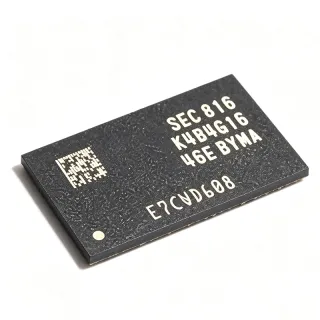
K4B2G1646 - 2Gb DDR3/DDR3L SDRAM 128Mx16 | Samsung
Référence : K4B2G1646 ✓ Actif| Qté | Prix unitaire | Total |
|---|---|---|
| 1 | $10.08 | $10,08 |
| 10 | $9.57 | $95,70 |
| 100 | $9.07 | $907,00 |
| 500 | $8.6 | $4 300,00 |
| 1 000 | $8.35 | $8 350,00 |
K4B2G1646 Présentation
DDR3 SDRAM (Double Data Rate Type Three Synchronous Dynamic Random-Access Memory) is a member of the DDR SDRAM family of volatile memory ICs within the broader DRAM and semiconductor memory hierarchy. It transfers data on both rising and falling clock edges, uses an 8-bit prefetch architecture, and delivers higher bandwidth at lower power than DDR2, making it the dominant system memory for embedded and consumer platforms from roughly 2007 onward.
Key features of the K4B2G1646 family include on-die termination (ODT) for signal integrity at high data rates, ZQ calibration for output driver impedance matching, auto precharge, an asynchronous reset function, and a data mask function on the x16 organization. Industrial-grade suffixes such as K4B2G1646F-BYMA support operating temperatures of -40C to +95C, while commercial grades such as K4B2G1646F-BCNB are specified from 0C to +85C.
Architecturally, the device comprises eight internal banks with bank-group style row activation, burst lengths of 8 (BL8) with chop support, CAS latency options scaled to speed bin, and dynamic ODT. The 1.35V DDR3L core lowers dynamic and standby power versus the 1.5V DDR3 core, a benefit in thermally constrained designs. The 96-FBGA package keeps the footprint compact for dense memory subsystems.
Typical applications include embedded processor and FPGA memory subsystems, industrial control and HMI boards, networking equipment, smart TVs, set-top boxes, medical devices, and automotive infotainment platforms where industrial temperature grades are selected.
When designing with this device, follow the JEDEC-style fly-by or tree routing guidance in the Samsung datasheet, keep 40-ohm to 60-ohm controlled-impedance traces length-matched within tolerance, and power VDD/VDDQ with 1.35V or 1.5V rails per die generation; DDR3L parts must be validated at the actual rail voltage of the platform.
This page synthesizes distributor pricing, stock data, drop-in family alternatives, and practical design notes not found in a single manufacturer datasheet.
Alternatives de remplacement direct pour K4B2G1646 — même boîtier, compatible broche à broche. Les références à boîtier différent nécessitant une retouche du PCB sont exclues.
Outil de comparaison rapide — sélectionnez des références alternatives pour une comparaison côte à côte :
K4B2G1646F-BYMA
✅ Remplacement direct📋 Alternative de référence (hors catalogue)
K4B2G1646F-BCNB
✅ Remplacement direct📋 Alternative de référence (hors catalogue)
K4B2G1646Q-BYK0
✅ Remplacement direct📋 Alternative de référence (hors catalogue)
K4B2G1646Q-BCK0
✅ Remplacement direct📋 Alternative de référence (hors catalogue)
K4B2G1646C-HCF8000
✅ Remplacement direct📋 Alternative de référence (hors catalogue)
K4B2G1646B
✅ Remplacement direct📋 Alternative de référence (hors catalogue)
K4B2G1646 Valeurs maximales et caractéristiques électriques
| Memory Density | 2 Gb |
| Organisation de la mémoire | 128M x 16 |
| Type de mémoire | DDR3 / DDR3L SDRAM (die generation dependent: B/C die = DDR3, F/Q die = DDR3L) |
| Supply Voltage (VDD/VDDQ) | 1.5 V (DDR3) / 1.35 V (DDR3L) |
| Max Data Rate | 2133 Mbps (K4B2G1646F-BCNB) |
| Boîtier | 96-FBGA (PBGA96) |
| Operating Temperature (Industrial, -BYMA suffix) | -40C to +95C |
| Operating Temperature (Commercial, -BCNB suffix) | 0C to +85C |
| On-Die Termination (ODT) | Yes |
| ZQ Calibration | Yes |
| Auto Precharge | Yes |
| Asynchronous Reset | Yes |
| Data Mask Function | Yes (x16 organization) |
| Type de montage | Surface Mount |
| Interface | SSTL-15 (DDR3) / SSTL-135 (DDR3L) |
Guide de configuration des broches du K4B2G1646 96-fbga (pbga96)
Configuration des broches du K4B2G1646 (boîtier 96-fbga (pbga96)). Ce circuit intégré numérique comprend des GPIO, des interfaces de communication (UART, SPI, I2C) et des broches d'alimentation. Consultez la fiche technique du fabricant pour les fonctions alternatives des broches et les options de configuration. Indispensable pour la conception de systèmes embarqués et la conception de circuits imprimés.

Aucune donnée de brochage détaillée disponible pour K4B2G1646.
Consultez la fiche technique pour la configuration complète des broches.
Applications typiques
K4B2G1646 convient pour 6 applications: Embedded Processor Memory Subsystem, FPGA Development and Prototyping Boards, Networking and Communications Equipment, Smart TV and Consumer Electronics, Medical and Diagnostic Equipment, Automotive Infotainment and Telematics.
Embedded Processor Memory Subsystem
The K4B2G1646 provides 2Gb of main memory for embedded MPUs and SoCs such as ARM Cortex-A class processors that expose a 16-bit DDR3/DDR3L controller. Its 128M x16 organization matches single-chip 16-bit memory controllers without needing two x8 devices, reducing BOM count and routing complexity. Industrial-suffix parts (K4B2G1646F-BYMA, -40C to +95C) keep the design qualified across the full industrial ambient range. ODT and ZQ calibration simplify impedance matching at 1600-2133 Mbps data rates on two- to four-layer boards. Placing the device within 50 mm of the SoC with length-matched fly-by routing typically sustains full-speed operation; beyond that, derate the speed bin or add read training in the controller.
Recommandé
FPGA Development and Prototyping Boards
Xilinx 7-series FPGAs pair naturally with the K4B2G1646 because the Xilinx Memory Interface Solution (MIG) IP directly supports x16 DDR3/DDR3L SDRAM with automatic calibration. The 2Gb density gives 256 MB of buffering - ample for video frame buffers, data acquisition capture, and soft-CPU (MicroBlaze) program memory. The 96-FBGA package allows controlled-impedance breakout on standard 4-layer stackups, and DDR3L 1.35V operation lowers I/O power versus DDR2 alternatives. At 1600 Mbps with BL8, a single x16 device delivers 3.2 GB/s peak bandwidth, sufficient for many FPGA designs without needing wider x32/x64 arrays.
Recommandé
Networking and Communications Equipment
Enterprise switches, routers, and industrial gateways use K4B2G1646-class DDR3 for packet buffers, routing tables, and management-CPU memory. Samsung's DDR3 line was, per DigChip, developed into 'the most used system solution, from PCs and home appliances, to automotive and medical devices', and networking remains a core segment. The 2133 Mbps speed bin of the F-die keeps latency low for line-rate forwarding, while ODT preserves signal integrity on heavily loaded address/command buses typical of multi-drop memory topologies. For temperature-hardened telecom cabinets, specify the -BY industrial suffix (-40C to +95C). Use fly-by routing with per-device termination settings configured through the memory controller mode registers.
Recommandé
Smart TV and Consumer Electronics
Smart TVs, set-top boxes, and streaming media players use x16 DDR3/DDR3L SDRAM like the K4B2G1646 for frame buffering and application memory in SoC platforms. The commercial-grade K4B2G1646F-BCNB (0C to +85C) fits the thermally controlled consumer environment and, at approximately $8.35 versus $10.08 for the industrial part (LCSC, as of 2026-10-11), reduces BOM cost at consumer volume. DDR3L 1.35V operation cuts memory subsystem power - significant for standby-energy regulations - and the 2Gb density covers 1080p/4K frame buffer needs for many SoCs. The 96-FBGA footprint maximizes board density inside slim display chassis.
Recommandé
Medical and Diagnostic Equipment
Patient monitors, ultrasound front ends, and diagnostic instruments require memory that is qualified across the clinical operating envelope, making the -40C to +95C K4B2G1646F-BYMA a natural fit. Samsung notes its DDR3 is used 'from PCs and home appliances, to automotive and medical devices', reflecting proven field reliability. The 2Gb (256 MB) capacity stores patient-history buffers, waveform capture, and embedded-Linux application images, while the asynchronous reset function lets a supervisory controller recover the memory deterministically after a watchdog event - valuable in devices requiring predictable fault recovery. DDR3L operation reduces internal heating in sealed, fanless medical enclosures.
Recommandé
Automotive Infotainment and Telematics
Automotive head units and telematics gateways operate over a wide ambient range, so the K4B2G1646F-BYMA (-40C to +95C per LCSC) is the appropriate suffix for in-cabin electronics exposed to solar loading and cold soak. Its DDR3L 1.35V core cuts dynamic power during sustained media playback and navigation rendering, and ZQ calibration maintains output driver impedance as cabin temperature swings. The 2Gb x16 organization suits mid-range infotainment SoCs with a single 16-bit DDR channel. Designers should derate the speed bin at the top of the temperature range, follow the Samsung datasheet derating tables for tCK and AC timings, and validate boot-time training across the full -40C to +95C span.
Recommandé
Récapitulatif des produits recommandés
Données de référence d'ingénierie pour K4B2G1646 — comparaison, recommandations de conception et informations de conformité.
Guide de sélection
Comparaison avec les alternatives
| Paramètre | Ce produit | K4B2G1646F-BYMA | K4B2G1646F-BCNB | K4B2G1646Q-BYK0 | K4B2G1646Q-BCK0 | K4B2G1646B |
|---|---|---|---|---|---|---|
| Package | 96-FBGA (PBGA96) | 96-FBGA - same | 96-FBGA - same | 96-FBGA - same | 96-FBGA (PBGA96) - same | 96-FBGA - same |
| Brand | Samsung Electronics | Samsung Electronics | Samsung Electronics | Samsung Electronics | Samsung Electronics | Samsung Electronics |
| Memory Type | DDR3 / DDR3L (die generation dependent) | DDR3L (F-die) | DDR3L (F-die) | DDR3L (Q-die) | DDR3L (Q-die) | DDR3 (B-die, 1.5V only) |
| Density / Organization | 2Gb / 128M x16 | 2Gb / 128M x16 | 2Gb / 128M x16 | 2Gb / 128M x16 | 128M x16 | 2Gb / 128M x16 |
| Operating Voltage | 1.5 V (DDR3 die) / 1.35 V (DDR3L die) | 1.35 V (DDR3L) | 1.5 V per DigChip listing / DDR3L capable | 1.35 V (DDR3L) | 1.35 V (DDR3L) | 1.5 V (DDR3) |
Principaux différenciateurs
- Industrial temperature rating available in the same footprint (vs K4B2G1646F-BCNB)
- Newer Q-die silicon generation (vs K4B2G1646F-BYMA)
- DDR3L low-voltage operation on F/Q die (vs K4B2G1646B)
Notes de conception
At 1600-2133 Mbps, enable on-die termination (ODT) rather than discrete parallel termination: the K4B2G1646 supports dynamic ODT, allowing different termination values for write and read bursts programmed via mode registers MRS/MR1. Route address/command in fly-by topology with series termination at the controller; keep data lanes length-matched to ±25 ps skew. Impedance-calibrate with the ZQ pin using a precision 240-ohm 1% resistor to GND - omitting this resistor is one of the most common DDR3 bring-up failures.
Power VDD and VDDQ at 1.35V for F-die/Q-die DDR3L suffixes (K4B2G1646F/Q) and 1.5V for B-die/C-die DDR3 suffixes (K4B2G1646B/C), with SSTL-135 or SSTL-15 signaling respectively. Estimated: peak active current at 2133 Mbps can reach several hundred milliamps per device; budget 0.5-1 A rail capability with 100 uF bulk plus 0.1 uF ceramics per ball cluster. Never power a DDR3-only die at 1.35V - it is out of specification. Check the full suffix before connecting rails.
Order by the FULL suffix-bearing MPN: K4B2G1646 alone does not encode die generation, speed grade, or temperature grade, so a purchase-order for the bare number can deliver a commercial-grade BCNB where an industrial BYMA was required. Suffix meaning: -BY = -40C to +95C industrial, -BC = 0C to +85C commercial; the letter after the 6 (B/C/F/Q) identifies the die and DDR3 vs DDR3L. Verify the speed-grade timing (e.g., -BYMA vs -BYK0) matches your controller's supported CAS latency and clock rates.
For the 96-FBGA package, fan out on a 4-layer stackup (SIG-GND-PWR-SIG) with VDD/VDDQ planes referenced directly under the ball field. Keep the device within 50 mm of the controller for full-speed operation; longer traces require speed-bin derating and read-leveling support. Provide the ZQ 240-ohm resistor within 5 mm of the ZQ ball and isolate it from noisy returns. Use VREF decoupling of 0.1 uF close to the VREF ball pair; VREF noise exceeding +/-1% of VDD can cause data-eye violations at 2133 Mbps.
Informations de conformité
Compliance data was not present in the Verified Web Data for K4B2G1646; consult the official Samsung Semiconductor product page or LCSC datasheet documents for RoHS/REACH certificates.