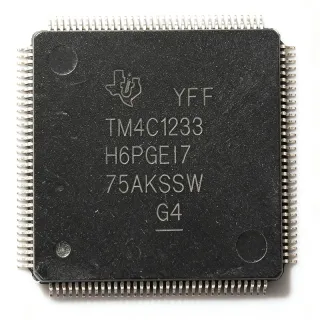
S5LS10106ASPGEQQ1 - Hercules TMS570 Cortex-R4F MCU 1MB Flash 144LQFP | TI
Référence : S5LS10106ASPGEQQ1 ✓ Actif| Qté | Prix unitaire | Total |
|---|---|---|
| 1 | $18.5 | $18,50 |
| 10 | $16.45 | $164,50 |
| 100 | $14.2 | $1 420,00 |
| 500 | $12.1 | $6 050,00 |
| 1 000 | $10.85 | $10 850,00 |
S5LS10106ASPGEQQ1 Présentation
A microcontroller (MCU) is a single-chip programmable computer that integrates a CPU core, memory (Flash for program storage, SRAM for working data), and a rich set of on-chip peripherals (timers, ADC, communication controllers). Cortex-R4F is ARM's real-time, fault-tolerant core architecture, aimed at safety-critical systems. The Hercules TMS570 line wraps the Cortex-R4F with ECC-protected Flash, parity/ECC on SRAM, dual Cortex-R4F lockstep (on certain siblings), a built-in Memory Protection Unit, and a windowed watchdog, positioning it as a safety MCU within the broader power management / domain controller hierarchy in modern vehicles.
Key features include 1 MB ECC Flash, 128 KB ECC SRAM, lockstep-friendly Cortex-R4F core, hardware CRC, 32-bit timers, an external-clock ECLK output, and a wide operating temperature range of -40C to +125C that satisfies automotive under-the-hood requirements. Three MibSPI ports with up to four chip selects each accelerate communication with external sensors and power-converter peripherals, while two CAN controllers support legacy automotive network integration.
Typical applications include automotive brake systems (ABS/ESC), electric power steering (EPS), airbag ECU, battery management systems (BMS), body and chassis ECUs, industrial safety PLCs, and railway signaling controllers. The 144-LQFP package exposes enough I/O for multi-channel sensor aggregation and redundant actuator drive.
Design consideration: AEC-Q100 qualification means this part has been characterized across automotive temperature profiles; designers should still apply the same PCB layout hygiene as for any high-speed MCU - decoupling within 1-2 mm of each supply pin, a solid ground plane under the 144-LQFP paddle and short traces to the high-speed oscillator. While the S5LS10106AS variant is a feature node, the S5LS20206AS sibling in the same family doubles flash/RAM.
This page synthesizes Hercules TMS570 family positioning, drop-in alternatives, and practical design notes not found in the manufacturer datasheet.
Alternatives de remplacement direct pour S5LS10106ASPGEQQ1 — même boîtier, compatible broche à broche. Les références à boîtier différent nécessitant une retouche du PCB sont exclues.
Variantes de cette série
Modèles de la même série directement compatibles avec S5LS10106ASPGEQQ1 (même facteur de forme et même empreinte) — différant par Core Architecture, Operating Temperature Range, RoHS Status.
Outil de comparaison rapide — sélectionnez des références alternatives pour une comparaison côte à côte :
S5LS20206ASPGEQQ1
✅ Remplacement direct📋 Alternative de référence (hors catalogue)
S5LS10206ASPGEQQ1
✅ Remplacement direct ⚠️ Spécifications non vérifiées📋 Alternative de référence (hors catalogue)
S5LS20216ASPGEQQ1
✅ Remplacement direct📋 Alternative de référence (hors catalogue)
S5LS10106ASPGEMQ1
✅ Remplacement direct ⚠️ Spécifications non vérifiées📋 Alternative de référence (hors catalogue)
TMS5701227CPGEQQ1
✅ Remplacement direct✓ En stock
$21.5 / unité
Voir la fiche technique →S5LS10106ASPGEQQ1 Valeurs maximales et caractéristiques électriques
| Core Architecture | ARM Cortex-R4F (Hercules TMS570 family) |
| Largeur du bus de données | 16/32-bit |
| Fréquence d'horloge maximale | 140 MHz |
| Program Memory Size | 1 MB (1M x 8) Flash |
| Program Memory Type | Flash (with ECC) |
| RAM Size | 128 KB (1M x 8) |
| Number of I/O | 68 |
| ADC Resolution | 12-bit |
| Tension d'alimentation de fonctionnement | 1.5 V (core) / 3.3 V (I/O) |
| Plage de température de fonctionnement | -40C to +125C |
| Boîtier / Format | 144-LQFP (20x20 mm) |
| Style de montage | SMD/SMT (gull wing) |
| Supply Type | External clock (programmable ECLK output) |
| Communication Interfaces | MibSPI x3 (4 chip selects each), SCI/UART x2, CAN x2 |
| AEC-Q100 Qualification | Yes (automotive grade) |
| Statut RoHS | Compliant (TI datasheet) |
Guide de configuration des broches du S5LS10106ASPGEQQ1 144-lqfp (20x20 mm)
Configuration des broches du S5LS10106ASPGEQQ1 (boîtier 144-lqfp (20x20 mm)). Ce circuit intégré numérique comprend des GPIO, des interfaces de communication (UART, SPI, I2C) et des broches d'alimentation. Consultez la fiche technique du fabricant pour les fonctions alternatives des broches et les options de configuration. Indispensable pour la conception de systèmes embarqués et la conception de circuits imprimés.

Aucune donnée de brochage détaillée disponible pour S5LS10106ASPGEQQ1.
Consultez la fiche technique pour la configuration complète des broches.
Applications typiques
S5LS10106ASPGEQQ1 convient pour 6 applications: Anti-Lock Braking System (ABS) / Electronic Stability Control (ESC), Electric Power Steering (EPS) ECU, Battery Management System (BMS) Master Controller, Airbag / Supplemental Restraint System (SRS) ECU, Industrial Safety PLC / IEC 61508 SIL-3 Controller, Body and Chassis Domain Controller.
Anti-Lock Braking System (ABS) / Electronic Stability Control (ESC)
The S5LS10106ASPGEQQ1's Cortex-R4F core with ECC-protected 1 MB Flash and 128 KB SRAM is well-suited for ABS/ESC domain controllers that demand deterministic 1 kHz control loops with sub-millisecond response. Two CAN controllers and three MibSPI (each with four chip selects) aggregate wheel-speed sensors and steer/brake actuators, while the 12-bit ADC captures hydraulic-pressure feedback. AEC-Q100 qualification across -40C to +125C means it survives brake-system ambient temperatures. Designers typically pair it with a TI TPS65381 power-management companion for functional safety.
Recommandé
Electric Power Steering (EPS) ECU
EPS ECUs need ASIL-D-capable processing with deterministic loops to drive the assist motor, and the S5LS10106ASPGEQQ1's Cortex-R4F architecture plus 68 GPIO suffice for torque-sensor conditioning, motor-phase PWM feedback and CAN-FD messaging to the vehicle network. The 140 MHz core bandwidth handles 16-bit PID loops at typical 200 Hz control rates; ECC on Flash and SRAM meets ISO 26262 single-point fault metrics required for steering. A board-mount 144-LQFP footprint simplifies thermal integration with the steering-column housing.
Recommandé
Battery Management System (BMS) Master Controller
The S5LS10106ASPGEQQ1's three MibSPI controllers (each with four chip selects) easily cascade multiple daisy-chained TI BQ76PL455A battery monitors across a 12S-16S pack, while the two SCI/UART channels handle diagnostic and pack-balancing traffic. ECC on Flash and SRAM meets the IEC 61508 / ISO 26262 fault-tolerance targets typically required for traction-battery master ECUs. The 144-LQFP package exposes enough GPIO for contactor control, isolation feedback and CAN vehicle-network exchange.
Recommandé
Airbag / Supplemental Restraint System (SRS) ECU
Safety-critical airbag ECUs require ASIL-D-grade processing, ECC memory and dual-input sensor aggregation - all delivered by the S5LS10106ASPGEQQ1's Cortex-R4F core and ECC-protected 1 MB Flash / 128 KB SRAM. The 12-bit ADC plus 68 GPIO handle dual-redundant accelerometer and pressure-sensor inputs, while the MibSPI ports drive deployment-loop diagnostic and safing logic. AEC-Q100 qualification across -40C to +125C and TI's safety documentation package ease customer homologation for airbag platforms.
Recommandé
Industrial Safety PLC / IEC 61508 SIL-3 Controller
Beyond automotive, the S5LS10106ASPGEQQ1 serves SIL-rated industrial controllers (process safety, emergency-stop, robotics guarding). The Cortex-R4F core plus ECC memories satisfy IEC 61508 SIL-3 diagnostic coverage; three MibSPI ports connect safety I/O racks and the dual CAN controllers carry PROFIsafe / CIP-Safety messages. The 144-LQFP mechanical format matches legacy 144-pin Cortex-R safety footprints and keeps existing PLC SIL certification paperwork intact.
Recommandé
Body and Chassis Domain Controller
Centralised body controllers in modern vehicles consolidate BCM, gateway, lighting and chassis functions onto a single MCU, and the S5LS10106ASPGEQQ1 provides the ECC-protected 1 MB Flash and 128 KB SRAM needed to run AUTOSAR stacks alongside CAN, CAN-FD and SPI peripherals. With two CAN controllers (ideal for chassis CAN and powertrain CAN bridging) and three MibSPI ports (LIN-transceiver interface, lighting drivers, seat-control peripherals), the part scales to mid-range body domain modules where a Cortex-M4 is undersized but a Cortex-R5 is overkill.
Recommandé
Récapitulatif des produits recommandés
Données de référence d'ingénierie pour S5LS10106ASPGEQQ1 — comparaison, recommandations de conception et informations de conformité.
Guide de sélection
Comparaison avec les alternatives
| Paramètre | Ce produit | S5LS20206ASPGEQQ1 | S5LS10206ASPGEQQ1 | S5LS20216ASPGEQQ1 | S5LS10106ASPGEMQ1 | TMS5701227CPGEQQ1 |
|---|---|---|---|---|---|---|
| Brand | Texas Instruments | Texas Instruments | Texas Instruments | Texas Instruments | Texas Instruments | Texas Instruments |
| Package | LQFP-144 (20x20 mm) | LQFP-144 - same | LQFP-144 - same | LQFP-144 - same | LQFP-144 - same | LQFP-144 - same |
| Core | ARM Cortex-R4F | ARM Cortex-R4F | ARM Cortex-R4F | ARM Cortex-R4F | ARM Cortex-R4F | ARM Cortex-R4F |
| Program Flash | 1 MB | 2 MB (+100%) | 1 MB (same) | 2 MB (+100%) | 1 MB (same) | 1 MB (same) |
| SRAM | 128 KB | 256 KB (+100%) | 160 KB (+25%) | 256 KB (+100%) | 128 KB (same) | 128 KB (same) |
| Max CPU Clock | 140 MHz | 140 MHz | 140 MHz | 140 MHz | 140 MHz | 140 MHz |
| AEC-Q100 | Yes | Yes | Yes | Yes | Yes | Yes |
| Temperature Range | -40C to +125C | -40C to +125C | -40C to +125C | -40C to +125C | -40C to +125C (extended) | -40C to +125C |
Principaux différenciateurs
- Larger Flash/RAM footprint at the same pinout (vs S5LS20206ASPGEQQ1)
- Identical performance, less memory cost than 2 MB sibling (vs S5LS20216ASPGEQQ1)
- Pin-to-pin compatible within the Hercules TMS570 family (vs TMS5701227CPGEQQ1)
Notes de conception
The S5LS10106ASPGEQQ1 uses a dual 1.5 V core / 3.3 V I/O supply. Place a 1 uF X7R ceramic decoupling capacitor within 1-2 mm of each VDD/VSS pair and a bulk 10 uF tantalum or polymer capacitor near the package. Sequence the 3.3 V I/O rail before the 1.5 V core (or as specified in the TI safety manual) to avoid internal latch-up. Use a TPS38xxx voltage supervisor for clean MCU reset on power-up and brown-out.
The 144-LQFP package dissipates up to approximately 1.0 W in safety applications. Provide a solid ground plane stitched beneath the LQFP, with thermal vias on the exposed paddle (LQFP has no exposed pad - use thermal relief copper pour on the top layer). Estimated: at 1.0 W dissipation and theta_JA of approximately 35 C/W on a 4-layer FR-4 with no airflow, junction temperature rise is about 35 C above ambient - within the -40C to +125C envelope if ambient is held below 90 C.
Route the high-speed MibSPI clock signals (typically 25-50 MHz) with 50 ohm controlled impedance, keep traces length-matched within 25 mil across the bus and keep them away from motor-drive PWM traces. Place the oscillator within 5 mm of the OSC pins with a guard ring tied to ground. Layer stack: 4-layer FR-4 with continuous ground plane on layer 2 and power plane on layer 3 keeps the Cortex-R4F emissions well under CISPR 25 automotive EMC limits.
Do not omit the external clock source: the S5LS10106AS uses an external oscillator, not an internal one. Ensure the ECLK output trace does not run parallel to the MibSPI clocks. Always enable ECC in software and run a PBIST (programmable built-in self-test) at startup - the Hercules TMS570 safety manual requires this for ASIL targets. Avoid enabling the JTAG pins as GPIO unless you have locked-out debug, as accidental re-enable on a sealed ECU breaks OEM homologation.
Informations de conformité
AEC-Q100 qualified per the Q1 suffix in the part number. RoHS and REACH compliance per TI product-page declarations. Halogen-free and lead-free per TI LQFP-144 automotive package standards.