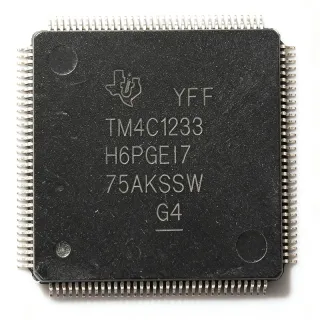
S5LS10106ASPGEQQ1 - Hercules TMS570 Cortex-R4F MCU 1MB Flash 144LQFP | TI
N.º de pieza: S5LS10106ASPGEQQ1 ✓ Activo| Cant. | Precio unitario | Total |
|---|---|---|
| 1 | $18.5 | $18,50 |
| 10 | $16.45 | $164,50 |
| 100 | $14.2 | $1.420,00 |
| 500 | $12.1 | $6.050,00 |
| 1.000 | $10.85 | $10.850,00 |
S5LS10106ASPGEQQ1 Descripción general
A microcontroller (MCU) is a single-chip programmable computer that integrates a CPU core, memory (Flash for program storage, SRAM for working data), and a rich set of on-chip peripherals (timers, ADC, communication controllers). Cortex-R4F is ARM's real-time, fault-tolerant core architecture, aimed at safety-critical systems. The Hercules TMS570 line wraps the Cortex-R4F with ECC-protected Flash, parity/ECC on SRAM, dual Cortex-R4F lockstep (on certain siblings), a built-in Memory Protection Unit, and a windowed watchdog, positioning it as a safety MCU within the broader power management / domain controller hierarchy in modern vehicles.
Key features include 1 MB ECC Flash, 128 KB ECC SRAM, lockstep-friendly Cortex-R4F core, hardware CRC, 32-bit timers, an external-clock ECLK output, and a wide operating temperature range of -40C to +125C that satisfies automotive under-the-hood requirements. Three MibSPI ports with up to four chip selects each accelerate communication with external sensors and power-converter peripherals, while two CAN controllers support legacy automotive network integration.
Typical applications include automotive brake systems (ABS/ESC), electric power steering (EPS), airbag ECU, battery management systems (BMS), body and chassis ECUs, industrial safety PLCs, and railway signaling controllers. The 144-LQFP package exposes enough I/O for multi-channel sensor aggregation and redundant actuator drive.
Design consideration: AEC-Q100 qualification means this part has been characterized across automotive temperature profiles; designers should still apply the same PCB layout hygiene as for any high-speed MCU - decoupling within 1-2 mm of each supply pin, a solid ground plane under the 144-LQFP paddle and short traces to the high-speed oscillator. While the S5LS10106AS variant is a feature node, the S5LS20206AS sibling in the same family doubles flash/RAM.
This page synthesizes Hercules TMS570 family positioning, drop-in alternatives, and practical design notes not found in the manufacturer datasheet.
Alternativas directas para S5LS10106ASPGEQQ1 — mismo encapsulado, compatible pin a pin. Se excluyen las piezas de otro encapsulado que requieren retrabajo de la PCB.
Variantes de esta serie
Modelos de la misma serie compatibles directamente con S5LS10106ASPGEQQ1 (mismo factor de forma y huella) — difiere en Core Architecture, Operating Temperature Range, RoHS Status.
Herramienta de comparación rápida — seleccione piezas alternativas para compararlas lado a lado:
S5LS20206ASPGEQQ1
✅ Sustitución directa📋 Alternativa de referencia (no en el catálogo)
S5LS10206ASPGEQQ1
✅ Sustitución directa ⚠️ Especificaciones sin verificar📋 Alternativa de referencia (no en el catálogo)
S5LS20216ASPGEQQ1
✅ Sustitución directa📋 Alternativa de referencia (no en el catálogo)
S5LS10106ASPGEMQ1
✅ Sustitución directa ⚠️ Especificaciones sin verificar📋 Alternativa de referencia (no en el catálogo)
TMS5701227CPGEQQ1
✅ Sustitución directa✓ En stock
$21.5 / unidad
Ver hoja de datos →S5LS10106ASPGEQQ1 Valores máximos y características eléctricas
| Core Architecture | ARM Cortex-R4F (Hercules TMS570 family) |
| Ancho del bus de datos | 16/32-bit |
| Frecuencia de reloj máxima | 140 MHz |
| Program Memory Size | 1 MB (1M x 8) Flash |
| Program Memory Type | Flash (with ECC) |
| RAM Size | 128 KB (1M x 8) |
| Number of I/O | 68 |
| ADC Resolution | 12-bit |
| Tensión de alimentación de funcionamiento | 1.5 V (core) / 3.3 V (I/O) |
| Rango de temperatura de funcionamiento | -40C to +125C |
| Encapsulado / Carcasa | 144-LQFP (20x20 mm) |
| Estilo de montaje | SMD/SMT (gull wing) |
| Supply Type | External clock (programmable ECLK output) |
| Communication Interfaces | MibSPI x3 (4 chip selects each), SCI/UART x2, CAN x2 |
| AEC-Q100 Qualification | Yes (automotive grade) |
| Estado RoHS | Compliant (TI datasheet) |
Guía de configuración de pines de S5LS10106ASPGEQQ1 144-lqfp (20x20 mm)
Configuración de pines para S5LS10106ASPGEQQ1 (encapsulado 144-lqfp (20x20 mm)). Este CI digital incluye GPIO, interfaces de comunicación (UART, SPI, I2C) y pines de alimentación. Consulte la hoja de datos del fabricante para conocer las funciones alternativas de los pines y las opciones de configuración. Esencial para el diseño de sistemas embebidos y el diseño de PCB.

No hay datos detallados de patillaje disponibles para S5LS10106ASPGEQQ1.
Consulte la hoja de datos para ver la configuración completa de patillas.
Aplicaciones típicas
S5LS10106ASPGEQQ1 es adecuado para 6 aplicacións: Anti-Lock Braking System (ABS) / Electronic Stability Control (ESC), Electric Power Steering (EPS) ECU, Battery Management System (BMS) Master Controller, Airbag / Supplemental Restraint System (SRS) ECU, Industrial Safety PLC / IEC 61508 SIL-3 Controller, Body and Chassis Domain Controller.
Anti-Lock Braking System (ABS) / Electronic Stability Control (ESC)
The S5LS10106ASPGEQQ1's Cortex-R4F core with ECC-protected 1 MB Flash and 128 KB SRAM is well-suited for ABS/ESC domain controllers that demand deterministic 1 kHz control loops with sub-millisecond response. Two CAN controllers and three MibSPI (each with four chip selects) aggregate wheel-speed sensors and steer/brake actuators, while the 12-bit ADC captures hydraulic-pressure feedback. AEC-Q100 qualification across -40C to +125C means it survives brake-system ambient temperatures. Designers typically pair it with a TI TPS65381 power-management companion for functional safety.
Recomendado
Electric Power Steering (EPS) ECU
EPS ECUs need ASIL-D-capable processing with deterministic loops to drive the assist motor, and the S5LS10106ASPGEQQ1's Cortex-R4F architecture plus 68 GPIO suffice for torque-sensor conditioning, motor-phase PWM feedback and CAN-FD messaging to the vehicle network. The 140 MHz core bandwidth handles 16-bit PID loops at typical 200 Hz control rates; ECC on Flash and SRAM meets ISO 26262 single-point fault metrics required for steering. A board-mount 144-LQFP footprint simplifies thermal integration with the steering-column housing.
Recomendado
Battery Management System (BMS) Master Controller
The S5LS10106ASPGEQQ1's three MibSPI controllers (each with four chip selects) easily cascade multiple daisy-chained TI BQ76PL455A battery monitors across a 12S-16S pack, while the two SCI/UART channels handle diagnostic and pack-balancing traffic. ECC on Flash and SRAM meets the IEC 61508 / ISO 26262 fault-tolerance targets typically required for traction-battery master ECUs. The 144-LQFP package exposes enough GPIO for contactor control, isolation feedback and CAN vehicle-network exchange.
Recomendado
Airbag / Supplemental Restraint System (SRS) ECU
Safety-critical airbag ECUs require ASIL-D-grade processing, ECC memory and dual-input sensor aggregation - all delivered by the S5LS10106ASPGEQQ1's Cortex-R4F core and ECC-protected 1 MB Flash / 128 KB SRAM. The 12-bit ADC plus 68 GPIO handle dual-redundant accelerometer and pressure-sensor inputs, while the MibSPI ports drive deployment-loop diagnostic and safing logic. AEC-Q100 qualification across -40C to +125C and TI's safety documentation package ease customer homologation for airbag platforms.
Recomendado
Industrial Safety PLC / IEC 61508 SIL-3 Controller
Beyond automotive, the S5LS10106ASPGEQQ1 serves SIL-rated industrial controllers (process safety, emergency-stop, robotics guarding). The Cortex-R4F core plus ECC memories satisfy IEC 61508 SIL-3 diagnostic coverage; three MibSPI ports connect safety I/O racks and the dual CAN controllers carry PROFIsafe / CIP-Safety messages. The 144-LQFP mechanical format matches legacy 144-pin Cortex-R safety footprints and keeps existing PLC SIL certification paperwork intact.
Recomendado
Body and Chassis Domain Controller
Centralised body controllers in modern vehicles consolidate BCM, gateway, lighting and chassis functions onto a single MCU, and the S5LS10106ASPGEQQ1 provides the ECC-protected 1 MB Flash and 128 KB SRAM needed to run AUTOSAR stacks alongside CAN, CAN-FD and SPI peripherals. With two CAN controllers (ideal for chassis CAN and powertrain CAN bridging) and three MibSPI ports (LIN-transceiver interface, lighting drivers, seat-control peripherals), the part scales to mid-range body domain modules where a Cortex-M4 is undersized but a Cortex-R5 is overkill.
Recomendado
Resumen de productos recomendados
Datos de referencia de ingeniería para S5LS10106ASPGEQQ1 — comparación, orientación de diseño e información de cumplimiento.
Guía de selección
Comparación con alternativas
| Parámetro | Este producto | S5LS20206ASPGEQQ1 | S5LS10206ASPGEQQ1 | S5LS20216ASPGEQQ1 | S5LS10106ASPGEMQ1 | TMS5701227CPGEQQ1 |
|---|---|---|---|---|---|---|
| Brand | Texas Instruments | Texas Instruments | Texas Instruments | Texas Instruments | Texas Instruments | Texas Instruments |
| Package | LQFP-144 (20x20 mm) | LQFP-144 - same | LQFP-144 - same | LQFP-144 - same | LQFP-144 - same | LQFP-144 - same |
| Core | ARM Cortex-R4F | ARM Cortex-R4F | ARM Cortex-R4F | ARM Cortex-R4F | ARM Cortex-R4F | ARM Cortex-R4F |
| Program Flash | 1 MB | 2 MB (+100%) | 1 MB (same) | 2 MB (+100%) | 1 MB (same) | 1 MB (same) |
| SRAM | 128 KB | 256 KB (+100%) | 160 KB (+25%) | 256 KB (+100%) | 128 KB (same) | 128 KB (same) |
| Max CPU Clock | 140 MHz | 140 MHz | 140 MHz | 140 MHz | 140 MHz | 140 MHz |
| AEC-Q100 | Yes | Yes | Yes | Yes | Yes | Yes |
| Temperature Range | -40C to +125C | -40C to +125C | -40C to +125C | -40C to +125C | -40C to +125C (extended) | -40C to +125C |
Diferenciadores clave
- Larger Flash/RAM footprint at the same pinout (frente a S5LS20206ASPGEQQ1)
- Identical performance, less memory cost than 2 MB sibling (frente a S5LS20216ASPGEQQ1)
- Pin-to-pin compatible within the Hercules TMS570 family (frente a TMS5701227CPGEQQ1)
Notas de diseño
The S5LS10106ASPGEQQ1 uses a dual 1.5 V core / 3.3 V I/O supply. Place a 1 uF X7R ceramic decoupling capacitor within 1-2 mm of each VDD/VSS pair and a bulk 10 uF tantalum or polymer capacitor near the package. Sequence the 3.3 V I/O rail before the 1.5 V core (or as specified in the TI safety manual) to avoid internal latch-up. Use a TPS38xxx voltage supervisor for clean MCU reset on power-up and brown-out.
The 144-LQFP package dissipates up to approximately 1.0 W in safety applications. Provide a solid ground plane stitched beneath the LQFP, with thermal vias on the exposed paddle (LQFP has no exposed pad - use thermal relief copper pour on the top layer). Estimated: at 1.0 W dissipation and theta_JA of approximately 35 C/W on a 4-layer FR-4 with no airflow, junction temperature rise is about 35 C above ambient - within the -40C to +125C envelope if ambient is held below 90 C.
Route the high-speed MibSPI clock signals (typically 25-50 MHz) with 50 ohm controlled impedance, keep traces length-matched within 25 mil across the bus and keep them away from motor-drive PWM traces. Place the oscillator within 5 mm of the OSC pins with a guard ring tied to ground. Layer stack: 4-layer FR-4 with continuous ground plane on layer 2 and power plane on layer 3 keeps the Cortex-R4F emissions well under CISPR 25 automotive EMC limits.
Do not omit the external clock source: the S5LS10106AS uses an external oscillator, not an internal one. Ensure the ECLK output trace does not run parallel to the MibSPI clocks. Always enable ECC in software and run a PBIST (programmable built-in self-test) at startup - the Hercules TMS570 safety manual requires this for ASIL targets. Avoid enabling the JTAG pins as GPIO unless you have locked-out debug, as accidental re-enable on a sealed ECU breaks OEM homologation.
Información de cumplimiento
AEC-Q100 qualified per the Q1 suffix in the part number. RoHS and REACH compliance per TI product-page declarations. Halogen-free and lead-free per TI LQFP-144 automotive package standards.