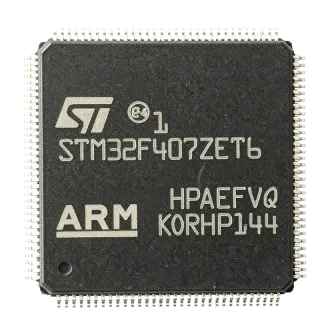
STM32F207ZGT6 - 32-bit ARM Cortex-M3 MCU, 1MB Flash | STMicroelectronics
Référence : STM32F207ZGT6 ✓ Actif| Qté | Prix unitaire | Total |
|---|---|---|
| 1 | $12.5 | $12,50 |
| 10 | $11.25 | $112,50 |
| 100 | $9.8 | $980,00 |
| 500 | $8.9 | $4 450,00 |
| 1 000 | $8.1 | $8 100,00 |
STM32F207ZGT6 Présentation
A microcontroller (MCU) is a compact integrated circuit designed to govern a specific operation in an embedded system. It contains a processor core, memory (Flash and SRAM), and programmable input/output peripherals. The STM32F207ZGT6 belongs to the STM32F2 series, which is part of the broader STM32 family of 32-bit Flash microcontrollers. This family is widely used in industrial control, consumer electronics, and IoT devices due to its balance of performance, power efficiency, and peripheral integration.
Key features of the STM32F207ZGT6 include a 120 MHz ARM Cortex-M3 core with 1.25 DMIPS/MHz, 1 MB of Flash memory, 128 KB of SRAM, and a comprehensive set of peripherals: 3x 12-bit ADCs, 2x DACs, 4x USARTs, 2x UARTs, 3x SPI, 2x I2C, 2x CAN, 1x USB 2.0 OTG FS/HS, 1x Ethernet MAC, and a camera interface. It also features a flexible memory controller (FMC) for external memory expansion, a true random number generator (RNG), and a cryptographic acceleration cell for AES, DES, and 3DES.
The STM32F207ZGT6 is built on a 90nm process technology, offering a good balance between performance and power consumption. It operates from a 1.8V to 3.6V power supply and supports a wide temperature range of -40°C to +85°C. The device includes multiple low-power modes (Sleep, Stop, Standby) to optimize energy consumption in battery-powered applications.
Typical applications include industrial automation, motor control, medical devices, point-of-sale terminals, and IoT gateways. The Ethernet MAC and USB OTG support enable connectivity in networked systems, while the rich analog peripherals suit data acquisition and control loops.
When designing with this MCU, ensure proper decoupling of the power supply pins and a stable clock source. The device supports external crystal oscillators (4-26 MHz) and an internal 16 MHz RC oscillator. For high-speed USB and Ethernet, an external 25 MHz crystal is recommended. The boot pins must be configured correctly for programming via USART or USB.
Alternatives de remplacement direct pour STM32F207ZGT6 — même boîtier, compatible broche à broche. Les références à boîtier différent nécessitant une retouche du PCB sont exclues.
Variantes de cette série
Modèles de la même série directement compatibles avec STM32F207ZGT6 (même facteur de forme et même empreinte) — différant par Ethernet, Flash Memory, Operating Temperature, Supply Voltage.
Outil de comparaison rapide — sélectionnez des références alternatives pour une comparaison côte à côte :
STM32F207ZGT6
✅ Remplacement direct✓ En stock
$8.1 / unité
Voir la fiche technique →STM32F207ZGT6TR
✅ Remplacement direct📋 Alternative de référence (hors catalogue)
STM32F207ZGT6
✅ Remplacement direct✓ En stock
$8.1 / unité
Voir la fiche technique →STM32F207ZGT6
✅ Remplacement direct✓ En stock
$8.1 / unité
Voir la fiche technique →STM32F207ZGT6
✅ Remplacement direct✓ En stock
$8.1 / unité
Voir la fiche technique →STM32F207ZGT6
✅ Remplacement direct✓ En stock
$8.1 / unité
Voir la fiche technique →STM32F207ZGT6
✅ Remplacement direct✓ En stock
$8.1 / unité
Voir la fiche technique →STM32F207ZGT6
✅ Remplacement direct✓ En stock
$8.1 / unité
Voir la fiche technique →STM32F207ZGT6
✅ Remplacement direct✓ En stock
$8.1 / unité
Voir la fiche technique →STM32F207ZGT6
✅ Remplacement direct✓ En stock
$8.1 / unité
Voir la fiche technique →STM32F207ZGT6
✅ Remplacement direct✓ En stock
$8.1 / unité
Voir la fiche technique →STM32F207ZGT6
✅ Remplacement direct✓ En stock
$8.1 / unité
Voir la fiche technique →STM32F207ZGT6
✅ Remplacement direct✓ En stock
$8.1 / unité
Voir la fiche technique →STM32F207ZGT6
✅ Remplacement direct✓ En stock
$8.1 / unité
Voir la fiche technique →STM32F207ZGT6
✅ Remplacement direct✓ En stock
$8.1 / unité
Voir la fiche technique →STM32F207ZGT6
✅ Remplacement direct✓ En stock
$8.1 / unité
Voir la fiche technique →STM32F207ZGT6
✅ Remplacement direct✓ En stock
$8.1 / unité
Voir la fiche technique →STM32F207ZGT6
✅ Remplacement direct✓ En stock
$8.1 / unité
Voir la fiche technique →STM32F207ZGT6
✅ Remplacement direct✓ En stock
$8.1 / unité
Voir la fiche technique →STM32F207ZGT6
✅ Remplacement direct✓ En stock
$8.1 / unité
Voir la fiche technique →STM32F207ZGT6 Valeurs maximales et caractéristiques électriques
| Core | ARM Cortex-M3 |
| Max Clock Frequency | 120 MHz |
| Flash Memory | 1 MB |
| SRAM | 128 KB |
| Tension d'alimentation | 1.8 V to 3.6 V |
| Température de fonctionnement | -40C to +85C |
| Boîtier | LQFP144 (20x20 mm) |
| Number of I/O Pins | 114 |
| ADC | 3x 12-bit, up to 24 channels |
| DAC | 2x 12-bit |
| USART/UART | 4x USART, 2x UART |
| SPI | 3x SPI |
| I2C | 2x I2C |
| CAN | 2x CAN 2.0B |
| USB | USB 2.0 OTG FS/HS |
| Ethernet | 10/100 Ethernet MAC |
| Timers | 12x 16-bit, 2x 32-bit |
| DMA | 16-channel DMA |
| RTC | Yes |
| RoHS | Compliant |
Configuration des broches de STM32F207ZGT6
| Broche 1 | PE2 — GPIO or alternate function |
| Broche 2 | PE3 — GPIO or alternate function |
| Broche 3 | PE4 — GPIO or alternate function |
| Broche 4 | PE5 — GPIO or alternate function |
| Broche 5 | PE6 — GPIO or alternate function |
| Broche 6 | VBAT — Battery backup supply |
| Broche 7 | PC13 — GPIO or RTC output |
| Broche 8 | PC14 — GPIO or OSC32_IN |
| Broche 9 | PC15 — GPIO or OSC32_OUT |
| Broche 10 | PF0 — GPIO or OSC_IN |
| Broche 11 | PF1 — GPIO or OSC_OUT |
| Broche 12 | PF2 — GPIO |
| Broche 13 | PF3 — GPIO |
| Broche 14 | PF4 — GPIO |
| Broche 15 | PF5 — GPIO |
| Broche 16 | PF6 — GPIO |
| Broche 17 | PF7 — GPIO |
| Broche 18 | PF8 — GPIO |
| Broche 19 | PF9 — GPIO |
| Broche 20 | PF10 — GPIO |
| Broche 21 | VSS — Ground |
| Broche 22 | VDD — Power supply |
| Broche 23 | PF11 — GPIO |
| Broche 24 | PF12 — GPIO |
| Broche 25 | PF13 — GPIO |
| Broche 26 | PF14 — GPIO |
| Broche 27 | PF15 — GPIO |
| Broche 28 | PG0 — GPIO |
| Broche 29 | PG1 — GPIO |
| Broche 30 | PG2 — GPIO |
| Broche 31 | PG3 — GPIO |
| Broche 32 | PG4 — GPIO |
| Broche 33 | PG5 — GPIO |
| Broche 34 | PG6 — GPIO |
| Broche 35 | PG7 — GPIO |
| Broche 36 | PG8 — GPIO |
| Broche 37 | PG9 — GPIO |
| Broche 38 | PG10 — GPIO |
| Broche 39 | PG11 — GPIO |
| Broche 40 | PG12 — GPIO |
| Broche 41 | PG13 — GPIO |
| Broche 42 | PG14 — GPIO |
| Broche 43 | PG15 — GPIO |
| Broche 44 | VSS — Ground |
| Broche 45 | VDD — Power supply |
| Broche 46 | PD0 — GPIO or OSC_IN |
| Broche 47 | PD1 — GPIO or OSC_OUT |
| Broche 48 | PD2 — GPIO |
| Broche 49 | PD3 — GPIO |
| Broche 50 | PD4 — GPIO |
| Broche 51 | PD5 — GPIO |
| Broche 52 | PD6 — GPIO |
| Broche 53 | PD7 — GPIO |
| Broche 54 | PD8 — GPIO |
| Broche 55 | PD9 — GPIO |
| Broche 56 | PD10 — GPIO |
| Broche 57 | PD11 — GPIO |
| Broche 58 | PD12 — GPIO |
| Broche 59 | PD13 — GPIO |
| Broche 60 | PD14 — GPIO |
| Broche 61 | PD15 — GPIO |
| Broche 62 | PC0 — GPIO or ADC input |
| Broche 63 | PC1 — GPIO or ADC input |
| Broche 64 | PC2 — GPIO or ADC input |
| Broche 65 | PC3 — GPIO or ADC input |
| Broche 66 | VSSA — Analog ground |
| Broche 67 | VDDA — Analog power supply |
| Broche 68 | PC4 — GPIO or ADC input |
| Broche 69 | PC5 — GPIO or ADC input |
| Broche 70 | PB0 — GPIO or ADC input |
| Broche 71 | PB1 — GPIO or ADC input |
| Broche 72 | PB2 — GPIO |
| Broche 73 | PB3 — GPIO or JTDO |
| Broche 74 | PB4 — GPIO or NJTRST |
| Broche 75 | PB5 — GPIO |
| Broche 76 | PB6 — GPIO or I2C1_SCL |
| Broche 77 | PB7 — GPIO or I2C1_SDA |
| Broche 78 | BOOT0 — Boot mode selection |
| Broche 79 | PB8 — GPIO or I2C1_SCL |
| Broche 80 | PB9 — GPIO or I2C1_SDA |
| Broche 81 | PE0 — GPIO |
| Broche 82 | PE1 — GPIO |
| Broche 83 | VSS — Ground |
| Broche 84 | VDD — Power supply |
| Broche 85 | PE7 — GPIO |
| Broche 86 | PE8 — GPIO |
| Broche 87 | PE9 — GPIO |
| Broche 88 | PE10 — GPIO |
| Broche 89 | PE11 — GPIO |
| Broche 90 | PE12 — GPIO |
| Broche 91 | PE13 — GPIO |
| Broche 92 | PE14 — GPIO |
| Broche 93 | PE15 — GPIO |
| Broche 94 | PB10 — GPIO or I2C2_SCL |
| Broche 95 | PB11 — GPIO or I2C2_SDA |
| Broche 96 | PB12 — GPIO or SPI2_NSS |
| Broche 97 | PB13 — GPIO or SPI2_SCK |
| Broche 98 | PB14 — GPIO or SPI2_MISO |
| Broche 99 | PB15 — GPIO or SPI2_MOSI |
| Broche 100 | PD8 — GPIO or USART3_TX |
| Broche 101 | PD9 — GPIO or USART3_RX |
| Broche 102 | PD10 — GPIO or USART3_CK |
| Broche 103 | PD11 — GPIO or USART3_CTS |
| Broche 104 | PD12 — GPIO or USART3_RTS |
| Broche 105 | PD13 — GPIO |
| Broche 106 | PD14 — GPIO |
| Broche 107 | PD15 — GPIO |
| Broche 108 | PC6 — GPIO or I2S2_MCK |
| Broche 109 | PC7 — GPIO or I2S2_SCK |
| Broche 110 | PC8 — GPIO or I2S2_SD |
| Broche 111 | PC9 — GPIO or I2S2_WS |
| Broche 112 | PA0 — GPIO or ADC input |
| Broche 113 | PA1 — GPIO or ADC input |
| Broche 114 | PA2 — GPIO or ADC input |
| Broche 115 | PA3 — GPIO or ADC input |
| Broche 116 | VSS — Ground |
| Broche 117 | VDD — Power supply |
| Broche 118 | PA4 — GPIO or DAC_OUT1 |
| Broche 119 | PA5 — GPIO or DAC_OUT2 |
| Broche 120 | PA6 — GPIO |
| Broche 121 | PA7 — GPIO |
| Broche 122 | PA8 — GPIO |
| Broche 123 | PA9 — GPIO or USART1_TX |
| Broche 124 | PA10 — GPIO or USART1_RX |
| Broche 125 | PA11 — GPIO or USB_DM |
| Broche 126 | PA12 — GPIO or USB_DP |
| Broche 127 | PA13 — GPIO or JTMS/SWDIO |
| Broche 128 | PA14 — GPIO or JTCK/SWCLK |
| Broche 129 | PA15 — GPIO or JTDI |
| Broche 130 | PC10 — GPIO |
| Broche 131 | PC11 — GPIO |
| Broche 132 | PC12 — GPIO |
| Broche 133 | PD0 — GPIO or OSC_IN |
| Broche 134 | PD1 — GPIO or OSC_OUT |
| Broche 135 | PD2 — GPIO |
| Broche 136 | PD3 — GPIO |
| Broche 137 | PD4 — GPIO |
| Broche 138 | PD5 — GPIO |
| Broche 139 | PD6 — GPIO |
| Broche 140 | PD7 — GPIO |
| Broche 141 | VSS — Ground |
| Broche 142 | VDD — Power supply |
| Broche 143 | PB12 — GPIO or SPI2_NSS |
| Broche 144 | PB13 — GPIO or SPI2_SCK |
Applications typiques
STM32F207ZGT6 convient pour 6 applications: Industrial Automation, IoT Gateway, Motor Control, Medical Devices, Point-of-Sale (POS) Terminals, Audio Processing.
Industrial Automation
The STM32F207ZGT6 is ideal for industrial automation due to its 120 MHz Cortex-M3 core, rich communication interfaces (CAN, UART, SPI, I2C), and advanced timers for PWM generation. It can handle real-time control loops, motor control, and PLC I/O modules. The device's 1 MB Flash allows storing complex control algorithms and communication stacks. Its wide operating temperature range (-40°C to +85°C) ensures reliability in harsh industrial environments. The Ethernet MAC enables connectivity to industrial networks like EtherCAT or PROFINET when paired with an external PHY. The multiple ADCs and DACs facilitate analog signal acquisition and generation for process control.
Recommandé
IoT Gateway
The STM32F207ZGT6 serves as a powerful IoT gateway MCU, connecting sensors and devices to the cloud. Its Ethernet MAC and USB OTG support wired and wireless connectivity (via external modules). The 1 MB Flash and 128 KB SRAM can run TCP/IP stacks (lwIP), MQTT, and TLS. The device's low-power modes help reduce energy consumption in always-on gateways. The multiple UARTs and SPI interfaces allow connection to various sensors and radio modules (e.g., Wi-Fi, LoRa). The cryptographic acceleration cell (AES, DES, 3DES) enhances security for data transmission. The RTC enables time-stamping of sensor data.
Recommandé
Motor Control
The STM32F207ZGT6 is well-suited for motor control applications, including BLDC, PMSM, and stepper motors. Its advanced timers (TIM1, TIM8) generate high-resolution PWM signals with dead-time insertion, essential for driving power stages. The 12-bit ADCs sample motor currents and voltages for FOC (Field-Oriented Control) algorithms. The 120 MHz core provides sufficient computational power for real-time control loops. The device's multiple communication interfaces (CAN, UART) enable integration with motor drives and industrial networks. The DMA controller offloads data transfer, reducing CPU load. The device's robust design and wide temperature range make it suitable for industrial motor drives.
Recommandé
Medical Devices
The STM32F207ZGT6 is used in medical devices such as patient monitors, infusion pumps, and diagnostic equipment. Its high processing power and rich analog peripherals (ADCs, DACs) enable precise signal acquisition and control. The device's 1 MB Flash allows storing complex algorithms for signal processing and user interfaces. The multiple communication interfaces (USB, UART, SPI) facilitate data transfer to host systems. The device's low-power modes are beneficial for battery-powered portable medical devices. The cryptographic acceleration cell can secure patient data. The device's reliability and long-term availability make it suitable for medical applications.
Recommandé
Point-of-Sale (POS) Terminals
The STM32F207ZGT6 is ideal for POS terminals, providing the processing power and connectivity needed for payment transactions. Its Ethernet MAC and USB OTG support wired and wireless connectivity to payment networks. The device's 1 MB Flash can store payment application code and encryption keys. The cryptographic acceleration cell (AES, DES, 3DES) ensures secure transactions. The multiple UARTs and SPI interfaces connect to card readers, PIN pads, and displays. The device's rich peripheral set and 114 I/O pins allow flexible system design. The wide operating temperature range ensures reliable operation in retail environments.
Recommandé
Audio Processing
The STM32F207ZGT6 can be used in audio processing applications such as audio interfaces, effects processors, and voice-controlled devices. Its 120 MHz Cortex-M3 core can handle audio DSP algorithms like filtering and equalization. The device's 2x 12-bit DACs can output analog audio signals, while the I2S interface (via SPI) connects to external audio codecs. The 1 MB Flash allows storing audio samples and processing code. The USB OTG supports audio streaming to/from a host. The device's low-latency interrupt handling ensures real-time audio processing. The cryptographic acceleration cell can be used for DRM protection.
Recommandé
Récapitulatif des produits recommandés
Données de référence d'ingénierie pour STM32F207ZGT6 — comparaison, recommandations de conception et informations de conformité.
Guide de sélection
Comparaison avec les alternatives
| Paramètre | Ce produit | STM32F207ZGT6 | STM32F407ZGT6 | STM32F205ZGT6 |
|---|---|---|---|---|
| Package | LQFP144 | LQFP144 | LQFP144 | LQFP144 |
| Brand | STMicroelectronics | STMicroelectronics | STMicroelectronics | STMicroelectronics |
| Core | ARM Cortex-M3 | ARM Cortex-M3 | ARM Cortex-M4 with FPU | ARM Cortex-M3 |
| Max Clock Frequency | 120 MHz | 120 MHz | 168 MHz | 120 MHz |
| Flash Memory | 1 MB | 1 MB | 1 MB | 1 MB |
| SRAM | 128 KB | 128 KB | 128 KB | 128 KB |
| Ethernet MAC | Yes | Yes | Yes | No |
| USB OTG | FS/HS | FS/HS | FS/HS | FS/HS |
| Price (1pc) | $12.50 | $12.50 | $14.20 | $11.80 |
Principaux différenciateurs
- Higher clock frequency than STM32F205ZGT6 (vs STM32F205ZGT6)
- Ethernet MAC included (vs STM32F205ZGT6)
- Lower power consumption than STM32F407ZGT6 (vs STM32F407ZGT6)
Notes de conception
The STM32F207ZGT6 requires a stable 3.3V supply. Decouple each VDD pin with a 100nF ceramic capacitor placed as close as possible to the pin, and add a 4.7uF bulk capacitor at the power entry. The VDDA pin should be filtered with a ferrite bead and a 1uF capacitor to reduce analog noise. Ensure the VDD and VDDA voltages are within 1.8V to 3.6V range.
For high-speed USB and Ethernet, use a 25 MHz crystal with load capacitors as specified in the datasheet. Keep the crystal traces short and away from high-speed digital signals. For the LQFP144 package, ensure proper solder paste stencil design for the 0.5mm pitch pins. Use a 4-layer PCB with a solid ground plane for best EMC performance.
Do not forget to configure the boot pins (BOOT0 and BOOT1) correctly. For normal operation, BOOT0 should be tied low. When programming via USART, BOOT0 must be high. Also, ensure the NRST pin has a 100nF capacitor to ground for reliable reset. The VCAP pins (if present) require a 2.2uF capacitor to ground for internal regulator stability.
Informations de conformité
RoHS and REACH compliant per STMicroelectronics. Not AEC-Q100 qualified; for automotive use, consider STM32F207ZGT6Q or similar.