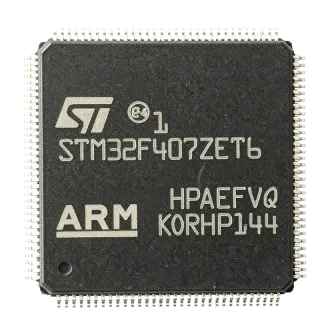
STM32F723ZET6 - 512KB Flash, 216MHz ARM Cortex-M7 MCU | STMicroelectronics
Référence : STM32F723ZET6 ✓ Actif| Qté | Prix unitaire | Total |
|---|---|---|
| 1 | $12.5 | $12,50 |
| 10 | $11.25 | $112,50 |
| 100 | $10 | $1 000,00 |
| 500 | $9 | $4 500,00 |
| 1 000 | $8.1 | $8 100,00 |
STM32F723ZET6 Présentation
What is a microcontroller? A microcontroller (MCU) is a compact integrated circuit designed to govern a specific operation in an embedded system. It integrates a processor core, memory (Flash and SRAM), and programmable input/output peripherals on a single chip. Microcontrollers are the backbone of embedded systems, ranging from simple 8-bit devices in household appliances to advanced 32-bit and 64-bit cores in automotive, industrial, and IoT applications. The STM32F723ZET6 belongs to the STM32F7 series, which is part of the broader STM32 family of 32-bit ARM Cortex-M microcontrollers, positioned between the mainstream STM32F4 series and the high-performance STM32H7 series.
Key features of the STM32F723ZET6 include a 216 MHz Cortex-M7 core with double-precision floating-point unit (FPU), a Chrom-ART Accelerator for enhanced graphics, and a TFT-LCD controller supporting up to XGA resolution. It also integrates a hardware cryptographic accelerator (AES, DES, 3DES, SHA-1, SHA-256, MD5), a true random number generator (TRNG), and a camera interface. The device supports a wide range of communication interfaces including Ethernet MAC, USB OTG HS/FS, CAN, SPI, I2C, UART, and SDMMC, making it highly versatile for connectivity-centric applications.
Technically, the STM32F723ZET6 is built on a 40nm process technology, offering a balance of performance and power efficiency. It operates from a 1.7V to 3.6V power supply and features multiple low-power modes (Sleep, Stop, Standby) to optimize energy consumption. The device includes a 12-bit ADC with up to 24 channels, a 12-bit DAC, and advanced timers for precise motor control and waveform generation. The Chrom-ART Accelerator offloads the CPU for 2D graphics operations, enabling smooth GUI rendering without burdening the core.
Typical applications include industrial control systems, human-machine interfaces (HMIs), medical devices, smart home gateways, and audio processing. The combination of high clock speed, rich peripherals, and graphics acceleration makes it ideal for applications requiring real-time processing and rich user interfaces. For instance, in an HMI application, the TFT-LCD controller and Chrom-ART Accelerator enable smooth rendering of graphical elements, while the Ethernet MAC provides connectivity for remote monitoring.
When designing with this device, ensure proper decoupling of the power supply pins with 100nF capacitors placed close to each VDD pin, and a 4.7uF bulk capacitor. The VDDA pin must be connected to a clean analog supply, and the VCAP pins require external capacitors as specified in the datasheet. For high-speed interfaces like Ethernet and USB, follow the layout guidelines in the STM32F7 hardware development application note (AN4666) to maintain signal integrity.
Alternatives de remplacement direct pour STM32F723ZET6 — même boîtier, compatible broche à broche. Les références à boîtier différent nécessitant une retouche du PCB sont exclues.
Variantes de cette série
Modèles de la même série directement compatibles avec STM32F723ZET6 (même facteur de forme et même empreinte) — différant par Operating Temperature, Package, Supply Voltage, Core, Flash Memory.
Outil de comparaison rapide — sélectionnez des références alternatives pour une comparaison côte à côte :
STM32F722ZET6
✅ Remplacement direct ⚠️ Spécifications non vérifiées✓ En stock
$6.2344 / unité
Voir la fiche technique →STM32F745ZET6
✅ Remplacement direct ⚠️ Spécifications non vérifiées📋 Alternative de référence (hors catalogue)
STM32F746ZET6
✅ Remplacement direct ⚠️ Spécifications non vérifiées📋 Alternative de référence (hors catalogue)
STM32F767ZIT6
✅ Remplacement direct ⚠️ Spécifications non vérifiées✓ En stock
$17.6 / unité
Voir la fiche technique →ATSAMA5D27C-D1G-CU
✅ Remplacement direct ⚠️ Spécifications non vérifiées✓ En stock
$19.1 / unité
Voir la fiche technique →STM32F723ZET6 Valeurs maximales et caractéristiques électriques
| Core | ARM Cortex-M7 |
| Max Clock Speed | 216 MHz |
| Flash Memory | 512 KB |
| SRAM | 256 KB |
| Boîtier | LQFP144 (20x20 mm) |
| Tension d'alimentation | 1.7V to 3.6V |
| Température de fonctionnement | -40C to +85C |
| GPIO Pins | 114 |
| ADC | 3x 12-bit, up to 24 channels |
| DAC | 2x 12-bit |
| Communication Interfaces | Ethernet MAC, USB OTG HS/FS, CAN, SPI, I2C, UART, SDMMC |
| Graphics | TFT-LCD controller, Chrom-ART Accelerator |
| Cryptography | AES, DES, 3DES, SHA-1, SHA-256, MD5, TRNG |
| Timers | Advanced, general-purpose, basic timers |
| RoHS | Compliant |
Configuration des broches de STM32F723ZET6
| Broche 1 | PE2 — GPIO or alternate function |
| Broche 2 | PE3 — GPIO or alternate function |
| Broche 3 | PE4 — GPIO or alternate function |
| Broche 4 | PE5 — GPIO or alternate function |
| Broche 5 | PE6 — GPIO or alternate function |
| Broche 6 | VBAT — Backup battery supply |
| Broche 7 | PC13 — GPIO or RTC output |
| Broche 8 | PC14 — GPIO or OSC32_IN |
| Broche 9 | PC15 — GPIO or OSC32_OUT |
| Broche 10 | PF0 — GPIO or alternate function |
| Broche 11 | PF1 — GPIO or alternate function |
| Broche 12 | PF2 — GPIO or alternate function |
| Broche 13 | PF3 — GPIO or alternate function |
| Broche 14 | PF4 — GPIO or alternate function |
| Broche 15 | PF5 — GPIO or alternate function |
| Broche 16 | PF6 — GPIO or alternate function |
| Broche 17 | PF7 — GPIO or alternate function |
| Broche 18 | PF8 — GPIO or alternate function |
| Broche 19 | PF9 — GPIO or alternate function |
| Broche 20 | PF10 — GPIO or alternate function |
| Broche 21 | VSS — Ground |
| Broche 22 | VDD — Power supply |
| Broche 23 | PF11 — GPIO or alternate function |
| Broche 24 | PF12 — GPIO or alternate function |
| Broche 25 | PF13 — GPIO or alternate function |
| Broche 26 | PF14 — GPIO or alternate function |
| Broche 27 | PF15 — GPIO or alternate function |
| Broche 28 | PG0 — GPIO or alternate function |
| Broche 29 | PG1 — GPIO or alternate function |
| Broche 30 | PG2 — GPIO or alternate function |
| Broche 31 | PG3 — GPIO or alternate function |
| Broche 32 | PG4 — GPIO or alternate function |
| Broche 33 | PG5 — GPIO or alternate function |
| Broche 34 | PG6 — GPIO or alternate function |
| Broche 35 | PG7 — GPIO or alternate function |
| Broche 36 | PG8 — GPIO or alternate function |
| Broche 37 | PG9 — GPIO or alternate function |
| Broche 38 | PG10 — GPIO or alternate function |
| Broche 39 | PG11 — GPIO or alternate function |
| Broche 40 | PG12 — GPIO or alternate function |
| Broche 41 | PG13 — GPIO or alternate function |
| Broche 42 | PG14 — GPIO or alternate function |
| Broche 43 | PG15 — GPIO or alternate function |
| Broche 44 | PD0 — GPIO or alternate function |
| Broche 45 | PD1 — GPIO or alternate function |
| Broche 46 | PD2 — GPIO or alternate function |
| Broche 47 | PD3 — GPIO or alternate function |
| Broche 48 | PD4 — GPIO or alternate function |
| Broche 49 | PD5 — GPIO or alternate function |
| Broche 50 | PD6 — GPIO or alternate function |
| Broche 51 | PD7 — GPIO or alternate function |
| Broche 52 | PD8 — GPIO or alternate function |
| Broche 53 | PD9 — GPIO or alternate function |
| Broche 54 | PD10 — GPIO or alternate function |
| Broche 55 | PD11 — GPIO or alternate function |
| Broche 56 | PD12 — GPIO or alternate function |
| Broche 57 | PD13 — GPIO or alternate function |
| Broche 58 | PD14 — GPIO or alternate function |
| Broche 59 | PD15 — GPIO or alternate function |
| Broche 60 | VSS — Ground |
| Broche 61 | VDD — Power supply |
| Broche 62 | PC0 — GPIO or ADC input |
| Broche 63 | PC1 — GPIO or ADC input |
| Broche 64 | PC2 — GPIO or ADC input |
| Broche 65 | PC3 — GPIO or ADC input |
| Broche 66 | PC4 — GPIO or alternate function |
| Broche 67 | PC5 — GPIO or alternate function |
| Broche 68 | PB0 — GPIO or ADC input |
| Broche 69 | PB1 — GPIO or ADC input |
| Broche 70 | PB2 — GPIO or alternate function |
| Broche 71 | PB3 — GPIO or alternate function |
| Broche 72 | PB4 — GPIO or alternate function |
| Broche 73 | PB5 — GPIO or alternate function |
| Broche 74 | PB6 — GPIO or alternate function |
| Broche 75 | PB7 — GPIO or alternate function |
| Broche 76 | PB8 — GPIO or alternate function |
| Broche 77 | PB9 — GPIO or alternate function |
| Broche 78 | PB10 — GPIO or alternate function |
| Broche 79 | PB11 — GPIO or alternate function |
| Broche 80 | PB12 — GPIO or alternate function |
| Broche 81 | PB13 — GPIO or alternate function |
| Broche 82 | PB14 — GPIO or alternate function |
| Broche 83 | PB15 — GPIO or alternate function |
| Broche 84 | PD8 — GPIO or alternate function |
| Broche 85 | PD9 — GPIO or alternate function |
| Broche 86 | PD10 — GPIO or alternate function |
| Broche 87 | PD11 — GPIO or alternate function |
| Broche 88 | PD12 — GPIO or alternate function |
| Broche 89 | PD13 — GPIO or alternate function |
| Broche 90 | PD14 — GPIO or alternate function |
| Broche 91 | PD15 — GPIO or alternate function |
| Broche 92 | VSS — Ground |
| Broche 93 | VDD — Power supply |
| Broche 94 | PA0 — GPIO or ADC input |
| Broche 95 | PA1 — GPIO or ADC input |
| Broche 96 | PA2 — GPIO or alternate function |
| Broche 97 | PA3 — GPIO or alternate function |
| Broche 98 | PA4 — GPIO or alternate function |
| Broche 99 | PA5 — GPIO or alternate function |
| Broche 100 | PA6 — GPIO or alternate function |
| Broche 101 | PA7 — GPIO or alternate function |
| Broche 102 | PA8 — GPIO or alternate function |
| Broche 103 | PA9 — GPIO or alternate function |
| Broche 104 | PA10 — GPIO or alternate function |
| Broche 105 | PA11 — GPIO or alternate function |
| Broche 106 | PA12 — GPIO or alternate function |
| Broche 107 | PA13 — GPIO or SWDIO |
| Broche 108 | PA14 — GPIO or SWCLK |
| Broche 109 | PA15 — GPIO or alternate function |
| Broche 110 | PC10 — GPIO or alternate function |
| Broche 111 | PC11 — GPIO or alternate function |
| Broche 112 | PC12 — GPIO or alternate function |
| Broche 113 | PD0 — GPIO or alternate function |
| Broche 114 | PD1 — GPIO or alternate function |
| Broche 115 | PD2 — GPIO or alternate function |
| Broche 116 | PD3 — GPIO or alternate function |
| Broche 117 | PD4 — GPIO or alternate function |
| Broche 118 | PD5 — GPIO or alternate function |
| Broche 119 | PD6 — GPIO or alternate function |
| Broche 120 | PD7 — GPIO or alternate function |
| Broche 121 | VSS — Ground |
| Broche 122 | VDD — Power supply |
| Broche 123 | PE0 — GPIO or alternate function |
| Broche 124 | PE1 — GPIO or alternate function |
| Broche 125 | PE7 — GPIO or alternate function |
| Broche 126 | PE8 — GPIO or alternate function |
| Broche 127 | PE9 — GPIO or alternate function |
| Broche 128 | PE10 — GPIO or alternate function |
| Broche 129 | PE11 — GPIO or alternate function |
| Broche 130 | PE12 — GPIO or alternate function |
| Broche 131 | PE13 — GPIO or alternate function |
| Broche 132 | PE14 — GPIO or alternate function |
| Broche 133 | PE15 — GPIO or alternate function |
| Broche 134 | PB10 — GPIO or alternate function |
| Broche 135 | PB11 — GPIO or alternate function |
| Broche 136 | PB12 — GPIO or alternate function |
| Broche 137 | PB13 — GPIO or alternate function |
| Broche 138 | PB14 — GPIO or alternate function |
| Broche 139 | PB15 — GPIO or alternate function |
| Broche 140 | PD8 — GPIO or alternate function |
| Broche 141 | PD9 — GPIO or alternate function |
| Broche 142 | PD10 — GPIO or alternate function |
| Broche 143 | PD11 — GPIO or alternate function |
| Broche 144 | PD12 — GPIO or alternate function |
Applications typiques
STM32F723ZET6 convient pour 6 applications: Industrial Control Systems, Human-Machine Interface (HMI), IoT Gateway, Medical Devices, Audio Processing, Smart Home Gateway.
Industrial Control Systems
The STM32F723ZET6 is ideal for industrial control systems due to its high-speed 216MHz Cortex-M7 core, advanced timers for PWM generation, and multiple communication interfaces (CAN, Ethernet, UART) for fieldbus connectivity. Its 512KB Flash and 256KB SRAM accommodate complex control algorithms and data logging. The hardware cryptographic accelerator ensures secure communication in industrial IoT applications. The device's wide operating temperature range (-40C to +85C) and robust peripheral set make it suitable for PLCs, motor drives, and robotic controllers. In a typical motor control application, the advanced timers generate precise PWM signals, while the ADC channels monitor current and voltage feedback, enabling closed-loop control with minimal latency.
Recommandé
Human-Machine Interface (HMI)
The STM32F723ZET6 excels in HMI applications with its integrated TFT-LCD controller and Chrom-ART Accelerator, which offload 2D graphics rendering from the CPU. This enables smooth, responsive user interfaces with high-resolution displays (up to XGA). The 512KB Flash provides ample storage for GUI assets, while the 256KB SRAM supports frame buffering. The device's rich connectivity (Ethernet, USB, UART) allows easy integration with external systems. In a typical HMI, the TFT-LCD controller drives the display directly, while the Chrom-ART Accelerator handles bitmap operations, freeing the CPU for application logic. The capacitive touch interface can be implemented using the I2C or SPI peripherals. The low-power modes help reduce energy consumption in battery-powered handheld HMIs.
Recommandé
IoT Gateway
The STM32F723ZET6 is well-suited for IoT gateways due to its Ethernet MAC, USB OTG, and multiple communication interfaces (SPI, I2C, UART, CAN). The hardware cryptographic accelerator (AES, SHA) enables secure data transmission, while the TRNG provides random numbers for key generation. The 512KB Flash and 256KB SRAM support protocol stacks like MQTT, CoAP, and TLS. In a typical IoT gateway, the Ethernet MAC connects to a wired network, while the USB OTG can interface with cellular modems or Wi-Fi modules. The device can handle data aggregation, protocol conversion, and edge processing. The low-power modes allow battery-backed operation during network outages. The wide supply voltage range (1.7V-3.6V) accommodates various power sources.
Recommandé
Medical Devices
The STM32F723ZET6 is suitable for medical devices such as patient monitors, infusion pumps, and diagnostic equipment. Its high-performance core enables real-time signal processing, while the 12-bit ADC with up to 24 channels captures physiological signals with high resolution. The TFT-LCD controller supports graphical displays for user interfaces, and the cryptographic accelerator ensures data security for patient records. The device's reliability and wide temperature range make it suitable for medical environments. In a patient monitor, the ADC samples ECG or SpO2 signals, the Cortex-M7 processes the data for waveform display, and the TFT-LCD controller renders the graphical interface. The Ethernet or USB interfaces allow data transfer to hospital networks. The low-power modes help extend battery life in portable devices.
Recommandé
Audio Processing
The STM32F723ZET6 is capable of audio processing applications such as audio effects processors, voice recognition, and multi-channel audio systems. The 216MHz Cortex-M7 with double-precision FPU provides ample computational power for DSP algorithms like FIR filters, FFT, and audio codecs. The I2S interface supports digital audio input/output, and the DAC can generate analog audio signals. The 512KB Flash can store audio samples or code, while the 256KB SRAM buffers audio streams. In a typical audio effects processor, the I2S interface receives digital audio from a codec, the Cortex-M7 applies effects (e.g., reverb, equalization), and the I2S outputs the processed audio. The Chrom-ART Accelerator can be used for audio visualization on a display. The device's low latency and deterministic execution make it suitable for real-time audio processing.
Recommandé
Smart Home Gateway
The STM32F723ZET6 is ideal for smart home gateways that connect various IoT devices (Zigbee, Z-Wave, Wi-Fi, Bluetooth) to the internet. Its multiple communication interfaces (UART, SPI, I2C, USB, Ethernet) allow integration with different wireless modules. The hardware cryptographic accelerator secures communication, and the TRNG generates session keys. The 512KB Flash and 256KB SRAM support protocol stacks for various smart home standards. In a typical smart home gateway, the device manages multiple wireless modules via UART or SPI, aggregates data, and communicates with the cloud via Ethernet or Wi-Fi. The TFT-LCD controller can drive a local display for status monitoring. The low-power modes help reduce energy consumption when idle. The device's rich peripheral set and high performance make it a central hub for home automation.
Recommandé
Récapitulatif des produits recommandés
Données de référence d'ingénierie pour STM32F723ZET6 — comparaison, recommandations de conception et informations de conformité.
Guide de sélection
Comparaison avec les alternatives
| Paramètre | Ce produit | STM32F722ZET6 | STM32F745ZET6 | STM32F746ZET6 | STM32F767ZIT6 | ATSAMA5D27C-D1G-CU |
|---|---|---|---|---|---|---|
| Package | LQFP144 | LQFP144 | LQFP144 | LQFP144 | LQFP144 | LQFP144 |
| Brand | STMicroelectronics | STMicroelectronics | STMicroelectronics | STMicroelectronics | STMicroelectronics | Microchip Technology |
| Core | ARM Cortex-M7 | ARM Cortex-M7 | ARM Cortex-M7 | ARM Cortex-M7 | ARM Cortex-M7 | ARM Cortex-A5 |
| Max Clock Speed | 216 MHz | 216 MHz | 216 MHz | 216 MHz | 216 MHz | 500 MHz |
Principaux différenciateurs
- Hardware cryptographic accelerator (vs STM32F722ZET6)
- Higher performance with Chrom-ART Accelerator (vs STM32F745ZET6)
- Lower power consumption (vs STM32F767ZIT6)
Notes de conception
The STM32F723ZET6 operates from 1.7V to 3.6V. Use a 100nF decoupling capacitor on each VDD pin and a 4.7uF bulk capacitor on the main supply. The VDDA pin must be connected to a clean analog supply, and the VCAP pins require external capacitors (2.2uF) as specified in the datasheet. For low-power modes, ensure the power supply can handle current spikes during wake-up.
For high-speed interfaces like Ethernet and USB, follow the layout guidelines in ST application note AN4666. Keep traces short and impedance-controlled (90 ohms for USB, 100 ohms for Ethernet). Place the external PHY close to the MCU and use a crystal oscillator with load capacitors as specified. For the TFT-LCD interface, route the parallel data lines with matched lengths to avoid skew.
The LQFP144 package has a thermal resistance (theta_JA) of approximately 40 C/W. At 216MHz with all peripherals active, power dissipation can reach 500mW, resulting in a 20C temperature rise above ambient. Ensure adequate airflow or a thermal pad on the PCB for high-temperature environments. The operating temperature range is -40C to +85C.
Informations de conformité
RoHS compliant per STMicroelectronics product page. Not AEC-Q100 qualified (industrial grade).