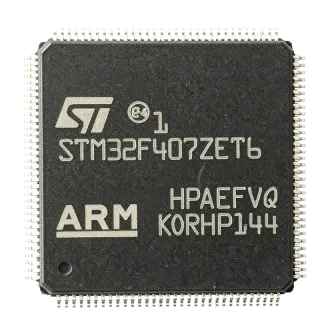
STM32F756ZGT6 - 32-bit ARM Cortex-M7 MCU 1MB Flash | STMicroelectronics
Référence : STM32F756ZGT6 ✓ Actif| Qté | Prix unitaire | Total |
|---|---|---|
| 1 | $12.5 | $12,50 |
| 10 | $11.25 | $112,50 |
| 100 | $10 | $1 000,00 |
| 500 | $9 | $4 500,00 |
| 1 000 | $8.1 | $8 100,00 |
STM32F756ZGT6 Présentation
What is a microcontroller? A microcontroller (MCU) is a compact integrated circuit designed to govern a specific operation in an embedded system. It contains a processor core, memory (Flash and SRAM), and programmable input/output peripherals on a single chip. Microcontrollers are the brain of embedded systems, executing firmware to control devices, process sensor data, and communicate with other systems. In the hierarchy of computing devices, a microcontroller falls under embedded processors, which are a subset of semiconductor devices. The STM32F7 series represents the high-performance tier of ST's STM32 family, offering the ARM Cortex-M7 core with DSP and FPU instructions for advanced signal processing and control.
Key features of the STM32F756ZGT6 include a 216 MHz ARM Cortex-M7 core with double-precision FPU and DSP instructions, 1 MB of Flash memory, 320 KB of SRAM, and a Chrom-ART Accelerator for enhanced graphics performance. It supports a wide range of communication interfaces: 4x USART, 4x UART, 6x SPI, 3x I2C, 2x CAN, 1x SDMMC, 1x Ethernet MAC, 1x USB OTG HS, 1x USB OTG FS, and 1x camera interface. The device also features a 12-bit ADC with up to 24 channels, a 12-bit DAC with 2 channels, and multiple timers including advanced-control timers. The operating voltage range is 1.7V to 3.6V, and the temperature range is -40°C to +85°C (T suffix).
The STM32F756ZGT6 is built on ST's advanced 90nm process technology, enabling high performance with low power consumption. The Cortex-M7 core with 6-stage pipeline and branch prediction delivers 2.14 CoreMark/MHz, making it one of the fastest MCUs in its class. The device includes a memory protection unit (MPU), a direct memory access (DMA) controller with 16 streams, and a true random number generator (TRNG) for security applications. The Chrom-ART Accelerator offloads 2D graphics operations from the CPU, improving GUI performance in display applications.
Typical applications include industrial control systems, motor drives, power conversion, IoT gateways, audio processing, and human-machine interfaces (HMI). The Ethernet MAC with IEEE 1588 support enables precise time synchronization in networked industrial systems. The camera interface supports parallel camera sensors for machine vision applications. The USB OTG HS with internal PHY allows high-speed data transfer in portable devices.
When designing with this device, ensure adequate decoupling on all power supply pins (VDD, VDDA, VDDUSB) with 100nF and 4.7uF capacitors. The VCAP pins require a 2.2uF capacitor for internal regulator stability. For high-speed interfaces like Ethernet and USB, follow the layout guidelines in the datasheet to maintain signal integrity. The device supports multiple boot modes via BOOT0 and BOOT1 pins, which must be configured correctly for firmware programming.
Alternatives de remplacement direct pour STM32F756ZGT6 — même boîtier, compatible broche à broche. Les références à boîtier différent nécessitant une retouche du PCB sont exclues.
Variantes de cette série
Modèles de la même série directement compatibles avec STM32F756ZGT6 (même facteur de forme et même empreinte) — différant par Operating Temperature, Package, SRAM, ADC, Communication Interfaces.
Outil de comparaison rapide — sélectionnez des références alternatives pour une comparaison côte à côte :
STM32F746ZGT6
✅ Remplacement direct ⚠️ Spécifications non vérifiées✓ En stock
$12.1 / unité
Voir la fiche technique →STM32F767ZIT6
✅ Remplacement direct ⚠️ Spécifications non vérifiées✓ En stock
$17.6 / unité
Voir la fiche technique →STM32F756ZGT6TR
✅ Remplacement direct ⚠️ Spécifications non vérifiées📋 Alternative de référence (hors catalogue)
STM32F756ZGT6
✅ Remplacement direct✓ En stock
$8.1 / unité
Voir la fiche technique →STM32F756ZGT6
✅ Remplacement direct✓ En stock
$8.1 / unité
Voir la fiche technique →STM32F756ZGT6 Valeurs maximales et caractéristiques électriques
| Core | ARM Cortex-M7 |
| Max Clock Speed | 216 MHz |
| Flash Memory | 1 MB |
| SRAM | 320 KB |
| Boîtier | LQFP144 (20x20 mm) |
| Operating Voltage | 1.7V to 3.6V |
| Température de fonctionnement | -40°C to +85°C |
| GPIO Pins | 114 |
| ADC | 3x 12-bit, up to 24 channels |
| DAC | 2x 12-bit |
| Timers | 12x 16-bit, 2x 32-bit |
| Communication Interfaces | 4x USART, 4x UART, 6x SPI, 3x I2C, 2x CAN, 1x SDMMC, 1x Ethernet MAC, 1x USB OTG HS, 1x USB OTG FS |
| DMA | 16-stream DMA controller |
| Cryptographic Acceleration | AES, DES, 3DES, SHA-1, SHA-256, MD5 |
| RoHS | Compliant |
Configuration des broches de STM32F756ZGT6
| Broche 1 | PE2 — GPIO / alternate functions |
| Broche 2 | PE3 — GPIO / alternate functions |
| Broche 3 | PE4 — GPIO / alternate functions |
| Broche 4 | PE5 — GPIO / alternate functions |
| Broche 5 | PE6 — GPIO / alternate functions |
| Broche 6 | VBAT — Battery backup supply |
| Broche 7 | PC13 — GPIO / RTC / tamper |
| Broche 8 | PC14 — GPIO / OSC32_IN |
| Broche 9 | PC15 — GPIO / OSC32_OUT |
| Broche 10 | PF0 — GPIO / alternate functions |
| Broche 11 | PF1 — GPIO / alternate functions |
| Broche 12 | PF2 — GPIO / alternate functions |
| Broche 13 | PF3 — GPIO / alternate functions |
| Broche 14 | PF4 — GPIO / alternate functions |
| Broche 15 | PF5 — GPIO / alternate functions |
| Broche 16 | PF6 — GPIO / alternate functions |
| Broche 17 | PF7 — GPIO / alternate functions |
| Broche 18 | PF8 — GPIO / alternate functions |
| Broche 19 | PF9 — GPIO / alternate functions |
| Broche 20 | PF10 — GPIO / alternate functions |
| Broche 21 | VSS — Ground |
| Broche 22 | VDD — Power supply |
| Broche 23 | PF11 — GPIO / alternate functions |
| Broche 24 | PF12 — GPIO / alternate functions |
| Broche 25 | PF13 — GPIO / alternate functions |
| Broche 26 | PF14 — GPIO / alternate functions |
| Broche 27 | PF15 — GPIO / alternate functions |
| Broche 28 | PG0 — GPIO / alternate functions |
| Broche 29 | PG1 — GPIO / alternate functions |
| Broche 30 | PG2 — GPIO / alternate functions |
| Broche 31 | PG3 — GPIO / alternate functions |
| Broche 32 | PG4 — GPIO / alternate functions |
| Broche 33 | PG5 — GPIO / alternate functions |
| Broche 34 | PG6 — GPIO / alternate functions |
| Broche 35 | PG7 — GPIO / alternate functions |
| Broche 36 | PG8 — GPIO / alternate functions |
| Broche 37 | PG9 — GPIO / alternate functions |
| Broche 38 | PG10 — GPIO / alternate functions |
| Broche 39 | PG11 — GPIO / alternate functions |
| Broche 40 | PG12 — GPIO / alternate functions |
| Broche 41 | PG13 — GPIO / alternate functions |
| Broche 42 | PG14 — GPIO / alternate functions |
| Broche 43 | PG15 — GPIO / alternate functions |
| Broche 44 | VSS — Ground |
| Broche 45 | VDD — Power supply |
| Broche 46 | PD0 — GPIO / alternate functions |
| Broche 47 | PD1 — GPIO / alternate functions |
| Broche 48 | PD2 — GPIO / alternate functions |
| Broche 49 | PD3 — GPIO / alternate functions |
| Broche 50 | PD4 — GPIO / alternate functions |
| Broche 51 | PD5 — GPIO / alternate functions |
| Broche 52 | PD6 — GPIO / alternate functions |
| Broche 53 | PD7 — GPIO / alternate functions |
| Broche 54 | PD8 — GPIO / alternate functions |
| Broche 55 | PD9 — GPIO / alternate functions |
| Broche 56 | PD10 — GPIO / alternate functions |
| Broche 57 | PD11 — GPIO / alternate functions |
| Broche 58 | PD12 — GPIO / alternate functions |
| Broche 59 | PD13 — GPIO / alternate functions |
| Broche 60 | PD14 — GPIO / alternate functions |
| Broche 61 | PD15 — GPIO / alternate functions |
| Broche 62 | VSS — Ground |
| Broche 63 | VDD — Power supply |
| Broche 64 | PC0 — GPIO / ADC input |
| Broche 65 | PC1 — GPIO / ADC input |
| Broche 66 | PC2 — GPIO / ADC input |
| Broche 67 | PC3 — GPIO / ADC input |
| Broche 68 | PC4 — GPIO / ADC input |
| Broche 69 | PC5 — GPIO / ADC input |
| Broche 70 | PB0 — GPIO / ADC input |
| Broche 71 | PB1 — GPIO / ADC input |
| Broche 72 | PB2 — GPIO / alternate functions |
| Broche 73 | PB3 — GPIO / alternate functions |
| Broche 74 | PB4 — GPIO / alternate functions |
| Broche 75 | PB5 — GPIO / alternate functions |
| Broche 76 | PB6 — GPIO / alternate functions |
| Broche 77 | PB7 — GPIO / alternate functions |
| Broche 78 | PB8 — GPIO / alternate functions |
| Broche 79 | PB9 — GPIO / alternate functions |
| Broche 80 | PB10 — GPIO / alternate functions |
| Broche 81 | PB11 — GPIO / alternate functions |
| Broche 82 | VSS — Ground |
| Broche 83 | VDD — Power supply |
| Broche 84 | PB12 — GPIO / alternate functions |
| Broche 85 | PB13 — GPIO / alternate functions |
| Broche 86 | PB14 — GPIO / alternate functions |
| Broche 87 | PB15 — GPIO / alternate functions |
| Broche 88 | PA0 — GPIO / ADC input / WKUP |
| Broche 89 | PA1 — GPIO / ADC input |
| Broche 90 | PA2 — GPIO / alternate functions |
| Broche 91 | PA3 — GPIO / alternate functions |
| Broche 92 | PA4 — GPIO / DAC output |
| Broche 93 | PA5 — GPIO / DAC output |
| Broche 94 | PA6 — GPIO / alternate functions |
| Broche 95 | PA7 — GPIO / alternate functions |
| Broche 96 | PA8 — GPIO / alternate functions |
| Broche 97 | PA9 — GPIO / alternate functions |
| Broche 98 | PA10 — GPIO / alternate functions |
| Broche 99 | PA11 — GPIO / alternate functions |
| Broche 100 | PA12 — GPIO / alternate functions |
| Broche 101 | PA13 — GPIO / SWDIO |
| Broche 102 | PA14 — GPIO / SWCLK |
| Broche 103 | PA15 — GPIO / alternate functions |
| Broche 104 | VSS — Ground |
| Broche 105 | VDD — Power supply |
| Broche 106 | PC10 — GPIO / alternate functions |
| Broche 107 | PC11 — GPIO / alternate functions |
| Broche 108 | PC12 — GPIO / alternate functions |
| Broche 109 | PC13 — GPIO / RTC / tamper |
| Broche 110 | PC14 — GPIO / OSC32_IN |
| Broche 111 | PC15 — GPIO / OSC32_OUT |
| Broche 112 | PH0 — GPIO / OSC_IN |
| Broche 113 | PH1 — GPIO / OSC_OUT |
| Broche 114 | PH2 — GPIO / alternate functions |
| Broche 115 | PH3 — GPIO / alternate functions |
| Broche 116 | PH4 — GPIO / alternate functions |
| Broche 117 | PH5 — GPIO / alternate functions |
| Broche 118 | PH6 — GPIO / alternate functions |
| Broche 119 | PH7 — GPIO / alternate functions |
| Broche 120 | PH8 — GPIO / alternate functions |
| Broche 121 | PH9 — GPIO / alternate functions |
| Broche 122 | PH10 — GPIO / alternate functions |
| Broche 123 | PH11 — GPIO / alternate functions |
| Broche 124 | PH12 — GPIO / alternate functions |
| Broche 125 | PH13 — GPIO / alternate functions |
| Broche 126 | PH14 — GPIO / alternate functions |
| Broche 127 | PH15 — GPIO / alternate functions |
| Broche 128 | VSS — Ground |
| Broche 129 | VDD — Power supply |
| Broche 130 | PI0 — GPIO / alternate functions |
| Broche 131 | PI1 — GPIO / alternate functions |
| Broche 132 | PI2 — GPIO / alternate functions |
| Broche 133 | PI3 — GPIO / alternate functions |
| Broche 134 | PI4 — GPIO / alternate functions |
| Broche 135 | PI5 — GPIO / alternate functions |
| Broche 136 | PI6 — GPIO / alternate functions |
| Broche 137 | PI7 — GPIO / alternate functions |
| Broche 138 | PI8 — GPIO / alternate functions |
| Broche 139 | PI9 — GPIO / alternate functions |
| Broche 140 | PI10 — GPIO / alternate functions |
| Broche 141 | PI11 — GPIO / alternate functions |
| Broche 142 | PI12 — GPIO / alternate functions |
| Broche 143 | PI13 — GPIO / alternate functions |
| Broche 144 | PI14 — GPIO / alternate functions |
Applications typiques
STM32F756ZGT6 convient pour 6 applications: Industrial Control Systems, IoT Gateways, Motor Drives, Human-Machine Interface (HMI), Audio Processing, Medical Devices.
Industrial Control Systems
The STM32F756ZGT6 is ideal for industrial control systems due to its high-performance Cortex-M7 core, advanced timers, and multiple communication interfaces. It can handle complex control algorithms, real-time data processing, and communication with PLCs and HMIs. The Ethernet MAC with IEEE 1588 enables precise time synchronization in distributed control systems. The device's 12-bit ADC and DAC allow accurate analog signal acquisition and generation. Its wide operating temperature range (-40°C to +85°C) ensures reliability in harsh industrial environments. The cryptographic acceleration unit provides secure communication for industrial IoT applications.
Recommandé
IoT Gateways
The STM32F756ZGT6 is well-suited for IoT gateways that require high processing power, connectivity, and security. Its Ethernet MAC and USB OTG interfaces allow connection to wired and wireless networks. The cryptographic acceleration unit enables secure TLS/DTLS communication, protecting data in transit. The device's large Flash and SRAM can store firmware updates and buffering for sensor data. The Chrom-ART Accelerator enhances GUI performance for local displays. With multiple UARTs, SPIs, and I2C interfaces, it can connect to various sensors and actuators. The low-power modes help reduce energy consumption in battery-powered gateways.
Recommandé
Motor Drives
The STM32F756ZGT6 is an excellent choice for motor drives, including BLDC, PMSM, and stepper motors. Its advanced-control timers (TIM1 and TIM8) generate high-resolution PWM signals with dead-time insertion, essential for driving power stages. The 12-bit ADC can sample motor currents and voltages with high speed, enabling field-oriented control (FOC) algorithms. The Cortex-M7 core with FPU and DSP instructions executes complex control loops efficiently. The device's multiple communication interfaces allow connection to encoders, resolvers, and host controllers. The cryptographic unit can secure firmware updates and communication in industrial motor drives.
Recommandé
Human-Machine Interface (HMI)
The STM32F756ZGT6 is ideal for HMI applications that require graphical displays, touch input, and connectivity. The Chrom-ART Accelerator offloads 2D graphics operations from the CPU, enabling smooth GUI rendering on TFT-LCD displays. The device supports external memory interfaces for larger frame buffers. It has a camera interface for capturing images, which can be used for gesture recognition or barcode scanning. The multiple communication interfaces allow connection to touch controllers, external storage, and network. The cryptographic unit secures data transmission in remote HMI systems. The device's high performance ensures responsive user interfaces.
Recommandé
Audio Processing
The STM32F756ZGT6 is suitable for audio processing applications such as audio effects, voice recognition, and audio streaming. Its Cortex-M7 core with FPU and DSP instructions can handle real-time audio algorithms like filtering, equalization, and compression. The device has multiple I2S and SAI interfaces for connecting audio codecs and amplifiers. The 320 KB SRAM provides ample buffering for audio streams. The USB OTG HS interface allows high-speed audio streaming to and from a host. The cryptographic unit can secure audio content in DRM applications. The device's low latency and high performance make it ideal for professional audio equipment.
Recommandé
Medical Devices
The STM32F756ZGT6 is used in medical devices such as patient monitors, infusion pumps, and diagnostic equipment. Its high processing power enables real-time signal processing for ECG, EEG, and other biosignals. The device's multiple ADCs can sample multiple analog channels simultaneously. The cryptographic unit ensures secure storage and transmission of patient data, complying with regulations like HIPAA. The wide operating temperature range and low power consumption make it suitable for portable medical devices. The device's long-term availability and ST's commitment to quality make it a reliable choice for medical applications.
Recommandé
Récapitulatif des produits recommandés
Données de référence d'ingénierie pour STM32F756ZGT6 — comparaison, recommandations de conception et informations de conformité.
Guide de sélection
Comparaison avec les alternatives
| Paramètre | Ce produit | STM32F746ZGT6 | STM32F767ZIT6 | STM32F756ZGT6TR |
|---|---|---|---|---|
| Package | LQFP144 | LQFP144 - same | LQFP144 - same | LQFP144 - same |
| Brand | STMicroelectronics | STMicroelectronics | STMicroelectronics | STMicroelectronics |
| Core | ARM Cortex-M7 | ARM Cortex-M7 | ARM Cortex-M7 | ARM Cortex-M7 |
| Max Clock Speed | 216 MHz | 216 MHz | 216 MHz | 216 MHz |
| Flash Memory | 1 MB | 1 MB | 2 MB | 1 MB |
| SRAM | 320 KB | 320 KB | 512 KB | 320 KB |
| Cryptographic Acceleration | Yes (AES, DES, 3DES, SHA-1, SHA-256, MD5) | No | Yes | Yes |
| Pin Compatibility | Reference | Pin-compatible | Not pin-compatible | Pin-compatible |
Principaux différenciateurs
- Integrated cryptographic acceleration unit (vs STM32F746ZGT6)
- True random number generator (TRNG) (vs STM32F746ZGT6)
- Higher Flash and SRAM than some alternatives (vs STM32F746ZGT6)
Notes de conception
The STM32F756ZGT6 requires a stable power supply. Connect a 100nF ceramic capacitor and a 4.7uF capacitor to each VDD pin, and a 1uF capacitor to VDDA. The VCAP pins (VCAP1 and VCAP2) must have a 2.2uF capacitor to ground for the internal voltage regulator. For battery-powered applications, connect VBAT to a backup battery or to VDD through a diode. Ensure the power supply can handle the peak current during Flash programming or high-speed operation.
For high-speed interfaces like Ethernet (MII/RMII) and USB OTG HS, follow the layout guidelines in the STM32F756ZG datasheet. Keep traces short and matched for differential pairs. Place the external PHY and crystal close to the MCU. Use a solid ground plane and separate analog and digital ground planes if necessary. For the 25 MHz crystal, place it within 10 mm of the OSC_IN/OSC_OUT pins and add load capacitors as specified.
A common mistake is forgetting to configure the BOOT0 and BOOT1 pins correctly. BOOT0 must be pulled low for normal boot from Flash, and BOOT1 can be left floating. Also, ensure the VCAP capacitors are connected; without them, the device may not start. When using the Ethernet MAC, the external PHY must be properly initialized via MDIO, and the clock must be provided. For low-power modes, ensure all unused GPIOs are configured to analog mode to reduce leakage current.
Informations de conformité
RoHS and REACH compliant per STMicroelectronics. Not AEC-Q100 qualified; for automotive, consider STM32F756ZGxx with AEC-Q100 grade if available.