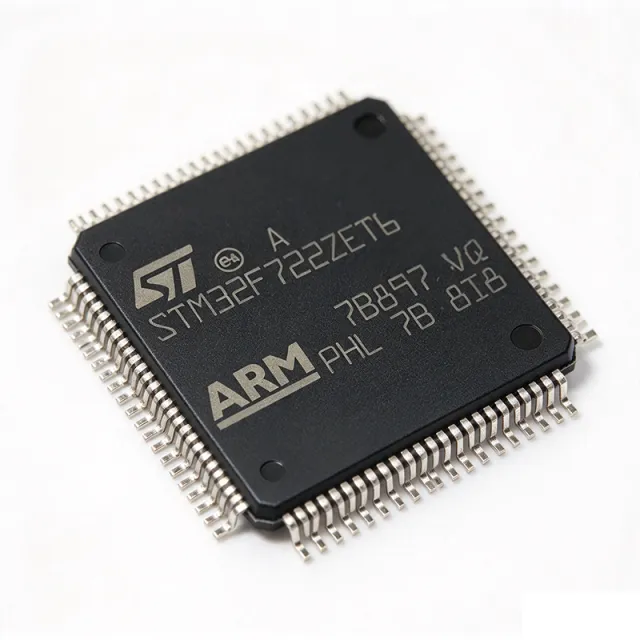
STM32F722ZET6 - 512KB Flash, 216MHz ARM Cortex-M7 MCU | STMicroelectronics
MPN: STM32F722ZET6 ✓ Active| Qty | Unit Price | Extended |
|---|---|---|
| 1 | $10.6875 | $10.69 |
| 10 | $7.7188 | $77.19 |
| 100 | $6.8281 | $682.81 |
| 500 | $6.5313 | $3,265.65 |
| 1,000 | $6.2344 | $6,234.40 |
STM32F722ZET6 Overview
An ARM Cortex-M7 microcontroller is a high-performance 32-bit processor core designed for embedded systems that demand intensive computation, such as digital signal processing, motor control, and graphical user interfaces. The Cortex-M7 core features a 6-stage pipeline, branch prediction, and optional double-precision floating-point unit (FPU), enabling efficient execution of complex algorithms. In the system hierarchy, the STM32F722ZET6 sits at the application processor level, interfacing with memory, peripherals, and external devices to control and process data in real-time.
Key features of the STM32F722ZET6 include a 216 MHz CPU with a single-precision FPU, 512 KB flash, 256 KB SRAM, and a comprehensive set of peripherals. It supports a wide supply voltage range of 1.7V to 3.6V, operates over a temperature range of -40°C to +85°C, and includes advanced security features such as a true random number generator (TRNG) and a cryptographic acceleration cell. The device also features a Chrom-ART Accelerator for enhanced graphical performance, making it ideal for human-machine interface (HMI) applications.
Technically, the STM32F722ZET6 is built on a 90nm process technology, offering a balance between performance and power consumption. It includes a memory protection unit (MPU) for enhanced reliability, a direct memory access (DMA) controller with up to 16 channels, and a flexible memory controller (FMC) supporting external memory interfaces. The device also integrates a 12-bit ADC with up to 24 channels, two 12-bit DACs, and multiple 16-bit and 32-bit timers, providing precise analog and timing control.
Typical applications include industrial control systems, motor drives, advanced human-machine interfaces, IoT gateways, audio processing, and high-end consumer electronics. The combination of high clock speed, ample memory, and rich peripherals makes it a versatile choice for designers requiring a powerful MCU in a compact package.
When designing with the STM32F722ZET6, ensure proper decoupling of the power supply pins with 100nF capacitors placed close to each VDD pin, and a 4.7uF bulk capacitor on the main supply. The device supports multiple low-power modes, including Sleep, Stop, and Standby, which can be leveraged to optimize energy consumption in battery-powered applications.
Drop-in alternatives for STM32F722ZET6 — same package, pin-to-pin compatible. Different-package parts requiring PCB rework are excluded.
Variants in this series
Same-series models that are drop-in compatible with STM32F722ZET6 (same form factor and footprint) — differing in Operating Temperature, Package, SRAM, ADC, Communication Interfaces.
Quick Comparison Tool — Select alternative parts for side-by-side comparison:
STM32F767ZIT6
✓ In Stock
$17.6 / Unit
View Datasheet →STM32F722RET6
✓ In Stock
$8.1 / Unit
View Datasheet →STM32F722ZET6TR
📋 Reference alternative (not in catalog)
STM32F722ZET6Q
📋 Reference alternative (not in catalog)
STM32F746ZET6
📋 Reference alternative (not in catalog)
LPC54628J512BD208
📋 Reference alternative (not in catalog)
STM32F722ZET6 Maximum Ratings & Electrical Characteristics
| Core | ARM Cortex-M7 |
| Maximum Clock Speed | 216 MHz |
| Flash Memory | 512 KB |
| SRAM | 256 KB |
| Package | LQFP144 (20x20 mm) |
| Supply Voltage | 1.7V to 3.6V |
| Operating Temperature | -40°C to +85°C |
| Number of I/O Pins | 114 |
| ADC Resolution | 12-bit |
| Number of ADC Channels | 24 |
| DAC Resolution | 12-bit |
| Number of DAC Channels | 2 |
| USART Interfaces | 4 |
| SPI Interfaces | 5 |
| I2C Interfaces | 4 |
| USB OTG | HS and FS |
| Ethernet MAC | Yes |
| Camera Interface | Yes |
| Timers | 12 (16-bit and 32-bit) |
| DMA Channels | 16 |
| FPU | Single-precision |
| RoHS Status | Compliant |
STM32F722ZET6 Pin Configuration
| Pin 1 | PE2 — GPIO or alternate function |
| Pin 2 | PE3 — GPIO or alternate function |
| Pin 3 | PE4 — GPIO or alternate function |
| Pin 4 | PE5 — GPIO or alternate function |
| Pin 5 | PE6 — GPIO or alternate function |
| Pin 6 | VBAT — Battery backup supply |
| Pin 7 | PC13 — GPIO or RTC output |
| Pin 8 | PC14 — GPIO or OSC32_IN |
| Pin 9 | PC15 — GPIO or OSC32_OUT |
| Pin 10 | PF0 — GPIO or alternate function |
| Pin 11 | PF1 — GPIO or alternate function |
| Pin 12 | PF2 — GPIO or alternate function |
| Pin 13 | PF3 — GPIO or alternate function |
| Pin 14 | PF4 — GPIO or alternate function |
| Pin 15 | PF5 — GPIO or alternate function |
| Pin 16 | PF6 — GPIO or alternate function |
| Pin 17 | PF7 — GPIO or alternate function |
| Pin 18 | PF8 — GPIO or alternate function |
| Pin 19 | PF9 — GPIO or alternate function |
| Pin 20 | PF10 — GPIO or alternate function |
| Pin 21 | VSS — Ground |
| Pin 22 | VDD — Power supply |
| Pin 23 | PF11 — GPIO or alternate function |
| Pin 24 | PF12 — GPIO or alternate function |
| Pin 25 | PF13 — GPIO or alternate function |
| Pin 26 | PF14 — GPIO or alternate function |
| Pin 27 | PF15 — GPIO or alternate function |
| Pin 28 | PG0 — GPIO or alternate function |
| Pin 29 | PG1 — GPIO or alternate function |
| Pin 30 | PG2 — GPIO or alternate function |
| Pin 31 | PG3 — GPIO or alternate function |
| Pin 32 | PG4 — GPIO or alternate function |
| Pin 33 | PG5 — GPIO or alternate function |
| Pin 34 | PG6 — GPIO or alternate function |
| Pin 35 | PG7 — GPIO or alternate function |
| Pin 36 | PG8 — GPIO or alternate function |
| Pin 37 | PG9 — GPIO or alternate function |
| Pin 38 | PG10 — GPIO or alternate function |
| Pin 39 | PG11 — GPIO or alternate function |
| Pin 40 | PG12 — GPIO or alternate function |
| Pin 41 | PG13 — GPIO or alternate function |
| Pin 42 | PG14 — GPIO or alternate function |
| Pin 43 | PG15 — GPIO or alternate function |
| Pin 44 | VSS — Ground |
| Pin 45 | VDD — Power supply |
| Pin 46 | PD0 — GPIO or alternate function |
| Pin 47 | PD1 — GPIO or alternate function |
| Pin 48 | PD2 — GPIO or alternate function |
| Pin 49 | PD3 — GPIO or alternate function |
| Pin 50 | PD4 — GPIO or alternate function |
| Pin 51 | PD5 — GPIO or alternate function |
| Pin 52 | PD6 — GPIO or alternate function |
| Pin 53 | PD7 — GPIO or alternate function |
| Pin 54 | PD8 — GPIO or alternate function |
| Pin 55 | PD9 — GPIO or alternate function |
| Pin 56 | PD10 — GPIO or alternate function |
| Pin 57 | PD11 — GPIO or alternate function |
| Pin 58 | PD12 — GPIO or alternate function |
| Pin 59 | PD13 — GPIO or alternate function |
| Pin 60 | PD14 — GPIO or alternate function |
| Pin 61 | PD15 — GPIO or alternate function |
| Pin 62 | VSS — Ground |
| Pin 63 | VDD — Power supply |
| Pin 64 | PC0 — GPIO or ADC input |
| Pin 65 | PC1 — GPIO or ADC input |
| Pin 66 | PC2 — GPIO or ADC input |
| Pin 67 | PC3 — GPIO or ADC input |
| Pin 68 | PC4 — GPIO or ADC input |
| Pin 69 | PC5 — GPIO or ADC input |
| Pin 70 | PB2 — GPIO or alternate function |
| Pin 71 | PE0 — GPIO or alternate function |
| Pin 72 | PE1 — GPIO or alternate function |
| Pin 73 | VSS — Ground |
| Pin 74 | VDD — Power supply |
| Pin 75 | PB10 — GPIO or alternate function |
| Pin 76 | PB11 — GPIO or alternate function |
| Pin 77 | PB12 — GPIO or alternate function |
| Pin 78 | PB13 — GPIO or alternate function |
| Pin 79 | PB14 — GPIO or alternate function |
| Pin 80 | PB15 — GPIO or alternate function |
| Pin 81 | PD8 — GPIO or alternate function |
| Pin 82 | PD9 — GPIO or alternate function |
| Pin 83 | PD10 — GPIO or alternate function |
| Pin 84 | PD11 — GPIO or alternate function |
| Pin 85 | PD12 — GPIO or alternate function |
| Pin 86 | PD13 — GPIO or alternate function |
| Pin 87 | PD14 — GPIO or alternate function |
| Pin 88 | PD15 — GPIO or alternate function |
| Pin 89 | VSS — Ground |
| Pin 90 | VDD — Power supply |
| Pin 91 | PA0 — GPIO or ADC input |
| Pin 92 | PA1 — GPIO or ADC input |
| Pin 93 | PA2 — GPIO or alternate function |
| Pin 94 | PA3 — GPIO or alternate function |
| Pin 95 | PA4 — GPIO or DAC output |
| Pin 96 | PA5 — GPIO or DAC output |
| Pin 97 | PA6 — GPIO or alternate function |
| Pin 98 | PA7 — GPIO or alternate function |
| Pin 99 | PA8 — GPIO or alternate function |
| Pin 100 | PA9 — GPIO or alternate function |
| Pin 101 | PA10 — GPIO or alternate function |
| Pin 102 | PA11 — GPIO or alternate function |
| Pin 103 | PA12 — GPIO or alternate function |
| Pin 104 | PA13 — GPIO or SWDIO |
| Pin 105 | PA14 — GPIO or SWCLK |
| Pin 106 | PA15 — GPIO or alternate function |
| Pin 107 | VSS — Ground |
| Pin 108 | VDD — Power supply |
| Pin 109 | PB3 — GPIO or alternate function |
| Pin 110 | PB4 — GPIO or alternate function |
| Pin 111 | PB5 — GPIO or alternate function |
| Pin 112 | PB6 — GPIO or alternate function |
| Pin 113 | PB7 — GPIO or alternate function |
| Pin 114 | PB8 — GPIO or alternate function |
| Pin 115 | PB9 — GPIO or alternate function |
| Pin 116 | PE7 — GPIO or alternate function |
| Pin 117 | PE8 — GPIO or alternate function |
| Pin 118 | PE9 — GPIO or alternate function |
| Pin 119 | PE10 — GPIO or alternate function |
| Pin 120 | PE11 — GPIO or alternate function |
| Pin 121 | PE12 — GPIO or alternate function |
| Pin 122 | PE13 — GPIO or alternate function |
| Pin 123 | PE14 — GPIO or alternate function |
| Pin 124 | PE15 — GPIO or alternate function |
| Pin 125 | VSS — Ground |
| Pin 126 | VDD — Power supply |
| Pin 127 | PB0 — GPIO or ADC input |
| Pin 128 | PB1 — GPIO or ADC input |
| Pin 129 | PB2 — GPIO or alternate function |
| Pin 130 | PE7 — GPIO or alternate function |
| Pin 131 | PE8 — GPIO or alternate function |
| Pin 132 | PE9 — GPIO or alternate function |
| Pin 133 | PE10 — GPIO or alternate function |
| Pin 134 | PE11 — GPIO or alternate function |
| Pin 135 | PE12 — GPIO or alternate function |
| Pin 136 | PE13 — GPIO or alternate function |
| Pin 137 | PE14 — GPIO or alternate function |
| Pin 138 | PE15 — GPIO or alternate function |
| Pin 139 | VSS — Ground |
| Pin 140 | VDD — Power supply |
| Pin 141 | PB0 — GPIO or ADC input |
| Pin 142 | PB1 — GPIO or ADC input |
| Pin 143 | PB2 — GPIO or alternate function |
| Pin 144 | PE7 — GPIO or alternate function |
Typical Applications
STM32F722ZET6 is suitable for 6 applications: Industrial Control Systems, Motor Drives, Human-Machine Interface (HMI), IoT Gateways, Audio Processing, Consumer Electronics.
Industrial Control Systems
The STM32F722ZET6 is ideal for industrial control systems due to its high processing power (216 MHz Cortex-M7) and rich peripheral set. It can handle complex control algorithms, real-time data acquisition, and communication protocols like EtherCAT and PROFINET. The multiple timers and ADCs enable precise motor control and sensor interfacing. Its robust operating temperature range (-40°C to +85°C) ensures reliability in harsh industrial environments. The device supports various industrial communication interfaces, including Ethernet MAC, USART, SPI, and I2C, facilitating seamless integration into factory automation networks. The 512 KB flash and 256 KB SRAM provide ample space for firmware and data buffering, while the DMA controller offloads the CPU for efficient data transfer. Overall, the STM32F722ZET6 delivers the performance and connectivity required for advanced industrial applications.
Recommended
Motor Drives
The STM32F722ZET6 excels in motor drive applications, offering a 216 MHz Cortex-M7 core with single-precision FPU for executing complex field-oriented control (FOC) algorithms. It features 12 timers, including 32-bit timers, with complementary PWM outputs and dead-time insertion, essential for driving three-phase inverters. The high-resolution ADCs (12-bit, up to 24 channels) enable precise current and voltage sensing. The device supports encoder and Hall sensor interfaces for position feedback. Its rich connectivity options, including CAN and Ethernet, allow for remote monitoring and control. The 512 KB flash provides ample space for motor control firmware, while the 256 KB SRAM supports real-time data logging. The STM32F722ZET6's performance and peripheral integration make it a top choice for high-performance motor drives in robotics, automotive, and industrial automation.
Recommended
Human-Machine Interface (HMI)
The STM32F722ZET6 is well-suited for HMI applications, featuring a Chrom-ART Accelerator that offloads the CPU for graphical rendering, enabling smooth and responsive user interfaces. The device supports external memory interfaces (FMC) for connecting SDRAM or NOR flash, expanding graphical memory. It includes a camera interface for image capture and multiple communication interfaces for touch controllers and displays. The 216 MHz clock speed ensures fast UI updates, while the 512 KB flash and 256 KB SRAM provide ample storage for graphics assets and UI code. The device's low-power modes help extend battery life in portable HMIs. With support for various display resolutions and touch technologies, the STM32F722ZET6 is a versatile choice for industrial HMIs, smart home panels, and medical devices.
Recommended
IoT Gateways
The STM32F722ZET6 is an excellent choice for IoT gateways, combining high processing power with extensive connectivity options. It features Ethernet MAC, USB OTG HS/FS, and multiple USART/SPI/I2C interfaces, enabling seamless connection to cloud services and local sensors. The 216 MHz Cortex-M7 core can handle protocol stacks like MQTT, CoAP, and TLS encryption, while the cryptographic acceleration cell offloads security operations. The device supports external memory interfaces for storing large data logs. Its low-power modes are crucial for energy-efficient operation in remote deployments. The 512 KB flash and 256 KB SRAM provide ample resources for running a real-time operating system (RTOS) and application code. The STM32F722ZET6's robust security features, including TRNG and crypto cell, ensure secure data transmission, making it ideal for industrial IoT and smart city applications.
Recommended
Audio Processing
The STM32F722ZET6 is well-suited for audio processing applications, leveraging its 216 MHz Cortex-M7 core with single-precision FPU to handle real-time audio algorithms such as filtering, equalization, and noise reduction. The device includes multiple I2S interfaces for connecting audio codecs and digital microphones. Its high-speed ADC and DAC (12-bit) enable direct audio signal processing. The 512 KB flash and 256 KB SRAM provide ample memory for audio buffers and processing code. The device supports DMA for efficient audio data transfer without CPU intervention. With its high performance and rich audio peripherals, the STM32F722ZET6 is ideal for applications like audio effects processors, voice recognition systems, and professional audio equipment.
Recommended
Consumer Electronics
The STM32F722ZET6 is a powerful MCU for consumer electronics, offering high performance for applications like smart home devices, wearables, and gaming peripherals. Its 216 MHz Cortex-M7 core enables smooth user interfaces and complex processing tasks. The device includes a camera interface for image capture, USB OTG for connectivity, and multiple timers for precise control. Its low-power modes are essential for battery-powered devices. The 512 KB flash and 256 KB SRAM provide ample storage for application code and data. The STM32F722ZET6's rich peripheral set and high performance make it a versatile choice for a wide range of consumer products, from smart speakers to fitness trackers.
Recommended
Recommended Products Summary
Engineering reference data for STM32F722ZET6 — comparison, design guidance, and compliance information.
Selection Guide
Comparison with Alternatives
| Parameter | This Product | STM32F722ZET6TR | STM32F722ZET6Q | STM32F767ZIT6 | STM32F746ZET6 |
|---|---|---|---|---|---|
| Package | LQFP144 | LQFP144 | LQFP144 | LQFP144 | LQFP144 |
| Brand | STMicroelectronics | STMicroelectronics | STMicroelectronics | STMicroelectronics | STMicroelectronics |
| Core | ARM Cortex-M7 | ARM Cortex-M7 | ARM Cortex-M7 | ARM Cortex-M7 | ARM Cortex-M7 |
| Maximum Clock Speed | 216 MHz | 216 MHz | 216 MHz | 216 MHz | 216 MHz |
| Flash Memory | 512 KB | 512 KB | 512 KB | 2 MB | 1 MB |
| SRAM | 256 KB | 256 KB | 256 KB | 512 KB | 320 KB |
| TFT-LCD Controller | No | No | No | Yes | Yes |
| JPEG Codec | No | No | No | Yes | No |
| Operating Temperature Range | -40°C to +85°C | -40°C to +85°C | -40°C to +105°C | -40°C to +85°C | -40°C to +85°C |
Key Differentiators
- Higher clock speed and performance (vs STM32F407ZET6)
- More SRAM (vs STM32F746ZET6)
- Pin-compatible with higher-memory variants (vs STM32F767ZIT6)
Design Notes
Ensure proper decoupling of the power supply pins. Place a 100nF ceramic capacitor close to each VDD pin and a 4.7uF bulk capacitor on the main supply. The STM32F722ZET6 operates from 1.7V to 3.6V, so verify that the supply voltage is within this range under all load conditions. Use a low-ESR capacitor for the VCAP pins if present.
For the LQFP144 package, ensure adequate thermal relief by providing a solid ground plane and thermal vias under the exposed pad (if present). The device's power dissipation should be calculated based on the application's current consumption and clock speed. Keep high-speed signal traces short and use proper impedance control for USB and Ethernet interfaces.
Avoid exceeding the absolute maximum ratings, especially on the supply voltage and I/O pins. The STM32F722ZET6 has a maximum junction temperature of 125°C, so ensure adequate cooling in high-temperature environments. When using the ADC, ensure that the reference voltage is stable and noise-free. Also, be aware of the boot configuration pins (BOOT0) to avoid unintended boot modes.
Compliance Information
RoHS compliant per STMicroelectronics product page. Not AEC-Q100 qualified; for automotive, consider STM32F722ZET6Q (extended temp) or other automotive-grade variants.