メモリIC
サブカテゴリ
製品 (459)

K4A8G165WB-BCPB - 8Gb DDR4 SDRAM 2133Mbps x16 | Samsung
The Samsung K4A8G165WB-BCPB is an 8Gb B-die DDR4 SDRAM organized as 512M x 16, operating at a data rate of 2133 Mbps from a single 1.2V supply, housed in a 96-ball FBGA (TFBGA) package rated for 0C to +85C operation. DDR4 SDRAM is the fourth generation of double data rate synchronous dynamic random access memory, the dominant main-memory technology in embedded systems, industrial PCs, networking equipment, and consumer electronics. Within the memory hierarchy, DDR4 sits above DDR3L by offering lower operating voltage (1.2V vs 1.5V), higher data rates, and bank-group architecture that improves burst performance. The x16 organization allows single-chip deployment in memory systems that do not require x8 or x4 ECC configurations. Key features of the K4A8G165WB-BCPB include 8Gb density on Samsung's B-die process, 2133 Mbps/pin bandwidth, and 1.2V core supply delivering roughly 25% lower power than DDR3 at comparable speeds. The device supports DDR4 bank-group architecture with 4 groups, on-die termination (ODT), and standard DDR4 command timing as defined in the Samsung datasheet. The B-die architecture uses a refined CMOS process to achieve high cell density with stable retention characteristics. Internal bank grouping reduces effective tRFC overhead per burst, improving random-access efficiency. VDDQ is also 1.2V, simplifying power-tree design with a single rail when current limits permit. Typical applications include industrial control main memory, network appliance buffering, set-top boxes, smart TVs, and embedded ARM/x86 systems using DDR4 controllers with 16-bit memory buses. Design consideration: DDR4 routing requires length-matched fly-by or point-to-point topologies with careful Vref and ODT calibration; consult the Samsung datasheet timing tables and your SoC memory controller guide before layout. This page synthesizes distributor pricing, drop-in alternatives, and practical design notes not found in the manufacturer datasheet. Pricing as of 2026-09-04.

K4A8G165WB-BCRC - 8Gb DDR4 SDRAM 2400Mbps x16 | Samsung
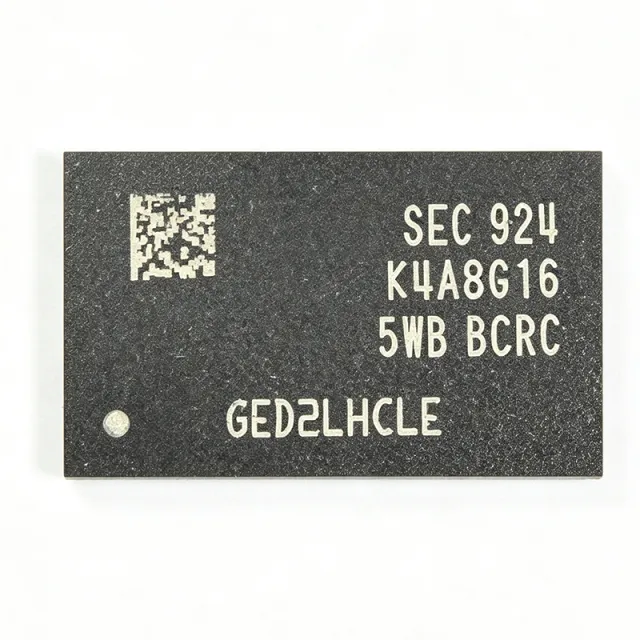
The Samsung K4A8G165WB-BCRC is an 8Gb (512M x 16) DDR4 SDRAM DRAM component fabricated on Samsung's advanced B-die process, operating at 1.2V VDD with a data rate of 2400 Mbps (DDR4-2400, CL17 class) in a 96-ball fine-pitch Ball Grid Array (FBGA-96, PBGA96) surface-mount package with a -40C to +95C industrial operating range. DDR4 SDRAM is the fourth generation of double-data-rate synchronous dynamic random-access memory, the volatile working memory that holds active data and instructions between a processor and long-term storage. Within the memory hierarchy, DDR4 DRAM sits above caches and below storage, offering gigabyte-class density at nanosecond-class latency. DDR4 improved on DDR3 by lowering VDD from 1.5V/1.35V to 1.2V, doubling bank groups to eight via Bank Group Architecture, and adding features such as on-die termination refinements and CRC. Key features of the K4A8G165WB family include the auto precharge function, an asynchronous reset function for rapid initialization, CRC and CA parity protection for command/address integrity, dynamic on-chip termination (ODT) that reduces signal reflections on high-speed buses, and ZQ calibration for accurate output driver impedance matching across temperature and voltage drift. The x16 organization with 512M addressable words suits systems that use one or two DRAMs without the complexity of x8-wide multi-chip topologies. The B-die 8Gb monolithic die maximizes density per component, reducing component count and board area compared with stacking multiple 4Gb devices. Its 2400 Mbps/pin data rate delivers 4.8 GB/s per device at the x16 interface width, adequate for embedded ARM, FPGA, and networking SoC memory controllers that implement DDR4-2400. Typical applications include industrial control systems, network communication equipment, servers and storage controllers, and test and measurement instrumentation, where the -40C to +95C grade and CRC/CA parity support robust operation. Design consideration: DDR4-2400 signal integrity demands careful length-matched routing, reference-plane-continuous fly-by or point-to-point topology, and controller ZQ calibration sequencing per the Samsung datasheet initialization procedure. This page synthesizes distributor pricing, drop-in alternatives, and practical design notes not found in the manufacturer datasheet.
K4A8G165WB-BCRC - 8Gb DDR4 SDRAM x16 2400Mbps | Samsung
The Samsung K4A8G165WB-BCRC is an 8Gb DDR4 SDRAM (B-die) organized as 512M x 16, delivering a 2400 Mbps data rate (PC4-19200) from a 1.2V supply in a 96-ball FBGA (PBGA96) package. DDR4 SDRAM (fourth-generation Double Data Rate Synchronous Dynamic Random-Access Memory) is the industry-standard volatile DRAM technology for computing and embedded systems. It transfers data on both clock edges and operates at 1.2V versus DDR3's 1.5V, cutting core power by roughly 25% while raising bandwidth. Within the memory hierarchy it sits as the main-system-memory tier: DRAM -> DDR4 SDRAM -> volatile memory -> semiconductor memory. Key features of the -BCRC speed grade include 2400 Mbps operation at CL17-class timings, an operating temperature range of -40C to +95C, on-die termination (ODT), dynamic ODT, ZQ calibration, auto-precharge, an asynchronous reset input, and CRC and CA parity support for link integrity. The x16 organization provides a wide 16-bit data bus, maximizing bandwidth per chip and simplifying single-chip designs. Technically, the device uses Samsung's 8Gb B-die monolithic DRAM process with CMOS core logic. Bank-group architecture enables fast back-to-back accesses, while programmable read/write latencies and refresh modes (auto-refresh and self-refresh) let the memory controller optimize for latency or power. The fine-pitch FBGA-96 package (0.8 mm ball pitch) delivers short, controlled-impedance interconnects for signal integrity at 1200 MHz clock rates. Typical applications include server and data-center memory subsystems, industrial PCs and control systems, network routers and switches, and automotive-adjacent infotainment and connectivity platforms. Design consideration: maintain a stable 1.14V-1.26V supply with dense decoupling near the power balls and follow the datasheet fly-by routing and VREF guidelines to pass eye-mask compliance at 2400 Mbps. This page synthesizes distributor pricing, drop-in alternatives within the Samsung K4A8G165WB family, and practical design notes not found in the manufacturer datasheet.
K4A8G165WB-BCTD - 8Gb DDR4 SDRAM 512Mx16 2666Mbps | Samsung
The Samsung K4A8G165WB-BCTD is an 8Gb (gigabit) DDR4 SDRAM memory chip organized as 512M x 16, operating at 2666 Mbps data rate from a 1.2V supply, housed in a 96-ball FBGA (96FBGA) package rated for 0C to +85C operation. DDR4 SDRAM (Double Data Rate Fourth Generation Synchronous Dynamic Random Access Memory) is the JEDEC-standard mainstream DRAM technology used as main memory in PCs, servers, embedded systems, and networking equipment. It succeeds DDR3 with lower operating voltage (1.2V vs 1.5V), higher data rates, bank groups, and improved signaling such as on-die termination and DBI (data bus inversion). Within the memory hierarchy, DDR4 SDRAM sits under synchronous DRAM, random access memory, and semiconductor memory. Key features of the K4A8G165WB (B-die generation) include 8Gb density in a single die, a 512M x 16 organization that suits systems using 16-bit or 32-bit memory buses without byte-write enable complexity, and a 2666 Mbps/pin data rate (PC4-21300 class, CL19 at 1.2V per JEDEC DDR4 speed bins). The x16 organization provides dedicated data mask (DM) and differential DQS signals per byte lane for reliable high-speed data capture. Architecturally, the device uses DDR4 bank-group architecture with internal pipelined operations, allowing back-to-back accesses within a bank group at tCCD_S-limited rates and across groups at faster tCCD_L rates. Dynamic on-die termination (ODT), ZQ calibration, and per-byte write leveling support signal integrity across the fly-by routed command/address bus typical of DDR4 designs. Typical applications include embedded computing boards, industrial PCs, networking switches and routers, set-top boxes, automotive infotainment platforms, and any SoC/FPGA design with a DDR4 x16 memory controller requiring 1GB per chip (8Gb). Design consideration: maintain the 1.14V-1.26V VDD window and follow the fly-by routing with ODT enabled; validate controller timing at the -TC (2666) bin because speed-bin suffixes are not interchangeable without re-qualification. This page synthesizes distributor pricing, drop-in alternatives, and practical design notes not found in the manufacturer datasheet.
K4A8G165WB-BCWE - 8Gb DDR4 SDRAM 3200Mbps 1.2V | Samsung
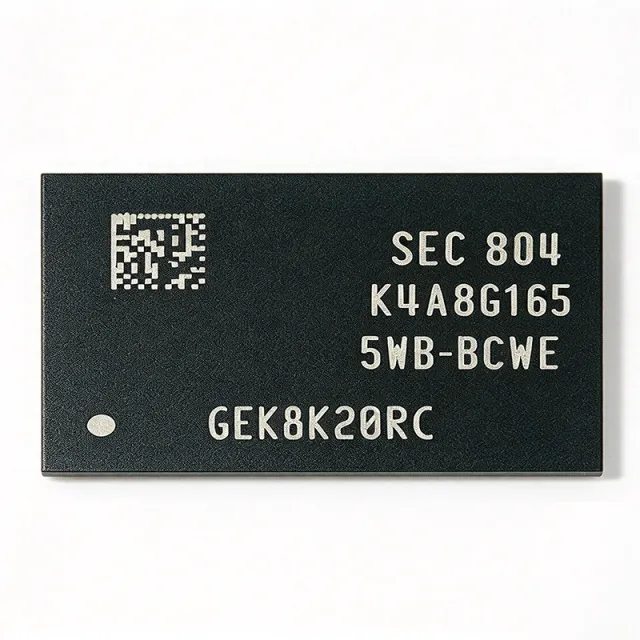
The Samsung K4A8G165WB-BCWE is an 8 Gb DDR4 SDRAM memory IC organized as 512M x 16, operating at a data rate of 3200 Mbps from a 1.2 V supply, housed in a 96-ball FBGA (96FBGA) surface-mount package. DDR4 SDRAM (Double Data Rate 4 Synchronous Dynamic Random-Access Memory) is a volatile memory technology that transfers data on both edges of the clock signal, doubling bandwidth versus DDR3 at the same clock. As a member of the voltage regulator of system cost and power - DRAM -> synchronous DRAM -> DDR SDRAM -> DDR4 hierarchy - it operates at 1.2 V instead of the 1.5 V of DDR3, cutting power consumption by roughly 25% while raising density and bandwidth. DDR4 is the industry-standard main memory for servers, workstations, desktops, networking, and embedded computing platforms. Key features of the K4A8G165WB-BCWE include the 3200 Mbps speed bin (PC4-25600 class), a 16-bit data interface suited to space-constrained boards that cannot use 64/72-bit DIMM channels, bank group architecture for improved effective bandwidth, and on-die termination with ZQ calibration for signal integrity. The commercial temperature range of 0 to +85 C covers consumer, computing, and most industrial environments. Architecturally, this device belongs to Samsung's DDR4 B-die family, widely recognized for tight timing and strong overclocking headroom. It uses a burst length of 8, supports auto precharge, asynchronous reset, CRC and data mask functions, and dynamic on-chip termination, all of which reduce controller overhead and improve bus efficiency at high data rates. Typical applications include desktop and embedded x86/ARM main memory, networking line cards, industrial gateways, set-top boxes, and gaming or workstation graphics-adjacent memory buffers, where an 8 Gb x16 device allows 4 GB to 8 GB of memory in only two to four packages. Design consideration: route the 3200 Mbps data lines with controlled impedance and length matching, and place decoupling capacitors directly at the 1.2 V VDD balls; the datasheet layout guidelines should be followed to avoid eye-diagram closure. This page synthesizes distributor pricing, verified drop-in alternatives across Samsung, Micron, and Nanya, and practical design notes not found in the manufacturer datasheet alone.
K4A8G165WC-BCRC - 8Gb DDR4 SDRAM 2400Mbps x16 | Samsung
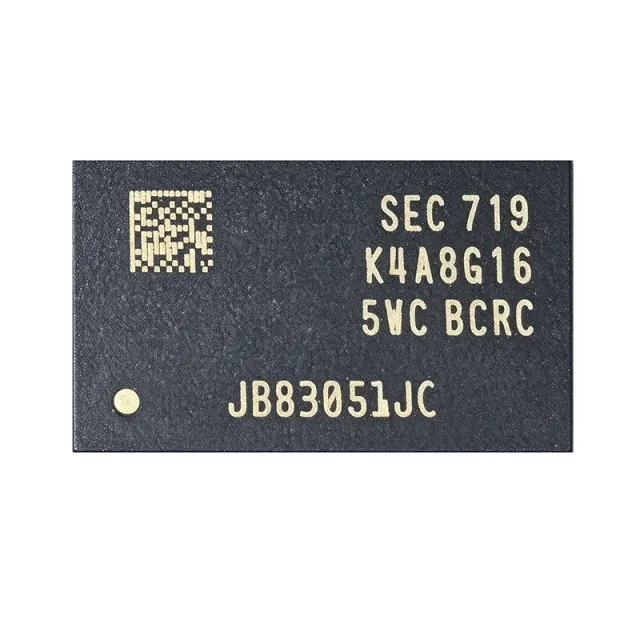
The Samsung K4A8G165WC-BCRC is an 8 Gb DDR4 SDRAM memory IC organized as 512M x 16, operating at a data rate of 2400 Mbps (1333 MHz clock) from a nominal 1.2 V supply (1.14 V to 1.26 V), housed in a 96-ball FBGA (TFBGA) package. DDR4 SDRAM (Double Data Rate 4 Synchronous Dynamic Random Access Memory) is the fourth generation of the JEDEC-defined DDR memory family. In the system hierarchy it sits under synchronous DRAM -> volatile memory IC -> semiconductor memory, serving as the main working memory for processors, SoCs and controllers. DDR4 lowered operating voltage from DDR3's 1.5 V to 1.2 V, cutting dynamic power by roughly 25% while raising data rates up to 3200 Mbps. Key features of this C-die part include an 8 Gbit density in a x16 organization with a 16-bit data interface, auto precharge, asynchronous reset, CRC and CA parity for command/address integrity, on-die ZQ calibration, dynamic on-die termination (ODT), and data mask (DM) support per byte lane. These features improve signal integrity and data reliability at high speeds. Technically, the device uses Samsung's C-die process and a bank-group architecture that allows faster burst access between bank groups. Ballouted per JEDEC DDR4 standards, the 96-ball FBGA is the industry-standard footprint, so JEDEC-compliant x16 8 Gb DDR4 parts from other vendors land on the same PCB land pattern. Operating current is specified around 2 mA (standby idle) and up to 64 mA operating per distributor data. Typical applications include embedded computing modules, industrial controllers, networking and gateway equipment, set-top boxes, smart TVs, medical monitoring devices, and test and measurement instruments that need a compact, soldered-down memory. Design tip: route the 16-bit data bus with length-matched traces to the controller, honor VTT termination (dynamic ODT helps), and decouple the 1.2 V VDD rail with low-ESR ceramics close to the ball field; verify speed-grade compatibility with your memory controller's trained timings. This page synthesizes distributor pricing, verified drop-in alternatives, design notes and FAQs not consolidated in the manufacturer datasheet.
K4A8G165WC-BCTD - 8Gb DDR4 SDRAM 2666Mbps x16 | Samsung
The Samsung K4A8G165WC-BCTD is an 8 Gb DDR4 SDRAM organized as 512M x16, supporting DDR4-2666 data rates up to 2666 Mbps at a 1.2 V core supply (1.14 V to 1.26 V operating range), housed in a 96-ball FBGA (96FBGA) package. DDR4 SDRAM (Double Data Rate 4 Synchronous Dynamic Random Access Memory) is the fourth generation of the JEDEC DDR DRAM family, sitting within the memory IC hierarchy: DRAM -> synchronous DRAM -> DDR SDRAM -> DDR4 SDRAM. DDR4 doubles the bank count of DDR3, lowers operating voltage from 1.5 V to 1.2 V, and introduces bank groups with burst lengths of 8, improving bandwidth per watt for main memory and buffering applications. Key features of this C-die component include CRC (cyclic redundancy check) on write data, ZQ calibration for output driver impedance accuracy, dynamic on-die termination (ODT), data mask (DM) support on the x16 organization, automatic precharge, and an asynchronous reset input. Samsung manufactures the die on its advanced 1Y nm-class process, which improves bit density, endurance, and power efficiency compared to older 2x nm generations. Electrically, the device operates from a 1.2 V VDD with a tolerance band of 1.14 V to 1.26 V, and a clock rate of 1.333 GHz (DDR4-2666 class). The x16 organization halves the external device count needed for a 16-bit data bus versus x8 parts, simplifying layout for embedded boards, though it foregoes some of the ECC-friendly granularity of x8 components. Typical applications include industrial controllers and IPC main memory, networking equipment line cards, set-top boxes, digital TVs, and embedded systems that pair the SDRAM with DDR4-capable SoCs, FPGAs, or memory controllers requiring mainstream DDR4-2666 throughput. For design, keep the FBGA package's fly-by address/command routing on 4-layer or better PCBs, honor the 1.14 V minimum supply, and follow JEDEC DDR4 x16 ballout constraints for trace-length matching. This page synthesizes distributor pricing, drop-in alternatives, and practical design notes not found in the manufacturer datasheet.
K4A8G165WC-BCTD - 8Gb DDR4 SDRAM 512Mx16 2666Mbps | Samsung
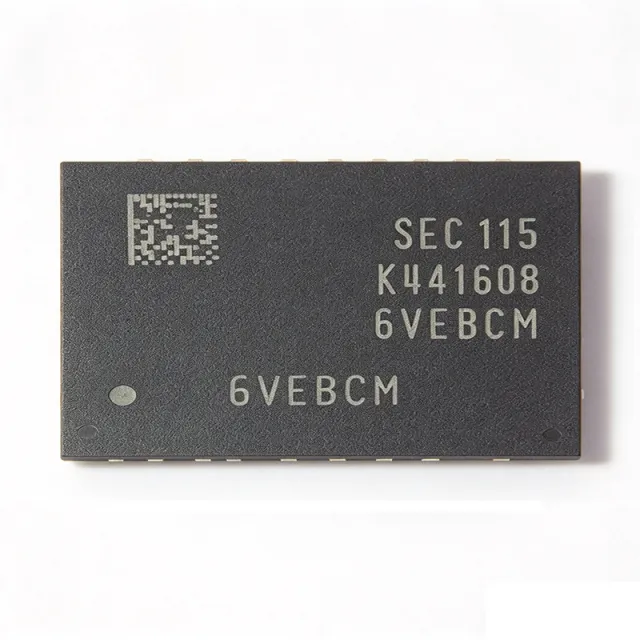
The Samsung K4A8G165WC-BCTD is an 8Gb DDR4 SDRAM organized as 512M x 16, supporting a data rate of 2666 Mbps (DDR4-2666 class) at a 1.2V supply (1.14V to 1.26V operating range), housed in a 96-ball FBGA (96FBGA) package. DDR4 SDRAM (Double Data Rate 4 Synchronous Dynamic Random-Access Memory) is the fourth generation of JEDEC-standard volatile synchronous DRAM. It transfers data on both edges of a differential clock, doubling bandwidth relative to DDR3, while lowering core voltage from 1.5V to 1.2V for improved power efficiency. In the memory hierarchy, DDR4 SDRAM sits as the main-system-memory tier within the broader DRAM family, serving servers, desktops, networking, and embedded computing platforms. Key features of the K4A8G165WC-BCTD include auto precharge, an asynchronous reset function, CRC (Cyclic Redundancy Check) for link-level data integrity, ZQ calibration for output driver accuracy, dynamic on-chip termination (ODT) for signal quality, and a data mask function. These JEDEC-standard DDR4 features simplify board design and improve reliability at high data rates. The x16 organization allows engineers to reach large memory capacity with fewer chips and simpler address routing than x4 or x8 alternatives. The device is built on Samsung's mature C-die DRAM process and complies with core DDR4 features such as posted CAS, programmable CAS latency (CWL), internal (self) calibration, and on-die termination via the ODT pin. All control and address inputs are synchronized to a pair of externally supplied differential clocks (CK/CK#), with inputs latched at the clock crosspoint. The operating temperature grade is 0C to +95C. Typical applications include servers and data center memory, networking and communication equipment, industrial PCs, and embedded computing modules that require high-bandwidth, high-density DDR4 in a compact footprint. A key design consideration: at 2666 Mbps, signal integrity is dominated by trace length matching, ODT settings, and the mandatory 240-ohm ZQ calibration resistor to ground; follow Samsung's datasheet layout guidelines and place decoupling capacitors close to the power balls. This page synthesizes distributor pricing and stock, same-footprint drop-in alternatives across Samsung, Micron and Nanya, and practical design notes not found in the manufacturer datasheet. Pricing as of 2026-09-04: from approximately $50.66 to $51.42 per unit at distributors such as LCSC, with several hundred units in stock.
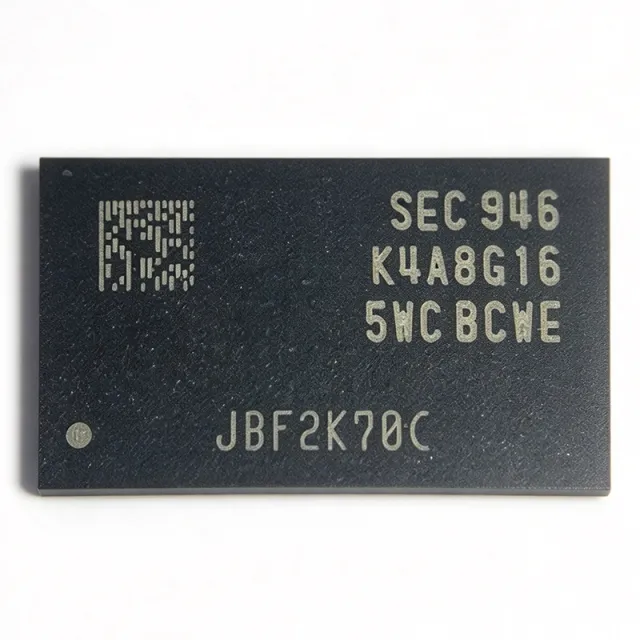
K4A8G165WC-BCWE - 8Gb DDR4-3200 SDRAM | Samsung | 96FBGA
The Samsung K4A8G165WC-BCWE is an 8Gb DDR4 SDRAM memory IC organized as 512M x 16, operating at a 3200 Mbps data rate from a 1.2V supply, housed in a 96-ball FBGA (96FBGA) package rated for 0C to +85C operation. DDR4 SDRAM (Double Data Rate 4 Synchronous Dynamic Random Access Memory) is the fourth generation of the JEDEC-defined DDR DRAM family, positioned above DDR3 and below DDR5 in the memory hierarchy. An SDRAM stores each bit as charge in a capacitor-cell array, refreshed periodically, and synchronizes all transfers to a clock so a memory controller can pipeline reads and writes. DDR4 doubles the bank count versus DDR3, adds bank groups, and lowers the core supply to 1.2V, cutting power roughly 25% versus DDR3 at comparable bandwidth. Key features of this C-die component include the 3200 Mbps speed bin (DDR4-3200, PC4-25600 class), x16 organization with data-mask support for partial writes, and per Samsung's DDR4 product family: CRC and CA parity functions, ZQ calibration, dynamic on-die termination (ODT), auto precharge, and an asynchronous reset function. The x16 data width suits controllers with narrower 16-bit or 32-bit buses typical of embedded, networking, and industrial designs. Architecturally, the device uses bank groups to allow faster back-to-back accesses, a DLL-enabled mode for timing accuracy, and on-die termination that reduces external components. The 1.2V VDD with separate 1.2V VDDQ rails and VPP for cell arrays reflects DDR4's power partitioning. Typical applications include industrial controllers, computing modules and SOMs, networking equipment line cards, firmware logging buffers, and replacement sourcing for DDR3-era 8Gb designs moving to DDR4. Design consideration: route address/command lines fly-by with proper ODT settings and verify the speed bin (BCWE = 3200) matches your controller's trained timings; the commercial 0-85C grade is not suitable for industrial -40C environments - use a T-grade variant instead. This page synthesizes distributor pricing, JEDEC-compatible drop-in alternatives, and practical DDR4 design notes not consolidated in the Samsung datasheet alone.
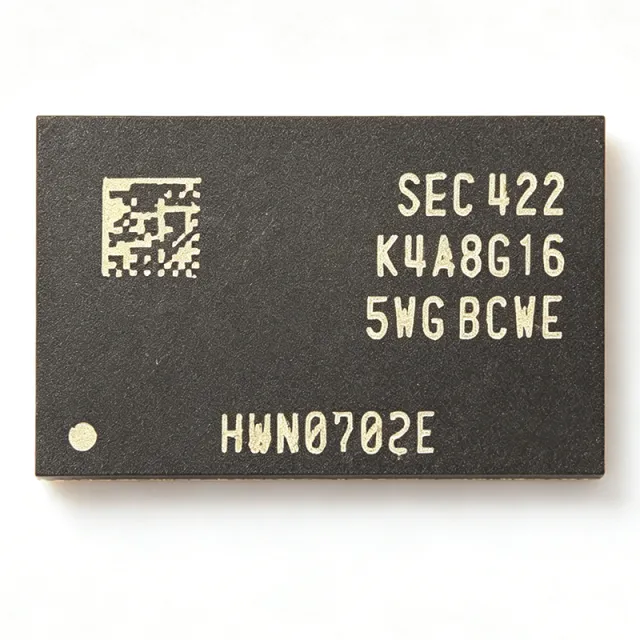
K4A8G165WG-BCWE - 8Gb DDR4 SDRAM 3200Mbps 1.2V | Samsung
The Samsung Semiconductor K4A8G165WG-BCWE is an 8Gb DDR4 SDRAM memory IC organized as 512M x 16, operating at data rates up to 3200 Mbps with a 19 ns clock cycle time, supplied at 1.2V in a 96-ball FBGA (BGA-96) surface-mount package. DDR4 SDRAM (Double Data Rate 4 Synchronous Dynamic Random Access Memory) is the fourth generation of the JEDEC DDR DRAM family. A DRAM stores each bit in a capacitor-based memory cell that must be periodically refreshed, and the synchronous interface means all operations are timed to a clock signal. Within the memory hierarchy, the K4A8G165WG-BCWE sits at the main-memory component level: DRAM cell -> DDR4 SDRAM -> synchronous DRAM -> volatile memory IC -> semiconductor. Compared with DDR3, DDR4 lowers the core supply from 1.5V to 1.2V, raises bank-group parallelism, and improves burst length and prefetch efficiency, so system designers gain both bandwidth and power savings. Key features include the 8 Gbit density in a single x16-wide device, a 3200 Mbps/pin maximum data rate (PC4-25600 class), and the 1.2V operating supply that reduces dynamic power versus 1.35V DDR3L alternatives. The commercial temperature range of 0C to +85C suits desktop, consumer, and networking equipment but not extended-temperature industrial designs (the -I grade variant serves that need). Samsung B-die based construction is well regarded for tight timing margins. Architecturally, the device uses a 16n prefetch with bank groups, enabling high effective bandwidth while keeping internal core speeds manageable. On-die termination, DLL, and ZQ calibration circuits maintain signal integrity across the high-speed command/address and data buses as defined by the DDR4 SDRAM standard. Typical applications include desktop PC and workstation DIMMs, embedded CPU memory subsystems (ARM/x86 SoCs), networking routers and switches, industrial gateways, and consumer electronics requiring 1-8 GB of main memory per board. Design consideration: DDR4 fly-by routing requires per-DRAM write leveling and careful length matching; budget ~1.2V +/- 3% (per Samsung datasheet) and verify termination against your memory controller's supported speed grade. This page synthesizes distributor pricing, stock data, drop-in alternatives, and practical design notes not found in the Samsung datasheet alone.
K4AAG085WA-BCPB - 16Gb DDR4 SDRAM 2Gx8 | Samsung
The Samsung K4AAG085WA-BCPB is a 16 Gbit DDR4 SDRAM DRAM organized as 2G x 8, operating from a 1.2 V supply in a 78-ball FBGA (78FBGA) package, belonging to Samsung's 8Gb-class DDR4 memory family for mainstream server, desktop and embedded platforms. A DDR4 SDRAM (Double Data Rate 4 Synchronous Dynamic Random Access Memory) is a volatile memory IC that transfers data on both clock edges, doubling effective bandwidth versus DDR3 at the same clock. Within the memory hierarchy it sits at the DRAM level: memory IC -> DRAM -> DDR SDRAM -> DDR4 SDRAM -> system main memory. DDR4 lowers operating voltage from 1.5 V (DDR3) to 1.2 V and raises bank-group parallelism with bank group architecture for higher data rates. Key features of the K4AAG085WA family include 16 Gbit density in a x8 organization, 1.2 V core supply, DDR4 bank group architecture, on-die termination (ODT), DLL-enabled mode operation, and the compact 78FBGA surface-mount package. Speed grades within the WA family reach up to 3200 Mbps pin speed (as documented for the BCWE grade). The BCPB suffix identifies a specific speed bin and commercial temperature range; engineers must confirm the exact bin timing parameters from the Samsung datasheet before design lock. Architecturally, the device uses an 8-bank or bank-group structure with burst lengths of 8 (BL8), programmable CAS latency, and activation/power-down management per the DDR4 SDRAM standard protocol. The datasheet abstract notes that timings specified apply to DLL-enabled mode of operation. Typical applications include server DIMMs and memory modules, desktop PC main memory, embedded industrial controllers requiring high-density DRAM, networking equipment buffering, and AI/edge compute platforms where 16 Gbit-per-chip density reduces component count. Design consideration: DDR4 routing requires length-matched, impedance-controlled fly-by topology for command/address lines and ODT calibration during init; confirm speed-bin timings against your memory controller. This page synthesizes verified distributor data, same-package drop-in alternatives, and engineering design notes not found in the manufacturer datasheet alone.
K4AAG085WA-BCRC - 16Gb DDR4 SDRAM 2Gx8 FBGA | Samsung
The Samsung K4AAG085WA-BCRC is a 16 Gbit DDR4 SDRAM memory chip organized as 2G x 8, operating from a single 1.2 V supply and housed in a 78-ball FBGA (78FBGA) surface-mount package. It belongs to Samsung's high-volume DDR4 DRAM family built to deliver top speed, bandwidth, and reliability with lower energy consumption than previous DDR generations. DDR4 SDRAM is a synchronous dynamic random-access memory and the fourth generation of the DDR (Double Data Rate) family, itself a descendant of SDRAM within the broader memory IC hierarchy (DRAM -> synchronous DRAM -> DDR SDRAM -> DDR4 SDRAM). DDR4 transfers data on both clock edges, doubling effective bandwidth versus DDR3 at the same clock, and reduces operating voltage from 1.5 V/1.35 V down to 1.2 V, which cuts both dynamic power and heat in dense memory subsystems. Key features of the K4AAG085WA-BCRC include 16 Gbit density in a x8 organization, a commercial operating temperature range of 0C to +85C (indicated by the C suffix in the speed grade), the compact 78FBGA lead-free package, and DDR4 power efficiency at 1.2 V. The 8-bit data width allows memory controllers to build wide 64-bit or wider buses with a multiple of eight devices per rank. Architecturally, the device integrates Samsung's DDR4 core with bank-group-based data masking and burst chop support, on-die termination (ODT) for signal integrity, and standard JEDEC DDR4 command and address timing. Ball-map compatibility within the K4AAG085WA family (BCWE at 3200 Mbps, BCTD at 2400 Mbps) allows speed-grade substitutions without PCB changes. Typical applications include PC and server DRAM modules (UDIMM, RDIMM), embedded and industrial motherboards, networking switches and routers, set-top boxes, and graphics or acceleration cards that require high-density x8 DRAM. Design consideration: DDR4 routing requires length-matched address/command groups and fly-by termination; verify the exact maximum data rate of the BCRC speed grade against the official Samsung datasheet before setting memory-controller timing. This page synthesizes verified distributor data, drop-in speed-grade alternatives, and practical design notes not found in the manufacturer datasheet alone.

K4AAG085WA-BCTD - 16Gb DDR4 2666Mbps SDRAM | Samsung
The Samsung Electronics K4AAG085WA-BCTD is a 16Gbit DDR4 SDRAM memory chip organized as 2G x 8, operating at 2666 Mbps data rate from a single 1.2V supply, housed in a 78-ball FBGA (78FBGA) package rated for 0C to +85C operation. DDR4 SDRAM (Double Data Rate 4 Synchronous Dynamic Random Access Memory) is the fourth generation of JEDEC-defined DRAM, sitting within the memory hierarchy as volatile main memory for computing systems. Compared with DDR3, DDR4 lowers operating voltage from 1.5V to 1.2V, doubles bank groups, and raises burst length to BL8, delivering higher bandwidth at lower power per transfer. Key features of the K4AAG085WA-BCTD include its high 16Gb (2 gigabyte) density in a single x8 component, 2666 Mbps/pin data rate, and a 1.2V core supply with DDR4 power-saving features such as a deep power-down mode and per-bank group refresh scheduling. The 78-ball FBGA surface-mount package minimizes board area and shortens signal paths for improved signal integrity at high data rates. Architecturally, the device uses an 8n prefetch with sixteen logical banks organized into four bank groups, which enables high sustained bandwidth while relaxing timing constraints. Samsung's advanced DRAM process technology provides the bit-cell scaling required to reach 16Gb per die, with internal bank-group interleaving supporting the 2666 Mbps transfer rate within a standard JEDEC DDR4-2666 timing profile. Typical applications include embedded computing modules, industrial controllers, networking equipment, storage appliances, and firmware/data logging systems where a 16Gb x8 DDR4 component is required. Its 0C to +85C commercial temperature range suits servers, desktops, and industrial environments with controlled ambient conditions. When designing with this device, memory controller timing must be validated against the JEDEC DDR4-2666 speed bin, and the 78-ball FBGA footprint requires careful length-matched PCB routing on the data, address, and clock nets. Note that the -BCTD speed grade must match the controller's supported speed bins during initialization and training. This page synthesizes distributor pricing, verified drop-in alternatives, and practical design notes not found in the manufacturer datasheet alone.
K4AAG085WA-BCWE - 16Gb DDR4-3200 SDRAM 1.2V | Samsung
The Samsung K4AAG085WA-BCWE is a 16 Gbit DDR4 SDRAM memory IC organized as 2G x 8, operating at 3200 Mbps data rate from a 1.2 V supply (1.14 V to 1.26 V rail range), housed in a 78-ball FBGA package (9 x 11 mm, 0.8 mm ball pitch) rated for 0 to 85 C operation. DDR4 SDRAM (Double Data Rate Fourth Generation Synchronous Dynamic Random Access Memory) is a volatile memory technology that transfers data on both edges of the clock, doubling bandwidth versus DDR3 at the same clock frequency. Within the memory hierarchy, DRAM sits between CPU caches and non-volatile storage such as NAND flash, serving as main system memory in computing and embedded platforms. Key features of the K4AAG085WA-BCWE include the 16 Gbit monolithic density in a x8 organization, 3200 Mbps/pin bandwidth for high-throughput data paths, and the reduced 1.2 V operating voltage that Samsung states delivers roughly 25% lower power than DDR3. The 78FBGA package suits high-density surface-mount assembly on memory modules and compute boards. Architecturally, the device implements the JEDEC DDR4 interface with bank groups, enabling faster back-to-back access than DDR3, plus on-die termination and programmable CAS latency for signal integrity tuning. Samsung DDR4 uses advanced process nodes to achieve the 16 Gbit density in a compact die while maintaining reliability targets for server and industrial workloads. Typical applications include servers and datacenter DIMMs, embedded controllers and industrial computing modules, networking equipment, and desktop PC main memory. The x8 organization allows either single-chip use or error-correcting configurations where each DRAM is paired with ECC logic. When designing with this part, validate JEDEC timing parameters against your memory controller at the target speed bin; a 3200 Mbps part can be down-clocked to 2666 MT/s platforms, but firmware timing tables must be updated and validated in BIOS or U-Boot. This page synthesizes distributor pricing, drop-in alternatives within the K4AAG085W family, and practical design notes not consolidated in the manufacturer datasheet.
K4AAG085WM-BCRC - 32Gb DDR4 SDRAM x8 1.2V | Samsung
The Samsung K4AAG085WM-BCRC is a 32Gb DDR4 SDRAM DRAM component organized x8, operating from a 1.2V supply, in a 78-ball FBGA package. It belongs to Samsung's DDR4 SDRAM family supporting data rates up to 3200 Mbps/pin, per the Samsung DDR4 product page. DDR4 SDRAM (Double Data Rate 4 Synchronous Dynamic Random Access Memory) is the fourth generation of the DDR DRAM hierarchy: DRAM -> synchronous DRAM -> DDR SDRAM -> DDR4 SDRAM -> memory subsystem of a computing platform. Compared with DDR3, DDR4 lowers the core supply to 1.2V (about 25% lower power per Samsung), uses a bank-group architecture, and raises pre-fetch and data-rate limits, making it the dominant main-memory technology in servers, desktops, and embedded controllers. Key family features include the 1.2V VDD supply with separate 1.2V VDDQ, on-die termination (ODT), bank-group architecture with up to 16 banks, programmable CAS latency, and a CRC/CA parity option on the command/address bus. The x8 organization simplifies layout versus x16 variants at equal density and matches ECC-native memory controllers. The -BCRC speed suffix denotes one of Samsung's DDR4 speed grades; the 'B' die/grade codes identify the fab process generation used by Samsung for its DDR4 lineup. Technically, DDR4 SDRAM synchronizes all operations to a differential clock (CK/CK#) and transfers two data words per clock cycle on the DQ bus. Samsung's DDR4 devices integrate DLL-based output timing, a 1.2V SSTL12 I/O interface, and thermal features that support reliable operation in dense memory subsystems. Typical applications include server DIMMs and memory-down designs on x86 and ARM platforms, industrial gateways, networking line cards, and FPGA-based processing boards that use DDR4 memory controllers. Design consideration: always follow Samsung's layout guidance for length-matched, impedance-controlled DQ/CA routing (typically 40-ohm on-die-terminated nets) and verify the exact speed grade and CAS latency mapping of the -BCRC suffix in the official datasheet before finalizing the memory controller configuration. This page synthesizes distributor stock data, same-family drop-in alternatives, and design notes not found in the manufacturer datasheet.
K4AAG085WM-BCWE - 16Gb DDR4 3200Mbps 78FBGA | Samsung
The Samsung K4AAG085WM-BCWE is a 16Gb DDR4 SDRAM memory IC organized as 2G x 8, operating at 3200 Mbps data rate from a 1.2V supply, housed in a 78-ball FBGA (78FBGA) package rated for 0C to +85C commercial temperature operation. DDR4 SDRAM (Double Data Rate fourth-generation Synchronous Dynamic Random Access Memory) is a class of volatile memory ICs that transfer data on both edges of a clock signal, doubling effective bandwidth versus DDR3. In the memory hierarchy, DDR4 SDRAM sits between the CPU cache and storage, serving as the primary working memory in computing modules, networking equipment, and embedded controllers. The JEDEC-standard DDR4 interface uses a bank-group architecture for improved efficiency. Key features of the K4AAG085WM-BCWE include its 16 Gb density in a single die, the 2G x 8 organization that suits byte-wide memory buses, and a 3200 Mbps (DDR4-3200) speed grade delivering 25.6 GB/s of peak bandwidth per device. Operating at 1.2V, Samsung DDR4 consumes approximately 25% less power than DDR3 at equivalent speeds, per Samsung's DDR4 product literature. The -BCWE suffix denotes the speed/timing bin and die revision within the K4AAG085W family. Samsung's DDR4 devices use advanced process nodes to achieve high density with low operating and standby current, supporting the bank-group architecture and on-die termination defined by the DDR4 standard for signal integrity at high data rates. Typical applications include server and desktop DIMM/UDIMM assemblies, networking routers and switches, industrial controllers, embedded computing modules, and firmware boot or data logging systems that require high-bandwidth volatile memory. When designing with DDR4, ensure the memory controller supports the DDR4-3200 timing bin, implement fly-by routing with per-DROOP calibration (ZQ), and verify power delivery decoupling on the VDD/VDDQ 1.2V rails. This page synthesizes distributor pricing and stock data, same-family drop-in alternatives, and practical design notes not consolidated in the manufacturer datasheet, with prices as of 2026-09-04.
K4AAG165WA-BCRC - 16Gb DDR4 SDRAM, FBGA-96 | Samsung | DRAM
The Samsung K4AAG165WA-BCRC is a 16-gigabit DDR4 SDRAM (DRAM) memory component organized as 1G x 16, operating at 1.2V in a 96-ball FBGA (FBGA-96) surface-mount package. It belongs to Samsung's DDR4 DRAM family supporting data rates up to 3200 Mbps per pin, with the -BCRC speed grade suffix indicating a specific speed-bin and temperature-grade variant of the K4AAG165WA die. A DDR4 SDRAM is a synchronous dynamic random-access memory, the fifth generation of the DDR (Double Data Rate) SDRAM standard hierarchy: DRAM -> DDR SDRAM -> DDR4 SDRAM -> volatile memory -> semiconductor memory. DDR4 transfers data on both clock edges, achieving high bandwidth at a reduced 1.2V supply versus the 1.5V of DDR3, cutting power consumption by roughly 25% according to Samsung's official DDR4 product page. DDR4 devices use a bank-group architecture, internal refresh schemes, and low-voltage SSTL12 I/O to deliver the bandwidth required by servers, PCs, and embedded systems. Key features of the K4AAG165WA family include 16 Gb density in a single die, x16 organization suited to 16-bit memory buses, industrial operating temperature support (the -BCWE variant of this family is rated -40C to +95C per LCSC), and 1.2V core supply consistent with the JEDEC DDR4 ecosystem. The FBGA-96 package provides a compact footprint for dense memory arrays on SO-DIMMs, UDIMMs, RDIMMs, and memory-down PCB designs. Architecturally, the device implements the DDR4 bank-group topology, burst-length 8 access, programmable CAS latency, and on-die termination. Command, address, data, DQS strobes, and power/ground balls follow the standard x16 DDR4 ball map defined in the Samsung datasheet (K4AAG165WA, 23-page DDR4 SDRAM Memory datasheet, 961 KB). Typical applications include memory-down designs for industrial controllers, networking equipment, embedded single-board computers, and notebook or desktop DRAM module manufacturing where 16 Gb x16 components populate 2 GB-per-chip 16-bit memory channels. Design consideration: DDR4 length-matching, on-die termination settings, and VTTQ termination require careful signal-integrity engineering; always follow the Samsung datasheet routing guidelines and the memory controller's recommended ZQ calibration and refresh intervals. This page adds value beyond the datasheet by consolidating drop-in same-family alternatives (including BCPB/BCWE/BCRC speed-grade and W/T-die variants), pricing tiers, application pairings, and practical design notes synthesized from distributor and manufacturer data not found in a single source.
K4AAG165WA-BCTD - 16Gb DDR4 SDRAM 2666Mbps | Samsung
The Samsung K4AAG165WA-BCTD is a 16 Gb DDR4 SDRAM memory IC organized as 1G x 16, operating at 2666 Mbps data rate from a 1.2 V supply in a 96-ball FBGA (96FBGA) package with a commercial operating temperature range of 0C to +85C. DDR4 SDRAM (Double Data Rate 4 Synchronous Dynamic Random Access Memory) is the fourth generation of DDR DRAM, sitting within the memory hierarchy as DRAM -> synchronous DRAM -> DDR SDRAM -> DDR4. Compared with DDR3, DDR4 lowers operating voltage from 1.5 V to 1.2 V, increases bank count to 16 (with bank groups), and raises per-pin data rates, delivering higher bandwidth at lower energy per bit. DDR4 is the dominant main-memory technology for computing systems, embedded controllers, and industrial platforms. Key features of this device include the 16 Gbit density in a x16 organization, a 2666 Mbps data rate (PC4-21300 class performance), and the low 1.2 V core supply that reduces dynamic power versus earlier generations. Samsung DDR4 also employs bank-group architecture for improved effective bandwidth and delivers strong reliability metrics suitable for volume computing platforms. Technically, the device uses a synchronous interface clocked by the memory controller, with internal banks arranged in bank groups so that accesses to different groups can be pipelined, raising effective throughput. The 96FBGA surface-mount package minimizes signal-path length, supporting the tight timing margins required at 2666 Mbps. Termination (ODT) and DLL-based timing control maintain signal integrity on the high-speed address/command and data buses. Typical applications include desktop and notebook PC main memory (SODIMM/UDIMM modules), embedded and industrial computing boards, networking equipment line-card memory, smart TVs and set-top boxes, and consumer electronics requiring 2 GB-per-chip-class density in a x16-wide data bus. Design consideration: at 2666 Mbps, PCB trace-length matching, reference-plane continuity, and per-byte ODT configuration are critical; always follow the memory controller vendor's layout guideline for fly-by or symmetric routing and verify AC timing at your target CL setting. This page adds information gain beyond the datasheet: distributor pricing snapshots, drop-in same-footprint alternatives from Samsung's own speed/temp/organization matrix, and practical DDR4 layout and sourcing notes in one place.
K4AAG165WB-MCRC - 16Gb DDR4 SDRAM, 2400 Mbps | Samsung
The Samsung Electronics K4AAG165WB-MCRC is a 16 Gb DDR4 SDRAM DRAM organized as 1G x 16, operating at 2400 Mbps data rate (DDR4-2400, PC4-19200) from a 1.2 V supply, housed in a 96-ball FBGA (96FBGA) surface-mount package with a commercial operating temperature range of 0 to 85 C. A single device provides 2 GB of DRAM capacity per chip, making it one of the highest-density x16 DDR4 components used in memory-down designs. DDR4 SDRAM (Double Data Rate 4 Synchronous Dynamic Random Access Memory) is the fourth generation of the JEDEC-defined DDR memory family. In the system hierarchy, DRAM sits below CPU caches as the primary working memory, bridging the speed gap between processors and storage. DDR4 improved on DDR3 by lowering the operating voltage from 1.5 V to 1.2 V, doubling bank groups, and raising data rates up to 3200 Mbps and beyond. Key features of the K4AAG165WB-MCRC include its 16 Gb density in a single x16 organization, 2400 Mbps data rate for approximately 19.2 GB/s of peak bandwidth per chip at DDR4-2400, and the low 1.2 V core supply that reduces power consumption versus DDR3 alternatives. The x16 organization simplifies memory-down designs by requiring fewer chips than x8 parts for a given bus width, and the compact 96FBGA footprint keeps routing short for signal integrity at 1200 MHz clock rates. The WB-generation die uses Samsung advanced DRAM process technology with bank-group architecture that allows faster sequential access within a burst. On-die termination (ODT), DLL-off mode, and programmable CAS latency support board-level timing optimization. The part supports standard DDR4 commands including ACT, PRE, REF, and MRS via mode registers, and the 96-ball FBGA ball map follows the JEDEC-standard x16 DDR4 footprint, enabling second-source drop-in compatibility with other JEDEC-compliant 16 Gb x16 DDR4 components. Typical applications include laptop and notebook main memory (memory-down soldered DRAM), embedded industrial computing, networking appliances, set-top boxes, and edge AI inference boards where 2 GB per chip and x16 bus organization are required. It is widely used as a replaceable soldered DRAM on consumer laptop motherboards. When designing with this part, follow DDR4 routing guidelines: length-match the 16 data bits per byte-lane, implement VTT termination, and decouple the 1.2 V VDD rail with at least 10 uF plus 0.1 uF per device. Verify controller MRS programming matches the -M (2400 Mbps, CL17-class) speed bin. This page synthesizes distributor pricing, pin-compatible drop-in alternatives across Samsung and Micron, and practical design notes not found in the manufacturer datasheet.
K4AAG165WM-BCRC - 16Gb DDR4 x16 SDRAM 3200Mbps | Samsung
The Samsung K4AAG165WM-BCRC is a 16Gb DDR4 SDRAM memory chip organized as 1G x 16, operating at data rates up to 3200 Mbps from a 1.2V VDD supply, housed in a 96-ball FBGA surface-mount package. It is part of Samsung's DDR4 DRAM family built on advanced die-shrink process technology. DDR4 SDRAM (Double Data Rate 4 Synchronous Dynamic Random Access Memory) is the fourth generation of the DDR DRAM standard, sitting within the memory hierarchy under volatile main memory in computing and embedded systems. Compared with DDR3, DDR4 lowers operating voltage from 1.5V to 1.2V, doubles bank groups, and increases data rates up to 3200 Mbps, cutting system power consumption by roughly 25% at equivalent bandwidth. Key features of this part include a wide operating temperature envelope, auto precharge, asynchronous reset, CRC and parity protection on critical signals, ZQ calibration for on-die termination accuracy, dynamic on-chip termination (ODT), and data mask functionality for selective byte writes. These functions are shared across Samsung's DDR4 x16 product line, including the verified K4A4G165WE-BCRC and K4AAG165WC-BCWE siblings. The device uses a bank-group architecture with multiple internal banks per group, enabling short burst interleave and improving effective bandwidth. Dynamic ODT plus ZQ calibration maintains signal integrity on heavily loaded x16 buses at 3200 Mbps, while CRC protects address/command integrity in high-reliability designs. Bank group scheduling allows the memory controller to overlap activation and precharge across groups, sustaining high efficiency. Typical applications include industrial controllers and embedded computing modules, networking and telecommunications equipment, consumer electronics and set-top platforms, and PC/server DRAM modules. The x16 organization suits designs needing 16-bit or 32-bit (two-chip) data buses without byte-lane stitching complexity. Design consideration: maintain 1.2V core and 1.2V (VDDQ) termination rails with tight decoupling, route fly-by or balanced-tap address/command topologies per JEDEC DDR4 guidelines, and complete ZQ calibration on the 240-ohm reference resistor (RZQ) with 1% accuracy. This page synthesizes distributor pricing, same-family drop-in alternatives, and practical design notes not found in the manufacturer datasheet, providing buyers and engineers a single decision-ready resource.
K4AAG165WM-BCTD - 16Gb DDR4 SDRAM 2666Mbps | Samsung
The Samsung K4AAG165WM-BCTD is a 16 Gb DDR4 SDRAM organized as 1 Gb x 16, operating at 2666 Mbps data rate from a single 1.2 V supply, housed in a 96-ball FBGA (96FBGA) package rated for 0C to +85C operation. DDR4 SDRAM (Double Data Rate 4 Synchronous Dynamic Random Access Memory) is the fourth generation of the JEDEC DDR memory family. Compared with DDR3, DDR4 delivers higher speed, greater bank count, lower operating voltage (1.2 V vs 1.5 V), and improved reliability features such as CRC, ZQ calibration, dynamic on-chip termination, and an asynchronous reset function. In the memory hierarchy, it sits as the main volatile working memory between the CPU and non-volatile storage. Key features include a 16 Gb density on a single die, x16 organization with data mask support for partial writes, 2666 Mbps/pin speed for 21.3 GB/s peak bandwidth per chip, and a low 1.2 V core supply (1.14 V to 1.26 V tolerance). Samsung's DDR4 process technology reduces standby and active power versus DDR3, enabling thermally constrained and battery-powered designs. Architecturally, the device uses an 8n prefetch with dual-ended clocking, on-chip DLL, and programmable CAS latency per JEDEC DDR4 requirements. Auto precharge, self-refresh, and ZQ output calibration simplify controller integration. Typical applications include embedded computing main memory, industrial controllers, networking equipment, and consumer electronics platforms that use x16-wide DDR4 memory buses. Design consideration: route address/command and data lines as length-matched groups and follow the controller's fly-by or daisy-chain topology guidelines; refresh rate (tREFI) must be observed across the full temperature range. This page synthesizes distributor pricing, drop-in alternatives, and practical design notes not found in the manufacturer datasheet.
K4AAG165WM-BCWE - 16Gb DDR4-3200 SDRAM x16 | Samsung
The Samsung K4AAG165WM-BCWE is a 16-gigabit DDR4 SDRAM memory IC organized as 1G x 16 (256M x 16), operating at data rates up to 3200 Mbps on a 1.2V VDD supply, housed in a 78-ball FBGA surface-mount package. It is Samsung's W-die revision component in the 16Gb x16 DDR4 family. DDR4 SDRAM (Double Data Rate 4 Synchronous Dynamic Random Access Memory) is the fourth generation of DDR DRAM, sitting within the memory hierarchy of volatile semiconductor memory: DRAM -> SDRAM -> DDR SDRAM -> DDR4 SDRAM -> power management and memory subsystem of computing platforms. Compared with DDR3, DDR4 lowers operating voltage from 1.5V to 1.2V, doubles bank groups to eight, and raises data rates to 3200 Mbps in this speed bin, improving bandwidth per watt for memory controllers that support the JEDEC DDR4 interface. Key features include the high 16Gb density in a single x16 component, 3200 Mbps speed grade (BCWE bin), and a wide common I/O bus that simplifies 16-bit-wide memory interfaces. Bank-group architecture allows faster inter-bank access, while on-die termination and DLL-based output calibration preserve signal integrity at high data rates on standard PCB stackups. Technically, the device uses a 256M x 16 internal organization with DDR4 row/bank-group/column addressing, programmable CAS latency, and burst length 8 operation. The W-suffix die revision reflects Samsung's latest generation 16Gb DDR4 process, improving bit density and power efficiency versus earlier A/C-die versions in the same family. Typical applications include embedded computing and industrial mainboards, networking and telecom line cards, set-top boxes, smart TVs, gaming consoles, and automotive-infotainment-class SoC platforms that use x16-wide DDR4 memory channels. A key design consideration is memory-controller compatibility: verify the die revision (WM) against the SoC or controller qualified-device list, and respect PCB length matching and VTT termination requirements at 3200 Mbps to guarantee eye-margin compliance across temperature. This page adds value beyond the datasheet by synthesizing distributor pricing signals, same-package drop-in variants (die and speed bin options), and practical layout guidance for high-speed DDR4 routing not found in a single manufacturer document.
K4B2G1646 - 2Gb DDR3/DDR3L SDRAM 128Mx16 | Samsung
The Samsung K4B2G1646 is a 2 Gigabit DDR3/DDR3L SDRAM organized as 128M x 16, fabricated on successive Samsung die generations (B-die DDR3, C-die DDR3, F-die and Q-die DDR3L) and housed in a 96-ball FBGA (PBGA96) package. Standard speed grades reach 2133 Mbps data rate at 1.5V, while DDR3L variants operate at 1.35V with backward compatibility to 1.5V operation. DDR3 SDRAM (Double Data Rate Type Three Synchronous Dynamic Random-Access Memory) is a member of the DDR SDRAM family of volatile memory ICs within the broader DRAM and semiconductor memory hierarchy. It transfers data on both rising and falling clock edges, uses an 8-bit prefetch architecture, and delivers higher bandwidth at lower power than DDR2, making it the dominant system memory for embedded and consumer platforms from roughly 2007 onward. Key features of the K4B2G1646 family include on-die termination (ODT) for signal integrity at high data rates, ZQ calibration for output driver impedance matching, auto precharge, an asynchronous reset function, and a data mask function on the x16 organization. Industrial-grade suffixes such as K4B2G1646F-BYMA support operating temperatures of -40C to +95C, while commercial grades such as K4B2G1646F-BCNB are specified from 0C to +85C. Architecturally, the device comprises eight internal banks with bank-group style row activation, burst lengths of 8 (BL8) with chop support, CAS latency options scaled to speed bin, and dynamic ODT. The 1.35V DDR3L core lowers dynamic and standby power versus the 1.5V DDR3 core, a benefit in thermally constrained designs. The 96-FBGA package keeps the footprint compact for dense memory subsystems. Typical applications include embedded processor and FPGA memory subsystems, industrial control and HMI boards, networking equipment, smart TVs, set-top boxes, medical devices, and automotive infotainment platforms where industrial temperature grades are selected. When designing with this device, follow the JEDEC-style fly-by or tree routing guidance in the Samsung datasheet, keep 40-ohm to 60-ohm controlled-impedance traces length-matched within tolerance, and power VDD/VDDQ with 1.35V or 1.5V rails per die generation; DDR3L parts must be validated at the actual rail voltage of the platform. This page synthesizes distributor pricing, stock data, drop-in family alternatives, and practical design notes not found in a single manufacturer datasheet.
K4B4G1646 - 4Gb DDR3 SDRAM x16 96-FBGA | Samsung
The Samsung K4B4G1646 is a 4 Gigabit DDR3 SDRAM memory IC organized x16 with a parallel interface, housed in a 96-ball FBGA package. The family spans multiple die revisions (B-die, D-die, Q-die) and speed grades from 800 MHz up to 2133 Mbps data rate, operating from a 1.5V core supply (1.35V for DDR3L variants such as the K4B4G1646Q). DDR3 SDRAM (Double Data Rate Type Three Synchronous Dynamic Random Access Memory) is a JEDEC-standard memory technology that transfers data on both clock edges, achieving high bandwidth at low operating voltage. Within the memory hierarchy, the K4B4G1646 belongs to the DRAM family: memory IC -> DRAM -> DDR3 SDRAM -> DDR3L, serving as main memory in embedded processors, industrial controllers, and networking equipment. Key features of the family include a dynamic on-chip termination (ODT) function, ZQ calibration for output impedance matching, an asynchronous reset function, auto precharge, and a data mask function for partial write operations. Operating temperature ranges from 0C to +95C on standard grades. The 96-FBGA surface-mount package minimizes board area and shortens signal paths for high-speed operation. Architecturally, the 4Gb density is implemented as multiple internal banks that allow interleaved row access, sustaining high effective bandwidth during burst transfers. The x16 organization simplifies 16-bit and 32-bit memory system designs by reducing required chip count versus x8 devices. The Q-die DDR3L variants provide drop-down compatibility to 1.35V operation for lower power consumption. Typical applications include industrial control main memory, networking and router buffering, digital video surveillance recording, and embedded processor memory subsystems for SoCs and FPGAs requiring dense, high-bandwidth DDR3. Design consideration: verify the speed grade suffix (e.g., HCMA at 1866 Mbps, BC at 2133 Mbps) against your memory controller's timing budget, and route fly-by clock/topology per JEDEC DDR3 guidelines with proper ODT settings. This page synthesizes distributor pricing, drop-in alternatives, cross-reference findings, and practical design notes not found in the manufacturer datasheet.