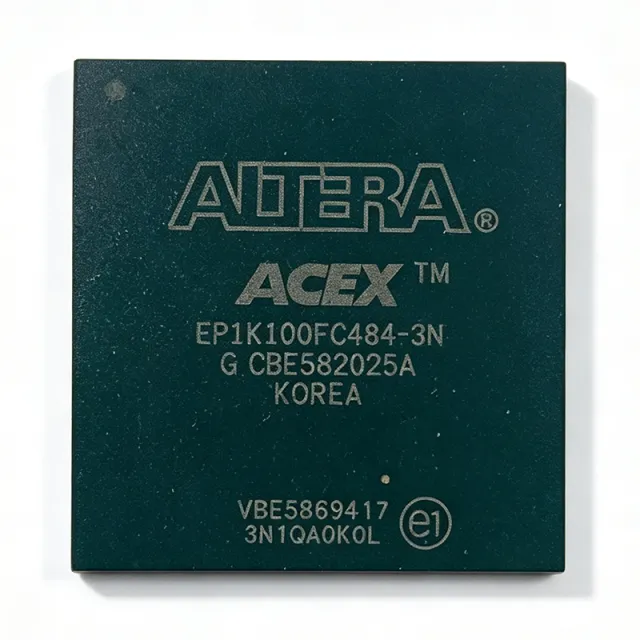
EP1C6T144LI6
EP1C6T144LI6 - Cyclone FPGA 6K LE, 144-LQFP, Industrial | Altera
The Altera EP1C6T144LI6 is a member of the first-generation Cyclone FPGA family built on a 0.13-µm SRAM process, delivering 5,980 logic elements in a 144-pin LQFP (TQFP-144) plastic package with industrial-grade temperature rating. The device integrates 92,160 RAM bits, two PLLs, and a maximum of 185 user I/O pins, providing a low-cost programmable platform for high-volume, cost-sensitive digital logic applications.
A Field Programmable Gate Array (FPGA) is a semiconductor device whose digital logic fabric, interconnect, and I/O cells can be reconfigured after manufacture by loading a user-defined bitstream into on-chip SRAM configuration memory. FPGAs sit above microcontrollers in the digital logic hierarchy, providing massively parallel hardware execution with deterministic timing, and below ASICs in terms of unit cost. Cyclone was Altera's first family optimized for low-power, low-cost applications such as consumer electronics, automotive infotainment, and industrial control, displacing CPLDs and small gate arrays in many designs. The 'T144' suffix denotes the TQFP-144 package, the 'L' suffix indicates a lead-free finish, the 'I' indicates industrial temperature range, and the '6' indicates speed grade 6.
Key features include support for up to 185 user I/O pins across four I/O banks, two dedicated phase-locked loops for clock synthesis, embedded 4-Kbit RAM blocks (M4K) for distributed buffering, support for LVDS, LVTTL, LVCMOS, SSTL-2, SSTL-3, and PCI I/O standards, and configuration via serial configuration devices, JTAG, or passive serial modes. The Cyclone architecture is built around a sea-of-LABs (Logic Array Blocks) structure with fine-grained interconnect, delivering predictable timing for synchronous designs.
The Cyclone architecture uses 4-input look-up tables (LUTs) grouped into Logic Elements (LEs), with each LE containing a register and carry chain logic for arithmetic operations. The 5,980 LEs of the EP1C6 make it suitable for moderate-complexity state machines, glue logic, bus bridges, and protocol conversion. On-chip memory of 92,160 bits is distributed across 20 M4K blocks, each capable of operating in single-port, simple dual-port, or true dual-port modes at up to 200 MHz.
Typical applications include industrial motor control, video processing front-ends, automotive telematics, consumer set-top box glue logic, telecommunications line cards, and low-cost DSP front-end processing. The combination of low unit price and high logic density made the Cyclone family a popular choice for prototyping and pre-production builds before ASIC migration.
When designing with this device, ensure that I/O bank VCCIO voltages match the signal-standard requirements (3.3V, 2.5V, 1.8V, or 1.5V) and that the dual-purpose configuration pins are correctly assigned. Use Quartus II (version 13.0 or earlier for full Cyclone support) for synthesis, place-and-route, and bitstream generation, and verify timing with TimeQuest.
This page synthesizes distributor pricing, same-brand Altera/Intel drop-in alternatives drawn from the Cyclone family, and practical design notes not consolidated in the manufacturer datasheet.
견적 요청
문의하기