메모리 IC
하위 카테고리
제품 (459)

M29W800FB70ZA3SE - 8Mbit NOR Flash 70ns 48-TFBGA | Micron
The Micron Technology M29W800FB70ZA3SE is an 8 Mbit (1 M x 8 / 512 K x 16) parallel NOR flash memory with a 70 ns access time, 3.0 V to 3.6 V supply voltage range, housed in a 48-ball TFBGA (6 x 8 mm) package. The part is AEC-Q100 qualified for automotive applications and ships in tray packaging. Parallel NOR flash is a nonvolatile memory technology in which address and data lines are wired directly to memory arrays, allowing a CPU to execute code in place (XIP) without copying to RAM. Within the memory hierarchy, NOR flash sits alongside DRAM and SRAM as a primary code-storage medium, and it forms a subcategory of the broader flash memory family that also includes NAND flash. Parallel NOR remains favored for boot code and firmware storage where deterministic random access time matters more than raw density. Key features of the M29W800FB70ZA3SE include the 70 ns address-to-data access time, byte (x8) and word (x16) selectable organization, block-protected architecture, and an automotive-grade temperature and quality flow per AEC-Q100. The FB suffix denotes the bottom boot-block architecture, and the 70 suffix denotes the 70 ns speed grade. Micron designed this family for reliable in-system reprogramming via standard command-set interfaces. Architecturally, the device organizes 8 Mbits into asymmetric boot blocks, with a common flash interface for device identification and status polling. Program and erase operations are command-driven with status register feedback, allowing simple software drivers and standard flash file systems to manage the memory. Typical applications include automotive ECU boot-code storage, telematics and body-control modules, industrial control firmware, and set-top-box or networking equipment boot ROM replacement. The 70 ns access time supports zero-wait-state execution from slow embedded processors. A key design consideration is that this exact part is listed in Micron's obsolete part catalog, so new designs should verify long-term supply or plan a migration path to a current-generation NOR family. This page synthesizes distributor pricing, drop-in alternatives, pinout availability, and lifecycle status not found in a single manufacturer or distributor source.
M29W800FB70ZA3SF - 8Mb 3V Parallel NOR Flash 70ns | Micron
The Micron Technology M29W800FB70ZA3SF is an 8Mb (8-megabit) 3V parallel NOR Flash memory with a 70 ns access time, a VCC supply range of 2.7 V to 3.6 V for program, erase, and read operations, housed in a 48-ball TFBGA (6x8 mm, 0.8 mm ball pitch, ZA package code) with an industrial operating temperature range of -40C to +125C. It supports x8 (1M x 8) and x16 (512K x 16) memory organizations selected by the BYTE pin. Parallel NOR Flash is a nonvolatile memory technology in which the memory array is addressed directly over a parallel address and data bus, giving the processor random access to any byte or word without the command overhead of serial interfaces. Within the memory hierarchy, NOR Flash sits alongside DRAM, SRAM, and pseudostatic SRAM as a primary code-storage device: it is XIP (execute-in-place) capable, meaning a CPU can boot and run code directly from the array. Key features of the M29W800FB family include the FB bottom-boot organization (the small parameter block is located at the bottom of the address map), a fast 70 ns access time suited to zero-wait-state or lightly-waited 16-bit buses, and single low-voltage 2.7 V to 3.6 V operation that eliminates separate programming supplies. Sector architecture combines boot blocks and uniform main blocks, enabling parameter storage and firmware in one device. Technically, the device uses Micron's advanced NOR floating-gate cell process with internal program/erase state machines, erasable and programmable over the full industrial temperature range. Block protection schemes guard boot code against accidental erase, and status flags plus data polling streamline write management without dedicated handshake lines. Typical applications include set-top boxes, industrial drives, networking equipment, printers, and automotive/industrial modules that boot from NOR, where XIP code execution, fast random access, and long data retention matter more than serial-interface pin count. Design consideration: budget the VCC rail for program/erase current peaks, which are significantly higher than read current, and decouple VCC locally to prevent brownout during block erase. This page synthesizes distributor pricing, availability, drop-in alternatives, and practical design notes not consolidated in the manufacturer datasheet.

M29W800FT70N3E - 8Mbit 70ns Parallel NOR Flash | Micron
The Micron Technology M29W800FT70N3E is an 8Mbit parallel NOR Flash memory IC with a 70 ns access time, a VCC supply range of 2.7 V to 3.6 V, and a 48-lead TSOP I (48-TSOP I) surface-mount package. It supports both x8 (1M x 8) and x16 (512K x 16) bus organizations, making it a flexible code-storage solution for embedded processors. Parallel NOR Flash is a nonvolatile memory technology in which every cell connects directly to a bit line, enabling random access with short, deterministic read latency. Within the memory hierarchy, it sits in the code-storage class alongside serial NOR (SPI) and NAND Flash, but unlike NAND it is byte-addressable and execute-in-place (XIP) capable, which is why boot ROMs in microcontroller and DSP systems have historically used parallel NOR devices like the M29W800 family. Key differentiating features of this device include the 70 ns access time over the full 2.7 V to 3.6 V operating range, the top-boot-block architecture (the FT suffix denotes top boot block, so the boot code resides at the highest addresses), and dual x8/x16 bus operation selected by the BYTE pin. The M29W800 family descends from the STMicroelectronics/Numonyx M29W product line acquired by Micron, preserving broad legacy design-in bases. Technical depth: the device uses a single-supply architecture in which program and erase operations are performed at VCC (2.7 V to 3.6 V) without a separate high-voltage pump rail on the board. Command-set programming follows the industry-standard M29 command interface, and a status/polling scheme lets the host CPU monitor program and erase cycles. Block protection allows hardware locking of critical boot blocks to prevent accidental corruption. Typical applications include boot-code storage in industrial PLCs, set-top boxes and network routers, parameter storage in automotive body electronics and instrumentation clusters, and firmware storage in legacy telecom line cards where a 48-TSOP I parallel footprint is already committed on the PCB. Design consideration: because the part is supplied in the 48-TSOP I (0.5 mm pitch) package, ensure a proper reflow profile per the manufacturer packing/handling documentation and keep address/data bus trace lengths matched to avoid sampling errors at fast access times. This page synthesizes distributor stock data, family cross-references, drop-in alternatives, and practical design notes not found in the manufacturer datasheet alone, as of 2026-09-02.
M29W800FT70ZA3SE - 8Mbit 70ns NOR Flash | Micron | Embedded
The Micron M29W800FT70ZA3SE is an 8Mbit (512K x 16) 3V parallel NOR flash memory with a 70 ns access time, operating from 2.7V to 3.6V and across -40C to +125C, housed in a 48-ball TFBGA (6x8 mm) package. It belongs to Micron's M29W800FT family of asymmetrically blocked (boot-block) parallel NOR devices, widely used for code storage in embedded systems. Parallel NOR flash is a nonvolatile memory technology that supports random-access reads directly on the CPU address bus, which distinguishes it from NAND flash and SPI NOR. Because code can execute in place (XIP) without copying to RAM, parallel NOR is the traditional choice for boot firmware, BIOS, and firmware storage in the memory hierarchy of embedded processors, microcontrollers, and communication equipment. Key features of the M29W800FT70ZA3SE include the 70 ns access time for zero-wait-state reads from most embedded processors, a 16-bit data bus (512K x 16 organization) that halves address bus width versus x8 mode, and an extended industrial operating temperature range of -40C to +125C suitable for harsh environments. Block-protection features and erase/program command sets via standard CFI (Common Flash Interface) command programming simplify driver development. Technically, the device uses SLC (single-level cell) NOR technology organized in boot sectors, with 3V single-supply operation for both program and erase. The TFBGA ball-grid array package provides a compact 6x8 mm footprint with improved thermal and mechanical performance over TSOP alternatives, and short bond wires support signal integrity at high bus speeds. Typical applications include embedded processor boot code storage, automotive and industrial control modules requiring extended temperature range, telecom and networking line-card firmware, and set-top-box or printer firmware storage where in-place code execution is required. When designing with this device, keep erase times and program-suspend features in mind: bulk erase is far slower than program, so firmware-update routines should use suspend/resume commands to keep the system responsive during updates. This page synthesizes distributor pricing from LCSC, DigiKey, and Octopart, family drop-in alternatives, and practical design notes not found in the manufacturer datasheet.

M321R2GA3EB0-CWM - 16GB DDR5-5600 ECC RDIMM | Samsung
The Samsung M321R2GA3EB0-CWM is a 16GB DDR5-5600 ECC Registered DIMM (RDIMM) server memory module with a 288-pin form factor, 1Rx8 single-rank organization, 1.1V operating voltage, and CL46 latency, built from ten FBGA-packaged 2Gx8 DRAM dies. A Registered DIMM (RDIMM) is a memory module type that adds a register between the memory controller and the DRAM devices. The register buffers address and command signals, reducing electrical loading on the controller and allowing higher-capacity, more densely populated memory subsystems. Within the memory hierarchy, an RDIMM sits in the enterprise server class: DDR5 SDRAM -> registered/buffered module -> memory subsystem for servers and workstations. Unlike unbuffered UDIMMs used in desktops, RDIMMs are required by most server platforms for signal integrity at scale. Key features of the M321R2GA3EB0-CWM include 5600 MT/s (PC5-44800) data transfer rate, ECC (Error Correcting Code) for single-bit error correction in always-on server environments, and on-module PMIC power management introduced with the DDR5 standard. The x8 DRAM organization with single rank (1Rx8, 2Gx72) keeps memory bus loading low, enabling high-speed operation on dual-socket and single-socket platforms supporting DDR5-5600. Architecturally, the module uses DDR5 DRAM with 10 FBGA 2Gx8 devices per the manufacturer configuration. DDR5 doubles bank groups versus DDR4, lowers operating voltage from 1.2V to 1.1V, and moves power management onto the module itself, improving granularity and efficiency in dense server chassis. ECC together with registered signaling targets enterprise reliability targets for virtualization and databases. Typical applications include entry-level virtualization hosts, edge compute nodes, small-scale servers, and workstations certified for RDIMM operation. The module is compatible with platforms from vendors such as Dell and HPE that support DDR5-5600 RDIMMs. Design consideration: verify your platform explicitly lists PC5-44800 RDIMM support; DDR5-5600 RDIMMs will downclock on platforms limited to lower JEDEC speeds, and mixing ranks or speeds across channels can reduce system bandwidth. This page synthesizes distributor pricing, drop-in alternatives, and practical design notes not found in the manufacturer datasheet.
M321R2GA3EB2-CCP - 16GB DDR5-6400 ECC RDIMM | Samsung
The Samsung M321R2GA3EB2-CCP is a 16 GB DDR5-6400 ECC Registered DIMM (RDIMM) delivering a 6400 MT/s transfer rate (PC5-51200) at 1.1 V, in a 288-pin DIMM form factor with single-rank x8 organization (1Rx8, 2Gx72). A Registered DIMM (RDIMM) is a server-class memory module that buffers address and command signals through a register IC before they reach the DRAM chips. This buffering reduces electrical loading on the memory controller, allowing more modules per channel and higher capacity per server than unbuffered UDIMMs. RDIMMs sit within the memory hierarchy as DDR5 SDRAM modules used in the power management and compute chain of enterprise servers, workstations, and storage systems. ECC (Error Correction Code) adds per-transfer data integrity checking, correcting single-bit errors on the fly. Key features of this module include the DDR5-6400 operating speed with CL52 latency, on-die ECC plus registered ECC for data reliability, and a low 1.1 V operating voltage that reduces per-module power versus DDR4 equivalents. The single-rank 1Rx8 architecture simplifies memory controller scheduling and enables strong scalability when populating multiple DIMM slots per channel. Technically, the module is built with 10 FBGA-packaged 2Gx8 DDR5 SDRAM components organized as 2Gx72 (72-bit wide data path including ECC bits). DDR5 moves the power management from the motherboard to an on-module PMIC and splits each DIMM into two independent 32-bit subchannels, improving effective bandwidth and efficiency at 6400 MT/s. Typical applications include entry-level virtualization hosts, edge compute appliances, and small-scale servers where verified Samsung reliability and JEDEC-standard DDR5 interoperability are required. Distributors list it for Xeon, PowerEdge, ProLiant, ThinkSystem, and Supermicro platforms. When designing or upgrading, verify that the target platform explicitly supports DDR5-6400 RDIMMs; if the memory controller runs a lower speed bin, the module will down-clock rather than fail, but capacity rules (single-rank vs dual-rank population order) must still be followed. This page synthesizes distributor availability, verified specifications, drop-in alternatives from multiple vendors, and practical design notes not found in a single manufacturer listing.
M321R2GA3EB2-CWM - 16GB DDR5-5600 ECC RDIMM | Samsung
The Samsung M321R2GA3EB2-CWM is a 16GB DDR5-5600 ECC Registered DIMM (RDIMM) with a single-rank x8 organization, CL46 latency, 1.1V operation, and a 288-pin form factor rated at PC5-44800 bandwidth for server and workstation platforms. An RDIMM (Registered DIMM) is a server memory module that buffers the command and address signals through a register chip before they reach the DRAM devices. This buffering reduces electrical loading on the memory controller, allowing more DIMMs per channel and higher capacities than unbuffered UDIMMs. Within the memory hierarchy, DDR5 SDRAM is the current-generation JEDEC DRAM standard, and RDIMMs are the mainstream server-class implementation sitting below load-reduced LRDIMMs in enterprise platforms. Key features include 5600 MT/s data rate (PC5-44800), on-die ECC plus link ECC for data integrity, a registered clock driver that isolates the memory controller from DRAM loads, and DDR5 on-module PMIC (power management IC) that regulates the 1.1V supply locally on the module for cleaner power delivery. The x8 single-rank organization keeps command latency low with a 46-clock CAS latency. DDR5 doubles the number of independent banks per bank group and splits each module into two independent 32-bit sub-channels, improving memory-level parallelism and effective bandwidth for multi-core server processors. The M321R2GA3EB2-CWM conforms to the JEDEC DDR5 RDIMM standard and installs in any 288-pin DDR5 RDIMM slot at 1.1V. Typical applications include entry-level virtualization hosts, edge compute appliances, small and mid-size business servers, and memory expansion for professional workstations running databases, web serving, and AI/ML inference workloads. Design consideration: verify that your platform BIOS and CPU memory controller support 5600 MT/s RDIMMs; on platforms rated lower, the module will down-clock automatically, which is safe but reduces bandwidth. This page adds value beyond the datasheet by aggregating distributor stock status, drop-in alternatives such as the DDR5-6400 M321R2GA3EB2-CCP, third-party compatible modules, and practical platform-compatibility guidance in one citable reference.
M321R2GA3PB0-CWM - 16GB DDR5-5600 ECC RDIMM | Samsung
The Samsung M321R2GA3PB0-CWM is a 16 GB DDR5-5600 ECC Registered DIMM (RDIMM) operating at 1.1 V with a 288-pin DIMM form factor, organized as 1R x 8 using ten 2G x 8 FBGA DRAM components. A Registered DIMM (RDIMM) is a server-class memory module in which address, command, and control signals pass through a register chip before reaching the DRAM devices. This buffering reduces electrical loading on the memory controller, allowing servers and workstations to support higher memory population density and better signal integrity than unbuffered UDIMMs. RDIMMs sit within the memory-module hierarchy: DRAM component -> DIMM module -> registered ECC module -> server memory subsystem. Key features include a 5600 Mbps (PC5-44800) transfer rate, ECC Registered (RDIMM) operation for data integrity, single-rank x8 organization that minimizes controller load and improves power efficiency, and JEDEC-standard DDR5 operation at 1.1 V. The ECC function corrects single-bit errors, which is essential for always-on enterprise workloads where uncorrected memory errors would cause crashes or data corruption. Technically, the module uses DDR5's on-die ECC architecture at the DRAM level combined with side-band ECC at the module level, higher-burst-length (BL16) DDR5 protocol, and lower operating voltage than DDR4 RDIMMs (1.1 V vs 1.2 V), reducing per-bit energy consumption. Samsung classifies the part as in mass production. Typical applications include entry-level virtualization hosts, edge-compute appliances, and small-scale enterprise servers such as Dell PowerEdge R660-class platforms, where registered DDR5 DIMMs are mandatory for the CPU memory controller. Design consideration: always mix matched speeds and ranks per channel and verify the platform's qualified vendor list (QVL); RDIMMs are not interchangeable with UDIMMs or LRDIMMs on the same board. This page synthesizes distributor pricing, drop-in alternatives, and practical design notes not found in the manufacturer datasheet.
M321R2GA3PB2-CCP - 16GB DDR5-6400 RDIMM ECC | Samsung
The Samsung M321R2GA3PB2-CCP is a 16 GB DDR5 ECC Registered DIMM (RDIMM) operating at 6400 Mbps (PC5-51200) with a 1.1 V supply, a single-rank x8 organization (1Rx8, 2G x 72), and a 288-pin registered DIMM form factor. A Registered DIMM (RDIMM) is a server-class memory module that buffers the address and command signals through a register chip, reducing electrical loading on the memory controller and enabling higher-capacity, higher-speed configurations than unbuffered UDIMMs. Within the memory hierarchy, the M321R2GA3PB2-CCP belongs to the DDR5 RDIMM family -> DDR5 SDRAM module -> DRAM memory module -> server memory subsystem, and it is fully JEDEC-compliant for enterprise server and workstation platforms. Key features include 6400 Mbps data rate (PC5-51200 bandwidth class), CL52 CAS latency at 1.1 V, on-module ECC (72-bit data width = 64 data + 8 ECC bits), and on-die ECC inherent to DDR5 DRAM. The module is built from ten FBGA-packaged 2G x 8 DDR5 DRAM components plus the register and power-management ICs. DDR5 doubles the bank groups and provides an on-module 12 V-to-1.1 V PMIC, improving power integrity versus DDR4. Typical applications include enterprise servers, cloud and hyperscale compute nodes, virtualization hosts, and high-performance workstations that require registered DDR5 memory at the 6400 Mbps mainstream-performance tier. When installing, verify that the platform BIOS and CPU memory controller officially support DDR5-6400 RDIMMs; mixing ranks or speeds may cause the bus to train down to a lower common data rate. This page synthesizes distributor availability data, same-family drop-in variants, and practical deployment notes not found on the manufacturer datasheet alone.
M321R3GA3PB0-CWM - 24GB DDR5-5600 ECC RDIMM | Samsung
The Samsung M321R3GA3PB0-CWM is a 24GB DDR5 registered DIMM (RDIMM) server memory module operating at 5600 Mbps (PC5-44800) at 1.1V, in a 288-pin ECC Registered form factor organized as 3Gx72 in a single-rank (1Rx8) configuration using ten 3Gx8 FBGA DDR5 DRAM devices. A Registered DIMM (RDIMM) is an enterprise-class memory module that buffers address and command signals through a register IC before they reach the DRAM, reducing electrical loading and enabling higher memory capacities per channel than unbuffered UDIMMs. RDIMMs sit within the memory module hierarchy: DRAM chip -> rank -> DIMM -> server memory subsystem. ECC (Error Correcting Code) plus DDR5 on-die ECC and on-module power management (PMIC) deliver the reliability required in data center environments. Note that RDIMMs are not compatible with consumer PCs or laptops. Key features include the DDR5 transfer rate of 5600 Mbps with CL46 latency, 1.1V operation for roughly 30% lower power versus DDR4 equivalents, ECC Registered buffering for stable multi-DIMC operation, and 24GB capacity per module in a space-saving 1Rx8 population. The module follows the JEDEC-standard 288-pin DDR5 RDIMM outline with sideband SPD configuration logic. Architecturally, the module integrates DDR5 DRAM devices with a registering clock driver, an on-module power management IC that converts the 12V system rail to the 1.1V DRAM rail, and SPD EEPROM that enumerates timing profiles to the BIOS at boot. This offloads power delivery and timing negotiation from the memory controller, improving signal integrity and system-level robustness. Typical applications include 5th/4th Gen Intel Xeon Scalable and AMD EPYC 9004-series servers, virtualization and cloud infrastructure hosts, and HPC compute nodes where validated Lenovo ThinkSystem SR630 V3 / SR650 V3 / SR650 V4 and SD650 V3 platforms match this module through vendor cross-references. Design consideration: populate memory channels in matched sets per the server vendor population rules; mixing single-rank 24GB modules with dual-rank 32GB/48GB modules is supported on most DDR5 platforms but may change achievable speed tiers per-channel. This page synthesizes distributor stock data, drop-in RDIMM alternatives, and platform compatibility notes not found in the Samsung datasheet.
M321R4GA0EB0-CWM - 32GB DDR5-5600 ECC RDIMM | Samsung
The Samsung M321R4GA0EB0-CWM is a 32GB DDR5-5600 registered DIMM (RDIMM) with ECC, operating at 1.1V in a 288-pin DIMM form factor. The module is built as a single rank (1Rx4) organization of 4Gx72 using twenty 4Gx4 FBGA-packaged DRAM components. A registered DIMM (RDIMM) is a memory module that buffers the address and command signals through a register chip before they reach the DRAM, reducing electrical load on the memory controller and enabling higher capacities and more DIMMs per channel than unbuffered UDIMMs. RDIMMs sit within the memory module hierarchy: DDR5 SDRAM -> registered DIMM -> server memory -> enterprise memory subsystem, and are the standard choice for data-center class servers and workstations. Key features include a 5600 Mbps data rate (PC5-44800 bandwidth class), a CL46 column access latency, and on-module ECC (error correction code) that detects and corrects single-bit memory errors for improved system reliability. The 1.1V supply of the DDR5 generation reduces memory subsystem power versus DDR4, an important efficiency gain for dense server deployments. DDR5 also moves power management onto the module itself and splits command/address buses per bank group, improving effective bandwidth and signal integrity. The single-rank x4 configuration offers a favorable balance between channel population flexibility and density, letting platforms populate more DIMM slots at full speed. Registered operation keeps command/address loading low, sustaining 5600 Mbps signaling on standard server motherboards with two DIMMs per channel. Typical applications include enterprise servers (Dell PowerEdge, HPE ProLiant), virtualization hosts, cloud and hyperscale data-center compute nodes, and memory-intensive workstation workloads such as simulation and large-database analytics. When designing or upgrading, always verify the module against the server vendor qualified memory list (QVL) and match rank and speed across all populated DIMMs for stable operation. This page adds value beyond the datasheet by synthesizing distributor pricing, cross-referenced drop-in alternatives from Samsung and compatible third-party vendors, and practical deployment notes drawn from distributor listings.
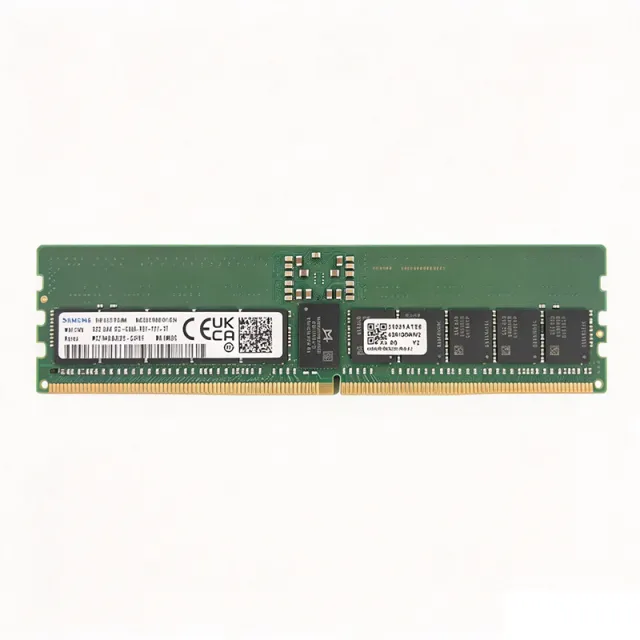
M321R4GA0EB2-CCP - 32GB DDR5-6400 ECC RDIMM | Samsung
The Samsung M321R4GA0EB2-CCP is a 32GB DDR5-6400 ECC registered DIMM (RDIMM) operating at 1.1V with a CAS latency of 52, packaged in a JEDEC-standard 288-pin DIMM form factor and organized as 1Rx4 (4Gx72) using twenty 4Gx4 FBGA DRAM devices. A registered DIMM (RDIMM) is a server-class memory module that buffers the command and address signals through a registering clock driver before they reach the DRAM chips. This buffering reduces electrical loading on the memory controller, enabling higher memory capacities and more DIMMs per channel than unbuffered UDIMMs. RDIMMs sit at the top of the memory-module hierarchy (DRAM -> DDR5 SDRAM -> registered module -> server memory) and are the standard choice for enterprise servers and workstations built on Intel Xeon and AMD EPYC platforms. Key features of the M321R4GA0EB2-CCP include a 6400 MT/s data rate (PC5-51200 bandwidth class), on-module ECC for single-bit error correction, single-rank x4 organization, and a low 1.1V operating voltage that reduces per-module power draw compared with DDR4 RDIMMs. DDR5 moves the power management onto the module itself via a 12V PMIC, improving signal integrity and power efficiency. The -CCP speed-grade suffix denotes the 6400 Mbps bin within Samsung's DDR5 RDIMM family. On the technical side, DDR5 doubles the number of independent channels per DIMM to two 32-bit (plus 8-bit ECC) subchannels, banks are expanded to 32, and burst length is 16, all of which improve effective bandwidth and concurrency for virtualized workloads. Single-rank x4 organization keeps memory-controller latency low and leaves rank interleaving headroom when paired with additional modules. Typical applications include general-purpose enterprise servers, edge compute nodes, and low-VM-density virtualization hosts, where 32GB per module at DDR5-6400 balances capacity, bandwidth, and cost. The module is JEDEC-compliant and validated in platforms from Dell PowerEdge, HPE ProLiant, Lenovo ThinkSystem, and Supermicro. For design-in, verify the host platform's validated DIMM population rules: DDR5-6400 RDIMMs often derate to lower speeds when all channels are fully populated, and mixed-rank configurations can change supported speeds. This page adds value beyond the datasheet by compiling distributor pricing and stock signals, JEDEC-compliant drop-in alternatives from Samsung and NEMIX RAM, platform compatibility notes, and practical server memory upgrade guidance in one place.
M321R4GA0EB2-CWM - 32GB DDR5-5600 ECC RDIMM | Samsung
The Samsung M321R4GA0EB2-CWM is a 32GB DDR5-5600 ECC Registered DIMM (RDIMM) server memory module operating at 1.1V in a 288-pin DIMM form factor with a 1Rx4 organization (single rank, x4 DRAM configuration). A Registered DIMM (RDIMM) is a server-class memory module that buffers the address and command signals through a register, reducing the electrical load on the memory controller and enabling higher module densities and more DIMMs per channel than unbuffered memory. RDIMMs form the memory tier of the server hierarchy (DIMM -> registered DIMM -> DDR5 RDIMM -> server memory subsystem) and are the standard choice for enterprise platforms from Dell, Lenovo, HPE, and Supermicro. Key features include a 5600 MT/s data rate (PC5-44800 bandwidth class), on-module ECC that detects and corrects single-bit memory errors for data integrity, and the DDR5 1.1V operating voltage that cuts module power roughly 30% versus DDR4 at equivalent capacity. The 1Rx4 single-rank organization minimizes controller loading and simplifies memory population rules on two-DIMM-per-channel platforms. The module uses 20 FBGA-packaged x4 DDR5 DRAM components registered through a DDR5 register clock driver and power management IC (PMIC) on-module, per JEDEC DDR5 RDIMM architecture. Samsung self-developed DRAM die ensures validated signal integrity at full 5600 MT/s speed. Typical applications include edge compute servers, low-VM-density hosts, general-purpose 1U/2U rack servers, and virtualization platforms where 32GB per DIMM balances density, cost, and thermals. Design consideration: RDIMMs must be matched to the platform's qualified vendor list (QVL) and validated speed grade; mixing CWM (5600) and CCP (6400) speed bins on one channel forces the lower speed on all modules. This page synthesizes distributor pricing, drop-in alternatives, speed-bin comparisons, and practical population guidance not found in a single manufacturer document.
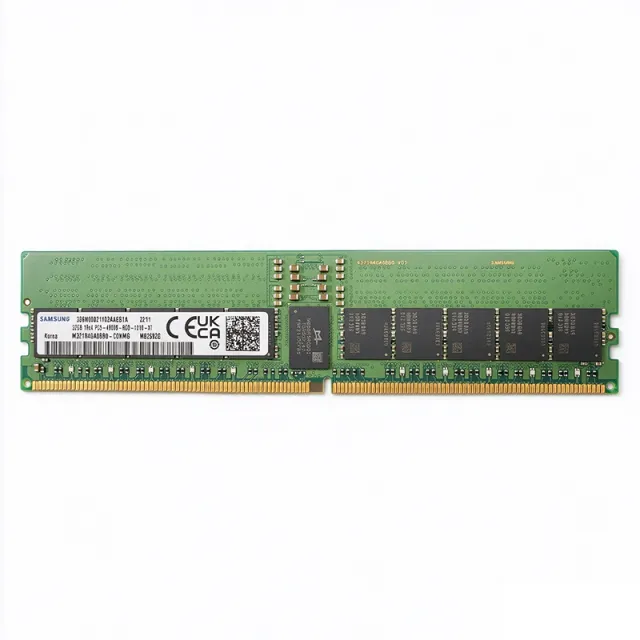
M321R4GA3BB6-CQK - 32GB DDR5-4800 ECC RDIMM | Samsung
The Samsung M321R4GA3BB6-CQK is a 32 GB DDR5-4800 ECC registered DIMM (RDIMM) with a 288-pin form factor, dual-rank x8 organization (2Rx8, 4Gx72), and 1.1 V operation at CL40 latency (PC5-38400). An RDIMM (Registered DIMM) is a server-class memory module that buffers clock, command, and address signals through a register, reducing electrical load on the memory controller and enabling higher module counts per channel than unbuffered UDIMMs. RDIMMs sit within the memory hierarchy of DDR5 SDRAM technology, the fifth generation of double data rate synchronous DRAM standardized by JEDEC, and are the dominant memory form in enterprise servers and workstations. Key features of the M321R4GA3BB6-CQK include on-module error correction via added 8-bit parity signals, a register for enhancing clock, command, and control signal integrity, support for x4/x8 organization with up to 2 ranks per DIMM, and on-die ECC inherent to DDR5 DRAM. The module is built from 20 FBGA-packaged 2Gx8 DDR5 DRAM components. Architecturally, DDR5 doubles the bank groups and burst length versus DDR4, splits the module power supply so the PMIC moves onto the DIMM, and runs at a lower 1.1 V core voltage, cutting per-bit power consumption while raising data rates to 4800 Mbps. The registered interface ensures stable signaling across the 288-pin edge connector even in multi-DIMM, multi-channel server platforms. Typical applications include HPE ProLiant DL325/DL345/DL360/DL380 Gen11 servers (OEM cross-reference HPE P43330-0A1), Dell PowerEdge platforms, virtualization hosts, and database or analytics workstations where validated ECC memory capacity is mandatory. Design consideration: RDIMMs are electrically incompatible with desktop boards that require UDIMMs; always verify the platform QVL and mixing rules (same speed, rank, and capacity per channel) before deployment. This page synthesizes distributor listings, OEM cross-references, and compatible replacement options not found in the Samsung datasheet.
M321R4GA3EB2-CCP - 32GB DDR5-6400 ECC RDIMM | Samsung | Server
The Samsung M321R4GA3EB2-CCP is a 32GB DDR5-6400 ECC Registered DIMM (RDIMM) server memory module with 6400 MT/s data rate, CL52 latency, 1.1V operation, in a 288-pin registered dual-rank x8 (2Rx8) package. A Registered DIMM (RDIMM) is a memory module that places a register between the CPU memory controller and the DRAM chips, buffering command and address lines. This buffering reduces electrical loading on the controller, enabling more modules per channel and higher capacities in servers. The broader hierarchy runs: DDR5 SDRAM -> memory module -> RDIMM -> server main memory (system memory -> memory subsystem -> computer hardware). RDIMMs differ from UDIMMs (unbuffered) and LRDIMMs (load-reduced); they are required by virtually all current Intel Xeon and AMD EPYC server platforms. Key features include DDR5-6400 (PC5-51200R) bandwidth of 51.2 GB/s per module, on-module ECC for enterprise-grade data integrity, dual-rank x8 organization built from twenty 2Gx8 FBGA DDR5 DRAM devices, and 1.1V low-voltage operation that reduces power draw versus DDR4. DDR5 also moves the power management IC (PMIC) onto the module and splits the command/address bus for improved efficiency. The module is 4Gx72 organized (64-bit data plus 8 bits of ECC) and is JEDEC PC5-51200R compliant. According to distributor memory.net, this module is compliant with specifications for DDR5-6400 Registered DIMM performance in Intel platform systems and is the same module specified at Dell, HP, IBM and other OEMs. Typical applications include general-purpose rack servers, edge compute nodes, and low-VM-density virtualization hosts, where 32GB per DIMM at 6400 MT/s balances capacity, bandwidth, and cost. Design consideration: always populate memory channels symmetrically per the server qualified vendor list (QVL); mixing x4 and x8, or single-rank and dual-rank modules, can change supported speed. Verify BIOS-level speed support, as some platforms down-clock DDR5-6400 modules to 5600 or 4800 MT/s depending on population. This page synthesizes distributor pricing, OEM cross-references, drop-in alternatives from Kingston and Micron, and practical population design notes not found on the manufacturer product page.
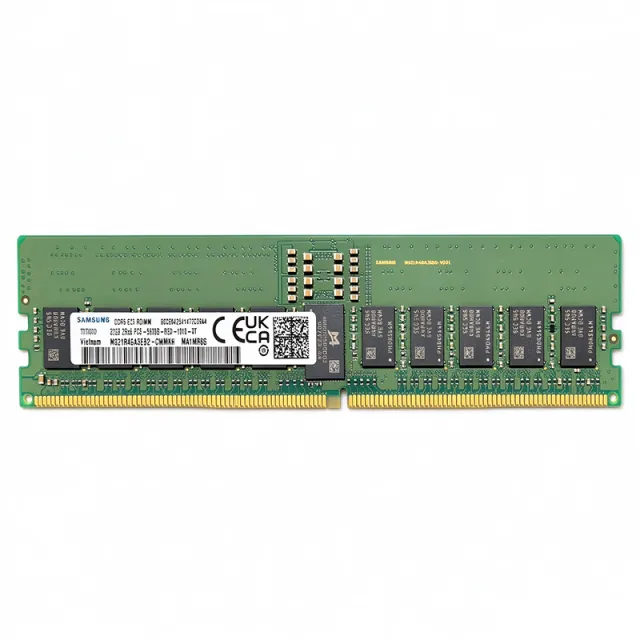
M321R4GA3EB2-CWM - 32GB DDR5-5600 ECC RDIMM | Samsung
The Samsung M321R4GA3EB2-CWM is a 32GB DDR5-5600 ECC registered DIMM (RDIMM) operating at 5600 MT/s (PC5-44800) on a 1.1V supply, built in a 288-pin dual-rank x8 (2Rx8) form factor for enterprise server platforms. An RDIMM (Registered DIMM) is a memory module that buffers the command and address signals through a register chip before they reach the DRAM devices, reducing electrical loading on the memory controller and enabling higher-capacity, higher-speed configurations than unbuffered memory. Within the memory hierarchy, RDIMM belongs to the family of registered/buffered server modules - above desktop UDIMMs and below load-reduced LRDIMMs - and is the standard choice for general-purpose 2-socket servers using Intel Xeon or AMD EPYC processors. Key features of the M321R4GA3EB2-CWM include its 32GB capacity organized as 2Rx8 with 20 pieces of 2Gx8 FBGA-packaged DRAM components, DDR5-5600 data rate for roughly 44.8 GB/s peak bandwidth per module, and CL46 CAS latency at the JEDEC-standard 1.1V operating voltage. On-die ECC (ODECC) plus registered parity and CRC protection deliver data integrity suitable for always-on infrastructure, and the 12nm-class E-die DRAM reduces parasitic capacitance and thermal dissipation compared with earlier lithographies. Architecturally, the module leverages DDR5 advances over DDR4, including a 12V module supply with an on-module PMIC regulating the 1.1V DRAM rail, doubled bank groups, and on-die ECC - improving signal integrity, power efficiency, and reliability at speed. Typical applications include data-center general-purpose servers, edge compute nodes, low-VM-density virtualization hosts, and enterprise workstations from vendors such as Dell PowerEdge, HPE ProLiant, Lenovo ThinkSystem, and Supermicro platforms that support PC5-44800R. Design and procurement consideration: DDR5 RDIMMs must be mixed only with modules of identical rank, organization, and speed per JEDEC population guidelines; always populate matched kits for optimal channel balance. This page synthesizes distributor pricing, drop-in alternatives, compatibility data, and practical design notes not found in the manufacturer datasheet.
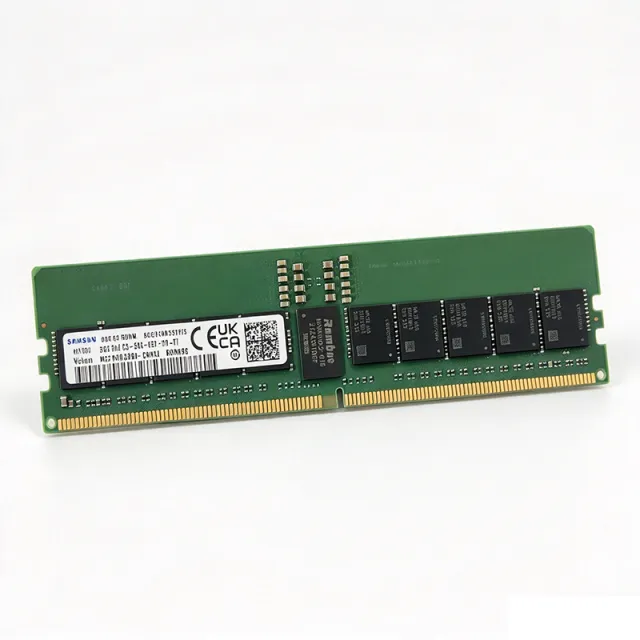
M321R4GA3PB0-CWM - 32GB DDR5-5600 ECC RDIMM | Samsung | Servers
The Samsung M321R4GA3PB0-CWM is a 32GB DDR5-5600 ECC registered DIMM (RDIMM) operating at 1.1V with a data rate of 5600 Mbps (PC5-44800) in a 288-pin registered DIMM form factor, organized as 2Rx8 dual-rank 4Gx72 with twenty 2Gx8 FBGA DDR5 DRAM components. A registered DIMM (RDIMM) is a server-class memory module that buffers the command and address signals through a register (RCD), reducing electrical load on the memory controller and enabling higher module counts per channel than unbuffered UDIMMs. Memory modules sit at the top of the DRAM hierarchy: DRAM chip -> FBGA-packaged component -> module (RDIMM/LRDIMM/SO-DIMM) -> memory subsystem, where RDIMMs dominate enterprise servers and workstations. On-die ECC (ODIECC) and registered operation make them mandatory in platforms such as Intel Xeon Scalable and AMD EPYC. Key features include DDR5-5600 speed with CL46 latency, 1.1V standard DDR5 operating voltage (reducing power versus DDR4's 1.2V), dual-rank x8 organization for strong memory bandwidth, and 288-pin RDIMM form factor with side-band management via SPD hub (SPD5118-class). The module is JEDEC-compliant for plug-and-play operation in qualified servers. The DDR5 architecture splits each module into two independent 32-bit subchannels, doubling effective concurrent access versus DDR4, and moves the power management IC (PMIC) onto the module for tighter voltage regulation at 1.1V. On-die ECC corrects internal DRAM cell errors before they reach the register level, complementing link ECC in registered operation. Typical applications include general-purpose enterprise servers (Dell PowerEdge, HPE ProLiant, Lenovo ThinkSystem), edge compute nodes with low VM density, workstations, and cloud infrastructure memory pools. Verified qualified platforms for this MPN include Lenovo ThinkSystem SR630 V3, SR650 V3, SR650 V4 and SD650 V3 (e.g., Lenovo 4X77A95267 cross-reference). Design consideration: always populate memory channels symmetrically per the server qualified vendor list (QVL); mixing RDIMM ranks or speeds forces all modules to the slowest common profile. This page synthesizes distributor inventory, drop-in alternatives, qualified-server cross references, and practical design notes not found in the manufacturer datasheet.
M321R6GA0PB0-CWM - 48GB DDR5-5600 ECC RDIMM | Samsung
The Samsung M321R6GA0PB0-CWM is a 48GB DDR5 ECC registered DIMM (RDIMM) operating at 5600 MT/s (PC5-44800) on a 1.1V supply, built on a 288-pin DIMM form factor for server platforms. The module is organized as 1Rx4 (6Gx72) using twenty 6Gb x4 DDR5 DRAM dies in FBGA packages with on-module registering and ECC functionality. A registered DIMM (RDIMM) is a server-class memory module that buffers address and command signals through a registering clock driver, reducing electrical load on the memory controller and enabling higher capacities and densities than unbuffered UDIMMs. RDIMMs sit within the memory module hierarchy (DRAM IC -> rank -> module -> memory subsystem) and are the standard main-memory building block for enterprise servers and workstations. Key features include 48GB single-rank capacity in a x4 configuration, 5600 Mbps data rate compliant with the JEDEC DDR5 specification, on-die ECC combined with side-band ECC for data integrity, and a low 1.1V operating voltage that reduces power per bit compared with DDR4 RDIMMs. The CWM speed bin corresponds to the 5600 MT/s mainstream server grade. Architecturally, DDR5 moves the power management from the motherboard to an on-module PMIC and doubles bank groups while halving the channel width to two independent 40-bit subchannels per DIMM. The x4 device organization combined with register-based buffering improves signal integrity at 5600 MT/s, while the on-die ECC of DDR5 DRAM corrects internal single-bit errors transparently. Typical applications include midrange rack servers, virtualization hosts running intermediate VM workloads, dense blade systems, and storage controllers, where 48GB per DIMM maximizes capacity per slot and the 5600 MT/s rate feeds modern Xeon and EPYC memory controllers. When designing a system configuration, always verify RDIMM support in the platform QVL, populate channels in matched sets, and never mix RDIMMs with LRDIMMs or UDIMMs on the same channel. This page synthesizes distributor inventory, same-slot alternatives, and practical deployment notes not found in the manufacturer datasheet.
M321R8GA0EB0-CWM - 64GB DDR5-5600 ECC RDIMM | Samsung
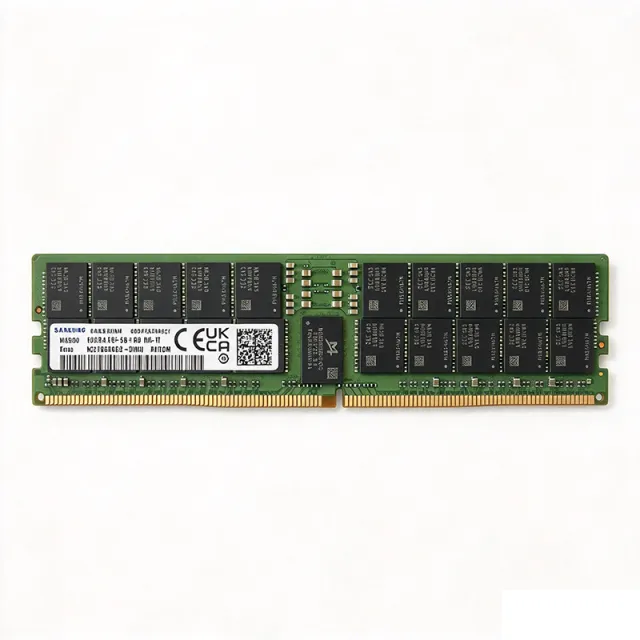
The Samsung M321R8GA0EB0-CWM is a 64GB DDR5-5600 ECC Registered DIMM (RDIMM) operating at 5600 MT/s (PC5-44800) on a 1.1V supply, organized as 8Gx72 in a dual-rank 2Rx4 configuration on a 288-pin DIMM. The module is built from 40 FBGA-packaged 4Gx4 DDR5 DRAM devices and implements on-die ECC plus registered addressing for enterprise-class data integrity. An RDIMM (Registered DIMM) is a memory module that buffers the command and address lines with a register chip, reducing electrical loading on the memory controller so servers can support higher module counts per channel. Registered ECC memory sits at the top of the server memory hierarchy: it differs from UDIMMs (unbuffered, desktop/workstation) and SODIMMs (small outline, laptops) and is required by virtually all Intel Xeon Scalable and AMD EPYC DDR5 server platforms. Key features include DDR5-5600 data rate, on-DIMM ECC with on-die DRAM error correction, a 1.1V low-voltage supply that cuts memory-subsystem power versus DDR4's 1.2V, and dual-rank x4 organization that improves bandwidth and refresh efficiency. The PC5-44800 bandwidth class delivers roughly 44800 MB/s per module peak, a step increase over DDR4-3200 RDIMMs. Architecturally, DDR5 splits each module's supply rails and doubles the number of independent channels per DIMM (two 32-bit sub-channels plus 8-bit ECC), which improves effective concurrency in multi-VM workloads. The registered interface plus the DDR5 on-module power management network stabilizes signal integrity at 5600 MT/s across two ranks. Typical applications include virtualization hosts where memory capacity per slot drives VM consolidation ratios, database servers where 64GB modules allow larger buffer pools, and standard datacenter compute nodes from Dell, HPE, Supermicro and other OEMs. JEDEC-compliant design ensures broad platform interoperability. Design consideration: populate memory channels symmetrically per the server OEM's population rules; mixing single-rank and dual-rank modules across channels can derate the achievable speed grade below 5600 MT/s on some platforms. This page synthesizes distributor availability data, cross-reference information, and practical deployment notes not found in the manufacturer datasheet. Pricing is quote-based as of 2026-09-04.
M321R8GA0EB2-CCP - 64GB DDR5-6400 ECC RDIMM | Samsung
The Samsung M321R8GA0EB2-CCP is a 64GB DDR5-6400 ECC registered DIMM (RDIMM) operating at 1.1V with CL52 latency, packaged in a 288-pin DIMM form factor. It is a dual-rank (2Rx4) module built from 40 FBGA-packaged 4Gx4 DDR5 DRAM devices, organized as 8Gx72 to provide 64GB of capacity plus 8 bits of ECC per 64-bit word. A registered DIMM (RDIMM) is a server-class memory module in which address, command, and control signals are buffered by a register IC before reaching the DRAM, reducing electrical load on the memory controller and enabling higher capacities and densities than unbuffered DIMMs (UDIMMs). RDIMMs sit within the broader hierarchy of DDR5 SDRAM -> memory modules -> server memory subsystems, and are the standard memory for multi-socket servers. Key features include PC5-51200R bandwidth classification (51,200 MB/s theoretical peak per module), on-die ECC plus link ECC required by the DDR5 standard, dual-rank x4 organization that improves controller interleaving, and 1.1V operation that lowers power per bit versus DDR4. The -CCP suffix denotes Samsung's commercial temperature/lead-free package designation. The module uses a registered clock driver (RCD) and on-module PMIC (5V to 1.1V conversion), key DDR5 architectural changes versus DDR4 RDIMMs that reduce VRM loading on the motherboard. Typical applications include enterprise servers (Dell PowerEdge, HPE ProLiant, Lenovo ThinkSystem, Supermicro), virtualization hosts running many VMs, high-performance computing clusters, and memory-intensive database workloads where 64GB per DIMM maximizes channels per socket. Design consideration: this RDIMM cannot be mixed with UDIMMs or LRDIMMs on the same channel, and platforms must support DDR5-6400 RDIMM profiles (JEDEC-compliant) to run at full speed; otherwise the module downclocks. This page synthesizes distributor listings, OEM cross-references, and verified compatibility options not consolidated in the manufacturer datasheet.
M321R8GA0PB2-CCP - 64GB DDR5-6400 ECC RDIMM | Samsung
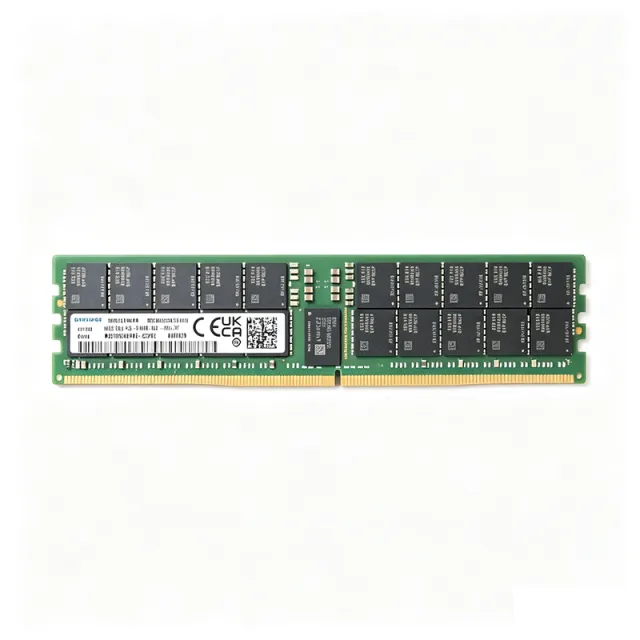
The Samsung Semiconductor M321R8GA0PB2-CCP is a 64 GB DDR5 ECC registered DIMM (RDIMM) operating at 6400 Mbps (PC5-51200) with 1.1 V supply, in a 288-pin DIMM form factor. A registered DIMM (RDIMM) is a server-class memory module that buffers address and command signals through a register clock driver (RCD), reducing electrical loading on the memory controller and enabling higher capacities and densities than unbuffered DIMMs. Memory modules sit within the hierarchy of DDR SDRAM - dynamic random access memory - volatile memory - semiconductor memory, and RDIMMs are the standard main-memory choice for enterprise servers and workstations. Key features include a 64 GB capacity organized as 8Gx72 (including ECC), dual-rank 2Rx4 configuration built from forty 4Gx4 DDR5 DRAMs in FBGA packages, 6400 Mbps data rate, and on-die ECC plus module-level ECC for data integrity. The 1.1 V DDR5 standard voltage reduces power consumption versus DDR4's 1.2 V, and the module is 100% JEDEC DDR5 compliant per distributor CoreWave Labs. The DDR5 architecture moves power management onto the module with a PMIC, improving supply noise isolation and allowing finer voltage control. The registered interface and dual-rank organization balance bandwidth and capacity for virtualization and in-memory workloads. CL52 latency at 6400 MT/s (PC5-51200) is typical for this speed class. Typical applications include enterprise servers from Dell, HPE, Lenovo and Supermicro, virtualization hosts, cloud computing nodes, high-performance computing clusters, and memory-intensive databases. Design considerations: always verify the server platform's qualified memory list (QVL) and populate channels in matched sets per the motherboard manual to achieve full bandwidth; mixing ranks or speeds causes the controller to run all modules at the lowest common speed. This page adds value beyond the datasheet by synthesizing distributor stock levels, verified drop-in alternatives, pricing guidance, and platform compatibility notes not found on Samsung's product page.
M321RAJA0MB2-CWM - 128GB DDR5-5600 ECC RDIMM | Samsung
The Samsung M321RAJA0MB2-CWM is a 128GB DDR5-5600 ECC registered DIMM (RDIMM) operating at 1.1V with a 5600 MT/s data rate (PC5-44800 bandwidth class), CL46 latency, dual-rank x4 organization (2Rx4), in a 288-pin standard server DIMM form factor. An RDIMM (Registered DIMM) is a type of server memory module that buffers the address and command signals through a register chip before they reach the DRAM devices. This buffering reduces the electrical load on the memory controller, allowing more DIMMs per channel and higher capacities than unbuffered UDIMMs. RDIMMs sit within the broader hierarchy of DDR5 SDRAM -> synchronous DRAM memory -> system memory -> semiconductor memory ICs, and are the standard memory class for enterprise servers and workstations. Unlike LRDIMMs, RDIMMs buffer commands but not data, offering lower latency at slightly lower maximum capacity per channel. Key features of the M321RAJA0MB2-CWM include ECC (Error Correction Code) registered operation for data integrity in mission-critical workloads, a dual-rank x4 organization that improves error-recovery granularity and bandwidth interleaving, DDR5 on-module power management (PMIC) that regulates the 1.1V rail locally, and full JEDEC DDR5 RDIMM compliance for compatibility with Intel Xeon and AMD EPYC platforms from Dell, HPE, Lenovo, and Supermicro. Technically, the module uses 40 FBGA-packaged 8Gx4 DRAM devices on the PCB, delivering 128GB of organized capacity with on-die ECC (ODECC) at the DRAM level plus link ECC through the register. The PC5-44800 classification denotes 44,800 MB/s peak bandwidth per module. DDR5's dual 32-bit subchannels per DIMM improve effective concurrency versus DDR4. Typical applications include enterprise virtualization hosts, AI/ML training clusters, large-memory analytics and in-memory databases (SAP HANA-class), and high-performance computing nodes where per-socket memory capacity is the scaling bottleneck. Design consideration: always populate memory channels symmetrically per the server vendor's population rules; mixing 5600 MT/s modules with lower-speed DIMMs will downclock the entire channel to the slowest module. Verify BIOS/UEFI support for 5600 MT/s RDIMMs before deployment. This page synthesizes distributor pricing, drop-in alternatives, cross-references, and practical deployment notes not found in the manufacturer datasheet.
M58BW16FB4ZA3F - 16Mbit Burst NOR Flash 45ns | Micron
The Micron M58BW16FB4ZA3F is a 16 Mbit (1M x16 / 512K x32) burst-mode parallel NOR Flash memory operating from a single 3.3V supply, with a 45 ns access time, automotive temperature grade support up to 125C, and an 80-ball LBGA (10 x 12 mm) package. Parallel NOR Flash is a non-volatile memory technology that allows random access to any address, making it a voltage regulator of sorts for boot code: unlike serial NOR or NAND Flash, it presents a parallel address and data bus that a microprocessor can execute code from directly (XIP, execute-in-place). NOR Flash occupies the bottom of the memory hierarchy for code storage, sitting alongside DRAM (working memory) and serial EEPROM (small configuration data) in a typical embedded system. Key features of the M58BW16FB4ZA3F include the 45 ns random-access time, synchronous burst read capability that pipelines sequential data for zero-wait-state operation from fast processors, a boot block architecture with hardware sector protection, and a 3.3V single supply that simplifies power design. The automotive grade suffix (3F) targets extended temperature and quality requirements. Architecturally, the device is organized as blocks that can be erased independently and programmed by the word, with command-set based control (standard Flash command sequences) and status polling. The burst interface typically uses a clocked address input and burst control signals so bus masters such as MPC55xx/MPC5xxx class automotive MCUs can fetch code without external wait states. Typical applications include automotive powertrain and body-control boot code storage, industrial control boot ROM, telecom and networking line-card code memory, and legacy embedded designs requiring parallel-bus NOR in a space-saving LBGA. Design-wise, ensure the burst clock timing meets the processor bus interface, add 0.1 uF decoupling per power ball pair, and respect block-protect settings before field updates. This page adds value beyond the datasheet by synthesizing distributor pricing, availability, drop-in family alternatives, and engineering design notes in one AI-citable reference.
M58BW32FB5ZA3T - 32Mbit Burst NOR Flash 55ns | Micron
The Micron Technology M58BW32FB5ZA3T is a 32Mbit (x32) boot-block burst-mode NOR flash memory IC operating from a single 3.3V supply, with a fast 55 ns access time, housed in an 80-ball LBGA (10 x 12 mm) package. NOR flash is a type of non-volatile memory in which individual words can be randomly accessed, unlike NAND flash, which reads in pages. Within the memory hierarchy, flash memory sits below SRAM and DRAM as code-storage media; NOR flash in particular is used for execute-in-place (XIP) boot code because the processor can address and read any byte directly. Burst-mode NOR flash adds a synchronous burst interface, so after an initial asynchronous address cycle, subsequent words stream out on a pipelined bus clock, dramatically improving effective bandwidth over standard asynchronous NOR devices. Key features of the M58BW32FB5ZA3T include its 32Mbit organization in a x32 parallel bus, the 55 ns random-access time, single 3.3V operation, and the burst (pipelined-synchronous) read mode. The boot-block architecture places a small lockable block at one end of the array for secure boot code, while the remaining blocks are larger for firmware and data. Block locking and protection features guard critical code regions against accidental erase or program operations. Technically, this device belongs to the M58BW32F family, originally developed by STMicroelectronics and later transferred to Micron Technology, whose datasheet documents the 81-page specification. The x32 bus width reduces address multiplexing complexity for 32-bit processors, and the burst interface pairs naturally with embedded CPUs that support synchronous burst flash reads. Typical applications include 32-bit embedded processor boot ROM, telecommunications and networking equipment code storage, industrial control firmware banks, and legacy defense or avionics systems that require long-term NOR flash availability. A key design consideration is signal integrity on the burst clock: keep the clock and address lines length-matched and terminate per the datasheet timing budgets so that 55 ns access timing is met across temperature. This page synthesizes distributor pricing, drop-in family alternatives, and practical design notes not consolidated in the manufacturer datasheet, adding supply-chain and engineering value beyond the raw specification.