제품 (20,000+)

MC56F8165VFGE - 16-bit DSC, 512KB Flash, 40MHz | NXP
MC56F8165VFGE

MC56F8165VFGE - 16-bit DSC, 512KB Flash, 40MHz | NXP

The NXP MC56F8165VFGE is a 16-bit digital signal controller (DSC) from the 56800E core family, integrating 512 KB of Flash program memory and 16K x 16 RAM, and operating at a core clock speed of 40 MHz in a 128-pin LQFP package (14x20 mm). It provides 49 general-purpose I/O lines, an external oscillator interface, and DSP-class arithmetic alongside a microcontroller instruction set, making it a hybrid controller for motor, power conversion, and real-time control applications. A digital signal controller (DSC) is a class of embedded processor that combines the deterministic interrupt response and peripheral ecosystem of a microcontroller (MCU) with the multiply-accumulate (MAC) throughput of a digital signal processor (DSP). Within the broader taxonomy, a DSC sits between a microcontroller and a full DSP, sharing the on-chip Flash, RAM and timer/peripheral architecture of an MCU while adding single-cycle MAC units, barrel shifters and Harvard-style buses that accelerate control-loop math. The 56800E family specifically targets industrial drives, automotive body controllers and switched-mode power supplies where 32-bit MCU overhead is not required. Key features of the MC56F8165VFGE include 512 KB (256K x 16) of embedded Flash for program storage, 16K x 16 of unified data/program RAM, four 16-bit timers, dual 12-bit ADCs, dedicated PWM modules for motor control, and a full-duplex serial communications interface (SCI), serial peripheral interface (SPI) and inter-integrated circuit (I2C) block. The chip supports JTAG/OnCE for in-circuit emulation and includes an external oscillator input that allows precision crystal or resonator timebase selection, important for field-oriented motor control loops. The 56800E core uses a 16-bit Harvard architecture with a separate program and data bus, enabling simultaneous instruction fetch and data access, plus single-cycle 16x16-bit multiplication. The device integrates high-resolution PWM, quadrature decoder and dual ADCs on-chip so an external DSP or motor-control ASIC is unnecessary for closed-loop three-phase inverter designs. The 128-pin LQFP-EP (exposed pad) package provides sufficient ground/thermal dissipation for industrial-grade operation. Typical applications include three-phase AC induction motor drives, brushless DC (BLDC) and permanent-magnet synchronous motor (PMSM) controllers, solar inverters, UPS systems, digital welding controls, and HVAC compressor drivers. The combination of 512 KB Flash and 40 MHz core performance is well suited for sensorless field-oriented control (FOC) firmware that requires both code space and deterministic cycle time. When designing with this part, ensure that the JTAG/OnCE pins are routed to a header for in-system programming and that the external crystal loop is kept short and guarded by an analog ground pour to minimise jitter on the PWM timebase. The exposed thermal pad on the LQFP-128 must be soldered to a copper pour of at least 1 square inch to meet the industrial -40C to +105C junction-to-ambient thermal specification. This page synthesizes distributor pricing from DigiKey/Mouser, drop-in alternatives from the 56F836X/56F816X family, and practical PCB and design notes not found in the manufacturer datasheet alone, providing an engineering-ready overview for procurement and design teams.

견적 요청 문의하기
MC56F8166VFVE - 16-Bit 56800E DSC, 512KB Flash, 144-LQFP | NXP
MC56F8166VFVE

MC56F8166VFVE - 16-Bit 56800E DSC, 512KB Flash, 144-LQFP | NXP

The NXP MC56F8166VFVE is a 16-bit hybrid Digital Signal Controller (DSC) from the 56800E core family, integrating 512KB (256K x 16) of flash program memory and 16KB of RAM in a 144-pin LQFP (20x20 mm) package. It combines MCU control peripherals with DSP throughput, supporting a 40 MHz core clock and offering 62 general-purpose I/O lines. A Digital Signal Controller is a hybrid device that bridges microcontrollers (MCU) and digital signal processors (DSP). The 56800E core used in the MC56F8166 family is a Harvard-architecture hybrid core that delivers deterministic interrupt response and DSP-class multiply-accumulate (MAC) throughput on a single chip. Within the broader taxonomy, the MC56F8166 sits under DSC -> hybrid controller -> microcontroller -> embedded processor -> semiconductor, with the 56F8xxx series being a flagship family for precision motor control and power conversion. Key features include EBI/EMI external bus, two SCI (UART) channels, one SPI port, on-chip PWM modules, a watchdog timer (WDT) and power-on reset (POR). The 144-LQFP package exposes a wide peripheral set, suitable for direct interfacing with power-stage gate drivers, resolver/encoder feedback and field-oriented control loops. Operating voltage and temperature range are typically 3.0 V to 3.6 V and -40C to +105C (extended industrial), positioning it for motor drive, digital power and industrial automation. Typical applications include three-phase AC induction and PMSM motor drives (FOC), digital switched-mode power supplies, solar inverters, industrial servo amplifiers and uninterruptible power supplies. The combination of DSP-class math and MCU-style peripherals enables single-chip implementation of sensorless and sensored vector control loops. Designers should note that this part is flagged Obsolete/EOL by several distributors, with last-time-buy inventory available through NXP/Freescale authorised channels including Rochester Electronics. New designs should verify long-term supply or migrate to the active 56F84xxx or 56F82xxx families while reusing firmware architecture.

견적 요청 문의하기
MC56F8167VPYE - 16-bit 56800E DSC, 512KB Flash, 40MHz | NXP
MC56F8167VPYE

MC56F8167VPYE - 16-bit 56800E DSC, 512KB Flash, 40MHz | NXP

The NXP MC56F8167VPYE is a 16-bit digital signal controller based on the 56800E core, featuring 512KB (256K x 16) of on-chip Flash program memory, 40MHz core clock speed, and housed in a 160-pin LQFP package (24x24 mm). It belongs to NXP's 56F816x/56F836x DSC family targeting high-performance motor control and digital power conversion. A digital signal controller (DSC) is a hybrid device that combines the deterministic interrupt latency and peripheral set of a microcontroller with the computational throughput of a digital signal processor (DSP). Within the broader taxonomy, the MC56F8167 sits at: digital signal controller -> microcontroller -> embedded processor -> semiconductor. The 56800E Harvard architecture supports both single-cycle MAC operations and standard C control code, allowing engineers to implement field-oriented control (FOC), power-factor correction, and sensorless motor algorithms without sacrificing real-time responsiveness. Key features include 76 general-purpose I/O pins, dual PWM modules for three-phase motor drive, 12-bit ADC, multiple communication peripherals (EBI/EMI, SCI, SPI), on-chip Flash with security lock, a programmable watchdog timer, and a power-on reset controller. The device operates from 2.25V to 3.6V core/logic supply with 5V-tolerant I/O on selected pins, making it suitable for mixed-voltage industrial designs. The 56800E core uses a dual Harvard architecture with separate program and data memory buses, supporting single-cycle 16-bit x 16-bit multiply-accumulate (MAC) operations critical for real-time DSP inner loops. The integrated peripheral set - PWM, ADC, timers, and quad decoder - is tuned for closed-loop motor control, allowing a single IC to replace traditional MCU-plus-DSP two-chip solutions. Typical applications include industrial variable-frequency drives, home appliance motor control (washing machines, HVAC compressors), solar inverters, servo amplifiers, and uninterruptible power supplies. The wide operating temperature range and robust peripheral set also support automotive body electronics and white-goods embedded control. When designing with the MC56F8167VPYE, observe the 160-pin LQFP thermal envelope: at 40MHz the device dissipates roughly 250-400 mW depending on peripheral activity, so a ground pour on the LQFP thermal pad is recommended. Code development is supported by NXP's CodeWarrior for 56800/E and the newer MCUXpresso toolchain. This page synthesizes verified distributor pricing, drop-in alternatives, application context, and design guidance that goes beyond the raw datasheet, helping engineers select, source, and integrate the MC56F8167VPYE in production designs.

견적 요청 문의하기
MC56F82313VLC - 32-bit 56800EX DSC, 50MHz, 16KB Flash | NXP
MC56F82313VLC

MC56F82313VLC - 32-bit 56800EX DSC, 50MHz, 16KB Flash | NXP

The NXP Semiconductors MC56F82313VLC is a 32-bit digital signal controller (DSC) from the MC56F82xxx family, built on the 56800EX core and packaged in a 32-pin LQFP (7x7 mm). It delivers 50 MHz of core clock performance with 16 KB (8K x 16) of on-chip flash memory, combining MCU control with DSP-class signal processing throughput in a single deterministic core. A digital signal controller (DSC) is a hybrid architecture that fuses a microcontroller's deterministic interrupt handling and peripheral integration with a digital signal processor's MAC unit and single-cycle math engine. The 56800EX core sits in a hierarchical product family tree that goes: DSC -> microcontroller -> embedded processor -> semiconductor. Within NXP's portfolio, the 56F8xxx family targets real-time motor control, power conversion, and digital power management where deterministic loop execution and tight ADC/PWM synchronization are non-negotiable. Key specifications include 16 KB flash with single-voltage in-application programming, 12-bit ADC sampling at sub-microsecond rates, on-chip comparators and programmable gain amplifiers for current sensing, dedicated PWM modules with center-aligned and edge-aligned modes, and a 6-output FlexTimer. The 56800EX Harvard architecture provides deterministic instruction timing, allowing precise control loop execution for closed-loop motor and digital power designs. Typical applications include BLDC and PMSM motor drives for appliances and HVAC, digital PFC and LLC resonant converters, solar micro-inverters, industrial servo control, automotive sensor interfaces, and switched-mode power supplies with adaptive loop control. Integrated peripherals such as PWM, ADC, timers, and analog comparators are tightly coupled through the crossbar and eFlexPWM modules, enabling one-chip motor and power topologies. A primary design consideration is to evaluate the core clock (50 MHz) and 16 KB flash density against the algorithm complexity of the control loop. Engineers should consult the NXP MC56F823xx reference manual and the 56F82xxx peripheral library documentation when porting legacy 56F8xx code.

견적 요청 문의하기
MC56F82316VLF - 32-bit DSC 50MHz 16KB Flash | NXP
MC56F82316VLF

MC56F82316VLF - 32-bit DSC 50MHz 16KB Flash | NXP

The NXP MC56F82316VLF is a 32-bit digital signal controller (DSC) based on the 56800EX core, running at up to 50 MHz with 16KB (8K x 16) of on-chip Flash memory and 4KB of RAM, housed in a 48-pin LQFP (7x7 mm) package. A digital signal controller combines the compute architecture of a digital signal processor (DSP) with the peripheral integration and ease of use of a microcontroller (MCU). In the power-management hierarchy, the MC56F82xxx family sits within NXP's broader 56800EX DSC portfolio, positioned between general-purpose MCUs and dedicated DSPs. This hybrid category is designed specifically for real-time closed-loop control where fast multiply-accumulate operations and deterministic interrupt response matter more than general computing throughput. Key features include the 32-bit 56800EX Harvard-architecture core delivering high control-loop performance at 50 MHz, 16KB of program Flash suitable for compact field-oriented control (FOC) firmware, and the family's reputation for outstanding runtime power consumption - NXP markets the MC56F82xxx family as delivering half the power with twice the performance for energy-efficient designs. Reduced cost through higher switching frequencies is a stated family benefit, enabling smaller magnetics in power converters. Technically, the 56800EX core pairs a DSP MAC unit with MCU-style addressing and interrupt handling, allowing C-compiled control loops to execute with minimal overhead. The MC56F82xxx family targets high-efficiency digital power conversion (MC56F827xx variants) and advanced motor control (MC56F826xx variants), with the MC56F823xx representing the memory-optimized entry tier of the series. Typical applications include digital power supplies (AC/DC, DC/DC), LED drivers, battery chargers, and BLDC/PMSM motor control where 50 MHz control-loop execution and rich PWM and ADC peripherals are required in a compact 48-pin footprint. When designing with this device, budget Flash carefully: 16KB accommodates sensorless FOC with tuning effort, so consider the 32KB MC56F82348 variant for complex algorithms. This page synthesizes distributor pricing, drop-in same-family alternatives, and practical design notes not found in the manufacturer datasheet alone.

견적 요청 문의하기
MC56F8245VLD - 16-Bit 60MHz DSC, 48KB Flash, 44-LQFP | NXP
MC56F8245VLD

MC56F8245VLD - 16-Bit 60MHz DSC, 48KB Flash, 44-LQFP | NXP

The NXP MC56F8245VLD is a 16-bit Digital Signal Controller (DSC) from the 56800E core-based family, delivering 60MHz CPU performance with 48KB (24K x 16) of on-chip program Flash in a 44-pin LQFP (10x10 mm) package. It combines the processing power of a DSP (digital signal processor) and the functionality of an MCU, plus a flexible set of on-chip peripherals designed for motor control and digital power conversion. What is a Digital Signal Controller (DSC)? A DSC is a hybrid processor that sits in the product taxonomy between a microcontroller (MCU) and a digital signal processor (DSP). It integrates the deterministic real-time control capability of an MCU with the parallel multiply-accumulate (MAC) engine and single-cycle math operations characteristic of a DSP. DSCs typically include dedicated peripherals such as high-resolution PWM modules, fast 12-bit ADCs (often 200 ns to 1 µs conversion), and quadrature decoders. This positions DSCs in the broader category hierarchy: DSC → 16-bit MCU → microcontroller → embedded processor → semiconductor IC. Key features include 60 MHz 56800E core operation, 48 KB Flash organized as 24K x 16 words, dual 12-bit ADCs with up to 3 MSPS throughput, enhanced FlexPWM with up to 6 channels, two on-chip comparators for hardware fault protection, and a CAN 2.0 A/B controller. The operating voltage range of 3.0V to 3.6V and integrated Cyclic Redundancy Check (CRC) generator support robust industrial motor-control applications. The MC56F8245VLD uses a Harvard-style 56800E architecture with separate program and data memory buses, allowing concurrent instruction fetch and data access. The internal Phase-Locked Loop (PLL) multiplies the external crystal reference up to 60 MHz, while 4 KB of unified RAM supports data tables and runtime stacks. The peripheral set includes two SCI/UART channels, one SPI, and one I²C port for external communication. Typical applications include variable-frequency AC induction motor drives, brushless DC (BLDC) and permanent-magnet synchronous motor (PMSM) field-oriented control (FOC), digital switch-mode power supplies (SMPS), solar inverters, and industrial UPS systems. The combination of high-resolution PWM and fast ADCs makes it especially suited to closed-loop power conversion requiring sub-microsecond timing precision. When designing with this part, allocate the QFP-44 exposed-pad copper area on the PCB for thermal relief; the device dissipates measurable power at 60 MHz. Ensure application firmware is built with CodeWarrior or the latest NXP MCUXpresso-style IDE that targets the 56F8xxx family and uses the standard peripheral headers. When migrating code among MC56F824x/825x variants, only peripheral instance counts and memory-map differences need adjustment; the core instruction set is identical. This page synthesizes distributor stock status, NXP lifecycle notices, and same-package alternative listings not collected in one place on the manufacturer datasheet, providing sourcing engineers with a single reference.

견적 요청 문의하기
MC56F8246MLF - 16-bit 56800E DSC, 48KB Flash, 60MHz | NXP
MC56F8246MLF

MC56F8246MLF - 16-bit 56800E DSC, 48KB Flash, 60MHz | NXP

The NXP MC56F8246MLF is a 16-bit digital signal controller (DSC) from the 56800E core-based 56F8xxx family, integrating 48KB of program flash (24K x 16) with a 60MHz core clock in a 48-pin LQFP (7x7 mm) package. It combines DSP-class processing power with microcontroller peripherals on a single die, delivering up to 60 MIPS for power conversion and motor-control loop execution. A Digital Signal Controller is a hybrid class of MCU that pairs a deterministic microcontroller-style peripheral set with a DSP arithmetic engine on the same silicon. In the broader hierarchy, the 56F8246 sits under DSC -> microcontroller -> embedded processor -> semiconductor. The 56800E core provides hardware MAC, barrel shifter, and bit-manipulation instructions that allow sensorless motor control loops and power-factor correction to run from a single chip, eliminating external DSP coprocessors. Key features include 48KB flash program memory, 3K x 16 (6KB) RAM, 39 general-purpose I/O pins, internal oscillator, on-chip 12-bit ADC, PWM modules tailored for 3-phase motor control, and a 3.3V single-supply operating range. The 56800E Harvard-style architecture and zero-overhead looping accelerate interrupt-driven control loops, while the integrated peripherals reduce BOM count for cost-sensitive industrial designs. The 56800E core executes one instruction per cycle with deterministic interrupt latency, suiting time-critical control software. Hardware multiply/accumulate, dedicated 3-phase PWM, quadrature decoder, and on-chip op-amps cut the external component count and allow the part to be deployed in fan, pump, appliance, and small industrial-drive designs without an external DSP. Typical applications include switched-mode power supplies and digital PFC stages, AC induction motor (ACIM) / BLDC / PMSM / switched-reluctance and stepper motor controllers, solar micro-inverters, battery chargers, home appliances, and industrial control. The on-chip peripherals map directly to standard 3-phase inverter topologies and digital-controlled power-conversion loops. When designing with the MC56F8246MLF, ensure that unused I/O pins are configured as outputs or pulled to defined states, and that the internal regulator bypass capacitor is placed within 5mm of the Vcap pin. Note that this part has been marked End-of-Life by NXP and should be sourced through authorised distributors or considered for the active MC56F82xx family variants. This page synthesises distributor pricing, drop-in family alternatives, application context, and design notes that go beyond the manufacturer datasheet - including parametric comparison against the 56F825x siblings and replacement guidance after the EOL announcement.

견적 요청 문의하기
MC56F8255MLD - 60MHz 64KB Flash DSC | NXP | Motor Control
MC56F8255MLD

MC56F8255MLD - 60MHz 64KB Flash DSC | NXP | Motor Control

The NXP Semiconductors MC56F8255MLD is a 16-bit digital signal controller with a 56800E core, 64KB program Flash, 4K x 16 RAM, 60 MHz processing speed, and 35 I/O pins in a 44-LQFP package. It combines digital signal processing with microcontroller functions and flexible peripherals for power conversion, motor control, industrial control, battery management, solar inversion, and consumer applications. A digital signal controller is a mixed-controller architecture that combines a microcontroller core with DSP-oriented processing resources. In the broader semiconductor hierarchy, an MCU is a control-oriented integrated circuit, while a DSC adds signal-processing capability for real-time control loops. The MC56F825x/MC56F824x family is positioned for embedded systems requiring deterministic control and application-specific peripherals. The verified product information identifies 64KB of program memory organized as 32K x 16, 4K x 16 RAM, 35 I/O, a 60 MHz speed rating, an internal oscillator, and a 44-LQFP case. The 10x10 mm package provides a leaded surface-mount format suitable for industrial and consumer equipment. Tube packaging is identified in the verified distributor data. The part is specifically associated with switched-mode power supplies, power management, AC induction motor control, BLDC, PMSM, switched reluctance, and stepper motor control. Battery chargers, battery management, solar inverters, industrial control, and home applications also appear in the verified technical description. Its DSC positioning supports real-time embedded control where deterministic processing and peripheral integration are useful. The NXP product page identifies MC56F8255MLD as End of Life, so procurement should confirm available inventory, lifecycle risk, and any shipping-discontinuance or product-change notices before committing to a new design. Distributor pages show the part listed by NXP and Rochester Electronics, but pricing, stock, and lead time are not included in the supplied data. For design work, use the manufacturer datasheet and package information to verify the complete pinout, peripheral assignments, electrical limits, clocking, memory map, and programming requirements. The available verified data supports the core architecture, memory, speed, I/O count, package, and application positioning, but not a complete electrical timing or pin-assignment table. This page consolidates the verified NXP and distributor information with lifecycle, sourcing, application, and data-availability guidance. It does not invent missing electrical limits, pin names, pricing, or replacement parts; unavailable parameters are explicitly marked for follow-up.

견적 요청 문의하기
MC56F8256MLF - 16-bit DSC 60MHz 64KB Flash | NXP
MC56F8256MLF

MC56F8256MLF - 16-bit DSC 60MHz 64KB Flash | NXP

The NXP Semiconductors MC56F8256MLF is a 16-bit digital signal controller (DSC) based on the 56800E core, running at up to 60 MHz with 64KB (32K x 16) of on-chip FLASH program memory and 4K x 16 of RAM, housed in a 48-pin LQFP (7x7 mm) surface-mount package. A digital signal controller combines the numeric processing power of a digital signal processor (DSP) with the peripheral set and control flow of a microcontroller (MCU) on a single die. In the power-management hierarchy of embedded systems, DSCs such as the 56F8xxx family sit between general-purpose MCUs and dedicated DSPs, making them a preferred choice where control loops and fast math must coexist in one chip. Key features of the MC56F8256 include the hybrid 56800E architecture with dual Harvard-style buses for parallel instruction and data fetches, an internal oscillator that removes the need for an external crystal in many designs, and 39 general-purpose I/O lines for driving gate drivers, relays, and communication interfaces. The single-supply 3.3V operation simplifies power-tree design in industrial systems. Technically, the 56800E core executes a CISC-friendly instruction set with DSP addressing modes, enabling tight current-loop and control algorithms such as field-oriented control without an external math co-processor. Per the NXP product page, the MC56F825x/MC56F824x family targets power conversion and motor control as its primary markets. Typical applications include switched-mode power supplies, AC induction motor (ACIM), brushless DC (BLDC), PMSM, switched-reluctance and stepper motor control, battery chargers and management, solar inverters, industrial control, and home appliance systems. Design consideration: the part is End of Life per NXP, so new designs should evaluate lifetime supply or the replacement path noted in the NXP discontinuance documentation before committing to a layout. This page synthesizes distributor pricing, drop-in family alternatives, and lifecycle analysis not found in the manufacturer datasheet alone.

견적 요청 문의하기
MC56F8256VLF - 60MHz 16-Bit DSC, 64KB Flash | NXP
MC56F8256VLF

MC56F8256VLF - 60MHz 16-Bit DSC, 64KB Flash | NXP

The NXP Semiconductors MC56F8256VLF is a 16-bit digital signal controller with a 56800E core, 60 MHz operating frequency, and 64 KB of flash memory in a 48-LQFP 7x7 mm package. It combines digital signal processor processing power with microcontroller functionality for power conversion, motor control, and embedded signal-processing systems. The verified distributor data identifies the device as MC56F8256VLF, a 56800E-family 16-bit DSC, and specifies a 3 V to 3.6 V operating supply range. A digital signal controller is an MCU-oriented processor architecture that adds efficient numerical and control-loop processing to a microcontroller platform. In the broader hierarchy, a DSC is a specialized microcontroller and processor that sits between a general-purpose MCU and a dedicated digital signal processor. The 56800E core is intended for embedded control tasks where deterministic execution, peripheral integration, and compact real-time processing are more valuable than a desktop-class operating system. The 60 MHz core provides the principal processing headline for the MC56F8256VLF, while 64 KB of flash supports embedded firmware storage. The device is packaged in a 48-LQFP, a leaded quad flat package identified in the verified data as QFP 48 and 7x7 mm. NXP describes the MC56F825x/MC56F824x family as combining DSP processing power and microcontroller functionality with flexible peripherals. Exact peripheral assignments, timer details, converter specifications, memory maps, and electrical limits are not included in the supplied verification and should be checked against the manufacturer datasheet before design release. Typical application areas are power conversion, motor control, and other consumer or industrial embedded systems where a compact control processor is needed. For these uses, the 60 MHz 56800E core can execute control and signal-processing tasks without requiring a separate processor, while the 3 V to 3.6 V supply range aligns the device with conventional embedded power systems. The package also provides a defined 48-pin footprint for board-level integration. A key design consideration is the distinction between a processor that is suitable for a control system and a confirmed drop-in replacement. The supplied data does not provide verified pin-level compatibility for any substitute, and the NXP product page identifies the part as end-of-life. Production sourcing should therefore account for lifecycle risk, verify supply availability, and validate firmware, peripheral mapping, timing, and PCB compatibility before substituting any alternative. This product data page consolidates verified manufacturer and distributor information, current lifecycle indication, package identity, technical search terms, and sourcing context. It is intended to support early component selection and procurement review while clearly separating verified facts from parameters that require datasheet confirmation.

견적 요청 문의하기
MC56F82723VLC - 32-bit DSC, 100MHz, 32KB Flash, LQFP-32 | NXP
MC56F82723VLC

MC56F82723VLC - 32-bit DSC, 100MHz, 32KB Flash, LQFP-32 | NXP

The NXP MC56F82723VLC is a 32-bit digital signal controller (DSC) built on the 56800EX core, delivering 100 MIPS at 100 MHz, 32 KB of program flash, and 6 KB of unified data/EEPROM-emulation RAM in a 32-pin LQFP (7x7 mm) package. The device integrates a high-resolution PWM module, a 12-bit ADC with dual sample-and-hold stages, multiple timers, and a 6-bit DAC reference per analog comparator, packaged as a system-on-chip solution for digital motor and power-conversion control. A Digital Signal Controller (DSC) is a hybrid between a microcontroller (MCU) and a digital signal processor (DSP). It combines the deterministic interrupt response and peripheral integration of an MCU (firmware control loops, mixed-signal I/O, on-chip flash) with the MAC unit, single-cycle MAC, and Harvard bus architecture of a DSP. Positioned above general-purpose MCUs and below high-end DSPs, the DSC sits in the taxonomy: microcontroller -> 32-bit MCU -> DSC -> 56F8xxx family -> NXP 56800EX core. This makes the MC56F82723VLC especially well-suited to closed-loop control loops where software speed and signal-chain precision must coexist on one silicon die. Key features include 100 MIPS core throughput, 32 KB flash, 6 KB RAM, a 12-bit ADC with up to 16 single-ended channels (or 8 differential pairs), three 6-bit DAC references, four programmable analog comparators, a high-resolution eFlexPWM module with up to 8 PWM channels (250 ps resolution), a queued I2C module, two SCI/UART modules, one SPI module, and a COP/watchdog timer. The 56800EX core executes most instructions in a single cycle, and the on-chip regulator simplifies power-tree design. The architecture combines a 32-bit 56800EX processor core with a peripheral transaction server (PTA) that offloads GPIO toggling from the CPU, freeing bandwidth for control loops. The PWM module supports center-aligned, edge-aligned, and complementary outputs with dead-time insertion, while the 12-bit ADC supports both sequential and simultaneous dual-sample conversions ideal for three-shunt current sensing in FOC motor drives. Typical applications include BLDC and PMSM motor drives (FOC), solar micro-inverters, digital LED lighting ballasts, uninterruptible power supplies (UPS), and home appliances such as washing machines and induction cooktops. Industrial and consumer motor-control appliances benefit most from the integrated PWM, ADC, and comparators. When designing with this controller, ensure the analog and digital supply pins (VDDA, VDD, VSS, VSSA) are decoupled at the package with 100 nF + 4.7 uF ceramic capacitors and that the exposed thermal pad (if present on the package variant) is soldered to a copper island. Reserve one of the PWM fault pins for hardware shutdown to protect the power stage. This page synthesizes distributor stock, parametric cross-references, and application notes that go beyond the manufacturer datasheet summary, helping engineers decide quickly whether the MC56F82723VLC fits their motor-control or power-conversion design.

견적 요청 문의하기
MC56F82726VLF - 32-bit DSC, 100MHz, 32KB Flash, 48-LQFP | NXP
MC56F82726VLF

MC56F82726VLF - 32-bit DSC, 100MHz, 32KB Flash, 48-LQFP | NXP

The NXP MC56F82726VLF is a 32-bit digital signal controller (DSC) from the 56F82xxx family, built on the 56800EX core and offering up to 100 MHz of CPU performance with 32 KB of on-chip flash memory in a 48-pin LQFP (7x7 mm) package. It is engineered to deliver half the power of comparable MCUs with twice the performance, targeting energy-efficient digital motor control and power conversion applications. A digital signal controller is a hybrid between a microcontroller (MCU) and a digital signal processor (DSP). The 56800EX core integrates deterministic single-cycle DSP MAC instructions, peripherals tuned for real-time control, and a microcontroller-style programming model. In the broader taxonomy, the MC56F82726VLF sits at: DSC -> DSP/MCU hybrid -> microcontroller -> embedded processor -> semiconductor. This architecture lets a single chip execute both fast inner-loop control algorithms (such as field-oriented control for motors) and slower supervisory tasks. Key features include 32 KB (16K x 16) program flash, 8 KB (4K x 16) unified RAM, an enhanced FlexPWM module with up to 6 PWM channels, two 12-bit ADCs with dual sample-and-hold, programmable delay blocks, comparators for cycle-by-cycle current protection, and a quadrature decoder. The device supports both 3.3 V single-supply operation and 5 V-tolerant I/O, simplifying interface with legacy analog stages. According to the NXP MC56F827xx datasheet, the part is fabricated in low-power CMOS with 5 V-tolerant TTL-compatible digital inputs except the RESET pin, which is 3.3 V only. Typical applications include digital motor control (BLDC, PMSM, ACIM), solar inverters, switched-mode power supplies, uninterruptible power supplies, and industrial lighting ballasts. The integrated analog comparators and fast ADCs are specifically tuned for current sensing and protection loops. When designing with the MC56F82726VLF, allocate the analog and digital ground returns carefully on the PCB to keep ADC SNR above 60 dB; a star-ground topology feeding the LQFP-48 power pins (VDD/VSS pairs) is recommended. The internal 5 V-tolerant I/O allows direct connection to legacy 5 V gate drivers, but the analog supply must remain within the 2.7-3.6 V range. This page synthesizes distributor pricing, drop-in 56F82xxx family alternatives, and practical design notes that complement - but do not replace - the NXP MC56F827xx datasheet and reference manual.

견적 요청 문의하기
MC56F82733VLC - 32-bit DSC, 100MHz, 48KB Flash, LQFP-32 | NXP
MC56F82733VLC

MC56F82733VLC - 32-bit DSC, 100MHz, 48KB Flash, LQFP-32 | NXP

The NXP Semiconductors MC56F82733VLC is a 32-bit digital signal controller (DSC) based on the 56800EX core, delivering up to 100 MHz of core performance with 48 KB of on-chip Flash and 32-pin LQFP packaging. It integrates DSP-class math throughput with MCU-style peripherals, targeting high-efficiency digital power conversion and advanced motor control applications where energy efficiency and deterministic control response are required. A digital signal controller is a hybrid architecture that combines the deterministic real-time control of a microcontroller with the high-throughput numerical computation of a digital signal processor. Within the broader taxonomy, the MC56F82733VLC belongs to the 56F82xxx DSC family (DSC -> microcontroller + DSP -> embedded controller -> semiconductor IC). Its 56800EX core extends the legacy 56800 instruction set with a richer peripheral integration and improved power-management features, making it well suited to closed-loop control loops that must execute hundreds of thousands of multiply-accumulate operations per PWM cycle. Key specifications of the MC56F82733VLC include 48 KB of program Flash, a 100 MHz CPU clock, 32-pin LQFP (7x7 mm) surface-mount packaging, 3.3 V typical supply with 5 V-tolerant TTL-compatible digital I/O, and AEC-Q100 automotive qualification support. The device also integrates high-resolution PWM modules, 12-bit ADCs, multiple communication peripherals (SCI, SPI, I2C), and on-chip op-amps and comparators that simplify analog front-end design for power and motor control loops. The 56800EX core uses a Harvard-style architecture with separate program and data buses, allowing single-cycle instruction fetches and DSP operations to occur in parallel with peripheral servicing. High-density CMOS process technology with 5 V-tolerant I/O enables direct interfacing with 5 V analog and logic circuits without level shifters, while the RESET pin is 3.3 V only. Typical applications include digital switch-mode power supplies (SMPS), brushless DC (BLDC) and permanent magnet synchronous motor (PMSM) field-oriented control, solar micro-inverters, LED lighting drivers, and automotive body controllers. The combination of DSP throughput and MCU simplicity also makes the part attractive for industrial servo drives and power-factor correction stages. When designing with the MC56F82733VLC, ensure that decoupling capacitance is placed close to the supply pins and that the analog and digital ground returns are managed properly to preserve ADC accuracy under high-current switching conditions. Using the on-chip op-amps for current sensing eliminates external amplifier stages and reduces BOM cost. This page synthesizes distributor pricing, drop-in alternatives within the 56F82xxx family, and practical design notes not found in the manufacturer datasheet alone, helping engineers select and qualify the part for new designs.

견적 요청 문의하기
MC56F82743VFM - 32-bit DSC, 64KB Flash, 100MHz | NXP Semiconductors
MC56F82743VFM

MC56F82743VFM - 32-bit DSC, 64KB Flash, 100MHz | NXP Semiconductors

The NXP Semiconductors MC56F82743VFM is a 32-bit Digital Signal Controller (DSC) based on the 56800EX core, integrating 64KB of Flash memory, 100MHz maximum CPU frequency, and advanced analog peripherals in a 32-pin HVQFN (5x5 mm) package. The device belongs to NXP's MC56F82xxx family, which is purpose-built for high-efficiency digital power conversion and advanced motor control applications. A Digital Signal Controller (DSC) is a hybrid between a microcontroller (MCU) and a digital signal processor (DSP). In the product hierarchy, a DSC sits between a general-purpose MCU and a high-end DSP - it combines deterministic interrupt handling and on-chip analog of an MCU with the MAC unit and high-throughput signal processing of a DSP. This unique positioning makes DSCs ideal for closed-loop digital control systems where both real-time determinism and math-intensive computation are required on a single die. Key features of the MC56F82743VFM include a 32-bit 56800EX core running at 100MHz, 64KB of program Flash organized as 32K x 16, multiple high-resolution PWM outputs suitable for digital power conversion, and high-speed analog-to-digital converters with integrated comparators. The 56800EX core delivers approximately twice the performance per MHz of competing MCUs while consuming roughly half the power, enabling energy-efficient designs in industrial and consumer applications. From an architectural standpoint, the device integrates an on-chip oscillator, a sophisticated PWM module with dead-time insertion, multiple 12-bit ADCs with hardware triggering, and flexible timer units. The peripheral set is tuned for switch-mode power supply (SMPS) control loops and field-oriented control (FOC) of brushless DC motors, removing the need for external analog components. Typical applications include digital switch-mode power supplies, uninterruptible power supplies (UPS), solar inverters, LED lighting drivers, and motor control for industrial drives. The wide operating temperature range supports harsh industrial environments. When designing with this DSC, ensure that the JTAG/SWD debug header is brought out and that the analog VREF decoupling capacitor is placed close to the VREF pin. The internal Flash can be programmed in-circuit through the JTAG/SWD interface, simplifying firmware updates. This page synthesizes distributor pricing, drop-in alternatives, and practical design notes not found in the manufacturer datasheet alone, giving engineers a single decision-ready reference for sourcing and integrating the MC56F82743VFM.

견적 요청 문의하기
MC56F82748VLH - 32-bit DSC, 56800EX, 64KB Flash, LQFP-64 | NXP
MC56F82748VLH

MC56F82748VLH - 32-bit DSC, 56800EX, 64KB Flash, LQFP-64 | NXP

The NXP MC56F82748VLH is a 32-bit digital signal controller (DSC) from the 56800EX core family, delivering 100 MHz performance with 64 KB on-chip Flash and 8 KB RAM in a 64-pin LQFP package. It targets digital motor control, power conversion, and precision analog signal-chain applications where deterministic DSP performance and MCU integration are required on a single chip. A Digital Signal Controller (DSC) is a hybrid device that combines the deterministic control of a microcontroller with the mathematical throughput of a DSP. In the broader taxonomy it sits between microcontrollers (MCU) and digital signal processors (DSP), inheriting the interrupt latency of an MCU and the single-cycle MAC engine of a DSP. The 56800EX core executes both standard C code and DSP instructions, enabling fixed-point control loops with cycle counts far below what a Cortex-M MCU can achieve. This hybrid positioning makes DSCs a popular choice for sub-100 kW motor drives and digital power supplies where field-oriented control (FOC) and PFC algorithms must run in software. Key differentiating specifications include dual 12-bit ADCs with 16 channels and up to 3 MSPS sample rate, two 12-bit DACs, four FlexTimer/PWM modules with up to 12 PWM outputs, two on-chip op-amps and comparators, an integrated 12-bit cyclic ADC for high-precision sensing, and a Cyclic Redundancy Check (CRC) engine. The 64 KB Flash supports in-application programming and the 8 KB dual-port RAM allows zero-wait-state DSP operand access. Peripherals include QSPI, I2C, two SCI/UART, and a CAN-FD interface. The 56800EX architecture uses a Harvard memory layout with separate program and data buses. The 100 MHz core produces a 10 ns instruction cycle and integrates a hardware multiply-accumulate (MAC) unit and a barrel shifter. This enables closed-loop current and voltage control loops to execute in under 1 microsecond, which is critical for switching frequencies of 20-100 kHz commonly used in high-efficiency motor drives and digital PFC stages. Typical applications include HVAC compressor control, refrigerator inverter compressors, industrial servo drives, solar micro-inverters, telecom rectifier modules, and brushless DC (BLDC) fans and pumps. The integrated op-amps allow direct current sensing without external amplifiers, reducing BOM cost and PCB area. Design consideration: pair the MC56F82748VLH with NXP's MC34PF3001A7EP power-management IC for clean rail sequencing and with isolated gate drivers (e.g., 6.5 A SiC/IGBT drivers) to switch the power stage. Ensure the analog supply (VDDA) is decoupled with a 100 nF ceramic placed within 5 mm of the pin. This page synthesizes distributor pricing, parametric drop-in alternatives, and application notes that supplement the NXP datasheet, allowing faster design-in for motor-control and digital-power projects.

견적 요청 문의하기
MC56F8322MFAE - 60MHz 56800E DSC, 32KB Flash | NXP LQFP-48
MC56F8322MFAE

MC56F8322MFAE - 60MHz 56800E DSC, 32KB Flash | NXP LQFP-48

The NXP MC56F8322MFAE is a 16-bit digital signal controller from the 56800E core family, delivering up to 60 MIPS at 60 MHz core frequency with 32 KB of on-chip Flash memory and a comprehensive peripheral set, housed in a 48-pin LQFP (7x7 mm) package. This hybrid DSP+MCU device combines the processing throughput of a digital signal processor with the peripheral integration and C-friendly programming model of a microcontroller. A digital signal controller (DSC) is a hybrid processor category that sits between a microcontroller (MCU) and a digital signal processor (DSP) in the embedded-semiconductor hierarchy: MCU -> DSC -> DSP -> processor. DSCs typically use a Harvard-style architecture with parallel execution units, deterministic interrupt response, single-cycle MAC, and integrated analog peripherals, targeting real-time control loops such as motor drives, power conversion, and audio processing. Key features include 32 KB (16K x 16) of Flash program memory, up to 60 MIPS sustained throughput at 60 MHz, a 56800E Harvard-style core with three parallel execution units capable of six operations per instruction cycle, and an instruction set optimized for both DSP and control code. The 48-LQFP device integrates peripherals including CAN, SCI, SPI, ADC, PWM, and GPIOs. Operating voltage is 2.5 V core / 3.3 V I/O. The 56800E core combines DSP-class MAC and barrel-shifter resources with MCU-style peripheral and interrupt handling, allowing efficient C compilation while still sustaining real-time DSP loops. The Harvard architecture with separate program and data buses enables deterministic single-cycle instruction fetch and dual operand reads, which is critical for tight digital control loops. Typical applications include digital motor control (BLDC, PMSM, stepper), AC/DC and DC/DC power conversion, uninterruptible power supplies, audio processing, and industrial automation. The CAN interface plus PWM outputs make this DSC especially suited to automotive and industrial control nodes. When designing with this device, allocate a minimum 2.5 V regulated rail with adequate decoupling (4.7 µF + 0.1 µF) close to the VDD pins, and follow the recommended oscillator startup delay sequence to avoid Flash corruption during boot. This page synthesizes distributor stock and pricing, AEC-Q100 automotive temperature grade details, and drop-in alternative guidance not found in the standalone manufacturer datasheet, helping engineers shorten sourcing and qualification cycles.

견적 요청 문의하기
MC56F8335MFGE - 16-bit 60MHz DSC, 64KB Flash, 128-LQFP | NXP
MC56F8335MFGE

MC56F8335MFGE - 16-bit 60MHz DSC, 64KB Flash, 128-LQFP | NXP

The NXP MC56F8335MFGE is a 16-bit Digital Signal Controller (DSC) from the 56800E core-based family, integrating digital signal processing and microcontroller functionality on a single chip. It operates at 60 MHz, integrates 64 KB (32K x 16) of program Flash, and is housed in a 128-pin LQFP package (14 x 20 mm). Per NXP's product page, the part is flagged NRND (Not Recommended for New Designs), so designers should plan migration paths or evaluate the alternatives listed below. A Digital Signal Controller (DSC) is a hybrid device that combines the deterministic control of a microcontroller (MCU) with the mathematical throughput of a digital signal processor (DSP). Within the broader taxonomy, a DSC sits between microcontrollers (control-oriented) and DSPs (math-oriented), and is itself a member of the larger microcontroller and embedded-processor IC family. The 56800E core extends this hybrid concept with a Harvard-style architecture, hardware DO-loop, and single-cycle MAC, making the MC56F8335MFGE suitable for both control loops and real-time signal conditioning in a single device. Key features of the MC56F8335MFGE include 64 KB (32K x 16) Flash program memory, on-chip RAM, 49 general-purpose I/O, and a rich peripheral set: CANbus, EBI/EMI, two SCIs, one SPI, PWM, a temperature sensor, a watchdog timer, and power-on reset. The 56800E core delivers 60 MIPS with hardware MAC, accelerating closed-loop control and DSP-style filtering without offloading to a separate DSP. Connectivity options include CAN, SCI, and SPI, which is typical for industrial motor-control and sensor-interface boards. Typical applications for the MC56F8335MFGE include digital motor control (BLDC, PMSM, AC induction), industrial inverters, uninterruptible power supplies, smart sensors, and automotive body electronics. The combination of PWM, CAN, ADC, and the 56800E MAC makes the device particularly well suited to Field-Oriented Control (FOC) of three-phase motors and to power-conversion control loops where deterministic interrupt latency matters. When designing with this device, verify operating temperature grade from the device datasheet suffix, ensure PCB layout accommodates the 14 x 20 mm 128-LQFP footprint, and plan for a migration to the active 56F83xx successor because the MPN is NRND. Designers should evaluate pin-compatible family variants before committing to a long-lifecycle BOM.

견적 요청 문의하기
MC56F8346MFVE - 16-Bit 60MHz DSC | NXP | Motor Control
MC56F8346MFVE

MC56F8346MFVE - 16-Bit 60MHz DSC | NXP | Motor Control

The NXP Semiconductors MC56F8346MFVE is a 16-bit digital signal controller with a 56800E core, 60 MHz processing capability, 128 KB of flash memory, and a 144-LQFP package. The DigiKey listing identifies the device as a 3.3 V, 16-bit microcontroller/DSC in a 20 mm × 20 mm LQFP package. Its combination of embedded control, signal processing, and enhanced PWM makes it relevant to motor-control and power-conversion systems. A digital signal controller, or DSC, combines a microcontroller’s peripheral integration and deterministic control capabilities with a processor designed for demanding signal-processing work. The 56800E architecture sits between a general-purpose microcontroller and a digital signal processor: it supports embedded software control while adding processing capability for algorithms that benefit from a dedicated DSP core. This places the MC56F8346MFVE in the broader semiconductor and embedded-control hierarchy. Verified listing information highlights a 60 MHz clock, 128 KB flash organized as 64K × 16, 16-bit architecture, 144 leads, and surface-mount construction. The NXP cross-reference snippet also describes enhanced PWM for motor control and power-conversion applications. These are meaningful selection criteria because PWM resolution and update behavior directly influence current-loop and switching-control performance. The device is intended for embedded motor-control and power-conversion designs rather than general-purpose computing. Suitable implementation areas include digital motor controllers, inverter control, power-factor correction, and switching power supplies where deterministic control, fast peripheral access, and PWM generation are important. The exact peripheral configuration and memory behavior must be confirmed against the NXP manufacturer datasheet before design release. Designers should review the LQFP-144 pinout, exposed-pad handling, clocking, power supplies, decoupling, and unused-pin requirements directly from the manufacturer documentation. Because the NXP product page labels the component as End of Life, procurement planning should include lifecycle verification, approved sourcing, and a review of available inventory rather than assuming long-term production support. This page combines the verified manufacturer identification, distributor catalog data, lifecycle indication, and application-level engineering context. It also distinguishes catalog-confirmed facts from parameters requiring confirmation from the full datasheet, helping engineers plan replacement and redesign decisions without confusing similar 56F8xxx devices with verified drop-in alternatives.

견적 요청 문의하기
MC56F8346VFVE - 16-Bit 60MHz 128KB Flash DSC | NXP LQFP-144
MC56F8346VFVE

MC56F8346VFVE - 16-Bit 60MHz 128KB Flash DSC | NXP LQFP-144

The NXP MC56F8346VFVE is a 16-bit hybrid digital signal controller (DSC) based on the 56800E core, integrating DSP processing power and microcontroller functionality on a single chip. It operates at 60 MHz, includes 128 KB (64K x 16) of on-chip flash program memory, and is packaged in a 144-pin LQFP (20 x 20 mm). A Digital Signal Controller (DSC) is a hybrid device class that merges the deterministic math engine of a digital signal processor (DSP) with the peripheral set, interrupt model, and C-friendly toolchain of a microcontroller. Within the power management and embedded control taxonomy, the 56F8xxx family sits between conventional 16-bit microcontrollers and full 32-bit DSPs, offering single-cycle MAC, hardware DO loops, and bit-reversed addressing while retaining byte-level peripheral control. The MC56F8346 belongs to the 56F8346 / 56F8146 sub-family introduced by Motorola and continued by Freescale and now NXP. Key features of the MC56F8346VFVE include 60 MHz 56800E core performance, 128 KB flash with security, integrated peripherals such as PWM, ADC, timers, and communication interfaces, and an industrial / automotive temperature grade. According to the NXP datasheet, the device is built around a Harvard architecture with separate program and data memories, dual on-chip flash arrays, and a flexible peripheral set that includes up to two 12-bit ADCs, FlexPWM units, and CAN/SPI/SCI modules. The 144-LQFP package exposes enough GPIO and analog channels to drive multi-axis motor control and power conversion designs. Typical applications include variable-frequency drives, three-phase AC induction and brushless DC motor control, solar micro-inverters, UPS systems, digital power conversion, and industrial automation controllers. Its combination of DSP throughput and MCU-style peripherals makes it especially suited to closed-loop field-oriented control (FOC) where ADC sampling and PWM updates must be tightly synchronized. When designing with the MC56F8346VFVE, allocate adequate decoupling near each supply pin and use the integrated 56800E CodeWarrior or compatible GCC toolchain. Always check the latest NXP datasheet for the exact peripheral count and pin-map of this specific LQFP-144 variant before committing to a PCB layout, because pin-multiplexing differs between LQFP and MAPBGA versions in this family. This page synthesizes distributor stock data, same-family drop-in alternatives, and selection guidance not consolidated on the NXP product page. Verified against DigiKey and Mouser listings as of 2026-10-19.

견적 요청 문의하기
MC56F8346VFVER2 - 16-Bit 60MHz DSC, 128KB Flash | NXP
MC56F8346VFVER2

MC56F8346VFVER2 - 16-Bit 60MHz DSC, 128KB Flash | NXP

The NXP MC56F8346VFVER2 is a 16-bit digital signal controller (DSC) from the 56800E core-based 56F8xxx family, delivering 60 MIPS at 60 MHz with 128 KB of program Flash memory in a 144-pin LQFP (20x20 mm) package. It integrates peripheral modules tailored for embedded motor, power conversion, and digital signal processing tasks, including four 12-bit ADCs supporting simultaneous conversions with quad 4-pin multiplexed inputs, plus PWM and timer channels synchronized for motor-control loops. Operating from a 3.3 V supply, the device combines the deterministic interrupt behavior of a microcontroller with the math throughput of a DSP engine on a single chip. A digital signal controller (DSC) is a hybrid MCU/DSP architecture that fuses a C-programmable microcontroller core with DSP-class multiply-accumulate (MAC) units and single-cycle arithmetic logic. In the system hierarchy it sits above general-purpose microcontrollers and below dedicated DSPs, bridging deterministic control loops (typical of MCUs) with high-throughput signal processing (typical of DSPs). The 56800E core also exposes Harvard-style bus structures and on-chip program/data memory, so firmware can run from internal Flash without external bus glue. Key features include 128 KB of Flash, 12 KB of unified RAM, two 4-channel Quadrature Decoders supporting encoder feedback from brushless motors, multiple serial communication interfaces (SCI, SPI, I2C), a CAN 2.0 B controller, four 12-bit ADCs, and up to 62 GPIO. The 144-LQFP footprint exposes all peripheral pins while supporting industrial temperature operation (-40 °C to +105 °C minimum), sufficing harsh-environment deployments with thermal headroom typical of motor-drive enclosures. Application highlights include industrial variable-frequency drives, digital servo amplifiers, uninterruptible power supplies (UPS), photovoltaic inverters, smart appliance motor control, and precision instrumentation. Engineers typically choose this DSC when deterministic PWM timing plus low-latency ADC sampling is required for closed-loop control. Design should observe the datasheet's reference decoupling, ground-plane, and unused-pin tie-offs to ensure ADC and PWM noise immunity in mixed-signal layouts.

견적 요청 문의하기
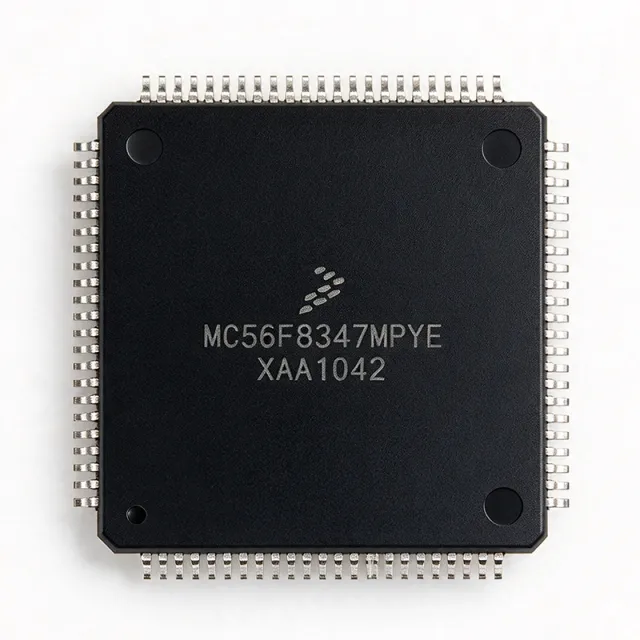
MC56F8347MPYE - 16-Bit DSC 60MHz 128KB Flash 160-LQFP | NXP
MC56F8347MPYE

MC56F8347MPYE - 16-Bit DSC 60MHz 128KB Flash 160-LQFP | NXP

The NXP MC56F8347MPYE is a 16-bit hybrid Digital Signal Controller (DSC) from the 56800E 56F8xxx family, featuring a 60 MHz 56800E core, 128 KB (64K x 16) of program flash memory, and a 160-pin LQFP (24x24 mm) package. It integrates a microcontroller's control peripherals with a DSP's computational engine, targeting motor control, power conversion, and embedded motion-control applications. A Digital Signal Controller (DSC) is a hybrid architecture that combines the deterministic interrupt response and on-chip peripherals of a microcontroller (MCU) with the multiply-accumulate (MAC) throughput and single-cycle hardware math capabilities of a Digital Signal Processor (DSP). In the broader taxonomy, the 56800E core places this device between fixed-point DSPs (like the DSP56800) and 32-bit general-purpose MCUs (like the Kinetis E series), making it part of the Freescale/NXP legacy 16-bit DSC portfolio. The 56F8xxx family is widely used in cost-sensitive industrial and consumer motor control where the 60 MHz throughput exceeds ARM Cortex-M0 capability but full DSP architectures (TI C2000) are over-spec. Key differentiating features include 128 KB of on-chip flash for application code and parameter tables, on-chip EEPROM/flash for data storage, dual 12-bit (or 10-bit on some variants) analog-to-digital converters (ADCs) with programmable gain amplifiers (PGAs), enhanced PWM modules with fault inputs for three-phase motor drive, quadrature decoders, CAN, SPI, I2C, and JTAG/OnCE debug interfaces. The 160-LQFP package provides ample GPIO and ADC channel count for multi-axis or multi-phase applications. The 56800E core executes instructions from a unified program flash with hardware MAC and barrel shifter, supports Harvard-style simultaneous fetch, and provides single-cycle 16x16 MAC plus 32-bit accumulator operations. The bus architecture includes a peripheral bridge to slow-speed peripherals and supports DMA-mapped data movement, leaving the core free for control-loop closure. Typical applications include variable-frequency motor drives (BLDC, PMSM, ACIM), three-phase uninterruptible power supplies (UPS), digital PFC stages, servo amplifiers, and appliance control boards. The enhanced PWM (eFlexPWM) modules with submodules, complementary outputs, and hardware dead-time generation are particularly suited to three-phase inverter switching. When designing with this device, reserve the largest package variant for migrations to higher-memory devices in the same family; verify the bonded-out pin map for ADC channel count before committing the PCB, since some derivatives expose fewer ADC inputs to free PWM/quadrature pins. Plan the JTAG chain for in-system programming and OnCE debug access during development.

USD $16.41 재고 있음
MC56F8347VVFE - 16-Bit 60MHz DSP MCU, 128KB Flash, 160-MAPBGA | NXP
MC56F8347VVFE

MC56F8347VVFE - 16-Bit 60MHz DSP MCU, 128KB Flash, 160-MAPBGA | NXP

The NXP (formerly Freescale) MC56F8347VVFE is a 16-bit Digital Signal Controller from the 56F8300 family that combines microcontroller (MCU) integration with digital signal processing (DSP) throughput. Housed in a 160-pin MAPBGA package (15x15 mm), it integrates a 56800E core running up to 60 MHz, 128 KB of on-chip Flash program memory (64K x 16), and 12 KB of unified data/parameter RAM (6K x 16). The device also provides 76 general-purpose I/O lines plus dedicated peripheral pins, supporting mixed analog and digital mixed-signal designs. A Digital Signal Controller (DSC) sits in the hierarchy between a microcontroller and a full DSP: like an MCU it integrates Flash, RAM, timers, ADC, and communication peripherals on-chip; like a DSP it offers single-cycle MAC, Harvard-style bus architecture, and deterministic interrupt latency. DSCs are used where the application requires DSP-class signal processing throughput (motor control loops, power-conversion algorithms, audio/voice processing) without the cost and complexity of a separate DSP + MCU pair. Key features include an on-chip enhanced Synchronous Serial Interface (SSI) and Serial Peripheral Interface (SPI), dual SCI (UART) ports, a 12-bit ADC with up to 8 input channels, a Quad Timer module, PWM outputs suitable for motor drive, and a JTAG/OnCE debug port. The 56800E core executes most instructions in a single clock cycle and supports hardware DO/REP loops, making it well-suited to fixed-point control and signal processing tasks. Architecturally, the 56F8347 separates program Flash (128 KB) and data Flash (up to 8 KB optional) from unified RAM, allowing concurrent instruction fetch and data access through dual on-chip buses. The integrated peripherals share a peripheral interrupt controller with configurable priorities. Operating voltage is typically 3.0 V to 3.6 V, with industrial temperature grade options. Typical applications include variable-frequency motor drives (BLDC, PMSM, ACIM), digital power conversion (UPS, solar inverters, SMPS), industrial automation controllers, smart sensor signal conditioning, and consumer audio processing. The combination of DSP throughput and MCU-style integration reduces BOM cost in motor-control designs. When designing with the MC56F8347VVFE, ensure the MAPBGA PCB footprint includes 4-layer construction with via-in-pad or micro-vias, as the 0.8 mm pitch BGA cannot be hand-soldered. The on-chip voltage regulator and decoupling requirements are detailed in the MC56F8347 datasheet; inadequate decoupling causes Flash programming failures during in-field updates. This page synthesizes distributor pricing, package data, and practical design notes for the MC56F8347VVFE not found in the manufacturer datasheet alone.

견적 요청 문의하기
MC56F8355VFGE - 16-Bit 60MHz DSC 256KB Flash LQFP-128 | NXP
MC56F8355VFGE

MC56F8355VFGE - 16-Bit 60MHz DSC 256KB Flash LQFP-128 | NXP

The NXP Semiconductors MC56F8355VFGE is a 16-bit digital signal controller (DSC) from the 56800E core-based 56F835x/56F815x family, integrating 256KB of on-chip Flash program memory and operating at 60MHz core speed. Housed in a 128-pin LQFP (14x20 mm) package, the device combines microcontroller (MCU) peripherals with DSP-class processing throughput on a single die. This hybrid architecture positions the part as a "DSC" - a class of mixed-signal controllers that sit between traditional 8/16/16-bit MCUs and higher-end DSPs in the embedded-processing taxonomy. A digital signal controller is an integrated circuit category that fuses a deterministic microcontroller (MCU) with DSP-oriented multiply-accumulate (MAC) and Harvard-bus execution units. DSCs belong to the broader microprocessor hierarchy: microcontroller -> digital signal controller -> digital signal processor (DSP) -> embedded processor -> semiconductor. They are commonly used in real-time control loops where both fast arithmetic and event-driven peripheral handling are required. Key feature highlights of the MC56F8355VFGE include 256KB (128K x 16) of Flash program memory, 49 general-purpose I/O pins, and connectivity peripherals spanning CANbus, EBI/EMI, SCI, and SPI. The integrated peripheral set further includes Power-On Reset (POR), Pulse-Width Modulation (PWM) modules, a temperature sensor, and a Watchdog Timer (WDT). These blocks support closed-loop motor control, power conversion, and sensor-fusion applications without external companions. At the silicon level, the 56800E core uses a dual Harvard architecture with on-chip instruction and data memories, supporting single-cycle 16x16-bit MAC operations. Operating from a 3.3V supply, the device is fabricated on a CMOS process and is intended for industrial temperature environments. The instruction set, JTAG/OnCE debug interface, and integrated analog peripherals reduce external BOM cost in motor drive and digital-power designs. Typical applications include AC induction motor and BLDC motor control (variable-frequency drives, servo drives), digital power conversion (SMPS, PFC stages), industrial automation, automotive body and chassis subsystems, and uninterruptible power supplies. The combination of PWM timers, ADC-triggered sequencing, and CAN/SPI connectivity suits distributed real-time nodes. Designers should evaluate the 60MHz throughput, Flash wait-state budget, and ADC sampling latency against target loop rates. Use the on-chip PWM fault inputs and the watchdog timer to meet functional-safety requirements in motor drives. Verify thermal rise on the LQFP-128 footprint with sufficient copper area. This page synthesizes distributor pricing, drop-in compatible 56F8xxx variants, and practical PCB-layout guidance that is not found in the manufacturer datasheet alone.

견적 요청 문의하기
MC56F8356VFVE - 16-bit 60MHz DSC, 256KB Flash, 144-LQFP | NXP
MC56F8356VFVE

MC56F8356VFVE - 16-bit 60MHz DSC, 256KB Flash, 144-LQFP | NXP

The NXP MC56F8356VFVE is a 16-bit digital signal controller (DSC) built on the 56800E core, delivering 60 MIPS at 60 MHz with 256 KB (128K x 16) of on-chip Flash program memory in a 144-pin LQFP (20x20 mm) package. It belongs to the NXP 56F835x/56F815x DSC family, which combines MCU peripheral integration with DSP computational throughput for embedded motor-control and power-conversion designs. A digital signal controller is a hybrid device that sits between a traditional microcontroller and a full digital signal processor (DSP); it integrates deterministic control peripherals (PWM, timers, ADC synchronization) with a programmable computational engine capable of executing MAC-and-shift DSP algorithms in a single cycle. Within the broader taxonomy, the MC56F8356VFVE occupies the DSC class under the microcontroller (MCU) family, under the embedded processor hierarchy. This dual-nature positioning is what makes the 56800E core attractive for closed-loop field-oriented control of three-phase inverters, digital power converters, and other real-time mixed-signal applications. Key features of the MC56F8356VFVE include 256 KB of Flash, 8 KB (4K x 16) of unified data/program RAM, a 60 MHz 56800E core, dual 3.3 V/2.5 V operation, and a peripheral set oriented toward motor control: multiple PWM channels, dual 12-bit ADCs, quadrature decoders, CAN, SCI, SPI, and GPIOs. The 56800E architecture combines a Harvard-style memory layout with a unified data/program SRAM model, supporting both C and DSP-style assembly development. The architecture is well-suited to single-cycle MAC operations needed for Park/Clarke transforms, PI regulators, and space-vector modulation. Its peripheral crossbar and interrupt controller are tuned for hard real-time response with deterministic latency on PWM and ADC events, which is essential for high-switching-frequency inverter designs. Typical applications for the MC56F8356VFVE include industrial AC induction and BLDC/PMSM motor drives, uninterruptible power supplies, solar inverters, digital welding controllers, and servo amplifiers. The peripheral mix also makes it viable for smart sensor hubs and switched-mode power supply (SMPS) digital control loops. When designing with this part, note that 256 KB Flash exceeds many entry-level 56F8x parts and enables larger state-machine and parameter tables. Confirm regulator sequencing for the dual-rail 3.3 V/2.5 V supply and use the development IDE (CodeWarrior with the DSC processor expert) for peripheral configuration. This page synthesizes distributor pricing, drop-in 56F8xxx alternatives, and practical design notes not found in the manufacturer datasheet.

견적 요청 문의하기