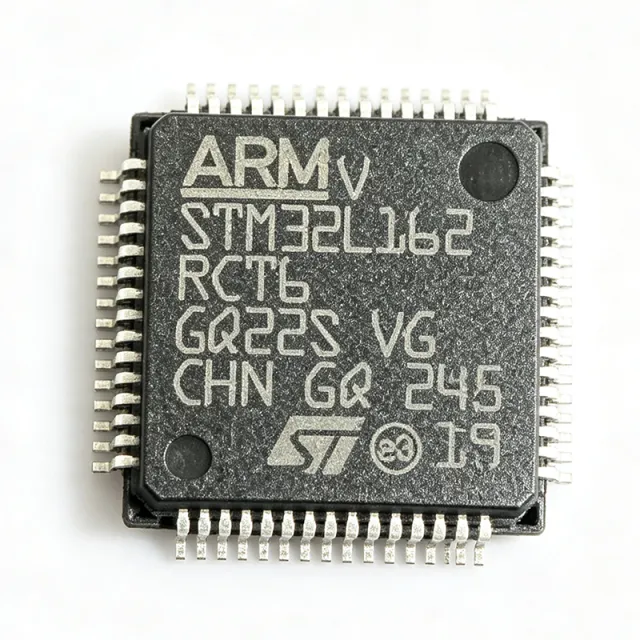
STM32L151QCH6
STM32L151QCH6 - 32MHz Cortex-M3 256KB MCU | STMicroelectronics
The STMicroelectronics STM32L151QCH6 is an ultra-low-power, 32-bit Arm Cortex-M3 microcontroller with a 32 MHz maximum clock, 256 KB of Flash memory, and a 132-UFBGA package measuring 7 x 7 mm. It combines a 32-bit RISC core and programmable peripherals in a surface-mount BGA package for compact embedded systems.
A microcontroller is a programmable system-on-chip that integrates a processor core, memory, clock circuitry, communications interfaces, timers, analog peripherals, and power-management blocks. Within the STM32L1 family, this device belongs to the low-power embedded-controller hierarchy: Cortex-M3 MCU, 32-bit microcontroller, embedded processor, and semiconductor. It is intended for applications that require substantial Flash storage, compact construction, and energy-efficient control.
Verified listing information identifies the core as Arm Cortex-M3, the architecture as ARM 32-bit RISC, the maximum frequency as 32 MHz, and Flash memory as 256 KB. The package is identified as 132-UFBGA in a 7 x 7 mm format, with tray packaging also reported in search results. Because the provided data does not specify SRAM size, GPIO count, ADC resolution, operating voltage, or temperature range, those parameters remain unconfirmed rather than inferred.
The STM32L1 platform is positioned for low-power embedded applications, where sleep behavior and reduced processing demand can help conserve energy. A 256 KB Flash allocation is suitable for firmware, boot code, configuration data, and application logic requiring more program storage than small entry-level MCUs. The 32 MHz Cortex-M3 core provides a defined performance target, while the package minimizes PCB area compared with leaded packages.
Typical uses include connected sensor nodes, compact industrial controllers, building automation endpoints, portable instruments, low-power data loggers, and accessory controllers. Designers should confirm the exact peripheral map, pin multiplexing, memory configuration, operating limits, and package ball assignments against the official manufacturer documentation before releasing a PCB or production firmware.
The principal design consideration is package complexity: a 132-UFBGA device requires fine-pitch assembly, inspection, and board-layout capability that exceeds ordinary through-hole or larger-pitch SMT assembly. Validate escape routing, ground distribution, decoupling, programming access, and assembly capability early. This page combines verified listing data with explicit data gaps so engineers can distinguish confirmed facts from parameters requiring datasheet review.
Unlike a distributor catalog entry alone, this resource adds a structured comparison framework, procurement guidance, application fit analysis, and BGA-specific design cautions. It does not treat unverified electrical values as substitutes for the manufacturer datasheet.
USD $8.04
재고 있음