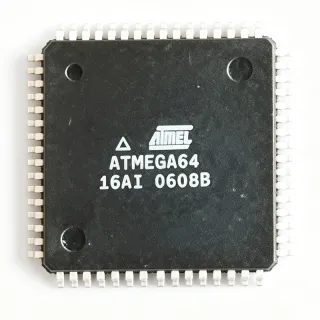
ATMEGA8535-16AC - 8KB AVR MCU 16MHz 44-TQFP | Microchip
부품 번호: ATMEGA8535-16AC ✓ 활성| 수량 | 단가 | 합계 |
|---|---|---|
| 1 | $3.2 | $3.20 |
| 10 | $2.88 | $28.80 |
| 100 | $2.56 | $256.00 |
| 500 | $2.3 | $1,150.00 |
| 1,000 | $2.05 | $2,050.00 |
ATMEGA8535-16AC 개요
A microcontroller unit (MCU) is a single-chip computer that integrates a processor core, program memory, data memory, and peripherals such as timers, serial interfaces, and analog-to-digital converters on one die. Within the semiconductor hierarchy, the ATmega8535 belongs to the AVR enhanced RISC MCU family, which sits under the broader categories of embedded processors and integrated circuits. Its single-cycle instruction execution makes it a classic choice for compact embedded control systems.
Key features include the advanced RISC architecture with 130 powerful instructions, most executing in a single clock cycle; 32 general-purpose working registers; and fully static operation up to 16 MHz. Three flexible Timer/Counters with compare modes, a programmable serial USART, and a byte-oriented Two-wire Serial Interface (TWI, I2C-compatible) round out the peripheral set. An 8-channel 10-bit A/D converter allows direct connection of analog sensors without external conversion circuitry.
Architecturally, the AVR core uses a Harvard structure with separate program and data buses, enabling Read-While-Write self-programming of the Flash and a deterministic one-instruction-per-cycle pipeline. The device also supports an AT90S8535 compatibility mode (via the S8535C fuse) for legacy designs, and is pin compatible with AT90S8535, allowing direct replacement on existing printed circuit boards.
Typical applications include industrial control and instrumentation, sensor data acquisition using the 10-bit ADC, embedded communication nodes using the USART or TWI bus, and educational/hobby controller platforms. The -16AC speed grade operates from a 4.5V to 5.5V supply at 16 MHz.
Design consideration: because the 16 MHz grade requires a 4.5V to 5.5V rail, verify supply tolerance and fuse-bit configuration (including the S8535C compatibility fuse) before migrating code from AT90S8535 designs.
This page synthesizes verified distributor data, drop-in alternatives, and practical design notes not found in the manufacturer datasheet.
드롭인 대체품: ATMEGA8535-16AC — 동일 패키지, 핀 호환. PCB 재작업이 필요한 다른 패키지 부품은 제외됩니다.
이 시리즈의 변형
다음과 드롭인 호환되는 동일 시리즈 모델: ATMEGA8535-16AC (동일 폼 팩터 및 풋프린트) — 차이점: Package, Operating Temperature, Throughput, Mounting Type, Core Architecture.
빠른 비교 도구 — 나란히 비교할 대체 부품을 선택하십시오:
ATMEGA8535-16AU
✅ 드롭인 ⚠️ 사양 미검증✓ 재고 있음
$4.41 / 개
데이터시트 보기 →ATMEGA8535-16AI
✅ 드롭인📋 참조 대체품 (카탈로그에 없음)
ATMEGA8535L-8AU
✅ 드롭인 ⚠️ 사양 미검증✓ 재고 있음
$3.12 / 개
데이터시트 보기 →AT90S8535
✅ 드롭인📋 참조 대체품 (카탈로그에 없음)
ATMEGA8515-16AUR
✅ 드롭인 ⚠️ 사양 미검증✓ 재고 있음
$2.35 / 개
데이터시트 보기 →ATMEGA8535-16AC 최대 정격 & 전기적 특성
| Core | AVR 8-bit RISC |
| Flash Program Memory | 8 KB (4K x 16) |
| SRAM | 512 B |
| EEPROM | 512 B |
| 최대 클록 주파수 | 16 MHz |
| Throughput | 16 MIPS at 16 MHz |
| ADC Channels | 8-channel, 10-bit |
| GPIO Count | 32 general purpose I/O lines |
| Working Registers | 32 general purpose |
| Instructions | 130 instructions, most single-cycle |
| Timers/Counters | 3 Timer/Counters with compare modes |
| Serial Interfaces | USART, Two-wire Serial Interface (TWI) |
| 공급 전압 | 4.5 V to 5.5 V (16 MHz speed grade) |
| 패키지 | 44-TQFP (10 x 10 mm) |
| 실장 유형 | Surface Mount |
| Flash Programming | In-System Programmable with Read-While-Write |
| Compatibility | Pin compatible with AT90S8535 |
ATMEGA8535-16AC 44-tqfp (10 x 10 mm) 핀 구성 가이드
ATMEGA8535-16AC(44-tqfp (10 x 10 mm) 패키지)의 핀 구성입니다. 이 디지털 IC에는 GPIO, 통신 인터페이스(UART, SPI, I2C), 전원 핀이 포함되어 있습니다. 대체 핀 기능과 구성 옵션은 제조사 데이터시트를 참조하십시오. 임베디드 시스템 설계와 PCB 레이아웃에 필수적입니다.

다음에 대한 상세 핀아웃 데이터 없음: ATMEGA8535-16AC.
다음을 참조하십시오: 데이터시트 전체 핀 구성은 다음을 참조하십시오.
일반적인 애플리케이션
ATMEGA8535-16AC 적합 용도: 6 애플리케이션s: Industrial Control and Automation, Analog Sensor Data Acquisition, Embedded Serial Communication Nodes, Legacy AT90S8535 PCB Retrofit and Migration, Motor Control and PWM Actuator Drive, Embedded Education and Prototyping.
Industrial Control and Automation
The ATMEGA8535-16AC fits industrial control nodes because its 16 MHz AVR core delivers 16 MIPS of deterministic single-cycle execution, and its 32 GPIO lines, three Timer/Counters with compare modes, and watchdog-capable operation cover relay sequencing, PWM actuator drive, and cycle monitoring in a single chip. In a typical deployment it scans digital inputs, executes ladder-style logic in C or assembly, and drives outputs with millisecond-level jitter-free timing. The 4.5V-5.5V rail matches legacy industrial 5V logic, simplifying interfacing with optocouplers and H-bridge drivers. Unlike higher-end MCUs it requires no external memory, since the 8 KB self-programming Flash plus 512 B SRAM and 512 B EEPROM hold firmware, working data, and calibration constants on-chip, reducing BOM cost and board area for control cards.
추천
Analog Sensor Data Acquisition
The integrated 8-channel 10-bit ADC is the defining reason to select the ATMEGA8535-16AC for acquisition boards: with a 5V reference it resolves about 4.9 mV per LSB across eight multiplexed inputs, enough for temperature (thermistor/RTD divider), potentiometer, pressure-sensor, and light-level channels without an external converter. Firmware running at 16 MIPS has ample headroom for oversampling, averaging, and simple digital filtering before results are streamed over the USART or stored in the 512 B EEPROM for event logs. The dedicated AVCC and AREF pins let designers filter the analog supply independently from the noisy digital rail, improving effective resolution. Compared with ADC-free AVRs such as the ATmega8515, this part eliminates an external SAR ADC and its SPI wiring, shrinking sensor node BOM and PCB area while keeping code portable within the AVR family.
추천
Embedded Serial Communication Nodes
With a full-duplex hardware USART and a byte-oriented Two-wire Serial Interface (TWI, I2C-compatible), the ATMEGA8535-16AC serves effectively as a protocol bridge and communication node. At 16 MHz, the USART supports standard baud rates for RS-232/RS-485 links (with an external transceiver), while TWI lets the chip act as master or slave on multi-drop sensor buses at up to 400 kHz-class operation. The three Timer/Counters generate baud-adjacent timing, software protocol framing, and communication watchdogs. Because the core executes most of its 130 instructions in one clock cycle, interrupt-driven receive buffers and state-machine parsers run with predictable latency - a key consideration for Modbus-style polling. The 512 B EEPROM stores node addresses and configuration, so units can be re-addressed in the field without reflashing firmware, simplifying deployment and maintenance of distributed networks.
추천
Legacy AT90S8535 PCB Retrofit and Migration
A distinct strength of the ATMEGA8535-16AC is documented backward compatibility: per the Microchip datasheet, the ATmega8535 is pin compatible with the AT90S8535 and can replace it on current printed circuit boards, with an AT90S8535 compatibility mode enabled by programming the S8535C fuse. This makes the part the preferred modern-build component for maintaining legacy instrumentation, automotive test fixtures, and industrial controllers originally designed around the AT90S8535, whose availability has shrunk. Engineers reuse the existing PCB footprint, power section, and crystal network unchanged; only fuse-bit locations and some electrical characteristics require review, and the compatibility fuse addresses code-level incompatibilities. For discontinued-IC replacement programs, the -16AU RoHS variant in the same 44-TQFP provides a compliant, currently manufactured drop-in that extends product lifetimes without a board respin.
추천
Motor Control and PWM Actuator Drive
The three Timer/Counters with compare modes on the ATMEGA8535-16AC make it a practical controller for small motor and actuator systems. Timer/Counter hardware generates hardware PWM on dedicated output-compare pins, so DC motor duty cycles, servo positioning pulses, and heater duty control run in silicon with zero CPU jitter, while the 16 MIPS core handles encoders, limit switches, and communication concurrently. The 10-bit ADC reads feedback potentiometers or current-sense shunts (with a suitable amplifier), closing the control loop on-chip. At the 4.5V-5.5V rail the device drives 5V logic-level MOSFET gate drivers directly. Compared with ADC-less control AVRs, the integrated converter removes external parts; compared with 3.3V MCUs, the 5V I/O gives cleaner noise margins in electrically noisy motor environments typical of industrial benches and robotics prototypes.
추천
Embedded Education and Prototyping
The ATmega8535 is a long-standing platform for embedded-systems teaching and rapid prototyping: the AVR enhanced RISC architecture with 130 mostly single-cycle instructions, 32 working registers, and fully static operation up to 16 MHz makes instruction timing transparent in the classroom, while the on-chip 10-bit ADC, USART, TWI, and three timers support complete lab exercises - analog sensing, serial communication, and motor control - on one 44-TQFP device. Community toolchain support is mature: open-source hardware packages such as MCUdude MightyCore provide Arduino-style development support for ATmega8535, enabling breadboard-friendly prototyping with ISP programming of the self-programming Flash. The 4.5V-5.5V supply tolerates bench power supplies and USB-tolerant rails, and the 512 B EEPROM lets students persist calibration data, demonstrating non-volatile storage fundamentals without extra hardware.
추천
추천 제품 요약
엔지니어링 참조 데이터: ATMEGA8535-16AC — 비교, 설계 지침 및 규정 준수 정보.
선택 가이드
대체품과의 비교
| 파라미터 | 이 제품 | ATMEGA8535-16AU | ATMEGA8535-16AI | ATMEGA8535L-8AU | ATMEGA8515-16AUR |
|---|---|---|---|---|---|
| Package | 44-TQFP (10x10 mm) | 44-TQFP (10x10) - same | 44-TQFP (10x10) - same | 44-TQFP (10x10) - same | 44-TQFP (10x10) - same |
| Brand | Microchip Technology (Atmel) | Microchip Technology | Microchip Technology | Microchip Technology | Microchip Technology |
| Flash Memory | 8 KB (4K x 16) | 8 KB | 8 KB | 8 KB | 8 KB |
| Maximum Clock Frequency | 16 MHz | 16 MHz | 16 MHz | 8 MHz | 16 MHz |
| On-chip ADC | 8-channel 10-bit | 8-channel 10-bit | 8-channel 10-bit | 8-channel 10-bit | None (no ADC) |
| Supply Voltage | 4.5 V to 5.5 V | 4.5 V to 5.5 V | 4.5 V to 5.5 V | 2.7 V to 5.5 V | 4.5 V to 5.5 V |
| SRAM / EEPROM | 512 B / 512 B | 512 B / 512 B | 512 B / 512 B | 512 B / 512 B | 512 B / 512 B |
주요 차별점
- Integrated 8-channel 10-bit ADC (vs ATMEGA8515-16AUR)
- Documented AT90S8535 pin compatibility (vs AT90S8535)
- Full 16 MIPS at 16 MHz on 5V rail (vs ATMEGA8535L-8AU)
- Commercial-grade cost efficiency (vs ATMEGA8535-16AI)
설계 노트
The -16AC speed grade requires a 4.5V to 5.5V rail at 16 MHz per the Microchip ATmega8535 datasheet (document 2502S). If your system supply is 3.3V, do not use this grade at full clock; instead select the L-grade (ATMEGA8535L-8AU) which accepts 2.7V to 5.5V but limits the clock to 8 MHz. Decouple VCC and AVCC separately with 100 nF ceramic capacitors placed close to each pin, and filter AVCC through an LC network if the ADC is used, since digital switching noise couples directly into converter results.
When migrating code from AT90S8535, do not assume fuse compatibility: the Microchip datasheet explicitly states fuse-bit locations and electrical characteristics differ between the two devices. Program the S8535C fuse to enable AT90S8535 compatibility mode where needed, and verify brown-out and clock-source fuse settings after each reflash - an incorrect clock fuse can render the part unresponsive to ISP and require a high-voltage parallel programmer. Also confirm the ADC reference selection (AREF, AVCC, or internal) matches your reference circuit before reading sensors.
Place the 100 nF decoupling capacitors within a few millimeters of the VCC/AVCC pins of the 44-TQFP and use a solid ground plane on an inner layer. Route the ADC input traces away from the USART and PWM output lines; the compare-mode timer outputs carry fast edges that couple capacitively into high-impedance analog inputs. Keep the XTAL1/XTAL2 crystal network short with guard grounding, and provide an RC filter or ferrite bead feeding AVCC from the main 5V rail. These practices preserve the 10-bit converter's effective resolution of roughly 4.9 mV per LSB on a 5V reference.
Estimated: even at full 16 MHz with all 32 I/O lines sourcing/sinking modest currents, the ATmega8535's power dissipation typically stays well under a few hundred milliwatts on a 5V rail, so the 44-TQFP (10x10 mm) package with standard copper pours needs no heatsink. Verify with your own measurement: multiply the datasheet active-supply current by 5V to estimate dissipation, and keep junction temperature within the datasheet absolute maximum rating for your ambient conditions.
규정 준수 정보
The provided verified data does not state RoHS/REACH/lead-free status for the -16AC suffix specifically; the RoHS-compliant same-die variant is ATMEGA8535-16AU. Verify compliance status on the official Microchip product page before procurement.