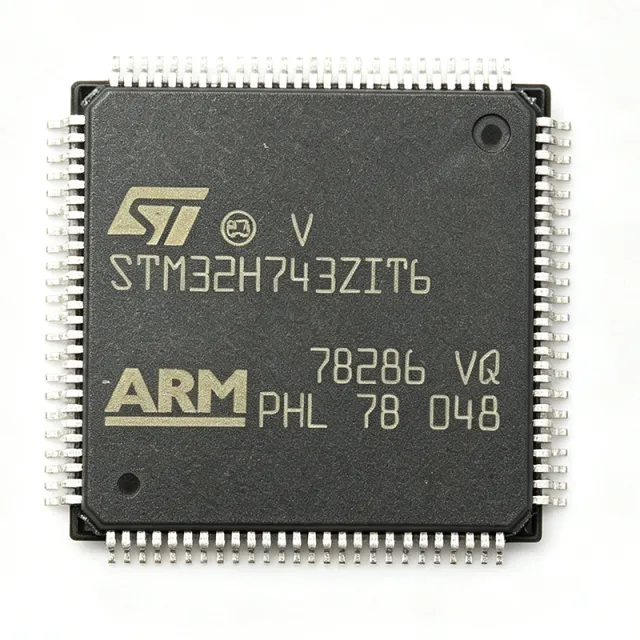
STM32H743ZIT6 - 480MHz Cortex-M7 MCU, 2MB Flash | STMicroelectronics
MPN: STM32H743ZIT6 ✓ Active| Qty | Unit Price | Extended |
|---|---|---|
| 1 | $12.9 | $12.90 |
| 10 | $11.6 | $116.00 |
| 100 | $10.4 | $1,040.00 |
| 500 | $9.4 | $4,700.00 |
| 1,000 | $8.55 | $8,550.00 |
STM32H743ZIT6 Overview
A microcontroller (MCU) is a compact integrated circuit that governs a specific operation in an embedded system, combining a processor core, memory, and programmable input/output peripherals on a single chip. The STM32H743ZIT6 belongs to the STM32H7 series, the high-performance tier of the broader STM32 family of 32-bit microcontrollers, placing it at the top of the MCU performance hierarchy alongside DSP-oriented parts.
Key features include the 480 MHz ARM Cortex-M7 core with a double-precision FPU, 2 MB of Flash, and 1 MB of SRAM. The peripheral set covers multiple high-speed ADCs, DACs, advanced timers, and connectivity interfaces including USART, SPI, I2C, CAN, USB, and Ethernet. A Chrom-ART graphics accelerator, hardware cryptographic accelerator, and true random number generator extend its reach into secure, graphics-rich designs.
Architecturally, the device integrates L1 cache, a memory protection unit (MPU), and a flexible memory controller supporting external SDRAM, NOR, and NAND Flash. Multiple power modes - sleep, stop, and standby - keep average consumption low for battery-operated equipment, while the integrated boot ROM supports system memory, Flash, and SRAM boot paths.
Typical applications include industrial automation, motor control, robotics, medical devices, audio processing, and high-end consumer electronics. In motor control, the advanced timers and fast ADCs enable precise PWM generation and current sensing at full clock speed.
For design, ensure adequate decoupling on all supply pins, use a low-impedance ground plane, and isolate the VDDA analog supply to minimize noise on ADC measurements. Follow ST's recommended PCB layout guidelines in the datasheet.
This page synthesizes distributor pricing, drop-in alternatives, and practical design notes not found in the ST datasheet, providing a comprehensive resource for engineers evaluating the STM32H743ZIT6.
Drop-in alternatives for STM32H743ZIT6 — same package, pin-to-pin compatible. Different-package parts requiring PCB rework are excluded.
Variants in this series
Same-series models that are drop-in compatible with STM32H743ZIT6 (same form factor and footprint) — differing in Communication Interfaces, Timers, Core, Flash Memory, SRAM.
Quick Comparison Tool — Select alternative parts for side-by-side comparison:
STM32H753ZIT6
✅ Drop-In✓ In Stock
$11.75 / Unit
View Datasheet →STM32H747ZIT6
✅ Drop-In✓ In Stock
$11.75 / Unit
View Datasheet →STM32H723ZGT6
✅ Drop-In✓ In Stock
$6.39 / Unit
View Datasheet →STM32H725ZGT6
✅ Drop-In ⚠️ 参数待验证✓ In Stock
$8.1 / Unit
View Datasheet →STM32H743ZIT6 Maximum Ratings & Electrical Characteristics
| Core | ARM Cortex-M7 32-bit |
| Maximum Clock Frequency | 480 MHz |
| Flash Memory | 2 MB |
| RAM | 1 MB |
| Supply Voltage Range | 1.62 V to 3.6 V |
| FPU | Double-precision FPU |
| Number of I/Os | 114 I/O |
| Package | 144-LQFP (20x20 mm) |
| Mounting Type | Surface Mount |
| Communication Interfaces | USART, SPI, I2C, CAN, USB, Ethernet |
| ADC | Multiple high-speed ADCs |
| DAC | Yes |
| Graphics Accelerator | Chrom-ART Accelerator |
| Security | Hardware cryptographic accelerator, true random number generator |
| Power Modes | Sleep, Stop, Standby |
| RoHS Status | Compliant |
STM32H743ZIT6 144-lqfp (20x20 mm) Pin Configuration Guide
Pin configuration for STM32H743ZIT6 (144-lqfp (20x20 mm) package). This digital IC includes GPIO, communication interfaces (UART, SPI, I2C), and power pins. Refer to the manufacturer datasheet for alternate pin functions and configuration options. Essential for embedded system design and PCB layout.

No detailed pinout data available for STM32H743ZIT6.
Refer to the datasheet for full pin configuration.
Typical Applications
STM32H743ZIT6 is suitable for 6 applications: Industrial Automation, Motor Control, Robotics, Medical Devices, Audio Processing, High-End Consumer Electronics.
Industrial Automation
The STM32H743ZIT6 fits industrial automation controllers where deterministic multi-axis coordination and rich connectivity are required. Its 480 MHz Cortex-M7 core with double-precision FPU executes control loops with fast cycle times, while Ethernet, CAN, and multiple USART/SPI/I2C buses connect PLC I/O modules, drives, sensors, and HMIs on one chip. The 2 MB Flash holds large ladder/IEC-style logic, protocol stacks, and web server assets without external memory, and the 1 MB SRAM buffers network traffic and data logging. Placed as the main controller with a 3.3V rail and hardware watchdog, the MCU's flexible memory controller can also attach external SDRAM for extended historical buffering, giving a single-chip solution for Industry 4.0 nodes.
Recommended
Motor Control
Advanced motor drives benefit directly from the STM32H743ZIT6's advanced timers and multiple high-speed ADCs. The timers generate complementary PWM outputs with programmable dead-time for three-phase inverters, while simultaneous-sampling ADCs capture phase currents for field-oriented control (FOC). At 480 MHz with a double-precision FPU, the current loop, speed loop, and position estimator all run in a single MCU with large timing margin, and the 2 MB Flash stores sensorless observer algorithms and firmware-update images. Typical implementation: MCU outputs six PWM channels to a gate driver, ADCs sense shunt currents via op-amps, and the 1 MB SRAM holds fault logs. The result is precise torque control with reduced BOM versus discrete DSP plus host MCU architectures.
Recommended
Robotics
Robot controllers need simultaneous multi-axis servo control, sensor fusion, and communication - exactly the STM32H743ZIT6's profile. The 480 MHz Cortex-M7 performs kinematics and IMU sensor fusion using its DP-FPU, the advanced timers drive multiple servo/BLDC axes, and Ethernet plus CAN FD coordinate with higher-level planners and peripheral joints. With 2 MB Flash and 1 MB RAM, trajectory tables, models, and RTOS stacks fit on-chip, while the flexible memory controller can attach SDRAM for vision buffering. The Chrom-ART accelerator can even drive a local HMI display without a separate graphics chip. Hardware crypto (RNG) supports secure fleet connectivity. This makes the H743 a compact single-chip brain for cobots, AMRs, and educational robot arms.
Recommended
Medical Devices
Portable diagnostic and monitoring equipment uses the STM32H743ZIT6 where signal processing throughput and low noise matter. Its high-speed ADCs digitize biosignals, the DP-FPU accelerates filtering and FFT-based analysis at 480 MHz, and 2 MB Flash retains calibration data, algorithms, and UI assets on-chip. The isolated VDDA supply domain supports clean analog front-ends, and low-power stop/standby modes extend battery runtime between charges in handheld instruments. USB provides device connectivity to host PCs for data export, while the true random number generator and cryptographic features support patient-data protection requirements. Typical uses include portable ultrasound front-ends, patient monitors, and lab point-of-care analyzers needing single-chip processing with graphic displays.
Recommended
Audio Processing
The STM32H743ZIT6 serves as a single-chip audio DSP and system controller. At 480 MHz with DP-FPU, it executes multi-band EQ, active crossover, and codec management in real time, using SAI/serial audio interfaces to connect I2S codecs. The 1 MB SRAM provides low-latency buffering for multi-channel streams, and 2 MB Flash stores presets, DSP coefficients, and UI resources. The Chrom-ART accelerator renders display-based user interfaces alongside audio processing without stealing core cycles. In products like digital mixers, guitar effects, and networked audio endpoints, the H743 eliminates a separate DSP, reducing BOM. Careful VDDA filtering and dedicated analog layout preserve the signal-to-noise ratio of the audio path.
Recommended
High-End Consumer Electronics
Premium consumer products - smart displays, e-bike dashboards, prosumer cameras, and smart appliances - leverage the STM32H743ZIT6 for its combination of graphics and control in one chip. The Chrom-ART Accelerator offloads 2D rendering to drive TFT displays while the 480 MHz core handles touch sensing, wireless module communication (via UART/SPI), and application logic. 2 MB Flash holds UI assets and firmware with OTA-update headroom, and the hardware cryptographic accelerator plus true RNG secure cloud credentials and payment-adjacent features. USB and Ethernet provide flexible connectivity. Wide 1.62V-3.6V operation and stop/standby modes simplify battery-powered designs, making this MCU a mainstream choice for feature-rich, connected consumer devices.
Recommended
Recommended Products Summary
Engineering reference data for STM32H743ZIT6 — comparison, design guidance, and compliance information.
Selection Guide
Comparison with Alternatives
| Parameter | This Product | STM32H753ZIT6 | STM32H747ZIT6 | STM32H723ZGT6 | STM32H725ZGT6 |
|---|---|---|---|---|---|
| Package | 144-LQFP (20x20 mm) | 144-LQFP (20x20 mm) - same | 144-LQFP (20x20 mm) - same | 144-LQFP (20x20 mm) - same | 144-LQFP (20x20 mm) - same |
| Brand | STMicroelectronics | STMicroelectronics | STMicroelectronics | STMicroelectronics | STMicroelectronics |
| Core | ARM Cortex-M7 @ 480 MHz | ARM Cortex-M7 @ 480 MHz | Cortex-M7 @ 480 MHz + Cortex-M4 | ARM Cortex-M7 @ up to 550 MHz | ARM Cortex-M7 @ up to 550 MHz |
| Flash Memory | 2 MB | 2 MB | 2 MB | 1 MB | 1 MB |
| Hardware Crypto | No (AES/RNG subset only) | Yes (full cryptographic accelerator + SFI) | No | No | No |
| Core Architecture | Single-core Cortex-M7 | Single-core Cortex-M7 | Dual-core M7 + M4 | Single-core Cortex-M7 | Single-core Cortex-M7 |
Key Differentiators
- Full 2 MB Flash / 1 MB RAM memory configuration (vs STM32H723ZGT6)
- Lower cost than the security-enabled variant (vs STM32H753ZIT6)
- Single-core simplicity versus dual-core overhead (vs STM32H747ZIT6)
Design Notes
Place a 100 nF ceramic decoupling capacitor on every VDD/VSS pin pair plus bulk 4.7-10 uF capacitance near the regulator, as close to the pins as possible with short, wide traces to a solid ground plane. The VDDA/VSSA analog domain needs its own local decoupling and, ideally, an RC or ferrite filter from the digital 3.3V rail to keep ADC noise low. Follow the layout guidelines in the ST datasheet and AN4207 (STM32H7 hardware development) application note for the 144-LQFP breakout pattern.
The MCU runs from 1.62V to 3.6V but internal core power must come from the on-chip regulator (LDO mode) or an external SMPS scheme depending on board design; verify the CAP/VCAP pin configuration against your variant's reference manual. Budget total current: at 480 MHz with all peripherals active, core consumption plus I/O loads can exceed 500 mA peaks - size the 3.3V rail and any USB VBUS budget accordingly. Use the stop/standby modes and clock gating (via STM32CubeMX power calculator) to cut average draw in battery products.
Three frequent mistakes on first-rev H7 boards: (1) leaving BOOT0 floating - strap it to ground via a resistor for normal Flash boot; (2) underestimating programming connectivity - bring out SWD (SWCLK/SWDIO) plus NRST to a header for ST-LINK debugging; (3) using the older 400 MHz clock configurations from pre-revision V documentation - current silicon reaches 480 MHz but requires the correct voltage scaling and flash latency settings from the latest reference manual (RM0433). Validate clock tree settings with STM32CubeMX before PCB freeze.
Compliance Information
RoHS compliance per STMicroelectronics product page and distributor listings (T6 suffix = RoHS/lead-free industrial grade). REACH, halogen-free and conflict minerals status not stated in provided data.
