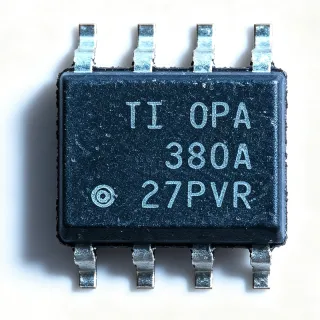
TLV2241ID - 12V 5.5kHz Rail-to-Rail Op Amp | Texas Instruments
부품 번호: TLV2241ID ✓ 활성TLV2241ID 개요
A rail-to-rail input operational amplifier accepts input signals that approach the positive and negative supply rails, while a rail-to-rail output allows the output voltage to swing closer to the supply limits. This makes the TLV2241ID useful in low-voltage systems where signal headroom is limited. Its 1 uA per channel supply current supports battery-powered and energy-conscious equipment, while the 5.5 kHz gain-bandwidth product is suited to low-frequency precision and monitoring functions.
The device is identified by Texas Instruments as a single, 12 V, 5.5 kHz operational amplifier. The TLV2241ID is specified for a 2.5 V to 12 V supply range and includes a -40 C to +125 C operating-temperature option identified in the part-details information. The 8-SOIC package supports standard PCB assembly methods and provides a straightforward pin-compatible platform for single-amplifier designs.
The TLV2241 family is designed around micropower operation and rail-to-rail signal handling. Compared with a conventional general-purpose amplifier operated from a larger supply, this device can operate from a 2.5 V single supply and consume approximately 1 uA per channel according to the family description. Its bandwidth is intentionally modest, making it more appropriate for slow sensor, control, and buffering paths than for high-speed signal processing.
Typical applications include battery-powered sensor conditioning, portable measurement equipment, industrial process inputs, low-current transducers, and general-purpose buffering. In these systems, the rail-to-rail input range can simplify biasing around sensors, while the low supply current reduces the effect of the amplifier on battery life. The 5.5 kHz bandwidth remains sufficient for many slowly changing physical signals.
Designers should select the package and pin configuration from the TLV2241 ordering information, verify the input and output common-mode limits for the actual supply voltage, and check stability with the selected feedback network and load capacitance. Decoupling capacitors should be placed close to the supply pins, and unused inputs should be configured according to the manufacturer's recommendations. The TLV2241ID is therefore a compact choice when low voltage, low current, and rail-to-rail operation are more important than wideband performance.
드롭인 대체품: TLV2241ID — 동일 패키지, 핀 호환. PCB 재작업이 필요한 다른 패키지 부품은 제외됩니다.
이 시리즈의 변형
다음과 드롭인 호환되는 동일 시리즈 모델: TLV2241ID (동일 폼 팩터 및 풋프린트) — 차이점: Amplifier Type, Number of Channels, Number of Pins, Package.
TLV2252AIDR
✅ 드롭인📋 참조 대체품 (카탈로그에 없음)
TLV2252AID
✅ 드롭인 ⚠️ 사양 미검증📋 참조 대체품 (카탈로그에 없음)
TLV2242ID
✅ 드롭인 ⚠️ 사양 미검증📋 참조 대체품 (카탈로그에 없음)
TLV2244ID
✅ 드롭인 ⚠️ 사양 미검증가격 문의
데이터시트 보기 →TLV2245ID
✅ 드롭인 ⚠️ 사양 미검증📋 참조 대체품 (카탈로그에 없음)
TLV2241ID 최대 정격 & 전기적 특성
| Product Type | Single operational amplifier |
| Number of Channels | 1 channel |
| Maximum Supply Voltage | 12 V |
| Supply Voltage Range | 2.5 V to 12 V |
| Gain-Bandwidth Product | 5.5 kHz |
| 공급 전류 | 1 uA per channel |
| Input Common-Mode Range | Rail-to-rail |
| Output Swing | Rail-to-rail |
| 동작 온도 | -40 C to +125 C |
| 패키지 | 8-SOIC (D) |
| 핀 수 | 8 pins |
| 실장 유형 | Surface mount |
| Amplifier Type | General-purpose amplifier |
| Supply Type | Single supply |
TLV2241ID 핀 구성
| 핀 1 | NC — Not connected (per datasheet) |
| 핀 2 | IN- — Inverting input |
| 핀 3 | IN+ — Noninverting input |
| 핀 4 | V- — Negative supply or ground |
| 핀 5 | NC — Not connected (per datasheet) |
| 핀 6 | OUT — Output |
| 핀 7 | V+ — Positive supply |
| 핀 8 | NC — Not connected (per datasheet) |
일반적인 애플리케이션
TLV2241ID 적합 용도: 6 애플리케이션s: Battery-Powered Sensor Conditioning, Industrial Process Signal Conditioning, Portable Measurement Equipment, Low-Current Transducer Interface, Embedded Control-Signal Buffering, Low-Power Data Acquisition Front End.
Battery-Powered Sensor Conditioning
The TLV2241ID fits low-voltage sensor interfaces where the 1 uA per-channel supply current helps limit battery drain and the 2.5 V to 12 V supply range supports compact single-supply systems. Its rail-to-rail input capability is useful when the sensor output approaches either supply rail. Place the amplifier close to the sensor and decouple the supply pins locally to minimize board-level noise pickup. The 5.5 kHz gain-bandwidth product is appropriate for slowly changing physical signals rather than fast pulses. Designers should confirm sensor biasing, input bias current, offset voltage, and output-loading requirements in the manufacturer datasheet before finalizing the circuit.
추천
Industrial Process Signal Conditioning
The TLV2241ID is suitable for conditioning slowly varying industrial signals when the system operates from a single 2.5 V to 12 V rail. Rail-to-rail input and output operation preserves useful signal headroom in low-voltage measurement circuits, while the 5.5 kHz bandwidth is sufficient for temperature, pressure, and level transducer signals. Place input filtering close to the connector and use stable feedback components to limit offset and noise contributions. For long sensor wiring, protect the input path against transient stress and verify common-mode limits against the actual supply voltage before deployment.
추천
Portable Measurement Equipment
The TLV2241ID supports portable and handheld measurement equipment because its low supply current reduces the power burden of always-on analog signal conditioning. The single-supply architecture simplifies rail planning, and the 8-SOIC package is easy to assemble in compact instruments. The 5.5 kHz gain-bandwidth product is well matched to temperature, pressure, and resistance-based sensors that change relatively slowly. Use a low-noise reference and short analog traces, keep the analog return path continuous, and verify the amplifier's startup and settling behavior in the complete instrument power sequence.
추천
Low-Current Transducer Interface
The TLV2241ID can buffer low-current transducer outputs when the design requires a 2.5 V minimum operating supply, approximately 1 uA per-channel supply current, and rail-to-rail signal handling. Its modest 5.5 kHz bandwidth favors slow sensor signals and helps avoid unnecessary design complexity. Place the amplifier at the transducer connector or sensor board, use a defined reference for single-supply operation, and confirm that the input bias current and offset voltage remain acceptable for the transducer's source impedance. The final design should also verify output settling over the required measurement bandwidth.
추천
Embedded Control-Signal Buffering
The TLV2241ID is appropriate for buffering slow control signals in embedded systems that require more drive than a general microcontroller input can provide while keeping power consumption modest. Its rail-to-rail output operation can be valuable when the control signal must approach the available supply range. The 5.5 kHz bandwidth is sufficient for low-rate actuator commands and analog setpoints. Keep feedback routing short, use conservative capacitive loading on the output, and validate stability using the manufacturer's recommended compensation conditions, particularly when driving long cables or capacitive loads.
추천
Low-Power Data Acquisition Front End
The TLV2241ID can form the analog front end of a low-power data-acquisition channel that handles sensor signals below its 5.5 kHz gain-bandwidth product. Its single-supply operation from 2.5 V to 12 V allows the analog section to share a rail with low-power digital circuitry, while approximately 1 uA per-channel current helps preserve energy budget. Use an anti-alias filter matched to the actual signal bandwidth, terminate high-impedance sensors correctly, and keep the analog section physically separated from switching regulators and fast digital clocks. Confirm offset, input-bias-current, and output-swing limits for the selected front-end gain.
추천
추천 제품 요약
엔지니어링 참조 데이터: TLV2241ID — 비교, 설계 지침 및 규정 준수 정보.
선택 가이드
대체품과의 비교
| 파라미터 | 이 제품 | TLV2252AIDR | TLV2252AID | TLV2242ID | TLV2244ID | TLV2245ID |
|---|---|---|---|---|---|---|
| Package | 8-SOIC (D) | 8-SOIC (D) | 8-SOIC (D) | 8-SOIC (D) | 8-SOIC (D) | 8-SOIC (D) |
| Brand | Texas Instruments | Texas Instruments | Texas Instruments | Texas Instruments | Texas Instruments | Texas Instruments |
주요 차별점
- Very low supply current for a general-purpose rail-to-rail amplifier (vs TLV2252AIDR)
- 5.5 kHz gain-bandwidth product matched to slow sensor and control signals (vs TLV2252AIDR)
- Rail-to-rail input and output operation in an 8-SOIC package (vs TLV2242ID)
설계 노트
The TLV2241ID is specified for a single supply from 2.5 V to 12 V and approximately 1 uA per-channel supply current. Keep the supply decoupling network close to pins 4 and 7, use a low-ESR bypass capacitor as recommended by the manufacturer, and avoid placing the amplifier near high-current switching nodes. Verify the complete circuit's supply current at the actual input common-mode voltage and output load because device current can vary with operating conditions.
Route the noninverting and inverting inputs as short, matched traces and keep them away from switching-regulator inductors, high-current power paths, and digital clock lines. Place input and feedback components close to the relevant pins to minimize parasitic capacitance and resistance. For a sensitive sensor interface, use a continuous ground reference beneath the analog section and terminate unused inputs according to the manufacturer's recommendations.
Do not assume that every amplifier in the same 8-SOIC footprint is electrically interchangeable. Before selecting TLV2252AIDR or another TLV22-family candidate, compare the manufacturer-specified input common-mode range, output swing, offset voltage, gain-bandwidth product, supply current, stability, and package pin assignments. A footprint match is necessary for PCB reuse but does not replace application-level validation.
The 5.5 kHz gain-bandwidth product indicates a low-frequency amplifier, so avoid using the TLV2241ID for wideband waveform, communications, or high-speed feedback loops. If capacitive loading is present, confirm that the chosen noise-gain and feedback values remain stable, and use an isolation resistor when necessary. Slow sensor signals should be band-limited with an RC or active filter to reduce out-of-band noise.
규정 준수 정보
The component is a general-purpose operational amplifier rather than an AEC-Q100-qualified automotive device. RoHS, REACH, lead-free, halogen-free, and conflict-minerals status require confirmation from the manufacturer product page or material declaration.