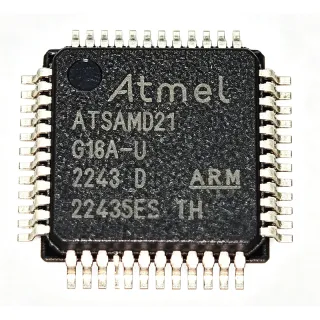
A42MX16-3PQG160I - 24K Gate 5V MX FPGA, 160-PQFP | Microchip
MPN: A42MX16-3PQG160I ✓ Active| Qty | Unit Price | Extended |
|---|---|---|
| 1 | $158.88 | $158.88 |
| 10 | $150.94 | $1,509.40 |
| 100 | $143.39 | $14,339.00 |
| 500 | $136.22 | $68,110.00 |
| 1,000 | $129.41 | $129,410.00 |
A42MX16-3PQG160I Overview
An FPGA (Field-Programmable Gate Array) is a type of programmable logic device that implements digital circuits through configurable logic blocks and routing fabric. Within the programmable logic hierarchy, the MX family sits alongside PLDs and CPLDs as a bridge between discrete logic and full ASIC design, enabling consolidation of multiple legacy PLDs into one low-cost, one-time-programmable device.
Key features include the antifuse-based one-time-programmable architecture, which is inherently resistant to configuration readback attacks and retains programming through power cycles without an external configuration PROM. The 5.0V tolerant I/O structure makes the MX family uniquely suited for replacing 5V bus-legacy designs where modern low-voltage FPGAs cannot interface directly. Speed grade 3 denotes the fastest commercial bin within the 42MX16 offering.
The MX architecture combines combinatorial and sequential modules with dedicated routing, providing predictable timing for glue logic, bus interfacing, state machines, and address decoding. Because configuration is stored in antifuse elements, there is no boot-up latency, an advantage in industrial control, avionics-adjacent and military-adjacent upgrade programs, and telecommunications infrastructure where deterministic power-up is required.
Typical applications include legacy PLD integration, industrial automation controllers, communication backplane interfacing, and test equipment, all of which benefit from the 5V-tolerant I/O and non-volatile configuration.
Design consideration: as a one-time-programmable device, verify design completion and run full functional simulation before programming; plan a design migration path within the 42MX family (for example A42MX24) to preserve gate-count headroom for future revisions.
Drop-in alternatives for A42MX16-3PQG160I — same package, pin-to-pin compatible. Different-package parts requiring PCB rework are excluded.
Variants in this series
Same-series models that are drop-in compatible with A42MX16-3PQG160I (same form factor and footprint) — differing in Speed Grade, Package, Family, RoHS Status, System Gates.
Quick Comparison Tool — Select alternative parts for side-by-side comparison:
A42MX24-3PQG160I
✅ Drop-In✓ In Stock
$48.9 / Unit
View Datasheet →A42MX09-3PQG160I
✅ Drop-In✓ In Stock
$41.8 / Unit
View Datasheet →A42MX16-3PQG160
✅ Drop-In✓ In Stock
$45.1 / Unit
View Datasheet →A42MX16-1PQG160
✅ Drop-In✓ In Stock
$29.4 / Unit
View Datasheet →A42MX16-1PQG160I
✅ Drop-In✓ In Stock
Contact for price
View Datasheet →A42MX16-2PQG160I
✅ Drop-In✓ In Stock
$1 / Unit
View Datasheet →A42MX16-3PQG160I Maximum Ratings & Electrical Characteristics
| Family | 42MX (MX FPGA) |
| System Gates | 24000 |
| User I/O | 125 |
| Speed Grade | 3 |
| Supply Voltage (Core) | 5.0 V |
| I/O Voltage Tolerance | 5.0 V tolerant |
| Programming Technology | Antifuse (one-time programmable) |
| Configuration Retention | Non-volatile (no external config PROM) |
| Package | 160-BQFP (PQG160) |
| Mounting Type | Surface Mount |
| Operating Temperature | -40C to +85C (Industrial) |
| Temperature Grade | I (Industrial) |
| Lead-Free | Yes (G suffix = lead-free balls) |
| RoHS Status | Compliant |
| Brand Alias | Microsemi / Actel legacy brand |
| Primary Use Case | Legacy PLD integration, 5V ASIC alternative |
A42MX16-3PQG160I legacy pld integration, 5v asic alternative Pin Configuration Guide
Pin configuration for A42MX16-3PQG160I (legacy pld integration, 5v asic alternative package). This digital IC includes GPIO, communication interfaces (UART, SPI, I2C), and power pins. Refer to the manufacturer datasheet for alternate pin functions and configuration options. Essential for embedded system design and PCB layout.

No detailed pinout data available for A42MX16-3PQG160I.
Refer to the datasheet for full pin configuration.
Typical Applications
A42MX16-3PQG160I is suitable for 6 applications: Legacy PLD Integration, Industrial Automation Controllers, Telecommunications Backplane Interface, Test and Measurement Equipment, Avionics and Defense Upgrade Programs, 5V ASIC Prototyping and Low-Volume Bridge.
Legacy PLD Integration
The A42MX16-3PQG160I consolidates multiple legacy 5V PALs, GALs, and CPLDs into a single 24K-gate antifuse device, eliminating board rework and multi-vendor part sourcing. Its 5.0V-tolerant I/O ring connects directly to TTL/5V CMOS buses without level shifters, and antifuse configuration ensures instant-on operation identical to the discrete devices it replaces. Because configuration is non-volatile, no boot PROM or configuration controller is needed, preserving the deterministic power-up timing of the original system.
Recommended
Industrial Automation Controllers
In factory automation and motor control backplanes, the A42MX16-3PQG160I implements state machines, encoder decoding, and safety interlock logic with -40C to +85C industrial temperature rating. The 5.0V architecture interfaces natively with legacy PLC I/O cards and 24V-domain peripheral logic through standard buffering. Antifuse one-time programming prevents configuration corruption from brownouts or EMI events, an advantage over SRAM FPGAs in electrically noisy industrial environments where configuration scrubbing is impractical.
Recommended
Telecommunications Backplane Interface
The device serves as a glue-logic and bus-switching fabric in telecom line cards and backplanes built around 5V TTL signaling standards. With 125 user I/Os in a 160-pin BQFP, it can implement address decoding, byte-lane switching, and interrupt aggregation across multiple line-card slots. The antifuse fabric delivers deterministic, glitch-free timing across power cycles - essential for carrier-grade systems that must return to service instantly after power restoration without reconfiguration delays.
Recommended
Test and Measurement Equipment
Bench instruments and automated test fixtures use the A42MX16-3PQG160I for fixture control logic, signal routing multiplexers, and handshaking interfaces to 5V-legacy instrument buses such as early GPIB-adjacent and custom TTL trigger chains. The ceramic PQG160 package offers mechanical robustness for repeated socketing in production fixtures, and the one-time-programmable fabric resists unintended reconfiguration when exposed to strong ESD or RF fields during high-voltage testing operations.
Recommended
Avionics and Defense Upgrade Programs
Military and avionics retrofit programs maintaining 5V TTL-era line-replaceable units adopt the A42MX16-3PQG160I as a form-fit replacement for obsolete programmable logic. The ceramic package and industrial-grade screening support extended-life platforms, while antifuse configuration security prevents bitstream extraction in sensitive applications. Microchip (formerly Actel/Microsemi) maintains long-term availability commitments for the MX family, reducing obsolescence risk for programs with 20+ year service lifetimes.
Recommended
5V ASIC Prototyping and Low-Volume Bridge
For designs bridging to or substituting an ASIC in 5V systems, the MX family provides a reliable single-chip ASIC alternative with deterministic timing and no configuration overhead. The A42MX16-3PQG160I prototypes bus-interface blocks and control planes at 24K gates before committing to mask fabrication, or serves as the permanent production device in volumes where ASIC NRE is unjustified. Design reuse within Libero SoC allows direct migration across MX16, MX24, and MX36 densities.
Recommended
Recommended Products Summary
Engineering reference data for A42MX16-3PQG160I — comparison, design guidance, and compliance information.
Selection Guide
Comparison with Alternatives
| Parameter | This Product | A42MX24-3PQG160I | A42MX09-3PQG160I | A42MX16-3PQG160 |
|---|---|---|---|---|
| Brand | Microchip Technology | Microchip Technology | Microchip Technology | Microchip Technology |
| Package | 160-BQFP (PQG160) | 160-BQFP (PQG160) - same | 160-BQFP (PQG160) - same | 160-BQFP (PQG160) - same |
| System Gates | 24000 | 36000 | 9000 | 24000 |
| Speed Grade | 3 (fastest) | 3 | 3 | 3 |
| Operating Temperature | -40C to +85C (I) | -40C to +85C (I) | -40C to +85C (I) | Commercial (0C to +70C) |
| Lead-Free (G suffix) | Yes | Yes | Yes | No (lead-containing balls) |
| Programming Technology | Antifuse OTP | Antifuse OTP | Antifuse OTP | Antifuse OTP |
Key Differentiators
- 50% more logic headroom (vs A42MX09-3PQG160I)
- Industrial temperature with lead-free balls (vs A42MX16-3PQG160)
- Cost-effective mainstream density (vs A42MX24-3PQG160I)
Design Notes
The A42MX16 is one-time programmable (antifuse). Run complete functional simulation and timing analysis in Microchip Libero SoC before programming any production units; a design change after programming requires new devices. Establish a bitstream archive per revision and verify I/O pin assignments against your PQG160 schematic - re-verify pin assignments when migrating between MX09/MX16/MX24 densities, as I/O ring allocation can shift.
The MX core operates at 5.0V. Provide adequate decoupling (multiple 0.1uF ceramics per power/ground pin pair plus bulk capacitance) and confirm total supply current against the 40MX/42MX datasheet current-estimation worksheet for your netlist, since antifuse devices draw static current dependent on routing utilization. The 5V-tolerant I/O ring means inputs must not be driven above VCCI + tolerance; consult the datasheet absolute maximum ratings.
The 160-BQFP ceramic package requires careful land-pattern design per the Microchip packaging datasheet for PQG160. Use 0.5mm-pitch-compliant footprint geometry, and plan rework carefully - ceramic BQFP devices are heavy and thermal cycling during removal risks pad lifting. For new layouts targeting migration across MX16/MX24/MX36 densities, design the footprint once to the PQG160 mechanical drawing for reuse.
For 5V TTL bus interfacing, add series termination (22-33 ohm) on heavily loaded outputs to control ringing on backplane stubs. MX I/O drive strength and edge rates are modest by modern standards, but long 5V bus traces in legacy backplanes benefit from series damping; verify timing margins with IBIS models available through Libero SoC.
Compliance Information
G suffix indicates lead-free solder balls; RoHS compliant per DigiKey/Mouser listings. REACH, halogen-free, and conflict-minerals status not stated in provided data.