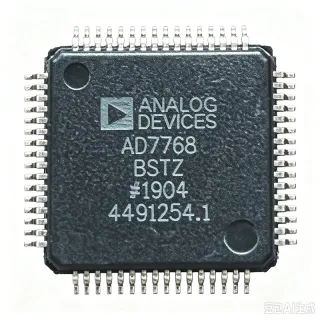
AD7768-1BSTZ - 24-bit Sigma-Delta Precision ADC | Analog Devices
MPN: AD7768-1BSTZ ✓ Active| Qty | Unit Price | Extended |
|---|---|---|
| 1 | $18.9 | $18.90 |
| 10 | $17.2 | $172.00 |
| 100 | $15.6 | $1,560.00 |
| 500 | $14.3 | $7,150.00 |
| 1,000 | $13.1 | $13,100.00 |
AD7768-1BSTZ Overview
A sigma-delta ADC is a type of analog-to-digital converter that oversamples the input signal with a 1-bit modulator and then applies on-chip digital filtering and decimation to produce a high-resolution output. In the precision measurement hierarchy, it sits above general-purpose SAR ADCs for dynamic-range-critical tasks, making it a core building block of industrial data acquisition (DAQ) systems and instrumentation front ends.
Key features include 24-bit resolution, a flexible decimation-rate digital filter enabling bandwidth/data-rate trade-offs, three selectable power modes that let designers optimize noise versus power consumption, and a reusable DAQ footprint for both isolated and non-isolated designs. According to Analog Devices, this establishes a new industry benchmark in combined AC and DC performance, allowing one hardware design to span multiple measurement variants.
Technically, the AD7768-1 combines a high-order Σ-Δ modulator with an on-chip sinc filter, providing excellent linearity and dynamic range for precision signal chains. Programmable power modes scale modulator clocking to match noise targets against power dissipation, which is valuable in battery-powered and high-density multichannel modules. The single-channel architecture simplifies layouts for one-channel precision front ends while keeping register-level compatibility with the AD7768 family.
Typical applications include dynamic signal analysis, power quality monitoring, vibration and acoustic sensing, precision instrumentation, and industrial DC-to-204 kHz measurement systems requiring a 24-bit sigma-delta converter.
Design considerations: choose the decimation filter settings and power mode early, since output data rate, input bandwidth, and supply current are interdependent; ensure clean, low-noise reference and analog supplies for full dynamic-range performance.
This page synthesizes distributor data, same-family alternatives, pricing tiers, and practical design notes not found in the manufacturer datasheet.
Drop-in alternatives for AD7768-1BSTZ — same package, pin-to-pin compatible. Different-package parts requiring PCB rework are excluded.
Variants in this series
Same-series models that are drop-in compatible with AD7768-1BSTZ (same form factor and footprint) — differing in Package, Interface, Number of Channels, Power Modes.
Quick Comparison Tool — Select alternative parts for side-by-side comparison:
AD7768BSTZ
✅ Drop-In📋 Reference alternative (not in catalog)
AD7768-4BSTZ
✅ Drop-In ⚠️ Specs Unverified✓ In Stock
$25.4545 / Unit
View Datasheet →AD7768-1BSTZ Maximum Ratings & Electrical Characteristics
| Resolution | 24 bit |
| Converter Type | Sigma-Delta (Σ-Δ) ADC with on-chip modulator and digital filter |
| Number of Channels | 1 |
| Max Throughput Rate | 256 kSPS |
| Output Data Rate Range | DC to 204 kHz (dynamic signal analysis range) |
| Power Modes | 3 selectable power modes (noise vs. power optimization) |
| Interface | SPI-compatible serial interface |
| Family Compatibility | Single-channel version of AD7768 (8-channel) |
| Package | 64-LQFP (10x10 mm) |
| Mounting Type | Surface Mount |
| Application Focus | AC and DC precision measurement, DAQ, isolated and non-isolated systems |
| Evaluation Kit | EV-AD7768-1FMCZ |
AD7768-1BSTZ 64-lqfp (10x10 mm) Pin Configuration Guide
Pin configuration for AD7768-1BSTZ (64-lqfp (10x10 mm) package). This analog component features input, output, and power supply pins. Refer to the manufacturer datasheet for offset null, compensation, and enable pin configurations. Ideal for signal conditioning and amplifier circuits.

No detailed pinout data available for AD7768-1BSTZ.
Refer to the datasheet for full pin configuration.
Typical Applications
AD7768-1BSTZ is suitable for 6 applications: Dynamic Signal Analysis, Industrial Data Acquisition Modules, Power Quality Monitoring, Vibration and Acoustic Sensing, Precision Instrumentation Front Ends, Isolated Measurement Systems.
Dynamic Signal Analysis
The AD7768-1BSTZ is explicitly positioned by Analog Devices for DC to 204 kHz dynamic signal analysis, making it a strong fit for vibration monitoring, acoustic analysis, and machinery condition monitoring systems. Its 24-bit resolution captures both large fundamental tones and micro-level harmonic detail in one sweep, while the on-chip sinc digital filter shapes bandwidth to the measurement task without external antialiasing stages. In a typical setup, a low-noise front-end amplifier drives the modulator input and the SPI data stream feeds a DSP for FFT processing. The selectable power modes let portable analyzers trade throughput for battery life, and the single reusable DAQ footprint spans multiple analyzer variants.
Recommended
Industrial Data Acquisition Modules
Industrial DAQ modules benefit directly from the AD7768-1BSTZ's combination of 24-bit resolution, programmable digital filtering, and up to 256 kSPS throughput. According to Analog Devices, the part establishes a reusable data acquisition footprint for both isolated and non-isolated measurement variants, so one PCB design can serve multiple product tiers by changing firmware decimation settings. In isolated systems, the SPI interface pairs naturally with digital isolators, keeping the precision analog domain galvanically separated from the controller. The three power modes reduce total module power in dense chassis installations, and register-level compatibility with the AD7768/AD7768-4 family simplifies firmware maintenance across a product line.
Recommended
Power Quality Monitoring
Power quality analyzers require simultaneous capture of fundamental (50/60 Hz) and high-order harmonic content up to the 50th harmonic and beyond, which the AD7768-1BSTZ covers with its DC to 204 kHz output data rate range and 24-bit resolution. The wide dynamic range captures both the large voltage waveform and small interharmonic components without range switching. Sampling well above the Nyquist requirement with an on-chip sinc filter suppresses aliasing from switching noise on the grid, improving measurement integrity in substation and industrial panel environments. The single-channel version suits per-phase measurement modules, while the AD7768BSTZ variant serves three-phase designs within the same firmware framework.
Recommended
Vibration and Acoustic Sensing
Piezoelectric accelerometers and MEMS microphones produce small, broadband signals where the AD7768-1BSTZ's 24-bit sigma-delta conversion preserves both low-level detail and high-amplitude events in a single record. Its programmable output data rate spans audio-band analysis up to the 204 kHz family ceiling, and the on-chip filter removes out-of-band noise that would otherwise alias into the vibration spectrum. The three power modes matter in distributed sensor nodes: high-accuracy mode during scheduled analysis windows, low-power mode during idle listening. Because the digital filter is integrated, the host MCU only receives decimated samples, reducing link bandwidth and CPU load in networked condition-monitoring systems.
Recommended
Precision Instrumentation Front Ends
Bench and modular instrumentation - digital multimeter analog front ends, source-measure units, and sensor conditioners - gain from the AD7768-1BSTZ's combined AC and DC precision in one converter. The sigma-delta architecture delivers excellent linearity for DC measurements while retaining 204 kHz-class bandwidth for AC signal capture, letting one acquisition engine serve both measurement modes. According to Analog Devices, this reusability across measurement variants is a core design goal of the AD7768-1. The SPI register interface allows instrument firmware to switch filter settings between fast-scan and high-resolution-scan modes at runtime, supporting auto-ranging and autoranging measurement sequences without hardware changes.
Recommended
Isolated Measurement Systems
For isolated industrial measurement - motor drives, medical-grade patient monitoring, and grid instrumentation - the AD7768-1BSTZ sits on the isolated analog side with its SPI data crossing a digital isolator barrier. Its low-power modes reduce the isolated supply budget, shrinking isolated DC-DC converter requirements, while 24-bit resolution maintains measurement fidelity across the isolation barrier. Analog Devices explicitly targets both isolated and non-isolated applications with the AD7768-1's reusable DAQ footprint. Because all heavy digital filtering happens on-chip, only the decimated data rate crosses the isolator, minimizing isolator speed requirements and the associated power and cost in high-channel-count isolated systems.
Recommended
Recommended Products Summary
Engineering reference data for AD7768-1BSTZ — comparison, design guidance, and compliance information.
Selection Guide
Comparison with Alternatives
| Parameter | This Product | AD7768BSTZ | AD7768-4BSTZ |
|---|---|---|---|
| Package | 64-LQFP (10x10 mm) | 64-LQFP (10x10 mm) | 64-LQFP (10x10 mm) |
| Brand | Analog Devices | Analog Devices | Analog Devices |
| Resolution | 24 bit | 24 bit | 24 bit |
| Number of Channels | 1 | 8 | 4 |
| Max Throughput | 256 kSPS | 256 kSPS (per channel) | 256 kSPS (per channel) |
| Output Data Rate Range | DC to 204 kHz | DC to 204 kHz | DC to 204 kHz |
| Power Modes | 3 | 3 | 3 |
Key Differentiators
- Lowest channel-count cost in the AD7768 family (vs AD7768BSTZ)
- Middle-channel option balancing density and cost (vs AD7768-4BSTZ)
- Reusable DAQ footprint across variants (vs AD7768BSTZ)
Design Notes
The AD7768-1BSTZ offers three power modes that directly set modulator clock rate, noise floor, and supply current. Select the mode before finalizing power budgets: the highest-performance mode is required to reach the widest-bandwidth 256 kSPS-class operation, while lower modes can cut consumption substantially for battery or dense modules. Decouple all analog and digital supplies with local 100 nF ceramics plus bulk 10 uF capacitance, and use a clean low-noise LDO or reference supply for the analog rail to preserve the 24-bit noise floor.
Place a solid, unbroken ground plane under the ADC and partition the layout into analog (modulator input, reference) and digital (SPI, clocks) regions. Route the reference trace short and wide with dedicated decoupling at the REF pin. Keep the modulator clock source low-jitter, since sigma-delta modulator SNR degrades with clock phase noise. The EV-AD7768-1FMCZ evaluation board layout from Analog Devices is a proven reference - mirror its ground and filtering strategy for first-pass success in isolated or non-isolated DAQ designs.
Do not assume the AD7768-1 is pin-compatible with the AD7768 or AD7768-4: channel-count differences change the analog input pin map even though the register framework and filter architecture are shared. Verify the output data rate and bandwidth against your chosen decimation setting - throughput, filter setting, and power mode are interdependent, and selecting a power mode after layout may invalidate noise expectations. Confirm anti-aliasing upstream of the modulator if large out-of-band interference is present in your signal environment.
Compliance Information
Compliance status was not explicitly stated in the provided web data. Verify on the official Analog Devices AD7768-1 product page before regulatory documentation.