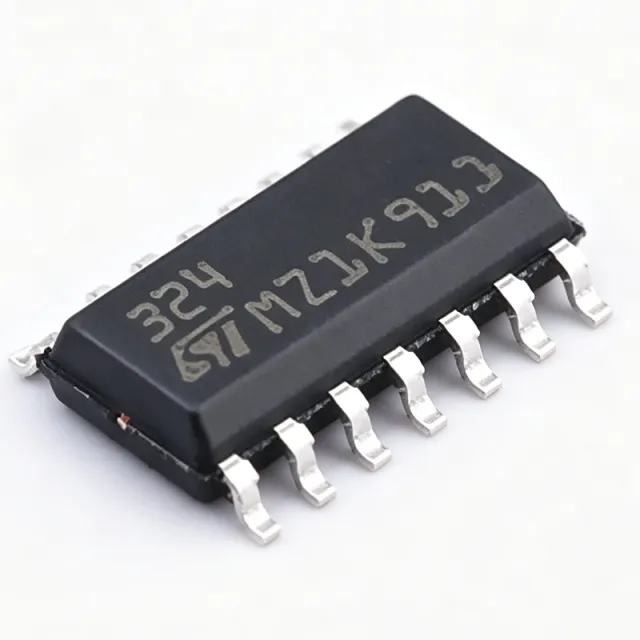
LM324DT - Quad Operational Amplifier | STMicroelectronics
MPN: LM324DT ✓ Active| Qty | Unit Price | Extended |
|---|---|---|
| 1 | $0.1418 | $0.14 |
| 10 | $0.1024 | $1.02 |
| 100 | $0.0906 | $9.06 |
| 500 | $0.0867 | $43.35 |
| 1,000 | $0.0827 | $82.70 |
LM324DT Overview
An operational amplifier (op-amp) is a high-gain voltage amplifier with differential inputs and a single-ended output, used in analog signal conditioning, filtering, and mathematical operations. The LM324 is a classic general-purpose op-amp family, known for its low cost, wide supply range, and ability to operate with a single supply, making it a staple in analog electronics. It sits within the hierarchy: operational amplifier -> linear amplifier -> analog IC -> semiconductor.
Key features include a wide supply voltage range (3V to 32V), low supply current (typically 700µA per amplifier), common-mode input voltage range including ground, and short-circuit protected outputs. The LM324DT also features true differential input stage, which allows the input to go below ground when operating from a single supply, and it has a typical gain-bandwidth product of 1.3MHz. These features make it versatile for many analog applications.
The LM324 uses a bipolar transistor architecture with a class-AB output stage, providing low output saturation voltage and high output current capability. It has an input offset voltage of typically 2mV and input bias current of typically 20nA, which are adequate for many precision applications. The device is internally frequency compensated for unity-gain stability, eliminating the need for external compensation components.
Typical applications include transducer amplifiers, DC gain blocks, active filters, and general-purpose signal conditioning in industrial, automotive, and consumer electronics. Its single-supply operation makes it ideal for battery-powered devices and automotive sensor interfaces where a negative rail is not available.
When designing with the LM324DT, ensure proper decoupling of the power supply pins with a 0.1µF ceramic capacitor close to the device. The output can swing close to the positive rail but not to the negative rail (ground) when using a single supply, so consider the output voltage range in your design. Also, avoid exceeding the absolute maximum supply voltage of 32V to prevent damage.
This page synthesizes distributor pricing, drop-in alternatives, and practical design notes not found in the STMicroelectronics datasheet, providing a comprehensive resource for engineers selecting the LM324DT.
Drop-in alternatives for LM324DT — same package, pin-to-pin compatible. Different-package parts requiring PCB rework are excluded.
Variants in this series
Same-series models that are drop-in compatible with LM324DT (same form factor and footprint) — differing in Slew Rate.
Quick Comparison Tool — Select alternative parts for side-by-side comparison:
LM324DR
📋 Reference alternative (not in catalog)
LM324ADT
📋 Reference alternative (not in catalog)
LM2902DT
📋 Reference alternative (not in catalog)
LM324DT Maximum Ratings & Electrical Characteristics
| Number of Channels | 4 |
| Supply Voltage (Single) | 3 V to 32 V |
| Supply Voltage (Dual) | ±1.5 V to ±16 V |
| Supply Current (per Amplifier) | 700 µA typical |
| Input Offset Voltage | 2 mV typical |
| Input Bias Current | 20 nA typical |
| Gain-Bandwidth Product | 1.3 MHz typical |
| Slew Rate | 0.4 V/µs typical |
| Common-Mode Rejection Ratio | 80 dB typical |
| Output Current | 40 mA typical |
| Operating Temperature Range | 0°C to +70°C |
| Package | SOIC-14 |
| Mounting Type | Surface Mount |
| RoHS Status | Compliant |
| Amplifier Type | General Purpose |
LM324DT Pin Configuration
| Pin 1 | 1OUT — Output of amplifier 1 |
| Pin 2 | 1IN- — Inverting input of amplifier 1 |
| Pin 3 | 1IN+ — Non-inverting input of amplifier 1 |
| Pin 4 | VCC — Positive power supply |
| Pin 5 | 2IN+ — Non-inverting input of amplifier 2 |
| Pin 6 | 2IN- — Inverting input of amplifier 2 |
| Pin 7 | 2OUT — Output of amplifier 2 |
| Pin 8 | 3OUT — Output of amplifier 3 |
| Pin 9 | 3IN- — Inverting input of amplifier 3 |
| Pin 10 | 3IN+ — Non-inverting input of amplifier 3 |
| Pin 11 | GND — Ground (negative supply) |
| Pin 12 | 4IN+ — Non-inverting input of amplifier 4 |
| Pin 13 | 4IN- — Inverting input of amplifier 4 |
| Pin 14 | 4OUT — Output of amplifier 4 |
Typical Applications
LM324DT is suitable for 6 applications: Transducer Amplifier, DC Gain Block, Active Filter, Signal Conditioning, Battery-Powered Devices, Automotive Sensor Interface.
Transducer Amplifier
The LM324DT is ideal for amplifying signals from sensors such as thermocouples, strain gauges, and photodiodes. Its low input bias current (20nA) minimizes loading on high-impedance sensors, and the wide supply range allows direct connection to industrial 24V rails. In a typical configuration, the op-amp is used in a non-inverting or instrumentation amplifier topology to condition the small sensor signal to a level suitable for an ADC. The common-mode input range includes ground, enabling single-supply operation with sensors referenced to ground. For best accuracy, use precision resistors in the feedback network and consider the input offset voltage (2mV typical) in calibration. The LM324DT's low cost and quad configuration make it economical for multi-channel sensor interfaces.
Recommended
DC Gain Block
The LM324DT can be used as a DC gain block to amplify small DC voltages, such as from a shunt resistor or a potentiometer. With a gain-bandwidth product of 1.3MHz, it provides stable gain up to a few hundred kHz. In a non-inverting configuration, the gain is set by two resistors, and the output can drive up to 40mA. The low supply current (700µA per amplifier) makes it suitable for battery-powered instruments. For DC precision, the input offset voltage (2mV typical) may require calibration, and the input bias current (20nA) should be considered when using high-value source resistances. The LM324DT's quad configuration allows multiple gain stages in one package, saving board space.
Recommended
Active Filter
The LM324DT is well-suited for active filters, such as low-pass, high-pass, and band-pass filters, in audio and instrumentation applications. Its 1.3MHz gain-bandwidth product allows filter cutoff frequencies up to a few hundred kHz. The quad configuration enables multi-stage filters, such as a 4th-order Butterworth filter, in a single package. When designing active filters, use the Sallen-Key or multiple-feedback topology with precision resistors and capacitors. The LM324DT's output can swing close to the positive rail but not to ground, so ensure the filter's output range is within the linear region. The low supply current and wide supply range make it suitable for portable and industrial filter applications.
Recommended
Signal Conditioning
The LM324DT is commonly used for signal conditioning in industrial and automotive systems, such as conditioning signals from temperature sensors, pressure sensors, and current shunts. Its wide supply range (3V to 32V) allows direct operation from automotive battery voltages, and the common-mode input range includes ground, enabling single-supply operation. In a typical application, the op-amp is configured as a differential amplifier to reject common-mode noise, or as a buffer to isolate a high-impedance source. The low input bias current (20nA) minimizes errors when interfacing with high-impedance sensors. The quad configuration allows multiple conditioning channels in one package, reducing component count and cost.
Recommended
Battery-Powered Devices
The LM324DT's low supply current (700µA per amplifier) and wide supply voltage range (3V to 32V) make it suitable for battery-powered devices, such as portable instruments, remote sensors, and consumer electronics. It can operate directly from a 3V lithium cell or a 9V battery, and the quad configuration provides multiple amplification channels without excessive power drain. In a typical application, the op-amp is used to condition sensor signals before digitization by a microcontroller's ADC. The output can drive small loads, such as LEDs or buzzers, directly. For extended battery life, consider using the shutdown feature of more advanced op-amps, but the LM324DT's simplicity and low cost make it a practical choice for many designs.
Recommended
Automotive Sensor Interface
The LM324DT can be used in automotive sensor interfaces, such as for engine coolant temperature, oil pressure, and throttle position sensors. Its wide supply range (up to 32V) allows direct connection to the vehicle's 12V or 24V electrical system, and the common-mode input range includes ground, enabling single-supply operation. In a typical application, the op-amp conditions the sensor signal to a 0-5V range for the engine control unit (ECU). The low input bias current (20nA) minimizes loading on high-impedance sensors. However, for automotive applications with extended temperature ranges (-40°C to +125°C), consider the LM2902DT, which is a drop-in replacement with a wider temperature rating.
Recommended
Recommended Products Summary
Engineering reference data for LM324DT — comparison, design guidance, and compliance information.
Selection Guide
Comparison with Alternatives
| Parameter | This Product | LM324DR | LM324ADT | LM2902DT |
|---|---|---|---|---|
| Package | SOIC-14 | SOIC-14 | SOIC-14 | SOIC-14 |
| Supply Voltage Range | 3V to 32V | 3V to 32V | 3V to 32V | 3V to 26V |
| Input Offset Voltage (typical) | 2mV | 2mV | 1mV | 2mV |
| Input Bias Current (typical) | 20nA | 20nA | 20nA | 20nA |
| Gain-Bandwidth Product | 1.3MHz | 1.3MHz | 1.3MHz | 1.3MHz |
| Operating Temperature Range | 0°C to +70°C | 0°C to +70°C | 0°C to +70°C | -40°C to +125°C |
| Quiescent Current (per amplifier) | 700µA | 700µA | 700µA | 700µA |
| Output Current | 40mA | 40mA | 40mA | 40mA |
Key Differentiators
- Lower input offset voltage option (vs LM324DR)
- Wider temperature range option (vs LM324DT)
- Quad configuration in SOIC-14 (vs LM358DT (dual))
Design Notes
Decouple the VCC pin (pin 4) with a 0.1µF ceramic capacitor placed as close to the pin as possible, and optionally a 10µF electrolytic capacitor for low-frequency decoupling. The LM324DT can operate from 3V to 32V, but ensure the supply is stable and within the absolute maximum ratings to avoid damage.
For best performance, use a ground plane and keep the input traces short and shielded from noisy signals. The LM324DT has a common-mode input range that includes ground, but avoid routing input traces near high-current switching traces to minimize noise coupling. Place the feedback resistors close to the op-amp to reduce parasitic capacitance.
The LM324DT output cannot swing to the negative rail (ground) when using a single supply; it can only go down to about 20mV above ground. If you need to measure signals near ground, use a pull-down resistor on the output or a rail-to-rail op-amp. Also, avoid exceeding the input common-mode range, which is from ground to VCC - 1.5V, to prevent phase reversal.
Compliance Information
RoHS compliant per STMicroelectronics product page. Not AEC-Q100 qualified; use LM2902DT for automotive-grade requirements.






