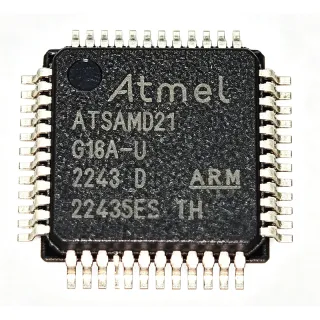
ATMXT154-CUR - maXTouch 154-Channel Touch Controller | Microchip
MPN: ATMXT154-CUR ✓ Active| Qty | Unit Price | Extended |
|---|---|---|
| 1 | $5.2 | $5.20 |
| 10 | $4.75 | $47.50 |
| 100 | $4.3 | $430.00 |
| 500 | $3.9 | $1,950.00 |
| 1,000 | $3.55 | $3,550.00 |
ATMXT154-CUR Overview
A touchscreen controller is a specialized mixed-signal IC that drives transmit and receive electrodes of a capacitive touch panel, measures mutual-capacitance changes at each sensor node, and applies proprietary algorithms to convert raw capacitance data into accurate X/Y touch coordinates. Within the system hierarchy, the touchscreen controller sits between the touch sensor stack (ITO patterned glass or film) and the host processor, communicating touch reports over an I2C or SPI-style host interface while managing sensor drive, filtering, and calibration autonomously.
Key differentiating capabilities of the maXTouch platform include high channel counts that enable large-format touch panels, simultaneous multi-touch reporting, support for passive stylus and gloved-hand input, and water-rejection and noise-immunity algorithms that maintain accuracy in electrically noisy environments such as automotive cabins and industrial floors. The device integrates the analog front end, charge amplifiers, ADC-based acquisition, and a processing core on one die, reducing the external component count of the touch subsystem.
Technically, the maXTouch architecture uses mutual-capacitance scanning with programmable frame rates and configurable channel mappings, allowing panel makers to optimize scan time versus signal-to-noise ratio. Firmware-defined configuration objects are stored on-chip and can be updated by the host, which shortens touch-tuning cycles during display module integration. Automatic calibration compensates for panel aging, temperature drift, and manufacturing spread across sensor stacks from different glass suppliers.
Typical applications include capacitive touch panels in consumer appliances, smart-home control panels, industrial HMI displays, and point-of-information terminals where multi-touch gestures and robust operation against display noise are required. The 154-channel capability suits medium-to-large panels used in kitchen appliances, fitness equipment, and embedded display modules.
A key design consideration is touch firmware configuration: performance depends heavily on a configuration file matched to the specific sensor stack (glass thickness, ITO pattern, overlay), so budget engineering time for touch tuning with the target panel and noise source in place. Ensure the host interface power domain and reset sequencing follow the maXTouch porting guide to avoid boot failures.
This page synthesizes distributor availability data, lifecycle context, alternative-part search results, and practical design notes not found in the manufacturer datasheet.
Drop-in alternatives for ATMXT154-CUR — same package, pin-to-pin compatible. Different-package parts requiring PCB rework are excluded.
Quick Comparison Tool — Select alternative parts for side-by-side comparison:
ATMXT154-MAHIR039
✅ Drop-In📋 Reference alternative (not in catalog)
ATMXT154-CUR Maximum Ratings & Electrical Characteristics
| Product Type | Capacitive Touchscreen Controller IC |
| Product Family | maXTouch |
| Touch Channels | 154 |
| Sensing Technology | Projected capacitive, mutual capacitance |
| Multi-Touch Support | Yes |
| Host Interface | I2C-compatible serial interface |
| Category (Distributor) | Interface ICs / Touch Screen Controllers |
| ECCN | EAR99 |
| Mounting Type | Surface Mount |
| Stylus Support | Passive stylus support (maXTouch family feature) |
| Water Rejection | Yes (maXTouch family noise/water algorithms) |
ATMXT154-CUR standard Pin Configuration Guide
Pin configuration for ATMXT154-CUR (standard package). Pin numbering, functions, and connection diagrams are defined in the manufacturer datasheet. Refer to it for the exact footprint and soldering guidelines.

No detailed pinout data available for ATMXT154-CUR.
Refer to the datasheet for full pin configuration.
Typical Applications
ATMXT154-CUR is suitable for 6 applications: Home Appliance Touch Control Panels, Industrial HMI Displays, Smart Home and Building Control Panels, Consumer Display Modules, Fitness Equipment and Vending Terminals, Point-of-Information and Payment Kiosks.
Home Appliance Touch Control Panels
Oven fronts, cooktops, refrigerators, and laundry appliances increasingly replace mechanical buttons with large projected-capacitive glass panels. The ATMXT154-CUR fits this market because its 154-channel capacity covers the dense electrode matrices of wide appliance fascias, while maXTouch water-rejection algorithms keep touch reporting stable when wet hands or boiled-over liquids contact the overlay. Gloved-hand support allows operation with oven mitts. The controller scans mutual capacitance across the sensor and reports multi-touch gestures over its I2C-compatible host interface to the appliance MCU. Its noise-immunity acquisition tolerates inverter-driven compressors and switching power supplies inside the same chassis. Use a configuration file tuned for the specific glass thickness and ITO pattern, and validate against the appliance's own EMI sources during touch tuning.
Recommended
Industrial HMI Displays
Factory terminals, machine interfaces, and operator panels require touch controllers that keep working amid electrically noisy environments: servo drives, VFDs, and contactors all inject common-mode noise onto the touch sensor. The ATMXT154-CUR addresses this with the maXTouch noise-immunity acquisition algorithms and automatic frequency hopping away from interference peaks. Its 154 channels suit medium-to-large industrial displays, and multi-touch enables pinch-zoom on process graphics. The controller autonomously handles calibration, compensating for panel aging and temperature drift over years of continuous duty in uncontrolled enclosures. Designers should place the controller's sensor traces away from motor drive cables and confirm the touch frame rate against host UI latency requirements. Firmware configuration objects are host-updatable, simplifying touch tuning across panel vendors in a product family.
Recommended
Smart Home and Building Control Panels
Wall-mounted smart home controllers, thermostat panels, and room schedulers use flush glass touch surfaces where aesthetics and reliability matter. The ATMXT154-CUR provides multi-touch gesture support and passive stylus operation for precise selection on dense control UIs, while its water rejection handles condensation and cleaning sprays on wall plates. The 154-channel capacity supports tall portrait-format panels with many widget zones. Its I2C-compatible host interface integrates naturally with low-power home-automation MCUs, and the maXTouch configuration can be updated by the host to re-tune touch sensitivity after a glass vendor change without hardware redesign. During integration, budget time for proximity to backlighting inverters, which raise the noise floor, and validate gloved and wet-finger behavior at final glass stack thickness.
Recommended
Consumer Display Modules
Embedded display modules for consumer devices benefit from the ATMXT154-CUR's single-die integration of the analog front end, acquisition ADC, and processing core, which shrinks the touch subsystem bill of materials versus discrete front ends. The 154-channel budget covers screens in the mid-size range used in appliances, fitness machines, and connected home hubs. Multi-touch reporting enables modern gesture-driven UIs, and maXTouch water rejection prevents false touches from condensation or splashes. Automatic calibration keeps performance consistent across display modules built with sensor stacks from multiple suppliers, a common situation in consumer supply chains. Tune the touch configuration with the exact display module assembled, including its bezel and bonding, because display noise spectra shift with panel revisions. Host-side firmware updates to the configuration object simplify mid-production touch re-tuning.
Recommended
Fitness Equipment and Vending Terminals
Treadmill consoles, stationary bike displays, and outdoor vending machines impose harsh touch conditions: sweat, rain, UV exposure, and heavy public use. The ATMXT154-CUR's projected-capacitive sensing with water rejection maintains accuracy where resistive or simpler capacitive solutions fail, and its passive stylus support accommodates gloved or fingertip-impaired users. The 154-channel count covers large landscape consoles with rich workout graphics requiring multi-touch zoom. maXTouch noise immunity is valuable near treadmills' motor drives and vending machines' refrigeration compressors. The controller's autonomous calibration handles the wide temperature swings of outdoor installations. Design the sensor shield layer properly for moisture, and re-validate the touch configuration whenever the front glass or adhesive bonding changes, since sweat film capacitance is a common tuning blind spot in this market segment.
Recommended
Point-of-Information and Payment Kiosks
Retail kiosks, ticketing machines, and self-service terminals need dependable multi-touch input with high uptime. The ATMXT154-CUR provides the maXTouch platform's noise robustness against the kiosk's own display, payment-terminal electronics, and surrounding fluorescent or LED signage. Its 154 channels support the large interactive surfaces typical of kiosk enclosures, and multi-touch plus stylus support enable signature capture and map-pinch interactions. Water rejection keeps the touchscreen responsive after cleaning cycles, a daily event in public deployments. The controller's I2C-compatible interface and host-updatable configuration allow centralized firmware maintenance across a kiosk fleet. For payment-adjacent designs, ensure the touch sensor ground returns do not share high-current ESD discharge paths, and validate touch operation during simulated ESD swipe events at the bezel edge where customers contact the metal frame.
Recommended
Recommended Products Summary
Engineering reference data for ATMXT154-CUR — comparison, design guidance, and compliance information.
Selection Guide
Comparison with Alternatives
| Parameter | This Product | ATMXT154-MAHIR039 |
|---|---|---|
| Brand | Microchip Technology | Microchip Technology |
| Touch Channels | 154 | 154 |
| Product Family | maXTouch | maXTouch |
| Sensing Technology | Projected capacitive (mutual) | Projected capacitive (mutual) |
| Host Interface | I2C-compatible | I2C-compatible |
| Firmware/Ordering Variant | CUR ordering code | MAHIR039 firmware variant |
Key Differentiators
- High channel count of 154 touch channels (vs ATMXT154-MAHIR039)
- maXTouch noise-immunity and water rejection algorithms (vs Generic touch controllers)
- Single-die analog front end plus processing core (vs Discrete touch front ends)
Design Notes
Touch performance on the ATMXT154-CUR depends almost entirely on a configuration object matched to your exact sensor stack (glass thickness, ITO pattern, adhesive bonding, bezel). Never assume the default firmware configuration will work on a new panel. Run the Microchip maXTouch tuning flow with the final display assembled and powered, including its own noise sources, before locking the configuration into production firmware. Re-tune whenever the display panel revision changes, because the noise spectrum shifts.
Route touch sensor traces away from display flex cables, backlight inverter runs, and switching-regulator loops. Keep the controller's ground reference solid and star-connected to the sensor shield. Place the ATMXT154-CUR as close to the sensor tail connector as practical to minimize trace capacitance imbalance, and follow the maXTouch porting guide for reset and power-domain sequencing so the controller boots cleanly with the host.
Estimated: provide a clean, well-decoupled analog supply for the touch controller, using at least a 1 uF plus 0.1 uF ceramic pair at the supply pins. Touch acquisition ADC accuracy degrades with supply ripple, so if the rail comes from a DC-DC converter, add an LC filter or ferrite bead before the touch controller. Verify the exact supply voltage and sequencing limits in the manufacturer datasheet before finalizing the power tree, as they were not published in the distributor summaries reviewed.
Compliance Information
ECCN EAR99 per Win Source data. RoHS/REACH/lead-free status not stated in verified distributor summaries; confirm via Microchip compliance documentation.