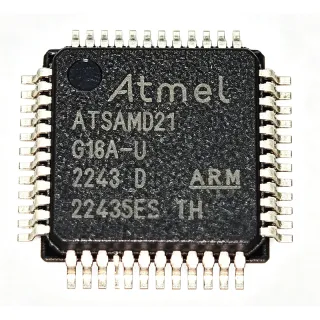
ATMXT1536E-M-CUR - maXTouch Capacitive Touch Sensor IC | Microchip
MPN: ATMXT1536E-M-CUR ✓ Active| Qty | Unit Price | Extended |
|---|---|---|
| 1 | $0 | $0.00 |
| 10 | $0 | $0.00 |
| 100 | $0 | $0.00 |
| 500 | $0 | $0.00 |
| 1,000 | $0 | $0.00 |
ATMXT1536E-M-CUR Overview
A capacitive touch controller is a type of sensor interface IC within the broader hierarchy of human-machine interface (HMI) semiconductors: sensor IC -> interface IC -> mixed-signal IC -> semiconductor. Projected-capacitive (PCAP) technology detects finger position by measuring changes in an electric field across an X-Y electrode grid, enabling multi-touch gestures through glass or plastic overlays. The maXTouch E-series targets mid-size touch panels such as smart-home control panels, appliances, automotive HMI sub-panels, and industrial touch surfaces.
Key features of the ATMXT1536E-M-CUR include high channel-count mutual-capacitance scanning for multi-finger tracking, Microchip's proprietary touch-decision algorithms that reject water and noise interference, an I2C-compatible host interface for straightforward MCU integration, and operation from a low-voltage supply suitable for battery-powered and 3.3V embedded designs. The device supports flexible electrode pattern configuration through in-system firmware objects, allowing OEMs to tune sensitivity, report rates, and gesture behavior without hardware redesign.
Architecturally, maXTouch E-series devices pair an analog front-end (AFE) with a digital signal processing core that performs baseline tracking, touch detection, and noise filtering, including frequency-hopping against charger-mode common-mode noise. Configurable object tables reside in nonvolatile memory and can be rewritten via the I2C bus during production calibration.
Typical applications include capacitive touch buttons and sliders on appliance control panels, touchscreen interfaces in smart thermostats and home-automation keypads, and industrial HMI front-ends where glove operation or wet-finger robustness is required.
When designing with this controller, follow Microchip's layout guidance: route sensor traces away from switching regulators, keep the sensor-to-IC traces short and matched, and allocate ground islands per the reference design to maximize signal-to-noise ratio.
This page adds value beyond the datasheet by consolidating distributor sourcing links, verified lifecycle status, design and layout guidance, and drop-in family alternatives in one engineering-ready reference.
Drop-in alternatives for ATMXT1536E-M-CUR — same package, pin-to-pin compatible. Different-package parts requiring PCB rework are excluded.
Quick Comparison Tool — Select alternative parts for side-by-side comparison:
ATMXT1536E-M-UR
✅ Drop-In ⚠️ 参数待验证📋 Reference alternative (not in catalog)
ATMXT1536E-M-C2UR
✅ Drop-In ⚠️ 参数待验证📋 Reference alternative (not in catalog)
ATMXT1536-M-CUR
✅ Drop-In ⚠️ 参数待验证📋 Reference alternative (not in catalog)
ATMXT1664S-M-CUR
✅ Drop-In ⚠️ 参数待验证📋 Reference alternative (not in catalog)
ATMXT1667T-M-CUR
✅ Drop-In ⚠️ 参数待验证📋 Reference alternative (not in catalog)
ATMXT1536E-M-CUR Maximum Ratings & Electrical Characteristics
| Product Type | Capacitive Touch Sensor IC (maXTouch E-series) |
| Manufacturer | Microchip Technology |
| Touch Technology | Projected capacitive (self and mutual capacitance) |
| Interface Type | I2C |
| Mounting Type | Surface Mount |
| Lifecycle Status | Active |
| Water Rejection | Supported (maXTouch E-series noise/water algorithms) |
ATMXT1536E-M-CUR standard Pin Configuration Guide
Pin configuration for ATMXT1536E-M-CUR (standard package). Pin numbering, functions, and connection diagrams are defined in the manufacturer datasheet. Refer to it for the exact footprint and soldering guidelines.

No detailed pinout data available for ATMXT1536E-M-CUR.
Refer to the datasheet for full pin configuration.
Typical Applications
ATMXT1536E-M-CUR is suitable for 6 applications: Smart Home Control Panels, Home Appliance Touch Controls, Industrial HMI Front Panels, Capacitive Buttons and Sliders on Consumer Devices, Touchscreen Control in Medical and Diagnostic Devices, Automotive Interior HMI Sub-Panels.
Smart Home Control Panels
The ATMXT1536E-M-CUR fits smart-home wall panels and thermostats where a mid-size projected-capacitive touch surface must work reliably through glass or plastic overlays. Its maXTouch E-series self/mutual-capacitance scanning supports multi-finger gestures such as swipes and pinch, while Microchip's noise-rejection algorithms maintain accuracy near Wi-Fi modules and switching power supplies commonly present in connected-home hardware. The controller offloads touch processing from the host MCU via the I2C interface and interrupt line, so a low-cost host processor can manage connectivity and UI rendering. Configuration objects can be tuned during production to match overlay thickness and electrode geometry, and water-rejection behavior prevents false triggers from condensation in kitchens and bathrooms, reducing field-failure risk in always-on installations.
Recommended
Home Appliance Touch Controls
Ovens, cooktops, washing machines, and refrigerators increasingly replace mechanical buttons with glass-front capacitive controls, and the ATMXT1536E-M-CUR addresses this domain directly. Its mutual-capacitance scanning detects touch through thick overlays, and the E-series water and noise rejection algorithms suppress false touches from boiling water, wet fingers, or electromagnetic interference from inverter motors and induction heating. The controller's configurable electrode layout supports sliders and wheels for power and temperature settings in addition to discrete buttons. Because the maXTouch firmware handles baseline drift compensation automatically, touch accuracy remains stable across temperature swings typical of kitchen environments. The I2C host interface integrates cleanly with appliance main controllers, and in-field firmware object tuning lets appliance OEMs recalibrate sensitivity without hardware changes during model refreshes.
Recommended
Industrial HMI Front Panels
Factory equipment, machine control terminals, and test instruments need touch interfaces that survive gloves, dust, and electrically noisy cabinets. The ATMXT1536E-M-CUR's projected-capacitive architecture with Microchip's touch-decision algorithms provides glove-mode operation via sensitivity tuning and frequency-hopping noise immunity against VFDs, servo drives, and switch-mode supplies typical on industrial floors. The controller reports processed touch data over I2C so the industrial host processor can concentrate on control logic and fieldbus communication. Its surface-mount construction suits conformal-coated, vibration-rated assemblies, and object-table configuration enables OEMs to qualify one touch design across multiple product variants. Long Microchip lifecycle support matters here, since industrial products often require 5-10 year availability commitments that the Active-lifecycle maXTouch E-series family helps satisfy.
Recommended
Capacitive Buttons and Sliders on Consumer Devices
For white goods trim panels, audio equipment, and personal-care devices, the ATMXT1536E-M-CUR implements capacitive buttons, sliders, and wheels on a single controller, replacing multiple discrete touch ICs. Its self-capacitance mode efficiently serves low-channel-count button arrays with low power consumption, while the same die scales to mutual-capacitance sliders for volume or brightness control with smooth positional resolution. The E-series baseline tracking compensates for overlay aging and temperature drift, keeping activation thresholds stable over the product lifetime. The I2C interface and CHG interrupt minimize host firmware complexity, and Microchip's configuration objects allow per-product tuning of touch thresholds, debounce, and report rates. LED backlighting synchronization and proximity wake-up features can further reduce system standby power in battery-powered consumer designs.
Recommended
Touchscreen Control in Medical and Diagnostic Devices
Benchtop diagnostic instruments, patient monitors, and medical control panels benefit from the ATMXT1536E-M-CUR's combination of reliable touch detection and clean-surface operation, since capacitive glass fronts can be wiped down easily, unlike mechanical keypads with crevices. The maXTouch E-series noise rejection maintains touch accuracy near the switching supplies and RF electronics found in medical equipment, and configurable sensitivity supports gloved operation in clinical settings. Its processed I2C touch output simplifies software certification because the host firmware receives validated touch coordinates rather than raw sensor data. Microchip's documented configuration interface and long-term availability support the design-history documentation and supply continuity demands of medical device manufacturers, while the controller's deterministic reporting rate aids responsive, predictable user interfaces in monitoring applications.
Recommended
Automotive Interior HMI Sub-Panels
Secondary automotive touch surfaces - climate control strips, door panels, steering-wheel buttons, and overhead consoles - are migrating to capacitive technology, and the maXTouch E-series architecture addresses this segment where a qualified variant is selected. The ATMXT1536E-M-CUR's underlying technology provides water rejection for rain-condensation scenarios, noise immunity against charger and CAN/LIN transceiver common-mode noise, and glove-compatible sensitivity tuning. The I2C interface connects naturally to body-domain controllers, and object-based configuration allows one platform touch module to be reused across vehicle trim levels with different electrode layouts. Verify the specific ordering suffix for automotive temperature-grade and AEC-Q100 qualification before committing the part to a vehicle program, as qualification grade is encoded in the Microchip ordering code rather than the base part number.
Recommended
Recommended Products Summary
Engineering reference data for ATMXT1536E-M-CUR — comparison, design guidance, and compliance information.
Selection Guide
Comparison with Alternatives
| Parameter | This Product | ATMXT1536E-M-UR | ATMXT1664S-M-CUR | ATMXT1667T-M-CUR |
|---|---|---|---|---|
| Brand | Microchip Technology | Microchip Technology | Microchip Technology | Microchip Technology |
| Touch Technology | Projected capacitive (self + mutual) | Projected capacitive (self + mutual) | Projected capacitive (self + mutual) | Projected capacitive (self + mutual) |
| Host Interface | I2C | I2C | I2C | I2C |
| Channel Configuration | 1536E configuration | 1536E configuration - same | 1664S configuration - different tier | 1667T configuration - different tier |
| Water/Noise Rejection | E-series algorithms | E-series algorithms - same | E-series algorithms | T-series algorithms - feature set differs |
Key Differentiators
- E-series water and noise rejection algorithms (vs ATMXT1536-M-CUR (non-E family member))
- Offloads touch processing from host MCU (vs General-purpose MCU with built-in touch peripheral (e.g., ATMEGA88PA PTC))
- Single-vendor silicon-to-firmware ecosystem (vs Cross-brand touch controllers (Infineon TrueTouch, FocalTech))
Design Notes
Follow Microchip's maXTouch hardware design guidelines strictly: route sensor electrode traces as short and uniform as possible, keep them away from switching regulators, display flex cables, and RF antennas, and maintain a solid ground reference beneath trace routing. Hatched ground with the hatch pitch specified in the reference design is preferred under the sensor area to reduce parasitic capacitance while preserving shielding. Consistent trace length and geometry across channels simplifies per-channel calibration and improves mutual-capacitance baseline uniformity across the panel.
The ATMXT1536E-M-CUR's noise rejection works best when the analog front-end supply is clean. Power the touch controller from a dedicated LDO or filtered rail rather than sharing a buck-converter output with motors or RF modules. Add the decoupling capacitance specified in the datasheet directly at the supply pins, and if charger-mode noise is expected (USB-powered products), enable the device's frequency-hopping configuration object during production tuning. Poor supply hygiene is the most common root cause of jittery touch reporting in field returns.
Do not treat the ordering-code suffixes as interchangeable: suffix characters in the ATMXT1536E-M-CUR encode packaging form, moisture-sensitivity level, and shipping quantity, and qualification grade differences (industrial vs automotive) may also be suffix-encoded. Verify the exact suffix meaning in the Microchip ordering-information table before substituting a similarly named part. Also allocate production calibration time: maXTouch devices require per-panel configuration of sensitivity, report rate, and water-rejection objects, and skipping this tuning step on first articles is a frequent cause of poor touch performance.
Compliance Information
Compliance status not explicitly stated in verified distributor data. Confirm RoHS/REACH/lead-free status on the official Microchip product page or material declaration document before procurement.