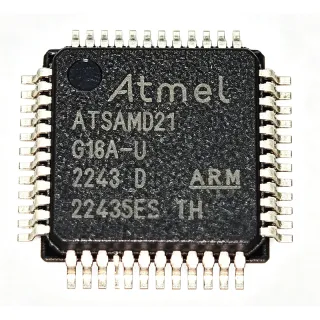
ATSAM4LS4AA-AU - 48MHz Cortex-M4 MCU 256KB Flash | Microchip
MPN: ATSAM4LS4AA-AU ✓ Active| Qty | Unit Price | Extended |
|---|---|---|
| 1 | $6.92 | $6.92 |
| 10 | $6.3 | $63.00 |
| 100 | $5.75 | $575.00 |
| 500 | $5.4 | $2,700.00 |
| 1,000 | $5.1 | $5,100.00 |
ATSAM4LS4AA-AU Overview
A microcontroller unit (MCU) integrates a processor core, memory, and peripherals on a single chip, sitting at the center of the embedded systems hierarchy: semiconductor -> integrated circuit -> microcontroller -> 32-bit ARM-based MCU. MCUs replace discrete processor-plus-peripherals combinations in cost- and power-sensitive designs.
Key features include the Cortex-M4 core with DSP instructions and FPU-class math support at 48 MHz, 256KB Flash with a dual-bank safe architecture, 16KB SRAM plus an additional 32KB... . The device provides a USB device port, a Peripheral Event System for inter-peripheral signaling without CPU intervention, and SleepWalking, which lets peripherals wake and act while the core sleeps.
The ATSAM4LS4AA-AU uses the picoPower-class SAM4L architecture with multiple sleep modes and hierarchical clock gating, achieving 1.5 uA in sleep mode. Data written into a RAM-based cache plus a Flash accelerator keeps core cycle efficiency high at 48 MHz.
Typical applications are battery-powered sensor nodes, wearable and portable medical devices, USB-connected instrument front ends, and low-power industrial monitoring where long battery life and fast wake-up dominate the design.
Design consideration: budget the 90 uA/MHz active current against total system duty cycle; frequent wake-ups favor this device because wake-up takes only 1.5 us.
This page synthesizes distributor pricing, drop-in alternatives, and practical design notes not found in the manufacturer datasheet.
Drop-in alternatives for ATSAM4LS4AA-AU — same package, pin-to-pin compatible. Different-package parts requiring PCB rework are excluded.
Variants in this series
Same-series models that are drop-in compatible with ATSAM4LS4AA-AU (same form factor and footprint) — differing in Wake-up Time, Core Processor, Package, Series, Flash Memory.
Quick Comparison Tool — Select alternative parts for side-by-side comparison:
No drop-in alternatives available for this product.
Request AlternativesATSAM4LS4AA-AU Maximum Ratings & Electrical Characteristics
| Core Processor | ARM Cortex-M4 |
| Core Size | 32-bit |
| Maximum Clock Frequency | 48 MHz |
| Flash Memory Size | 256 KB (256K x 8) |
| Active Mode Current | 90 uA/MHz |
| Sleep Mode Current | 1.5 uA |
| Wake-up Time | 1.5 us |
| Package | 48-TQFP (7x7 mm) |
| Mounting Type | Surface Mount |
| USB | USB Device |
| Peripheral Event System | Yes |
| SleepWalking | Yes |
| Security | Crypto peripherals (per Mouser listing: CRYPTO) |
| Packaging Option | Tray (per Mouser MRL listing) |
ATSAM4LS4AA-AU 48-tqfp (7x7 mm) Pin Configuration Guide
Pin configuration for ATSAM4LS4AA-AU (48-tqfp (7x7 mm) package). This digital IC includes GPIO, communication interfaces (UART, SPI, I2C), and power pins. Refer to the manufacturer datasheet for alternate pin functions and configuration options. Essential for embedded system design and PCB layout.

No detailed pinout data available for ATSAM4LS4AA-AU.
Refer to the datasheet for full pin configuration.
Typical Applications
ATSAM4LS4AA-AU is suitable for 6 applications: Battery-Powered Sensor Nodes, USB-Connected Instruments and Dongles, Wearable and Portable Medical Devices, Industrial Condition Monitoring, Smart Metering and Energy Monitoring, Consumer IoT and Smart Home Hubs.
Battery-Powered Sensor Nodes
The ATSAM4LS4AA-AU fits battery-powered wireless sensor nodes because average current, not peak speed, dominates battery life in duty-cycled sensing. Its 90 uA/MHz active current and 1.5 uA sleep current allow the node to sleep most of the time and burst at 48 MHz when sampling or transmitting. The 1.5 us wake-up time is fast enough that radio or ADC startup dominates, not MCU wake, eliminating the common penalty of sleeping deeply. With SleepWalking, the ADC and timer peripherals capture samples while the core remains in sleep, further cutting average draw to microamp levels in periodic-measurement applications such as environmental monitoring.
Recommended
USB-Connected Instruments and Dongles
The integrated USB device controller makes the ATSAM4LS4AA-AU a strong fit for USB dongles, sensor bridges, and bench instrument front ends that enumerate and stream data to a host PC. The 256KB Flash accommodates USB protocol stacks plus application logic without external memory, and the Cortex-M4 core handles data formatting at 48 MHz. Because the SAM4L USB peripheral can operate under SleepWalking-style event control, the MCU can stay in low-power sleep between host transactions, reducing standby current in always-plugged USB accessories. The 48-TQFP 7x7 mm package keeps the mechanical footprint small enough for thumb-drive-class enclosures.
Recommended
Wearable and Portable Medical Devices
Wearable medical devices such as vital-sign monitors and activity trackers benefit directly from the ATSAM4LS4AA-AU's power profile: 90 uA/MHz active, 1.5 uA sleep, and 1.5 us wake-up let the device sample heart-rate or motion signals hundreds of times per second while averaging only tens of microamps. The Peripheral Event System routes ADC results to comparators or timers without CPU involvement, supporting always-on biosignal monitoring. Per Mouser's listing, the part is offered in industrial temperature grade, supporting body-worn product reliability testing. The 7x7 mm TQFP is hand-assemblable for prototyping yet compact for wearables.
Recommended
Industrial Condition Monitoring
In industrial condition-monitoring equipment, the ATSAM4LS4AA-AU periodically samples vibration, temperature, or current sensors and reports over wired or wireless links. The industrial temperature rating noted in Mouser's listing supports factory-floor environments, while the Cortex-M4 core at 48 MHz runs FFT-based vibration analysis locally, sending only result summaries rather than raw waveforms. SleepWalking allows the timer and ADC to operate autonomously between measurement windows, keeping standby current at 1.5 uA in battery- or energy-harvesting-powered installations. The 256KB Flash holds DSP libraries, communication stacks, and calibration tables without external storage.
Recommended
Smart Metering and Energy Monitoring
Smart meter front ends require continuous sampling with long battery backup life, a combination the ATSAM4LS4AA-AU serves well. The 48 MHz Cortex-M4 core executes metering algorithms including RMS computation and harmonic analysis with DSP instructions, while SleepWalking lets the ADC and RTC peripherals maintain measurement schedules at microamp average current. The 1.5 us wake-up ensures no samples are missed when the core resumes. Per the Microchip product page, the SAM4L family achieves the lowest active power of any Cortex-M4 device, directly translating to longer backup-battery life in metering deployments where 10+ year field life is expected.
Recommended
Consumer IoT and Smart Home Hubs
Smart-home sensor peripherals - door/window contacts, motion detectors, remote controls - are classic ultra-low-power MCU loads for the ATSAM4LS4AA-AU. The device spends nearly all time in 1.5 uA sleep, wakes in 1.5 us on a button press or radio interrupt, and uses the Peripheral Event System to debounce inputs and sequence tasks with minimal CPU time. The USB device port supports configuration and firmware-update connections to a host. The 48-TQFP 7x7 mm package with industrial temperature grade (per Mouser) covers both indoor electronics and garage/outdoor sensor placements common in smart-home deployments.
Recommended
Recommended Products Summary
Engineering reference data for ATSAM4LS4AA-AU — comparison, design guidance, and compliance information.
Selection Guide
Comparison with Alternatives
| Parameter | This Product | ATSAM4LS4BA-AU | ATSAM4LC4AA-AU | ATSAM3S4AA-AU |
|---|---|---|---|---|
| Package | 48-TQFP (7x7 mm) | 48-TQFP (7x7 mm) - same | 48-TQFP (7x7 mm) - same | 48-TQFP (7x7 mm) - same |
| Brand | Microchip Technology | Microchip Technology | Microchip Technology | Microchip Technology |
| CPU Core | ARM Cortex-M4 | ARM Cortex-M4 | ARM Cortex-M4 | ARM Cortex-M3 |
| Flash Memory | 256 KB | 128 KB | 256 KB | 128 KB |
| Hardware Crypto | No (LS variant; Mouser lists CRYPTO for family) | No | Yes (LC Crypto variant) | No |
| USB Device | Yes | Yes | Yes | Yes |
Key Differentiators
- Best-in-class active power in any Cortex-M4 device (vs ATSAM3S4AA-AU)
- Double the Flash of the smaller same-footprint variant (vs ATSAM4LS4BA-AU)
- Cost-optimized versus the Crypto variant when security is not required (vs ATSAM4LC4AA-AU)
Design Notes
Budget power around duty cycle, not peak current. At 90 uA/MHz, running the 48 MHz core continuously draws roughly 4.3 mA (estimated: 90 uA/MHz x 48 MHz); a 10% duty cycle drops the average CPU current to about 0.43 mA before peripherals. For battery designs, place the MCU in the deepest appropriate sleep mode between events and rely on the 1.5 us wake-up so sleep depth can be aggressive. Use SleepWalking so ADC and timers sample autonomously while the core sleeps - this is the single largest average-current saving the SAM4L architecture offers.
Decouple every VDDIO/VDDCORE/VDDIN pin pair with 100 nF ceramics placed within 2 mm of the pins, and add bulk 4.7-10 uF near the supply entry. Keep the USB D+/D- traces as a 90-ohm differential pair routed away from the crystal. Use 1% load capacitors matched to the crystal specification on XIN32/XOUT32, since the 32 kHz RTC crystal accuracy directly determines long-term sleep-mode timing and wake-up scheduling in duty-cycled applications.
Do not assume Flash size portability across family members: the pin-compatible ATSAM4LS4BA-AU has 128KB versus this part's 256KB, and the ATSAM3S4AA-AU is a Cortex-M3 without M4 DSP instructions - code using DSP intrinsics or the FPU-class math pipeline will not compile or will run far slower. When substituting, regenerate linker scripts for the reduced Flash/SRAM and re-verify analog peripheral mapping, since multiplexed pin functions differ between SAM3S and SAM4L despite the shared TQFP-48 footprint.
Compliance Information
Mouser listing notes 'Green' packaging for this part; explicit RoHS/REACH declarations not present in provided data - verify on Microchip's product compliance page.