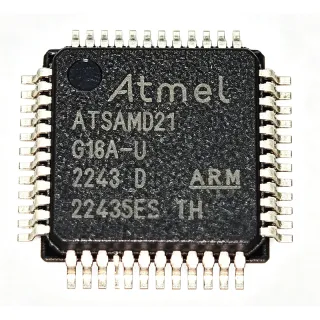
ATSAM4LC4AA-AU - 48MHz Cortex-M4 256KB Flash MCU | Microchip
MPN: ATSAM4LC4AA-AU ✓ Active| Qty | Unit Price | Extended |
|---|---|---|
| 1 | $0 | $0.00 |
| 10 | $0 | $0.00 |
| 100 | $0 | $0.00 |
| 500 | $0 | $0.00 |
| 1,000 | $0 | $0.00 |
ATSAM4LC4AA-AU Overview
A microcontroller (MCU) is a single-chip integrated circuit that combines a processor core, program memory, data memory, and peripherals into one device, forming the lowest layer of the embedded-system hierarchy above discrete logic and below application processors. The SAM4L series belongs to Microchip's ARM-based flash MCU portfolio and targets ultra-low-power embedded applications where battery life and wake-up responsiveness dominate the design.
The defining strength of the ATSAM4LC4AA-AU is power efficiency: it delivers approximately 90 uA/MHz in active mode, 1.5 uA in sleep mode, and one of the shortest wake-up times in any Cortex-M4-based device at down to 1.5 microseconds. These figures allow duty-cycled battery products to spend most of their life asleep yet react near-instantly to events. The supply voltage range is 1.68 V to 3.6 V, accommodating single-cell lithium and 3.3 V rails directly.
The ARM Cortex-M4 core provides 32-bit RISC execution with DSP-oriented instructions, enabling efficient signal processing such as sensor filtering without a separate DSP. The SAM4L family architecture integrates a flexible power management controller with multiple sleep modes, letting firmware gate clocks and domains per peripheral. Flash memory of 256 KB is executed in place, and the 32 KB SRAM supports buffering for wireless stacks and data logging.
Typical applications include battery-powered IoT sensor nodes, portable medical and measurement instruments, capacitive-touch human-machine interfaces, and industrial sensing endpoints where 90 uA/MHz active current directly extends field life. The 48 MHz performance headroom also suits lightweight motor control and data-acquisition tasks.
A key design consideration is that the SAM4L platform uses a 1.8 V to 3.3 V logic domain; interface 5 V systems through level shifters. Enable the device's low-power sleep modes and per-peripheral clock gating in firmware to realize the datasheet current figures.
This page synthesizes distributor availability data, same-family drop-in options, pricing guidance, and practical design notes beyond what the manufacturer datasheet alone provides.
Drop-in alternatives for ATSAM4LC4AA-AU — same package, pin-to-pin compatible. Different-package parts requiring PCB rework are excluded.
Variants in this series
Same-series models that are drop-in compatible with ATSAM4LC4AA-AU (same form factor and footprint) — differing in Wake-up Time, Core Processor, Package, Flash Memory, Series.
Quick Comparison Tool — Select alternative parts for side-by-side comparison:
ATSAM4LC2AA-AU
✅ Drop-In ⚠️ 参数待验证✓ In Stock
$4.05 / Unit
View Datasheet →ATSAM4LS4AA-AU
✅ Drop-In ⚠️ 参数待验证✓ In Stock
$5.1 / Unit
View Datasheet →ATSAM4LS2AA-AU
✅ Drop-In ⚠️ 参数待验证✓ In Stock
$5.39 / Unit
View Datasheet →ATSAM4LC4AA-AUR
✅ Drop-In📋 Reference alternative (not in catalog)
ATSAM4LC4AA-AU Maximum Ratings & Electrical Characteristics
| Core Processor | ARM Cortex-M4 |
| Core Size | 32-Bit |
| Maximum Clock Frequency | 48 MHz |
| Program Memory Size | 256 KB (256K x 8) FLASH |
| RAM Size | 32 KB (32K x 8) |
| Supply Voltage Range | 1.68 V to 3.6 V |
| Active Mode Current | 90 uA/MHz |
| Sleep Mode Current | 1.5 uA |
| Wake-up Time | 1.5 us (down to) |
| Operating Temperature | -40C to +85C (TA) |
| Package | 48-TQFP (7x7 mm) |
| Mounting Type | Surface Mount |
| Number of Pins | 48 |
| Series | SAM4L |
| Program Memory Type | FLASH |
| Packaging | Tray |
ATSAM4LC4AA-AU 48-tqfp (7x7 mm) Pin Configuration Guide
Pin configuration for ATSAM4LC4AA-AU (48-tqfp (7x7 mm) package). This digital IC includes GPIO, communication interfaces (UART, SPI, I2C), and power pins. Refer to the manufacturer datasheet for alternate pin functions and configuration options. Essential for embedded system design and PCB layout.

No detailed pinout data available for ATSAM4LC4AA-AU.
Refer to the datasheet for full pin configuration.
Typical Applications
ATSAM4LC4AA-AU is suitable for 6 applications: Battery-Powered IoT Sensor Nodes, Portable and Wearable Instruments, Capacitive Touch Human-Machine Interfaces, Industrial Sensing Endpoints, Smart Metering and Data Logging, Portable Audio and Signal Acquisition.
Battery-Powered IoT Sensor Nodes
The ATSAM4LC4AA-AU fits battery-powered IoT sensor nodes because its 90 uA/MHz active current and 1.5 uA sleep current directly translate into years of field life from a small cell. The 1.5 us wake-up time means the MCU can sleep between sensor samples and radio transmissions without missing events, and the 48 MHz Cortex-M4 core processes filtering and packet assembly quickly enough to return to sleep within milliseconds. With 256 KB FLASH and 32 KB SRAM, a full low-power wireless stack plus sensor drivers fits on-chip. Supplying the device from a 1.68 V to 3.6 V rail allows direct connection to lithium or 3.3 V regulator outputs, simplifying the power tree in coin-cell and single-cell designs.
Recommended
Portable and Wearable Instruments
Wearable and hand-held instruments benefit from the ATSAM4LC4AA-AU because every microamp of average current extends battery size savings and product runtime. At 1.5 uA in sleep and 90 uA/MHz active, the MCU spends most of its life idle, waking in 1.5 us to acquire a measurement, run DSP filtering on the Cortex-M4 core, and update a display. The 256 KB FLASH stores instrument firmware, calibration tables, and logging code, while 32 KB SRAM buffers acquisition data between transmissions. The compact 48-pin TQFP (7x7 mm) package suits dense wearable PCBs, and the -40C to +85C industrial temperature range covers body-worn products stored outdoors, from fitness sensors to portable medical monitors.
Recommended
Capacitive Touch Human-Machine Interfaces
The LC variant of the SAM4L family integrates a hardware capacitive-touch controller, making the ATSAM4LC4AA-AU a strong fit for touch-based control panels in appliances, thermostats, and industrial equipment. The 48 MHz Cortex-M4 executes touch-decision algorithms with fast wake-up, so keys respond instantly from sleep while the system still benefits from 1.5 uA standby current. With 256 KB FLASH, the device can run the touch library, a display driver, and application logic simultaneously without an external controller. The 1.68 V to 3.6 V supply range and 48-pin TQFP footprint allow compact single-chip touch HMI designs that previously needed a dedicated touch chip plus a separate MCU, reducing BOM count and cost.
Recommended
Industrial Sensing Endpoints
Industrial sensor endpoints - vibration, pressure, and environmental monitors - use the ATSAM4LC4AA-AU for its combination of DSP-capable 48 MHz Cortex-M4 processing and low duty-cycle power. FFT and filter computations run natively on the Cortex-M4 with DSP instructions, enabling on-node analytics that reduce network traffic. The -40C to +85C operating range matches industrial enclosures, and the 1.5 us wake-up allows event-driven sampling of intermittent signals without continuous polling. The 256 KB FLASH retains configuration and logging firmware through power cycles, and the 48-pin TQFP (7x7 mm) package provides enough GPIO and peripheral multiplexing for multiple sensor interfaces on a compact endpoint board within 3.3 V industrial rails.
Recommended
Smart Metering and Data Logging
Utility meters and data loggers demand years of battery operation plus sufficient compute for measurement algorithms, a balance the ATSAM4LC4AA-AU strikes with 90 uA/MHz active draw and 1.5 uA sleep draw. The device wakes in 1.5 us to capture consumption pulses or ADC samples, accumulates them in 32 KB SRAM, and periodically transmits summaries; the 256 KB FLASH stores tariff tables and firmware that can be updated in the field. Its 48 MHz performance headroom handles encryption for secure metering communication without an external crypto chip. Operating from 1.68 V to 3.6 V, the MCU connects directly to lithium thionyl-chloride cells common in meters, and the 7x7 mm TQFP suits sealed, compact meter housings.
Recommended
Portable Audio and Signal Acquisition
Portable audio recorders, biometric front ends, and general signal-acquisition products leverage the Cortex-M4 DSP instructions of the ATSAM4LC4AA-AU for real-time filtering, decimation, and encoding. At 48 MHz the core sustains sample-rate processing while drawing only 90 uA/MHz, so recorders achieve long runtime on small batteries. The 32 KB SRAM provides double-buffering between ADC capture and storage or radio transfer, and 256 KB FLASH holds codec firmware and menus. Wake-up from 1.5 uA sleep in 1.5 us enables voice-activity-triggered recording that misses nothing at the start of an event. The 1.68 V to 3.6 V supply and compact 48-pin TQFP integrate cleanly into hand-held, battery-powered enclosures.
Recommended
Recommended Products Summary
Engineering reference data for ATSAM4LC4AA-AU — comparison, design guidance, and compliance information.
Selection Guide
Comparison with Alternatives
| Parameter | This Product | ATSAM4LC2AA-AU | ATSAM4LS4AA-AU | ATSAM4LS2AA-AU | ATSAM4LC4AA-AUR |
|---|---|---|---|---|---|
| Package | 48-TQFP (7x7 mm) | 48-TQFP (7x7 mm) - same | 48-TQFP (7x7 mm) - same | 48-TQFP (7x7 mm) - same | 48-TQFP (7x7 mm) - same |
| Brand | Microchip Technology (Atmel) | Microchip Technology (Atmel) | Microchip Technology (Atmel) | Microchip Technology (Atmel) | Microchip Technology (Atmel) |
| Core | ARM Cortex-M4, 32-bit | ARM Cortex-M4, 32-bit | ARM Cortex-M4, 32-bit | ARM Cortex-M4, 32-bit | ARM Cortex-M4, 32-bit |
| Max Frequency | 48 MHz | 48 MHz | 48 MHz | 48 MHz | 48 MHz |
| FLASH | 256 KB | 128 KB | 256 KB | 128 KB | 256 KB |
| SRAM | 32 KB | 32 KB | 32 KB | 32 KB | 32 KB |
| Supply Voltage | 1.68 V to 3.6 V | 1.68 V to 3.6 V | 1.68 V to 3.6 V | 1.68 V to 3.6 V | 1.68 V to 3.6 V |
| Capacitive Touch Controller | Yes (LC variant, CATB) | Yes (LC variant) | No (LS variant) | No (LS variant) | Yes (LC variant) |
Key Differentiators
- Lowest active power in its Cortex-M4 flash MCU class (vs ATSAMD21G18A-AU)
- Double the FLASH of the cost-down variant (vs ATSAM4LC2AA-AU)
- Hardware capacitive-touch controller (vs ATSAM4LS4AA-AU)
Design Notes
To realize the datasheet 1.5 uA sleep current, firmware must gate clocks to all unused peripherals through the SAM4L power management controller and select the appropriate low-power sleep mode; leakage from external pull-ups on floating GPIOs can dominate total sleep current. Estimated: at a 1 percent duty cycle with 90 uA/MHz active operation for 1 ms every 100 ms, average current is roughly 0.45 uA plus sleep current, so coin-cell lifetime is sleep-current dominated. Verify measured sleep current against datasheet figures on the final PCB.
Place 100 nF ceramic decoupling capacitors at each VDD/VDDCORE pin pair as close to the 48-pin TQFP as possible, with one bulk 4.7 uF to 10 uF capacitor near the supply entry. The SAM4L internal LDO (VDDCORE) requires its specified output capacitor per the datasheet to maintain core stability during wake-up transitions. Keep the ground return path low-impedance with a solid ground plane, and route the 48 MHz system clock traces away from analog sensor inputs to preserve signal integrity.
The supply range is 1.68 V to 3.6 V - connecting a 5 V USB rail directly will damage the device; use an LDO or buck regulator. GPIOs are not specified as 5 V tolerant in the provided data, so 5 V logic interfaces require level shifting. Additionally, note the distinction between the LC and LS variants: firmware relying on the capacitive-touch controller will fail on LS-family pin-compatible parts, so lock the variant choice before PCB release.
For applications using the Cortex-M4 DSP instructions on fast ADC streams, minimize trace length between the MCU and analog front end, and star-ground analog references away from the 48 MHz digital switching domain. The 7x7 mm TQFP has fine 0.5 mm pin pitch - inspect solder joints with X-ray or AOI for volume production, and specify the -AUR tape-and-reel version for automated assembly to avoid tray-handling orientation errors.
Compliance Information
Compliance status was not stated in the provided web data; verify RoHS/REACH status on the Microchip product page before ordering. AEC-Q100 marked not_applicable pending confirmation - automotive variants, if any, carry separate ordering codes.