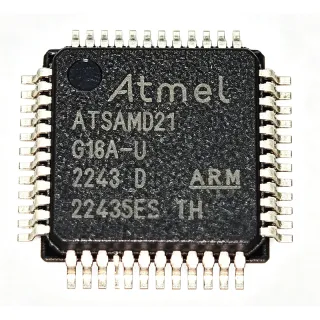
ATSAMD20G15A-ANT - 48MHz Cortex-M0+ MCU, 32KB Flash | TQFP-48 | Microchip
MPN: ATSAMD20G15A-ANT ✓ Active| Qty | Unit Price | Extended |
|---|---|---|
| 1 | $2.85 | $2.85 |
| 10 | $2.55 | $25.50 |
| 100 | $2.21 | $221.00 |
| 500 | $1.93 | $965.00 |
| 1,000 | $1.68 | $1,680.00 |
ATSAMD20G15A-ANT Overview
A microcontroller (MCU) is a single-chip computer that integrates a CPU core, program memory (flash), working memory (SRAM), and programmable peripherals on one silicon die. The Cortex-M0+ core sits at the low-power end of the ARM Cortex-M family, balancing deterministic performance with minimal energy per instruction. Microcontrollers in this class form the foundation of embedded systems spanning home automation, metering, consumer electronics, and industrial sensors, where deterministic real-time response and low standby current are essential.
Key features of the ATSAMD20G15G15 include an Event System that lets peripherals trigger each other without CPU intervention, reducing latency and current consumption, plus a SleepWalking capability that allows peripherals to operate while the CPU remains in deep sleep. The integrated PTC supports capacitive touch sensing, eliminating external touch controller ICs in many HMI designs. The SERCOM modules can be software-configured as UART, SPI, I2C, or LIN, giving designers maximum flexibility in a 48-pin budget.
The device uses a 32-bit ARM Cortex-M0+ core built on a low-power CMOS process, with a 2.62 mA/MHz active current and multiple low-power modes down to deep sleep with full SRAM retention. The 12-bit ADC provides up to 350 ksps throughput across up to 14 channels, and the 10-bit DAC supports audio and waveform generation. Brown-out detection, watchdog timer, and RTC with calendar mode support battery-backed timekeeping.
Typical applications include home automation devices, smart metering endpoints, consumer HMI with capacitive touch, industrial sensor nodes, low-cost wearables, and battery-powered IoT edge nodes. The wide 1.6V-3.6V supply range supports both single-cell Li-ion and 3.3V regulated rails. AEC-Q100 qualification is not part of this specific suffix; consult the -AUT variant for automotive grade.
When designing with this device, verify that your 48-pin TQFP land pattern matches the published mechanical drawing, and consider migrating to the -AUT suffix for environments requiring -40C to +125C AEC-Q100 qualification. This page consolidates distributor pricing, drop-in pin-compatible alternatives, and practical design guidance not collated in the manufacturer datasheet.
Drop-in alternatives for ATSAMD20G15A-ANT — same package, pin-to-pin compatible. Different-package parts requiring PCB rework are excluded.
Variants in this series
Same-series models that are drop-in compatible with ATSAMD20G15A-ANT (same form factor and footprint) — differing in ADC, DAC, Operating Temperature, RTC, SERCOM Modules.
Quick Comparison Tool — Select alternative parts for side-by-side comparison:
ATSAMD20G15A-AUT
✅ Drop-In📋 Reference alternative (not in catalog)
ATSAMD20G15A-MUT
✅ Drop-In✓ In Stock
$1.85 / Unit
View Datasheet →ATSAMD20G14A-ANT
✅ Drop-In📋 Reference alternative (not in catalog)
ATSAMD20G14B-MUT
✅ Drop-In ⚠️ 参数待验证✓ In Stock
$1.1 / Unit
View Datasheet →ATSAMD20E15A-MUT
✅ Drop-In ⚠️ 参数待验证📋 Reference alternative (not in catalog)
ATSAMD20G15A-ANT Maximum Ratings & Electrical Characteristics
| Core | ARM Cortex-M0+ 32-bit |
| Maximum CPU Clock | 48 MHz |
| Flash Program Memory | 32 KB |
| SRAM | 4 KB |
| Supply Voltage (VDDIN) | 1.6 V to 3.6 V |
| Operating Temperature | -40 C to +105 C (industrial) |
| ADC | 12-bit, up to 14 channels |
| DAC | 10-bit, 1 channel |
| Touch Controller (PTC) | 256-channel Peripheral Touch Controller |
| SERCOM Modules | Up to 6 configurable (UART/SPI/I2C/LIN) |
| RTC | Yes, with calendar mode |
| Event System | Yes (peripheral-to-peripheral) |
| Package | 48-pin TQFP (7x7 mm) |
| Mounting Type | Surface Mount |
| MSL Level | MSL3 (per JEDEC J-STD-020) |
| RoHS Status | Compliant (Pb-free) |
| AEC-Q100 Qualification | Not qualified (industrial grade) |
ATSAMD20G15A-ANT Pin Configuration
| Pin 1 | VDDIO — Digital I/O supply voltage |
| Pin 2 | PA02 — GPIO / ADC AIN[0] |
| Pin 3 | PA03 — GPIO / ADC AIN[1] / DAC VOUT |
| Pin 4 | PA04 — GPIO / VREF |
| Pin 5 | PA05 — GPIO |
| Pin 6 | PA06 — GPIO / PTC Y[6] |
| Pin 7 | PA07 — GPIO / PTC X[7] |
| Pin 8 | VDDIN — Main voltage supply input |
| Pin 9 | GND — Ground |
| Pin 10 | PA08 — GPIO / PTC X[8] |
| Pin 11 | PA09 — GPIO / PTC X[9] / SERCOM |
| Pin 12 | PA10 — GPIO / PTC Y[10] |
| Pin 13 | PA11 — GPIO / PTC X[11] / SERCOM |
| Pin 14 | PA14 — GPIO / PTC X[14] / SERCOM |
| Pin 15 | PA15 — GPIO / PTC X[15] / SERCOM |
| Pin 16 | PA16 — GPIO / PTC Y[16] |
| Pin 17 | PA17 — GPIO / PTC Y[17] |
| Pin 18 | PA18 — GPIO / PTC X[18] |
| Pin 19 | PA19 — GPIO / PTC X[19] / SERCOM |
| Pin 20 | VDDIO — Digital I/O supply voltage |
| Pin 21 | GND — Ground |
| Pin 22 | PA20 — GPIO / PTC Y[20] |
| Pin 23 | PA21 — GPIO / PTC Y[21] / SERCOM |
| Pin 24 | PA22 — GPIO / PTC X[22] / SERCOM |
| Pin 25 | PA23 — GPIO / PTC X[23] |
| Pin 26 | PA24 — GPIO / USB DP (not bonded on this device) |
| Pin 27 | PA25 — GPIO / USB DM (not bonded on this device) |
| Pin 28 | RESETn — Reset input, active low |
| Pin 29 | PA27 — GPIO |
| Pin 30 | PA28 — GPIO |
| Pin 31 | GND — Ground |
| Pin 32 | VDDIO — Digital I/O supply voltage |
| Pin 33 | PB00 — GPIO |
| Pin 34 | PB01 — GPIO |
| Pin 35 | PB02 — GPIO / SERCOM |
| Pin 36 | PB03 — GPIO / SERCOM |
| Pin 34 | PB04 — GPIO |
| Pin 37 | PB05 — GPIO |
| Pin 38 | PB06 — GPIO |
| Pin 39 | PB07 — GPIO |
| Pin 40 | PB08 — GPIO / SERCOM |
| Pin 41 | PB09 — GPIO / SERCOM |
| Pin 42 | PB10 — GPIO / SERCOM |
| Pin 43 | PB11 — GPIO / SERCOM |
| Pin 44 | GND — Ground |
| Pin 45 | VDDIN — Main voltage supply input |
| Pin 46 | PA30 — GPIO / SWD CLK |
| Pin 47 | PA31 — GPIO / SWD IO |
| Pin 48 | GND — Ground |
Typical Applications
ATSAMD20G15A-ANT is suitable for 6 applications: Home Automation Hubs and Sensor Nodes, Smart Metering and Energy Monitoring, Consumer HMI with Capacitive Touch, Industrial Sensor and Process Monitor, Battery-Powered IoT Edge Devices, Automotive Body and Convenience Electronics.
Home Automation Hubs and Sensor Nodes
The ATSAMD20G15A-ANT suits home automation hubs, Zigbee/BLE endpoints, and wireless sensor nodes because its ARM Cortex-M0+ core at 48 MHz delivers responsive event handling while consuming only 2.62 mA/MHz active. The 32 KB flash accommodates protocol stacks like BLE Mesh or Zigbee cluster libraries with firmware headroom, and the 6 SERCOMs can be software-configured as UART for a host radio, SPI for an external sensor, and I2C for an environmental sensor. The 1.6-3.6 V supply range supports single-cell Li-ion battery operation directly, and SleepWalking allows peripherals to wake the CPU only when a sensor threshold is crossed, yielding months of battery life in typical thermostat or door sensor duty cycles. The integrated 256-channel PTC eliminates the need for an external touch controller in wall switches.
Recommended
Smart Metering and Energy Monitoring
The ATSAMD20G15A-ANT is well matched to smart electricity, water, and gas metering endpoints. Its 12-bit ADC at up to 350 ksps accurately samples current shunts or voltage dividers for energy calculation with sufficient resolution for Class 1 metering accuracy. The 4 KB SRAM buffers energy accumulation registers between RTC-timed logging events, while the 32 KB flash stores metering firmware with persistent calibration tables. The wide 1.6-3.6 V supply lets the MCU run directly from a single Li-ion or two AA cells, and the RTC with calendar mode enables time-of-use billing schedules. Brown-out detection and watchdog timer support long-term unattended operation in basement or outdoor installations where manual reset is impractical.
Recommended
Consumer HMI with Capacitive Touch
The ATSAMD20G15A-ANT integrates Microchip's 256-channel Peripheral Touch Controller (PTC) which scans up to 256 capacitive touch electrodes without an external touch controller IC. This drives down BOM cost in white goods, audio controls, induction cooktops, and small appliances where a 7-segment display plus touch keypad is the primary user interface. The PTC supports both self-capacitance and mutual-capacitance sensing topologies, with hardware-accelerated scanning and noise-immune acquisition that operates reliably under noisy SMPS environments. The 48 MHz Cortex-M0+ core runs the user interface logic and debounces touch events, while the 4 KB SRAM holds display buffers. Compared to a discrete touch controller approach, the integrated PTC saves both PCB area and approximately $0.40 per unit on the BOM.
Recommended
Industrial Sensor and Process Monitor
The ATSAMD20G15A-ANT fits industrial 4-20 mA loop-powered sensor transmitters, RTD/thermocouple conditioning front ends, and predictive maintenance sensor pods. Its -40C to +105 C industrial temperature range covers most factory floor environments, and the 12-bit ADC measures process variables with sufficient accuracy for non-precision control loops. The Event System lets a sensor ADC trigger SERCOM SPI upload without waking the CPU, reducing average power in battery-powered wireless sensor pods. The SERCOMs can be software-configured as RS-485 UART for legacy industrial busses or I2C for digital sensors, and the 6-channel configurability covers most 4-20 mA + HART-modem bridge designs. The wide supply range supports both 24V industrial rails via a regulator and battery-backed operation during line power loss.
Recommended
Battery-Powered IoT Edge Devices
The ATSAMD20G15A-ANT is ideal for battery-powered IoT edge nodes like environmental monitors, asset trackers, and wearable health bands. The 1.6-3.6 V supply range lets it run directly from a single CR2032 coin cell or Li-Po battery without an external regulator, and SleepWalking peripherals can monitor I2C sensors while the CPU remains in deep sleep. The ARM Cortex-M0+ core's Thumb-2 efficiency yields more MIPS per milliwatt than 8-bit MCUs, which extends coin-cell life by months in duty-cycled applications. The 32 KB flash comfortably fits BLE stack fragments or LoRaWAN MAC layer code, and the integrated 10-bit DAC enables audio cue generation or analog feedback signals without an external DAC IC.
Recommended
Automotive Body and Convenience Electronics
The ATSAMD20G15A-ANT supports non-safety automotive body electronics like HVAC control panels, seat adjustment switches, lighting dimmers, and door-zone controllers where AEC-Q100 grade is not strictly required. The 32 KB flash holds CAN node firmware with diagnostic UDS support, and the SERCOMs can be software-configured as CAN, SPI, or LIN interfaces for body-domain networks. The 12-bit ADC accurately reads potentiometers for HVAC blend doors and seat position, while the DAC drives analog gauge pointers in some instrument cluster sub-modules. For designs that must be AEC-Q100 qualified, migrate to the ATSAMD20G15A-AUT suffix which shares the same 48-pin TQFP footprint and pinout, enabling a single PCB design that supports both industrial and automotive variants.
Recommended
Recommended Products Summary
Engineering reference data for ATSAMD20G15A-ANT — comparison, design guidance, and compliance information.
Selection Guide
Comparison with Alternatives
| Parameter | This Product | ATSAMD20G15A-AUT | ATSAMD20G15A-MUT | ATSAMD20G14A-ANT |
|---|---|---|---|---|
| Brand | Microchip Technology | Microchip Technology | Microchip Technology | Microchip Technology |
| Package | 48-pin TQFP (7x7 mm) | 48-pin TQFP (7x7 mm) - same | 48-pin QFN (7x7 mm) - different footprint | 48-pin TQFP (7x7 mm) - same |
| Core / Architecture | ARM Cortex-M0+ 32-bit | ARM Cortex-M0+ 32-bit | ARM Cortex-M0+ 32-bit | ARM Cortex-M0+ 32-bit |
| Flash | 32 KB | 32 KB | 32 KB | 16 KB (-50%) |
| SRAM | 4 KB | 4 KB | 4 KB | 2 KB (-50%) |
| Operating Temperature | -40C to +105C (industrial) | -40C to +125C (automotive) | -40C to +125C (automotive) | -40C to +105C (industrial) |
| AEC-Q100 Qualification | Not qualified | Yes (automotive grade) | Yes (automotive grade) | Not qualified |
| PTC Touch Channels | 256 | 256 | 256 | 256 |
Key Differentiators
- Integrated 256-channel Peripheral Touch Controller (vs PIC16F636-I/ST)
- Six SERCOM-configurable serial interfaces (vs STM32F072C8T6)
- Cortex-M0+ at 48 MHz versus PIC16F at 20 MHz (vs PIC16F636-I/ST)
Design Notes
Place a 1uF X7R ceramic bypass capacitor within 2 mm of each VDDIN and VDDIO pin pair, with a 0.1uF ceramic placed immediately at the pin. The internal 1.2 V core regulator requires minimum 1uF bulk capacitance on VDDOUT. According to Microchip SAM D20 family design notes, starved VDDIO bypass causes brown-out events during peak ADC sampling, so do not omit the bulk capacitor.
Keep the 48-pin TQFP land pattern within 0.5 mm pitch with solder mask defined (SMD) pads. Route the RESETn line directly to a debugger header with no series resistance above 100 ohm to preserve SWD signal integrity. Keep the VDDIN traces at least 0.5 mm wide and decouple them within 5 mm of the pin to avoid ringing during peak load steps from the ADC or SERCOM switching.
Estimated: At VDDIN = 3.3 V and full 48 MHz active current of 2.62 mA/MHz, the device draws approximately 126 mA peak. Designers migrating from PIC16F or STM32F0 designs frequently omit the SERCOM MUX configuration in code, leaving all serial interfaces disabled at reset. Verify SERCOM pad configuration via the PORT and PMUX registers in startup code before enabling peripherals, or the firmware will hang at the first UART/SPI/I2C access.
When using the 12-bit ADC at sample rates above 100 ksps, add a 10 nF ceramic bypass capacitor on each AIN pin within 5 mm to limit switching charge injection noise. Per the SAM D20 datasheet ADC section, ADC accuracy degrades by 1-2 LSB if the source impedance exceeds 1 kohm. For high-impedance sensors use an external op-amp buffer rather than relying on the ADC input leakage current specification of 1 uA maximum.
Compliance Information
RoHS compliant per Microchip product page (Pb-free 48-pin TQFP). AEC-Q100 not applicable for industrial -ANT suffix; migrate to ATSAMD20G15A-AUT for automotive grade.