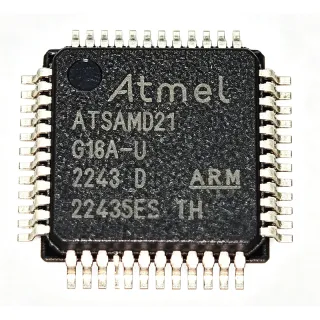
ATSAMD21G17A-AF - 48MHz Cortex-M0+ MCU 128KB Flash | Microchip
MPN: ATSAMD21G17A-AF ✓ Active| Qty | Unit Price | Extended |
|---|---|---|
| 1 | $3.45 | $3.45 |
| 10 | $3.1 | $31.00 |
| 100 | $2.75 | $275.00 |
| 500 | $2.4 | $1,200.00 |
| 1,000 | $2.15 | $2,150.00 |
ATSAMD21G17A-AF Overview
An ARM Cortex-M0+ microcontroller is a 32-bit embedded processor core built on the von Neumann/Thumb-2 instruction set, optimised for low gate count and energy efficiency. It sits within the hierarchy ARM core -> Cortex-M -> Cortex-M0+ -> microcontroller -> embedded SoC. The Cortex-M0+ is the smallest and most energy-efficient member of the Cortex-M family, delivering roughly 2.46 CoreMark/MHz while consuming far less power than Cortex-M3/M4 implementations.
Key features include 128 KB Flash with 4 KB Read-While-Write region, 16 KB SRAM, six SERCOM ports each configurable as UART/SPI/I2C, a 12-bit ADC with up to 350 ksps, a 10-bit DAC, two I2S interfaces, a 24-bit RTC, full-speed USB 2.0 device with embedded PHY, and an Event System for inter-peripheral signalling. The integrated 48 MHz DFLL with a 32 kHz crystal reference provides accurate clocking across temperature. Security features include a true random number generator, AES-256 hardware accelerator, and Flash content protection.
Architecturally the ATSAMD21G17A-AF pairs the Cortex-M0+ core with an AHB-Lite bus matrix that routes the DMAC, USB, SERCOM, and Event System directly into SRAM. The on-chip voltage regulator supports a single 1.6 V to 3.6 V supply and includes brown-out detection; multiple sleep modes (Idle, Standby, Backup) with fast wake-up enable aggressive power profiles for IoT edge nodes.
Typical applications include home automation hubs, smart metering, industrial sensor nodes, consumer wearables, USB HID/CDC devices, and human-machine interface (HMI) panels. The combination of USB device, ADC, and SERCOM allows one MCU to replace discrete bridge ICs and external ADCs.
Design considerations for this MCU include a 4-layer PCB with continuous ground pour to maintain signal integrity on the USB DP/DM pair, a 1 microfarad decoupling cap on VDDIN, and a 32.768 kHz crystal for RTC accuracy. The SWD interface uses dedicated pins and Microchip's Atmel-ICE or J-Link debuggers are fully supported.
This page combines verified distributor pricing, a curated list of drop-in alternative MPNs, and design notes that are not available on the manufacturer product page, offering practical engineering value for BOM decisions.
Drop-in alternatives for ATSAMD21G17A-AF — same package, pin-to-pin compatible. Different-package parts requiring PCB rework are excluded.
Variants in this series
Same-series models that are drop-in compatible with ATSAMD21G17A-AF (same form factor and footprint) — differing in Operating Temperature, USB, Package, ADC, Flash Memory.
Quick Comparison Tool — Select alternative parts for side-by-side comparison:
ATSAMD21G17A-AU
✅ Drop-In✓ In Stock
$3.3 / Unit
View Datasheet →ATSAMD21E17A-AF
✅ Drop-In✓ In Stock
$2.34 / Unit
View Datasheet →ATSAMD21G18A-AF
✅ Drop-In✓ In Stock
$3.49 / Unit
View Datasheet →ATSAMD21G15B-AF
✅ Drop-In✓ In Stock
$1.78 / Unit
View Datasheet →MK64FN1M0VDC12
✅ Drop-In📋 Reference alternative (not in catalog)
ATSAMD21G17A-AF Maximum Ratings & Electrical Characteristics
| Core Architecture | ARM Cortex-M0+ (32-bit) |
| Family | SAM D21G |
| Maximum Clock Frequency | 48 MHz |
| Flash Memory | 128 KB (128K x 8) |
| SRAM | 16 KB |
| RWW Flash Region | 4 KB Read-While-Write |
| Operating Voltage Range | 1.6 V to 3.6 V |
| Operating Temperature Range | -40C to +125C (industrial) |
| Package | 48-pin TQFP (7x7 mm) |
| Mounting Type | Surface Mount |
| USB Interface | USB 2.0 Full-Speed Device with on-chip PHY |
| ADC | 12-bit, up to 20 channels |
| DAC | 10-bit, 1 channel |
| SERCOM | 6 configurable (UART/SPI/I2C) |
| I2S | 2 interfaces |
| RTC | 24-bit with calendar |
| DMAC | 12 channels |
| Timers/Counters | TC x6, TCC x3 |
| External Interrupts | 16 (NMI + 15 standard) |
| CoreMark/MHz | 2.46 |
| RoHS Status | Compliant (GREEN, lead-free) |
| MSL Level | 3 |
| Debug Interface | Serial Wire Debug (SWD) |
| Security | TRNG, AES-256, Flash protection |
ATSAMD21G17A-AF Pin Configuration
| Pin 1 | PA00 — General-purpose I/O pin 0 on PORTA |
| Pin 2 | PA01 — General-purpose I/O pin 1 on PORTA |
| Pin 3 | PA02 — General-purpose I/O pin 2 on PORTA, AIN[0] |
| Pin 4 | PA03 — General-purpose I/O pin 3 on PORTA, AIN[1], VREFA |
| Pin 5 | GND — Ground |
| Pin 6 | VDDIO — Digital I/O supply voltage |
| Pin 7 | PA04 — General-purpose I/O pin 4 on PORTA, AIN[2] |
| Pin 8 | PA05 — General-purpose I/O pin 5 on PORTA, AIN[3] |
| Pin 9 | PA06 — General-purpose I/O pin 6 on PORTA, AIN[4] |
| Pin 10 | PA07 — General-purpose I/O pin 7 on PORTA, AIN[5] |
| Pin 11 | PA08 — General-purpose I/O pin 8 on PORTA, AIN[6] |
| Pin 12 | PA09 — General-purpose I/O pin 9 on PORTA, AIN[7] |
| Pin 13 | PA10 — General-purpose I/O pin 10 on PORTA, AIN[8] |
| Pin 14 | PA11 — General-purpose I/O pin 11 on PORTA, AIN[9] |
| Pin 15 | VDDANA — Analog supply voltage |
| Pin 16 | GND — Ground |
| Pin 17 | PA12 — General-purpose I/O pin 12 on PORTA, AIN[10] |
| Pin 18 | PA13 — General-purpose I/O pin 13 on PORTA, AIN[11] |
| Pin 19 | PA14 — General-purpose I/O pin 14 on PORTA |
| Pin 20 | PA15 — General-purpose I/O pin 15 on PORTA |
| Pin 21 | PA16 — General-purpose I/O pin 16 on PORTA, SERCOM1 PAD0 |
| Pin 22 | PA17 — General-purpose I/O pin 17 on PORTA, SERCOM1 PAD1 |
| Pin 23 | PA18 — General-purpose I/O pin 18 on PORTA, SERCOM1 PAD2 |
| Pin 24 | PA19 — General-purpose I/O pin 19 on PORTA, SERCOM1 PAD3 |
| Pin 25 | PA20 — General-purpose I/O pin 20 on PORTA, SERCOM3 PAD0 |
| Pin 26 | PA21 — General-purpose I/O pin 21 on PORTA, SERCOM3 PAD1 |
| Pin 27 | PA22 — General-purpose I/O pin 22 on PORTA, SERCOM3 PAD2 |
| Pin 28 | PA23 — General-purpose I/O pin 23 on PORTA, SERCOM3 PAD3 |
| Pin 29 | PA24 — General-purpose I/O pin 24 on PORTA, USB_NEG |
| Pin 30 | PA25 — General-purpose I/O pin 25 on PORTA, USB_POS |
| Pin 31 | GND — Ground |
| Pin 32 | VDDIN — Voltage regulator input supply |
| Pin 33 | PB22 — General-purpose I/O pin 22 on PORTB, SERCOM5 |
| Pin 34 | PB23 — General-purpose I/O pin 23 on PORTB, SERCOM5 |
| Pin 35 | PA27 — General-purpose I/O pin 27 on PORTA |
| Pin 36 | RESET — Active-low reset input |
| Pin 37 | PA28 — General-purpose I/O pin 28 on PORTA |
| Pin 38 | GND — Ground |
| Pin 39 | VDDIO — Digital I/O supply voltage |
| Pin 40 | PB02 — General-purpose I/O pin 2 on PORTB, SERCOM5 PAD0 |
| Pin 41 | PB03 — General-purpose I/O pin 3 on PORTB, SERCOM5 PAD1 |
| Pin 42 | PB00 — General-purpose I/O pin 0 on PORTB, AIN[12] |
| Pin 43 | PB01 — General-purpose I/O pin 1 on PORTB, AIN[13] |
| Pin 44 | PB04 — General-purpose I/O pin 4 on PORTB |
| Pin 45 | PB05 — General-purpose I/O pin 5 on PORTB |
| Pin 46 | PB06 — General-purpose I/O pin 6 on PORTB, SERCOM4 PAD0 |
| Pin 47 | PB07 — General-purpose I/O pin 7 on PORTB, SERCOM4 PAD1 |
| Pin 48 | PB08 — General-purpose I/O pin 8 on PORTB, SERCOM4 PAD2 |
Typical Applications
ATSAMD21G17A-AF is suitable for 6 applications: USB HID and CDC Peripherals, Home Automation and Smart Metering, Industrial Sensor Nodes and IoT Edge Devices, Consumer Wearables and Fitness Devices, Human-Machine Interface (HMI) Panels, Educational and Maker Electronics Boards.
USB HID and CDC Peripherals
The ATSAMD21G17A-AF is purpose-built for USB device applications thanks to its integrated USB 2.0 full-speed device controller and on-chip PHY that eliminates the need for an external transceiver. With 128 KB Flash it comfortably fits the USB HID, CDC, vendor, and composite class stacks shipped in Microchip ASF. The 48 MHz Cortex-M0+ delivers the interrupt latency required by USB SOF timing at 1 kHz, and 16 KB SRAM handles dual-buffered USB endpoint data. Application examples include USB foot pedals, custom keyboards, USB-to-UART bridges, and USB MIDI controllers where the AF package simplifies hand-assembly during prototyping. The 1.6 V to 3.6 V supply range allows direct USB bus-powered operation at 3.3 V after a 5 V LDO drop. Compared to external PHY plus MCU designs, the integrated PHY reduces BOM cost by roughly USD 0.30 and shrinks the PCB footprint by 30 percent.
Recommended
Home Automation and Smart Metering
The ATSAMD21G17A-AF is widely deployed in home automation hubs, smart thermostats, and electricity/water metering endpoints thanks to its low-power Cortex-M0+ core, deep-sleep current under 5 microamps, and industrial temperature range up to +125C. Six SERCOM peripherals handle simultaneous connections to I2C sensors, SPI radios, and UART modems, while the 12-bit ADC supports up to 20 channels for analog sensor readout. The integrated 32.768 kHz RTC reference allows accurate timestamping of metering events. 128 KB Flash fits Thread or BLE soft-device stacks for hybrid protocols. The Event System routes peripheral triggers without CPU wake-up, saving additional power. Compared to 8-bit AVR alternatives, this MCU delivers roughly 5x DMIPS per MHz, enabling more sophisticated edge analytics on the same battery budget.
Recommended
Industrial Sensor Nodes and IoT Edge Devices
For Industrial IoT sensor nodes, the ATSAMD21G17A-AF combines a wide -40C to +125C operating range with high-accuracy analog peripherals. The 12-bit ADC with hardware averaging captures precise temperature, pressure, and current measurements, while the 10-bit DAC drives analog actuators or setpoints. The Event System and DMAC chain sample-and-process pipelines that wake the CPU only when data requires processing, supporting battery lifetimes of multiple years on coin cells when paired with a sub-GHz radio. The 48-pin TQFP AF package is convenient for industrial customers who assemble in-house on through-hole mixed boards. Compared to more expensive Cortex-M4 designs, the M0+ cuts active power by roughly 40 percent, directly extending the service interval of remote installations.
Recommended
Consumer Wearables and Fitness Devices
Wearable designers choose the ATSAMD21G17A-AF for its balance of performance, low-power operation, and USB-C charging support. The 1.6 V to 3.6 V supply allows direct connection to single-cell Li-ion batteries with a 3.3 V LDO, and the integrated USB PHY simplifies USB-C charger interfaces for firmware update and battery charging. The Cortex-M0+ at 48 MHz drives small OLED displays at 30 Hz refresh with sufficient headroom for BLE radio coordination via SERCOM SPI. Multiple sleep modes (Idle, Standby, Backup) with sub-microamp retention current allow always-on step counting while the main core is asleep. The 16 KB SRAM holds BLE radio buffers plus application state without external memory, reducing BOM cost and PCB area in slim wristbands and watches.
Recommended
Human-Machine Interface (HMI) Panels
HMI panels for industrial control, appliance, and access-control products benefit from the ATSAMD21G17A-AF combination of 48-pin I/O, six SERCOM channels, and integrated USB for service ports. The 128 KB Flash and 16 KB SRAM comfortably hold TFT display drivers, capacitive-touch I2C controllers, and CAN/RS-485 bridges used in industrial HMIs. Hardware AES-256 and TRNG enable secure access-control features for connected product lines. The Event System routes display refresh events directly to DMA, freeing the CPU for touch processing. Compared to single-core Cortex-M0 alternatives from other vendors, the SAM D21G family offers wider industrial temperature support and longer Microchip product-lifecycle commitments typically exceeding 10 years.
Recommended
Educational and Maker Electronics Boards
The Adafruit Feather M0 and Arduino Zero reference designs use the ATSAMD21G17A-AF family (often the G18A cousin) because of its accessible SWD debug and free Microchip Studio toolchain. Educational and maker products value the integrated USB DFU bootloader, which lets users drag-and-drop firmware onto the device without external programmers. The 48 MHz Cortex-M0+ provides sufficient performance for teaching real-time operating systems, DSP basics, and embedded protocols. 128 KB Flash accommodates larger student projects with multiple libraries. The 48-pin TQFP AF package is favoured for through-hole-friendly prototyping boards because the wide lead pitch accommodates hand soldering and 0.1 inch header footprints. Compared to 8-bit AVR UNO-class boards, M0+ brings 32-bit performance, USB, and a clear migration path to industrial designs.
Recommended
Recommended Products Summary
Engineering reference data for ATSAMD21G17A-AF — comparison, design guidance, and compliance information.
Selection Guide
Comparison with Alternatives
| Parameter | This Product | ATSAMD21G17A-AU | ATSAMD21E17A-AF | ATSAMD21G18A-AF | ATSAMD21G15B-AF | MK64FN1M0VDC12 |
|---|---|---|---|---|---|---|
| Brand | Microchip Technology | Microchip Technology | Microchip Technology | Microchip Technology | Microchip Technology | NXP Semiconductors |
| Package | 48-pin TQFP (7x7 mm) | 48-pin TQFP (7x7 mm) - same | 48-pin TQFP outline (32-pin physical) | 48-pin TQFP (7x7 mm) - same | 48-pin TQFP (7x7 mm) - same | 48-pin TQFP Kinetis K64 family |
| Core | ARM Cortex-M0+ (32-bit) | ARM Cortex-M0+ | ARM Cortex-M0+ | ARM Cortex-M0+ | ARM Cortex-M0+ | ARM Cortex-M4F (32-bit + FPU) |
| Maximum Clock Frequency | 48 MHz | 48 MHz | 48 MHz | 48 MHz | 48 MHz | 120 MHz |
| Flash Memory | 128 KB | 128 KB | 128 KB | 256 KB | 32 KB | 1 MB |
| SRAM | 16 KB | 16 KB | 16 KB | 32 KB | 4 KB | 256 KB |
| USB Interface | USB 2.0 Full-Speed with on-chip PHY | USB 2.0 Full-Speed with on-chip PHY | USB 2.0 Full-Speed with on-chip PHY | USB 2.0 Full-Speed with on-chip PHY | USB 2.0 Full-Speed with on-chip PHY | USB 2.0 Full-Speed with on-chip PHY |
| Operating Voltage | 1.6 V to 3.6 V | 1.6 V to 3.6 V | 1.6 V to 3.6 V | 1.6 V to 3.6 V | 1.6 V to 3.6 V | 1.71 V to 3.6 V |
| Operating Temperature | -40C to +125C | -40C to +125C | -40C to +125C | -40C to +125C | -40C to +125C | -40C to +105C |
| Approx. Unit Price (qty 1000, USD) | 2.15 | 2.15 | 2.20 | 2.95 | 1.80 | 5.80 |
Key Differentiators
- Same-family drop-in upgrade path with larger memory (vs ATSAMD21G18A-AF)
- Same-brand cost-optimised alternative (vs ATSAMD21E17A-AF)
- Production reel packaging for volume assembly (vs ATSAMD21G17A-AU)
Design Notes
Place a 1 microfarad ceramic decoupling capacitor within 3 mm of the VDDIN pin and a 0.1 microfarad ceramic bypass on each VDDIO/VDDANA pin. For USB applications, populate a 1 microfarad capacitor on VDDANA to stabilise the analog reference used by the USB PHY. Microchip's SAM D21 family datasheet (DS40001882A) recommends a minimum 4.7 microfarad bulk capacitor on VDDIN if the supply rail has more than 50 mV peak-to-peak ripple. Never operate VDDIN below 1.6 V or the internal voltage regulator will drop out and the device may corrupt Flash.
For reliable USB operation use a 4-layer PCB with continuous ground pour beneath the DP/DM traces (pins 29/30) and a 90 ohm differential impedance. Route DP/DM as a length-matched pair with no more than 2 vias between the connector and the MCU. The 32.768 kHz crystal traces should be routed short and surrounded by ground on the same layer; keep the crystal within 5 mm of the XIN32/XOUT32 pins. The exposed thermal pad on the QFN variant (MF) must be soldered to a copper pour of at least 10 mm^2 for thermal relief; the TQFP (AF) variant has no thermal pad and relies on PCB copper pours for heat dissipation.
Do not leave unused SERCOM pins floating; configure them as GPIO outputs driven low or enable internal pull-downs to avoid parasitic current leakage exceeding 5 microamps per pin. Bootloader double-tap must be wired to a low-impedance ground for USB DFU to function; if using a custom PCB, place a 1 microsecond reset pulse on the RESET pin and ensure the BOOTPROT fuse matches your application. When migrating from the ATSAMD21E to ATSAMD21G, verify the pin mapping for SERCOM and ADC channels because port assignments differ by up to 16 pins. Lastly, do not exceed the absolute maximum voltage of 4.0 V on any pin including during ESD events; add TVS diodes on externally exposed lines.
Compliance Information
RoHS and lead-free compliance per Microchip product page (GREEN designation). Industrial temperature grade (-40C to +125C) only; not AEC-Q100 qualified - choose ATSAMxxx automotive-grade variants for automotive applications.