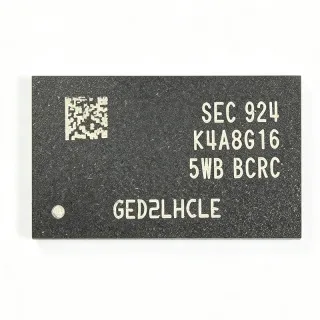
CY14B256KA - 256Kbit nvSRAM with RTC 45ns | Cypress
MPN: CY14B256KA ✓ Active| Qty | Unit Price | Extended |
|---|---|---|
| 1 | $6.2 | $6.20 |
| 10 | $5.58 | $55.80 |
| 100 | $4.96 | $496.00 |
| 500 | $4.4 | $2,200.00 |
| 1,000 | $3.95 | $3,950.00 |
CY14B256KA Overview
Nonvolatile SRAM is a memory class that combines the infinite read/write endurance of standard static RAM with nonvolatile data retention. Unlike EEPROM or Flash, nvSRAM writes to SRAM at SRAM speed with no page or sector erase cycles; on power loss, a STORE operation automatically copies the SRAM array into nonvolatile QuantumTrap elements, and a RECALL operation restores data on power-up. The CY14B256KA integrates this memory core with an RTC in a monolithic IC, making it a power-management-friendly replacement for battery-backed SRAM solutions.
Key features include a 32K x 8 organization on a parallel address/data bus, 25 ns (SP25) or 45 ns (SP45) access time grades, operation from a 3V (2.7V to 3.6V nominal range) supply, industrial temperature operation to +85C, and automatic hardware STORE on power fail. The embedded RTC provides date, time, and alarm functions that continue counting using an external backup source, consolidating two functions into one device.
Technologically, the device uses Cypress QuantumTrap nonvolatile elements, described by the manufacturer as producing highly reliable nonvolatile storage; SRAM cells can be read and written an unlimited number of times while independent nonvolatile data resides in the quantum trap array. The architecture avoids the wear-out mechanisms of floating-gate memory, giving nvSRAM a decisive endurance advantage in high-cycle data logging.
Typical applications include industrial data loggers, metering systems, network equipment configuration storage, POS terminals, and medical instrumentation where fast writes plus power-loss data integrity are mandatory.
A key design consideration: budget the tSTORE time and avoid asserting chip enable during a STORE cycle, since the SRAM array is busy while the nonvolatile copy completes.
This page synthesizes distributor pricing, drop-in speed-grade alternatives, and practical design notes not found in a single manufacturer datasheet.
Drop-in alternatives for CY14B256KA — same package, pin-to-pin compatible. Different-package parts requiring PCB rework are excluded.
Quick Comparison Tool — Select alternative parts for side-by-side comparison:
CY14B256KA-SP25XI
✅ Drop-In📋 Reference alternative (not in catalog)
CY14B256KA-SP45XI
✅ Drop-In📋 Reference alternative (not in catalog)
CY14B256LA-SP45XI
✅ Drop-In📋 Reference alternative (not in catalog)
CY14B256KA Maximum Ratings & Electrical Characteristics
| Memory Size | 256 Kbit (32K x 8) |
| Memory Type | nvSRAM (Nonvolatile SRAM) with RTC |
| Interface | Parallel |
| Access Time | 25 ns (SP25 grade) / 45 ns (SP45 grade) |
| Supply Voltage | 3 V (nominal) |
| Organization | 32K x 8 |
| Technology | QuantumTrap nonvolatile elements + SRAM |
| Endurance (SRAM reads/writes) | Unlimited |
| Real-Time Clock | Integrated full-featured RTC |
| Package | 48-SSOP |
| Mounting Type | Surface Mount |
| Operating Temperature | -40C to +85C (Industrial) |
| Automatic STORE | Yes (hardware STORE on power fail) |
| RECALL on Power-Up | Yes (automatic) |
| RoHS Status | Compliant |
CY14B256KA 48-ssop Pin Configuration Guide
Pin configuration for CY14B256KA (48-ssop package). This digital IC includes GPIO, communication interfaces (UART, SPI, I2C), and power pins. Refer to the manufacturer datasheet for alternate pin functions and configuration options. Essential for embedded system design and PCB layout.

No detailed pinout data available for CY14B256KA.
Refer to the datasheet for full pin configuration.
Typical Applications
CY14B256KA is suitable for 6 applications: Industrial Data Logging, Utility Metering Systems, Network Equipment Configuration Storage, Point-of-Sale and Transaction Terminals, Medical Instrumentation, Automotive and Industrial Test Equipment.
Industrial Data Logging
The CY14B256KA fits industrial data loggers because its parallel interface delivers 25-45 ns random access and unlimited SRAM write endurance, letting firmware log events every few milliseconds without the wear-out limits that terminate EEPROM-based loggers. The 32K x 8 array stores hours to days of process records, while the automatic hardware STORE on power failure guarantees that the most recent samples survive an unplanned outage. During a STORE cycle the nonvolatile QuantumTrap elements retain data independently of the SRAM array, so recovery is deterministic and does not require battery maintenance. Place the part on a power-fail-detect supervised 3V rail; firmware should reserve headroom for the tSTORE interval and avoid bus activity during it. Compared with serial Flash designs, the parallel bus and nvSRAM behavior eliminate erase scheduling entirely, simplifying logger firmware and improving worst-case write latency to nanoseconds rather than milliseconds.
Recommended
Utility Metering Systems
Smart electricity, gas, and water meters benefit directly from the CY14B256KA's combination of instant-write SRAM, nonvolatile retention, and an integrated real-time clock in one 48-SSOP IC. Metering firmware records tariff registers, load profiles, and tamper events continuously; the nvSRAM accepts each update at SRAM speed with no erase cycles, and the automatic STORE preserves data through brownouts or meter power interruptions. The embedded RTC timestamps events and supports tariff switching, replacing a discrete RTC plus battery-backed SRAM pair and removing the lithium cell, its socket, and its replacement schedule from the bill of materials. The 3V nominal supply matches standard metering microcontroller rails, and the industrial -40C to +85C rating covers outdoor meter enclosures. Designers should verify the RTC backup circuit per the datasheet and confirm total STORE count over the meter's 20-year service life against the datasheet endurance specification.
Recommended
Network Equipment Configuration Storage
Routers, switches, and industrial controllers store boot configuration, MAC/serial data, and fault logs in the CY14B256KA. Network boot code paths require deterministic read timing, which the parallel 25 ns or 45 ns access provides directly from the CPU bus without serial-Flash read latency, while configuration changes made by operators are committed instantly as ordinary SRAM writes. On rack power loss, the automatic hardware STORE transfers the working image into QuantumTrap nonvolatile cells, so the device reboots with its last valid configuration instead of reverting to defaults. The integrated RTC maintains timestamps for syslog and security event correlation across power cycles. Compared with EEPROM configuration stores, this architecture removes page-write delays from time-critical update paths; compared with battery-backed SRAM, it removes field battery replacement from the maintenance contract. Verify tRECALL boot-time impact when sizing power-good supervision windows in the system power supply.
Recommended
Point-of-Sale and Transaction Terminals
POS terminals and payment peripherals use the CY14B256KA to journal transactions and store security-relevant state where a power interruption mid-transaction must never lose data. Every transaction record is written to SRAM in nanoseconds, keeping checkout throughput unaffected, and the power-fail STORE commits the journal to nonvolatile storage without software intervention. The integrated RTC supplies legally significant timestamps for receipts and audit trails, and its backup path preserves time across outlet power loss. The 48-SSOP surface-mount package suits compact terminal PCBs, and the industrial temperature range tolerates poorly conditioned retail environments. Firmware designers should sequence the power-fail interrupt early enough in the supply decay to allow a complete STORE, sizing the hold-up capacitance accordingly per the datasheet STORE energy requirement. Against EEPROM journaling, this part eliminates erase-latency spikes that otherwise appear as checkout stalls during busy periods.
Recommended
Medical Instrumentation
Diagnostic and monitoring instruments require calibration constants, patient-session buffers, and event logs that survive power faults without maintenance visits. The CY14B256KA provides unlimited SRAM writes for continuous acquisition buffers at 25-45 ns access, so high-rate sample streams are never throttled by memory, and the automatic STORE protects unsaved records when mains power fails. The integrated RTC timestamps sessions for regulatory traceability, consolidating memory and clock into one 48-SSOP footprint that simplifies the calibration-constant memory subsystem. The 3V supply integrates with low-power analog front-end rails common in portable medical devices, and the absence of a backup battery removes a maintenance and disposal liability in clinical equipment fleets. Designers must qualify the STORE busy interval into their power-fail interrupt service routines and validate the RTC backup circuit against the datasheet, since missing calibration data after power events is a compliance-critical failure mode in medical platforms.
Recommended
Automotive and Industrial Test Equipment
Bench and production test instruments use the CY14B256KA for instrument settings, calibration tables, and captured-result scratch memory. The parallel bus allows the instrument CPU to use the 32K x 8 array as fast working RAM during measurement sequences, writing results continuously with no endurance concern, while the power-fail STORE ensures settings and unsent results survive an unexpected shutdown. The RTC enables timestamped test records and scheduled self-test scheduling across power cycles. The -40C to +85C industrial rating and 3V supply suit both rack-mounted and portable field instruments. Compared with a discrete RTC plus SRAM plus EEPROM stack, the monolithic integration reduces component count, board area, and calibration drift sources; compared with battery-backed SRAM, it eliminates the lithium cell that complicates instrument shipping and field service. Verify bus timing at the selected speed grade and reserve the tSTORE window in shutdown firmware before main power collapses.
Recommended
Recommended Products Summary
Engineering reference data for CY14B256KA — comparison, design guidance, and compliance information.
Selection Guide
Comparison with Alternatives
| Parameter | This Product | CY14B256KA-SP25XI | CY14B256KA-SP45XI | CY14B256LA-SP45XI |
|---|---|---|---|---|
| Package | 48-SSOP | 48-SSOP - same | 48-SSOP - same | 48-SSOP - same |
| Brand | Infineon Technologies (Cypress) | Infineon Technologies | Infineon Technologies | Infineon Technologies (Cypress) |
| Memory Size | 256 Kbit (32K x 8) | 256 Kbit (32K x 8) | 256 Kbit (32K x 8) | 256 Kbit (32K x 8) |
| Access Time | 25 ns / 45 ns (grade-dependent) | 25 ns | 45 ns | 45 ns |
| Interface | Parallel | Parallel | Parallel | Parallel |
| Integrated RTC | Yes | Yes | Yes | Yes (verify suffix features in ordering guide) |
Key Differentiators
- Faster bus timing available in same footprint (vs CY14B256KA-SP45XI)
- Lower cost at equivalent function (vs CY14B256KA-SP25XI)
- Integrated RTC eliminates discrete RTC + battery-backed SRAM stack (vs CY14B256LA-SP45XI (and generic battery-backed SRAM))
Design Notes
The automatic hardware STORE must complete before main power collapses, or the last SRAM writes are lost. Estimate: size the hold-up capacitance on the 3V rail so that, after the power-fail threshold asserts, the rail holds above the minimum operating voltage for the full tSTORE interval from the datasheet DC/AC tables. Feed the power-fail detect signal to the STORE pin early in the supply decay, and confirm the detection threshold is above the part minimum operating voltage. During STORE and RECALL, the SRAM array is busy - inhibit CE and hold the CPU in reset or a safe state until the cycle completes.
Use a solid ground plane under the 48-SSOP body and keep the parallel address/data bus traces short and length-matched where the bus exceeds roughly 10 cm to preserve 25 ns (SP25) access timing margins. Decouple VCC with a 0.1 uF ceramic capacitor placed within 2 mm of the supply pin, plus one bulk capacitor per rail. Route the RTC crystal and backup circuit per the datasheet layout guidance, away from switching regulator nodes, since RTC accuracy is sensitive to stray capacitance and coupled noise on the crystal pins.
Three frequent integration mistakes: (1) treating the part like EEPROM - normal writes are plain SRAM writes and only STORE operations have an endurance limit, so firmware should manage STORE frequency rather than write frequency; (2) asserting CE during STORE/RECALL, which returns invalid data and can corrupt the software state machine; (3) substituting K and L suffix variants (e.g., CY14B256LA) without checking the datasheet ordering guide, since suffixes encode RTC and voltage-class options. Always validate the exact ordering code against the Infineon ordering information table before release.
The parallel bus timing budget on the SP25 grade leaves only 25 ns of access time, so include trace delay and logic-family propagation delay in the chip-enable-to-data-valid calculation. Add series termination (22-33 ohm) on address and data lines when bus stubs or connectors are present, and avoid read cycles during STORE to prevent bus contention with the busy internal state.
Compliance Information
RoHS compliance per DigiKey listing for CY14B256KA-SP25XI. REACH, halogen-free, and conflict-minerals status not stated in provided data - verify on the Infineon product page.