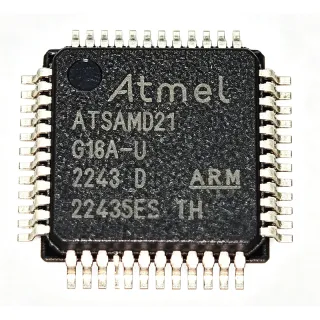
DSPIC33CK256MP305-I/PT - 16-Bit 100MIPS DSC 256KB Flash | Microchip
MPN: DSPIC33CK256MP305-I/PT ✓ Active| Qty | Unit Price | Extended |
|---|---|---|
| 1 | $4.6 | $4.60 |
| 10 | $4.2 | $42.00 |
| 100 | $3.85 | $385.00 |
| 500 | $3.55 | $1,775.00 |
| 1,000 | $3.25 | $3,250.00 |
DSPIC33CK256MP305-I/PT Overview
A digital signal controller combines the computational capability of a digital signal processor (DSP) with the peripheral integration and control architecture of a microcontroller (MCU). Within the embedded hierarchy, the dsPIC33CK sits in Microchip's 16-bit DSC family, positioned above general-purpose PIC microcontrollers and below the dual-core dsPIC33CH, targeting real-time closed-loop control systems that require fast math execution.
Key features of this device include 100 MIPS performance with a modified Harvard architecture and DSP engine supporting single-cycle MAC operations, 256KB (256K x 8) of self-programming Flash, and 64KB of on-chip RAM with dual-partition support for live firmware updates. The part carries Functional Safety (FuSa) documentation support, enabling designs targeting IEC 61508 and ISO 26262 style safety workflows.
The dsPIC33CK core integrates enhanced peripherals including high-resolution PWM modules for power conversion, multiple 12-bit ADC with simultaneous sampling capability, and flexible peripheral pin select (PPS) for routing digital functions to assignable pins. Hardware DSP instructions accelerate filters, transforms, and control-loop computations used in digital power and motor control.
Typical applications include precision brushless DC and PMSM motor control, digital power supplies and PFC stages, solar micro-inverters, and industrial sensing and automation nodes. The 100 MIPS core sustains multi-kilohertz control loops with headroom for field-oriented control mathematics.
Design consideration: this MP305 variant does not include CAN FD; designers requiring CAN must step to the pin-compatible MP505 variant. Decouple all VDD pins and place the VCAP capacitor per the manufacturer datasheet layout guidance for stable core supply operation.
This page synthesizes distributor pricing, drop-in same-package alternatives, and practical design notes not found in the manufacturer datasheet, with pricing as of 2026-09-23.
Drop-in alternatives for DSPIC33CK256MP305-I/PT — same package, pin-to-pin compatible. Different-package parts requiring PCB rework are excluded.
Variants in this series
Same-series models that are drop-in compatible with DSPIC33CK256MP305-I/PT (same form factor and footprint) — differing in Core, Package, RoHS Status, CAN, Programming Interface.
Quick Comparison Tool — Select alternative parts for side-by-side comparison:
DSPIC33CK256MP305-E/PT
✅ Drop-In📋 Reference alternative (not in catalog)
DSPIC33CK256MP205-I/PT
✅ Drop-In ⚠️ Specs Unverified✓ In Stock
$3.55 / Unit
View Datasheet →DSPIC33CK256MP505-I/PT
✅ Drop-In ⚠️ Specs Unverified📋 Reference alternative (not in catalog)
DSPIC33CK32MP305-I/PT
✅ Drop-In ⚠️ Specs Unverified📋 Reference alternative (not in catalog)
DSPIC33CK256MP306-I/MR
✅ Drop-In✓ In Stock
$4.41 / Unit
View Datasheet →DSPIC33CK256MP305-I/PT Maximum Ratings & Electrical Characteristics
| Core | dsPIC 33CK (16-bit DSC), single core |
| Maximum CPU Speed | 100 MIPS (100 MHz) |
| Program Memory Size | 256KB (256K x 8) Flash |
| RAM Size | 64KB |
| CAN | No CAN (this variant) |
| Operating Temperature Range | -40C to +85C (I = Industrial) |
| Package | 48-TQFP (7x7 mm), PT suffix |
| Mounting Type | Surface Mount |
| Packaging Variant | Tray (non-T); T suffix = Tape & Reel |
| Functional Safety Support | Yes (FuSa per DigiKey listing) |
| Core Processor Series | dsPIC33CK Single-Core DSC |
| RoHS Status | ROHS Compliant (per LCSC listing) |
| Product Status | Active |
| Automotive Qualification | Not qualified (E/PT variant is Automotive AEC-Q100) |
DSPIC33CK256MP305-I/PT 48-tqfp (7x7 mm), pt suffix Pin Configuration Guide
Pin configuration for DSPIC33CK256MP305-I/PT (48-tqfp (7x7 mm), pt suffix package). This digital IC includes GPIO, communication interfaces (UART, SPI, I2C), and power pins. Refer to the manufacturer datasheet for alternate pin functions and configuration options. Essential for embedded system design and PCB layout.

No detailed pinout data available for DSPIC33CK256MP305-I/PT.
Refer to the datasheet for full pin configuration.
Typical Applications
DSPIC33CK256MP305-I/PT is suitable for 6 applications: Precision BLDC / PMSM Motor Control, Digital Power Supplies and PFC, Solar Micro-Inverters and Renewable Energy Conversion, Industrial Automation and Sensor Nodes, Automotive and Functional Safety Subsystems, Medical and Laboratory Instrumentation Control.
Precision BLDC / PMSM Motor Control
The DSPIC33CK256MP305-I/PT fits precision motor control because its 100 MIPS core executes field-oriented control (FOC) with single-cycle hardware MAC instructions, sustaining multi-kilohertz current loops with algorithm headroom. The dsPIC33CK family integrates high-resolution PWM outputs for inverter gate drive and fast 12-bit ADC channels for simultaneous phase-current sampling, enabling sensorless and encoder-based drives. In use, the ADC is triggered by the PWM module at the center of each PWM period, the FOC loop computes dq-axis currents, and the updated duty cycles load into the PWM within one cycle. Quantified benefit: control-loop latencies in the low microseconds, versus software-limited execution on general-purpose MCUs. Trade-off: this variant has no CAN, so motor networking must use UART/SPI or an external transceiver.
Recommended
Digital Power Supplies and PFC
Digital power conversion benefits from the DSPIC33CK256MP305-I/PT's deterministic 100 MIPS execution and DSP engine, which implement voltage/current compensation loops with hardware DSP instructions. The family's high-resolution PWM supports phase-shifted full-bridge, LLC, boost PFC, and buck topologies with nanosecond-class resolution, while fast ADCs sample output voltage and inductor current every switching cycle. Typically the controller closes the inner current loop at the switching frequency and the outer voltage loop at one-tenth to one-twentieth that rate, using the on-chip digital compensator libraries from Microchip reference designs. Benefit: firmware-defined loop tuning and seamless mode switching without analog redesign. Trade-off: no CAN in MP305, so PMBus-style digital telemetry must route over UART/SPI-based protocols rather than CAN.
Recommended
Solar Micro-Inverters and Renewable Energy Conversion
Solar micro-inverter control demands fast, isolated gate-drive timing plus MPPT computation, which the DSPIC33CK256MP305-I/PT handles with its 100 MIPS core and 256KB Flash. High-resolution PWM generates interleaved boost and grid-tied inverter switching patterns, while the fast ADC samples panel voltage/current for maximum-power-point-tracking algorithms that run as background tasks between switching-cycle control loops. The 64KB RAM accommodates MPPT history buffers, protection state machines, and communication stacks simultaneously. Using this DSC, designers implement anti-islanding and grid-fault ride-through in firmware with deterministic timing. Trade-off: the industrial -40C to +85C rating suits outdoor electronics housed away from extreme heat; outdoor-mounted inverters near panel temperatures may require the E/PT variant rated to +125C.
Recommended
Industrial Automation and Sensor Nodes
Factory automation nodes use the DSPIC33CK256MP305-I/PT to combine real-time sensing with local control: its 100 MIPS core processes sensor streams with DSP filters (IIR/FIR) in hardware-accelerated form, while the flexible peripheral pin select (PPS) routes UART, SPI, I2C, and PWM to any assignable pin, simplifying board layout across enclosure constraints. The 256KB Flash stores protocol stacks, diagnostics, and OTA-capable firmware, and Functional Safety (FuSa) documentation support helps teams building equipment targeting safety standards. A typical node samples multiple analog channels, filters them on-chip, drives actuators via PWM, and reports over RS-485-style UART links. Trade-off: for nodes that must join CANopen or J1939 networks, choose the CAN FD-equipped MP505/MP306 variants instead.
Recommended
Automotive and Functional Safety Subsystems
For safety-relevant vehicle subsystems, the DSPIC33CK family provides Functional Safety (FuSa) support, and the DSPIC33CK256MP305-E/PT variant carries Automotive AEC-Q100 qualification per Octopart comparison data, making the family suitable for pumps, fans, actuators, and auxiliary motor drives. The 100 MIPS core executes motor control with diagnostic margin, and the 256KB Flash holds both application firmware and self-test routines required by safety concepts. In an electric water pump, for example, the DSC closes the FOC current loop every PWM cycle while running plausibility checks on current and position feedback. Design consideration: the standard -I/PT industrial part is not AEC-Q100 qualified; automotive programs must select the -E/PT qualified ordering code.
Recommended
Medical and Laboratory Instrumentation Control
Benchtop medical devices, infusion and analysis instruments, and portable diagnostics benefit from the DSPIC33CK256MP305-I/PT's blend of DSP throughput and microcontroller integration. The 100 MIPS core with single-cycle MAC runs signal-conditioning filters on sensor inputs, while 256KB Flash retains calibration tables, user interface logic, and logging; 64KB RAM supports data buffering for traceable records. PWM and ADC peripherals drive precision stepper pumps, heaters, and sensor front ends with deterministic timing. Because the device is a Microchip catalog part with RoHS compliance and active status, it supports long-lifecycle medical product planning, and FuSa documentation assists compliance workflows. Trade-off: instruments needing network connectivity over CAN should use MP505-family equivalents; this variant suits UART/USB-adjacent architectures.
Recommended
Recommended Products Summary
Engineering reference data for DSPIC33CK256MP305-I/PT — comparison, design guidance, and compliance information.
Selection Guide
Comparison with Alternatives
| Parameter | This Product | DSPIC33CK256MP305-E/PT | DSPIC33CK256MP205-I/PT | DSPIC33CK256MP505-I/PT | DSPIC33CK32MP305-I/PT | DSPIC33CK256MP306-I/MR |
|---|---|---|---|---|---|---|
| Package | 48-TQFP (7x7 mm) | 48-TQFP (7x7 mm) - same | 48-TQFP (7x7 mm) - same | 48-TQFP (7x7 mm) - same | 48-TQFP (7x7 mm) - same | 64-pin MR package - differs |
| Brand | Microchip Technology | Microchip Technology | Microchip Technology | Microchip Technology | Microchip Technology | Microchip Technology |
| CPU Speed | 100 MIPS | 100 MIPS | 100 MIPS | 100 MIPS | 100 MIPS | 100 MIPS |
| Flash Memory | 256KB | 256KB | 256KB | 256KB | 32KB | 256KB |
| Temperature Range | -40C to +85C (Industrial) | -40C to +125C (Extended/Automotive) | -40C to +85C (Industrial) | -40C to +85C (Industrial) | -40C to +85C (Industrial) | -40C to +85C (Industrial) |
Key Differentiators
- Cost-optimized: no CAN silicon overhead (vs DSPIC33CK256MP505-I/PT)
- Industrial volume availability at low cost (vs DSPIC33CK256MP305-E/PT)
- Functional Safety (FuSa) documentation support (vs DSPIC33CK256MP306-I/MR)
Design Notes
dsPIC33CK devices with on-chip regulators require a low-ESR capacitor on the VCAP/VDDCORE pin to stabilize the internal core supply; size it per the manufacturer datasheet recommendation and place it within a few millimeters of the pin. Decouple each VDD pin pair with 100 nF ceramic capacitors plus one bulk capacitor (typically 4.7 uF to 10 uF) near the device. Estimated: a 100 MHz dsPIC33CK core draws tens of milliamps, so supply ripple on VDD should be kept below the datasheet noise budget to avoid ADC reference degradation in motor-control applications. Verify exact current figures against the datasheet electrical characteristics table before finalizing the supply budget.
For motor-control layouts, keep the phase-current sensing traces (ADC inputs) short and route them away from PWM gate-drive nets to minimize switching-noise coupling into the ADC. Use the peripheral pin select (PPS) during schematic capture to cluster digital I/O on one side of the package and analog pins on the other, reducing crossovers. Place a solid ground plane under the TQFP and stitch it with vias near the VSS pins. This MP305 variant has no CAN transceiver burden, freeing board area that CAN designs must reserve - a small but real layout advantage.
Three frequent mistakes with this part: (1) assuming CAN is present - the MP305 explicitly has no CAN per the Mouser listing; verify communication requirements before schematic freeze or select MP505/MP306. (2) Using the industrial -I/PT in automotive sockets - it is not AEC-Q100 qualified; only the -E/PT variant is. (3) Confusing packing: DSPIC33CK256MP305-I/PT ships in trays, while DSPIC33CK256MP305T-I/PT is tape-and-reel; reel quantities matter for contract manufacturing. Always pull the latest datasheet revision from microchip.com before production sign-off.
Compliance Information
RoHS compliance per LCSC product listing (C3236095). Not AEC-Q100 qualified; the DSPIC33CK256MP305-E/PT variant is the Automotive AEC-Q100 member per Octopart comparison data. REACH, halogen-free, and conflict-minerals status not stated in the provided data.